
All insights

Can a mother's sole eyewitness testimony sustain a death sentence in a child rape-murder case?

Supreme Court Upholds Death Sentence for Stepfather Who Raped and Murdered Six-Year-Old

A stepfather was convicted for repeatedly sexually assaulting and then throttling to death his six-year-old stepdaughter. The Supreme Court upheld the concurrent conviction and death sentence, finding

Litigation India Editorial 24 September 2026 1 min read 2026 INSC 1050

Story

Case at a glance1 / 6

Supreme Court of India

Death Sentence Upheld: Child Rape-Murder by Stepfather

Waris vs State of Madhya Pradesh — 2026 INSC 1050

Court: Supreme Court of India; Criminal Appeal Nos. 429-430 of 2020Bench: Justice Vikram NathArea of Law: Criminal Law — child sexual assault, murder, capital punishmentKey Acts: IPC 1860, POCSO Act 2012, Indian Evidence Act 1872, CrPC 1973
A stepfather convicted of raping and throttling his six-year-old stepdaughter to death; death sentence confirmed.
Supreme Court Upholds Death Sentence for Stepfather Who Raped and Murdered Six-Year-Old · 2026 INSC 10502026-09-24T20:32:39.880950+00:00
The legal question2 / 6

Can a Mother's Sole Testimony Sustain a Death Sentence?

Core legal questions decided by the Supreme Court

  • Appellant: PW-1's evidence is unreliable due to material omissions, contradictions, unnatural conduct and PW-4 conflict; case is not rarest of rare.
  • Appellant: Legal aid counsel appointed same day as testimony; fair trial denied under Article 21.
  • Respondent: Core testimony of PW-1 unshaken through two cross-examinations; corroborated by medical evidence, CDR, extra-judicial confession and victim's dying declaration.
  • Respondent: Curative further cross-examination on 14.06.2025 remedied the defect; conviction and death sentence should be confirmed.
The Court had to decide whether a curative cross-examination could cure an Article 21 violation, and whether a mother's testimony alone could support a death sentence.
Supreme Court Upholds Death Sentence for Stepfather Who Raped and Murdered Six-Year-Old · 2026 INSC 10502026-09-24T20:32:39.880950+00:00
The Court's reasoning3 / 6

How the Court Reasoned: Step by Step

From the Article 21 defect to confirmed death sentence

  1. 1Step 1: Curative cross-examination on 14.06.2025 held to remedy Article 21 defect; no retrial needed as only one witness was affected.
  2. 2Step 2: Medical evidence (post-mortem) independently established homicidal throttling and fresh genital injury — objective substratum for all oral evidence.
  3. 3Step 3: Mother's testimony found reliable: particularity of throttling scene corroborated by autopsy; call detail record confirmed two calls on 23.04.2018.
  4. 4Step 4: Five credibility attacks rejected — omissions not material contradictions; silence of abused woman not fabrication; CDR corroborates not undermines; false implication theory incredible.
  5. 5Step 5: Victim's disclosure admitted under Section 32(1) and Section 6, Evidence Act; sexual assault proved by two independent evidentiary routes. Conviction upheld.
The curative cross-examination was a proportionate remedy, not a retrial. The conviction survived all five attacks on PW-1's credibility.
Supreme Court Upholds Death Sentence for Stepfather Who Raped and Murdered Six-Year-Old · 2026 INSC 10502026-09-24T20:32:39.880950+00:00
Key points4 / 6

Abused Woman's Silence: Not a Badge of Falsehood

Key legal distinction drawn by the Court on conduct of witnesses in domestic abuse cases

  • Courts must not judge abused women by stereotyped expectations of how they should have acted, per XYZ v. State of M.P. (2021) 16 SCC 179.
  • NFHS-5 data: approximately 29.3% of ever-married Indian women experienced spousal violence; about three-fourths never reported it.
  • An unlocked door is not freedom for a woman without money, means or refuge and caring for a gravely injured child.
  • The abuser's tools of silence — fear, isolation, control — cannot be converted into acquittal arguments against the victim who eventually speaks.
Silence, endurance and continued cohabitation are common features of abused women's experience, not indicia of fabrication.
Supreme Court Upholds Death Sentence for Stepfather Who Raped and Murdered Six-Year-Old · 2026 INSC 10502026-09-24T20:32:39.880950+00:00
The verdict5 / 6

The Verdict: Conviction and Death Sentence Upheld

Supreme Court's final determination on conviction

  • The Fact: Appellant repeatedly raped his six-year-old stepdaughter and throttled her to death within the matrimonial home on 23.04.2018.
  • The Law: Offences under Sections 376(2)(f), 376(2)(n), 376AB, 302, 201 IPC and Sections 5 and 6 POCSO Act proved beyond reasonable doubt; death sentence imposed for Sections 376AB and 302 IPC.
  • The Result: Article 21 defect cured by curative cross-examination; all five attacks on PW-1's credibility rejected; conviction and sentence upheld.
Conviction upheld for rape and murder of a six-year-old stepdaughter; death sentence confirmed; curative cross-examination held to remedy Article 21 violation.
Supreme Court Upholds Death Sentence for Stepfather Who Raped and Murdered Six-Year-Old · 2026 INSC 10502026-09-24T20:32:39.880950+00:00
Why it matters6 / 6

What This Judgment Means for Ordinary People

Practical significance of Waris vs State of Madhya Pradesh

  • A child victim's disclosure to her mother about sexual abuse can be admitted as a dying declaration even without expectation of death, under Section 32(1) of the Evidence Act.
  • Courts will not dismiss an abused woman's testimony simply because she stayed silent or did not flee — her silence is explained by fear and entrapment, not falsehood.
  • In capital cases, if a legal aid counsel is appointed on the day of cross-examination without preparation time, the resulting defect can be remedied by directed further cross-examination, not necessarily a full retrial.
  • Omissions from a police statement do not automatically destroy court testimony; only irreconcilable, material contradictions going to the core of the case matter.
The abuser's tools of silence and isolation cannot be used in court to discredit the victim who finally speaks.
Supreme Court Upholds Death Sentence for Stepfather Who Raped and Murdered Six-Year-Old · 2026 INSC 10502026-09-24T20:32:39.880950+00:00
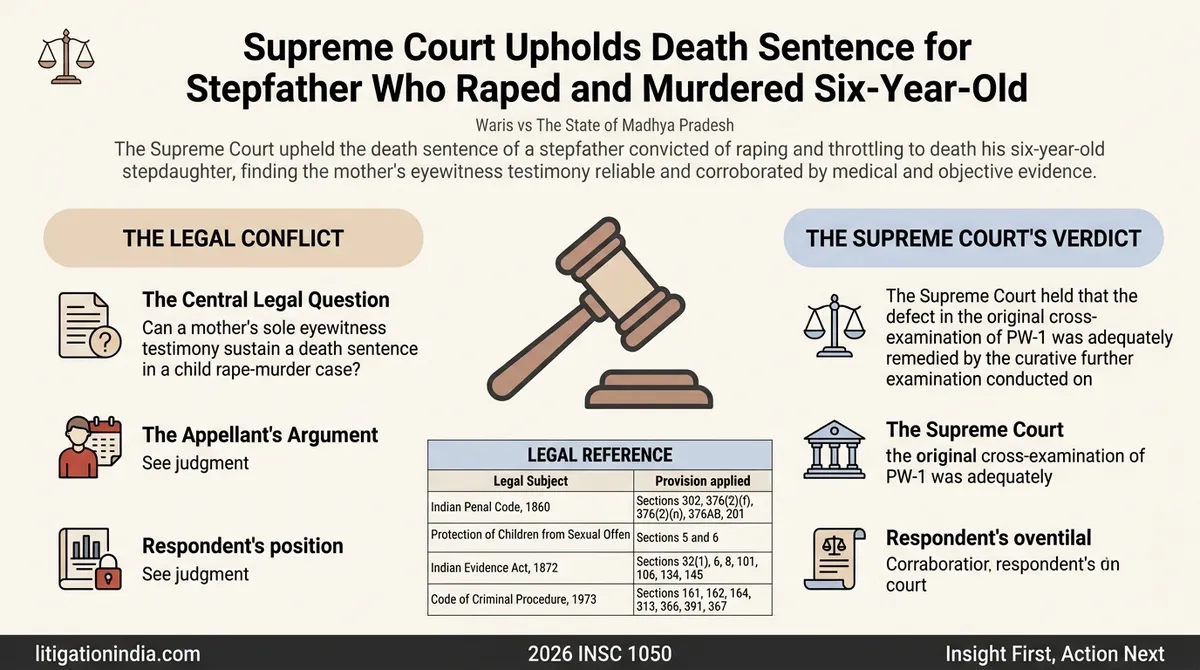
Supreme Court Upholds Death Sentence for Stepfather Who Raped and Murdered Six-Year-Old — infographic summary

What this case means

A stepfather was convicted for repeatedly sexually assaulting and then throttling to death his six-year-old stepdaughter. The Supreme Court upheld the concurrent conviction and death sentence, finding the mother's eyewitness testimony reliable, corroborated by medical evidence, telephone records, and the victim's dying declaration. The case clarifies how courts must assess the evidence of witnesses trapped in abusive households.

What the Supreme Court held

The Supreme Court held that the defect in the original cross-examination of PW-1 was adequately remedied by the curative further cross-examination conducted on 14.06.2025 pursuant to the Court's earlier order. The Court upheld the conviction of the appellant for the offences under Sections 376(2)(f), 376(2)(n), 376AB, 302 and 201 of the IPC and Sections 5 and 6 of the POCSO Act, finding the prosecution case proved beyond reasonable doubt. The question of sentence, including the death penalty, was addressed separately in the latter parts of the judgment.

Case: Waris vs The State of Madhya Pradesh (2026) Citation: 2026 INSC 1050

Want the full legal reasoning, citations and case documents?

Read the full judgment analysis
Waris
State of Madhya Pradesh
POCSO Act
Section 376AB IPC
Section 302 IPC
death sentence
rarest of rare
child sexual assault
dying declaration
Section 32(1) Evidence Act
Sections 302, 376(2)(f), 376(2)(n), 376AB, 201, Indian Penal Code, 1860
Sections 5 and 6, Protection of Children from Sexual Offences Act, 2012
Sections 32(1), 6, 8, 101, 106, 134, 145, Indian Evidence Act, 1872
Sections 161, 162, 164, 313, 366, 391, 367, Code of Criminal Procedure, 1973