
All insights

Must a public servant explain assets disproportionate to known income sources?

Supreme Court Upholds Conviction of Sub Registrar for Possessing Disproportionate Assets

A Sub Registrar from Kerala was convicted for possessing assets worth over 51% more than his known income sources during his service period. The Supreme Court dismissed his appeal, confirming both his

Litigation India Editorial 28 October 2026 1 min read 2026 INSC 1172

Story

Case at a glance1 / 6

Supreme Court of India

Sub Registrar Convicted for 51% Disproportionate Assets

V. Gopalakrishanan v. State of Kerala | 2026 INSC 1172

Court: Supreme Court of India | Date: October 28, 2026Bench: Justice Sanjay Kumar and Justice Sanjeev SachdevaArea of law: Prevention of Corruption / Disproportionate AssetsConviction under Section 13(2) read with Section 13(1)(e), Prevention of Corruption Act, 1988
Supreme Court Upholds Conviction of Sub Registrar for Possessing Disproportionate Assets · 2026 INSC 11722026-10-28T18:53:01.155035+00:00
The legal question2 / 6

Who Bears the Burden of Explaining Disproportionate Assets?

Core legal issue decided by the Court

  • Appellant: Prosecution relied on estimation, not actual evidence, for building valuation and household expenses.
  • Appellant: Disputed figures, if corrected, would reduce disproportionate assets significantly.
  • Respondent: Prosecution established foundational facts through PWD rates, price index, and documentary evidence.
  • Respondent: Even accepting all appellant's corrections, disproportion exceeds 26% — well above 10% threshold.
Supreme Court Upholds Conviction of Sub Registrar for Possessing Disproportionate Assets · 2026 INSC 11722026-10-28T18:53:01.155035+00:00
The Court's reasoning3 / 6

How the Court Reached Its Decision

Step-by-step legal reasoning

  1. 1Step 1: Prosecution proved foundational facts — assets exceeded income by Rs. 5,25,129 (51.88%) via Basic Statements.
  2. 2Step 2: Burden shifted to accused under Section 13(1)(e) PC Act and Section 109 Bharatiya Sakshya Adiniyam.
  3. 3Step 3: Even accepting appellant's disputed figures, excess remained above 26% — far beyond the 10% threshold.
  4. 4Step 4: Appellant produced no cogent documentary evidence to contradict prosecution's valuation or income figures.
  5. 5Step 5: Adverse inference drawn; conviction and reduced sentence confirmed; appeal dismissed.
Supreme Court Upholds Conviction of Sub Registrar for Possessing Disproportionate Assets · 2026 INSC 11722026-10-28T18:53:01.155035+00:00
Statutory comparison4 / 6

Key Statutory Provisions and Their Application

How each provision was applied in this case

ProvisionWhat it providesHow applied in this case
Section 13(1)(e), PC Act 1988Public servant in possession of property disproportionate to known income commits criminal misconductAssets found 51% above income; appellant could not satisfactorily account — conviction upheld
Section 109, Bharatiya Sakshya Adiniyam (= Section 106, Evidence Act 1872)Burden of proving fact especially within one's knowledge lies on that personUndisclosed income sources are within accused's special knowledge; burden on appellant to explain
Section 13(2), PC Act 1988Prescribes punishment for criminal misconductApplied to impose rigorous imprisonment of one year and fine of Rs. 2,00,000
Supreme Court Upholds Conviction of Sub Registrar for Possessing Disproportionate Assets · 2026 INSC 11722026-10-28T18:53:01.155035+00:00
The verdict5 / 6

The Court's Final Verdict

Fact, Law, and Result

  • The Fact: Sub Registrar accumulated assets of Rs. 5,25,129 over 51% above his family's income during the check period.
  • The Law: Under Section 13(1)(e) PC Act, once disproportionate assets are proved, accused must satisfactorily account for them; failure entitles court to adverse inference.
  • The Result: Conviction affirmed; one year rigorous imprisonment and Rs. 2,00,000 fine confirmed; appeal dismissed.
Appeal dismissed; interim bail vacated; appellant directed to surrender within two weeks to undergo remaining sentence.
Supreme Court Upholds Conviction of Sub Registrar for Possessing Disproportionate Assets · 2026 INSC 11722026-10-28T18:53:01.155035+00:00
Why it matters6 / 6

What This Judgment Means for Ordinary People

Practical significance

  • Public servants cannot escape corruption charges by raising minor arithmetic disputes over asset valuations.
  • If your assets far exceed your declared income, you must prove their lawful source — the burden is on you.
  • Prosecution need not investigate every speculative income claim an accused makes belatedly.
  • Courts will not let lengthy proceedings or old age alone defeat a corruption conviction; sentence may be reduced but conviction stands.
A public servant who cannot explain assets 51% above known income will be convicted — even 26% excess is far too high.
Supreme Court Upholds Conviction of Sub Registrar for Possessing Disproportionate Assets · 2026 INSC 11722026-10-28T18:53:01.155035+00:00
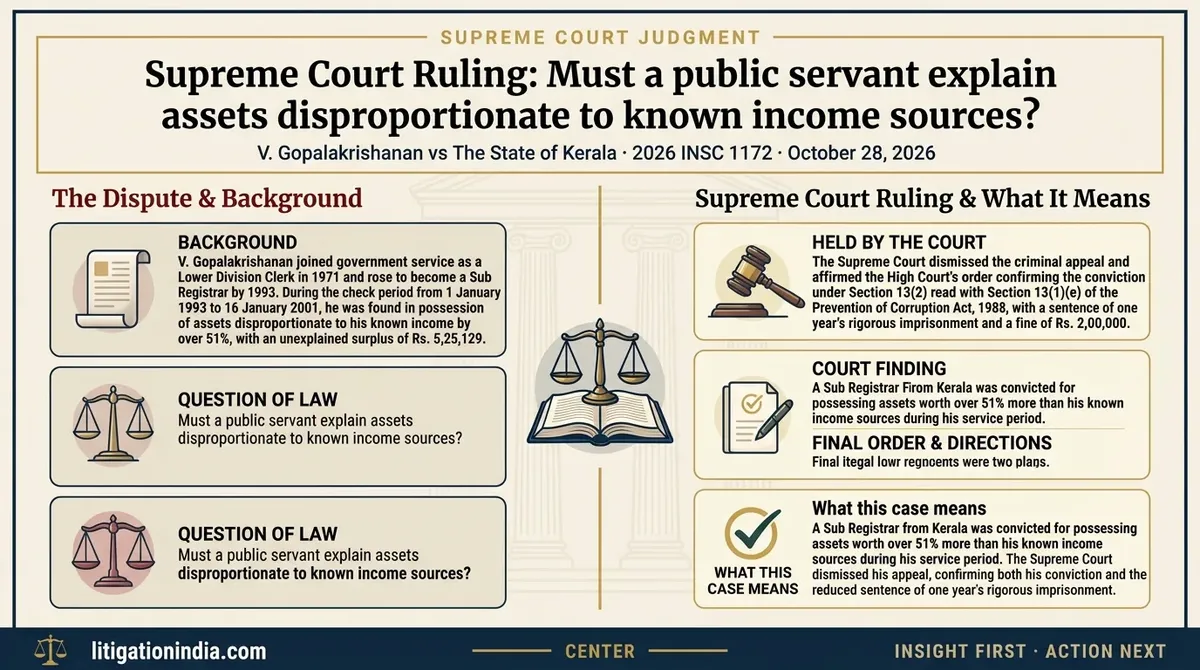
Supreme Court Upholds Conviction of Sub Registrar for Possessing Disproportionate Assets — infographic summary

What this case means

A Sub Registrar from Kerala was convicted for possessing assets worth over 51% more than his known income sources during his service period. The Supreme Court dismissed his appeal, confirming both his conviction and the reduced sentence of one year's rigorous imprisonment. The judgment clarifies that once the prosecution proves disproportionate assets, the burden shifts to the accused to explain them.

What the Supreme Court held

The Supreme Court dismissed the criminal appeal and affirmed the High Court's order confirming the conviction under Section 13(2) read with Section 13(1)(e) of the Prevention of Corruption Act, 1988, with a sentence of one year's rigorous imprisonment and a fine of Rs. 2,00,000. The interim bail granted to the appellant was vacated and he was directed to surrender before the concerned Trial Court within two weeks to undergo the remaining sentence.

Case: V. Gopalakrishanan vs The State of Kerala (2026) Citation: 2026 INSC 1172

Want the full legal reasoning, citations and case documents?

Read the full judgment analysis
V. Gopalakrishanan
State of Kerala
Prevention of Corruption Act 1988
disproportionate assets
Section 13(1)(e)
Section 13(2)
public servant
criminal misconduct
burden of proof
Sub Registrar
Section 13(1)(e) and Section 13(2), Prevention of Corruption Act, 1988
Section 109, Bharatiya Sakshya Adiniyam
Section 106, Indian Evidence Act, 1872
Criminal Law / Prevention of Corruption / Disproportionate Assets