
All insights

Can an acquittal be reversed when circumstantial evidence is incomplete and witnesses unreliable?

Supreme Court Upholds Acquittal in Double Murder Case Based on Weak Circumstantial Evidence

The State of Himachal Pradesh challenged the High Court's acquittal of Anchla, accused of murdering her stepmother and stepbrother. The Supreme Court dismissed the appeal, finding that the prosecution

Litigation India Editorial 1 October 2026 1 min read 2026 INSC 1074

Story

Case at a glance1 / 6

Supreme Court of India

Double Murder Acquittal Upheld: Gaps in Circumstantial Evidence

State of Himachal Pradesh vs. Anchla @ Chanchla | 2026 INSC 1074

Court: Supreme Court of India | Date: October 01, 2026Bench: Justice Manoj Misra and Justice Vijay BishnoiArea: Criminal Law — Murder, Circumstantial Evidence, Appeal against AcquittalState appealed against High Court's acquittal of accused charged under Section 302, Indian Penal Code, 1860
Supreme Court Upholds Acquittal in Double Murder Case Based on Weak Circumstantial Evidence · 2026 INSC 10742026-10-01T13:23:27.685425+00:00
The legal question2 / 6

Can Acquittal Be Reversed When Circumstantial Chain is Incomplete?

Core legal issue: sufficiency of circumstantial evidence to convict for murder

  • Appellant: High Court wrongly discarded critical evidence including DNA match, key recovery, and taxi driver's testimony on conjectures.
  • Appellant: Accused's blood at crime scene plus bleeding thumb injury plus last seen together forms a conclusive chain pointing to guilt.
  • Respondent: Last seen circumstance is weak given 6-7 day gap between last seen and discovery of bodies; third party involvement cannot be ruled out.
  • Respondent: DNA evidence is inconclusive as accused was a regular visitor; key recovery is doubtful; motive not proved.
Supreme Court Upholds Acquittal in Double Murder Case Based on Weak Circumstantial Evidence · 2026 INSC 10742026-10-01T13:23:27.685425+00:00
The Court's reasoning3 / 6

How the Court Evaluated Each Circumstance

Step-by-step reasoning leading to dismissal of appeal

  1. 1Step 1: Last seen — PW-1 improved upon Section 161 statement; not wholly reliable as sole witness.
  2. 2Step 2: Travel evidence — PW-4 and PW-18 held untrustworthy; IO could not explain what prompted recording their statements.
  3. 3Step 3: Lock and key recovery — Lock identity not proved; PW-3 saw lock on door handle not latch; recovery of keys inconsequential.
  4. 4Step 4: DNA match — Inconclusive since accused was a regular visitor; blood absent from clothes/strangulation material.
  5. 5Step 5: Motive, CDR lapses, and no complete chain — acquittal upheld, appeal dismissed.
Supreme Court Upholds Acquittal in Double Murder Case Based on Weak Circumstantial Evidence · 2026 INSC 10742026-10-01T13:23:27.685425+00:00
Key points4 / 6

Natural Witness vs. Set-Up Witness: A Key Distinction

Court's reasoning on why PW-4 and PW-18 were discredited

  • A natural witness volunteers information to police because the information itself appears incriminating or alarming.
  • Travelling in a taxi or staying at a hotel is not inherently incriminating, so PW-4 and PW-18 had no reason to approach police on their own.
  • The investigating officer could not disclose what prompted him to record their statements or on what date.
  • PW-4's own cross-examination revealed his statement was recorded after the accused was already arrested and police had the OPD slip.
  • Absence of hotel guest record further destroyed PW-18's credibility.
The investigating officer's failure to explain why and when witness statements were recorded raised a reasonable inference that those witnesses were set up.
Supreme Court Upholds Acquittal in Double Murder Case Based on Weak Circumstantial Evidence · 2026 INSC 10742026-10-01T13:23:27.685425+00:00
The verdict5 / 6

The Verdict: Appeal Dismissed, Acquittal Upheld

Final order of the Supreme Court

  • The Fact: Two persons were murdered by strangulation in August 2011; accused was stepdaughter of one victim with alleged motive over property.
  • The Law: In circumstantial evidence cases, every circumstance must be conclusively proved and the chain must exclude all hypothesis of innocence beyond reasonable doubt.
  • The Result: Prosecution failed to prove last seen, travel, lock identity, key recovery, DNA conclusiveness, or motive; High Court's acquittal upheld.
The appeal is accordingly dismissed. Prosecution failed to bring home the charge against the accused.
Supreme Court Upholds Acquittal in Double Murder Case Based on Weak Circumstantial Evidence · 2026 INSC 10742026-10-01T13:23:27.685425+00:00
Why it matters6 / 6

What This Judgment Means for Ordinary People

Practical significance of the ruling

  • Police must collect mobile tower location data alongside CDRs; failure to do so can fatally weaken a murder prosecution.
  • DNA evidence alone cannot convict if the accused had prior legitimate access to the location where blood was found.
  • Courts will question why and how a witness came to give information to police; witnesses set up by investigators will be discredited.
  • In cases based only on circumstantial evidence, every gap in the chain of proof benefits the accused.
A chain of circumstantial evidence must leave no reasonable ground for innocence — if it does, the accused must be acquitted.
Supreme Court Upholds Acquittal in Double Murder Case Based on Weak Circumstantial Evidence · 2026 INSC 10742026-10-01T13:23:27.685425+00:00
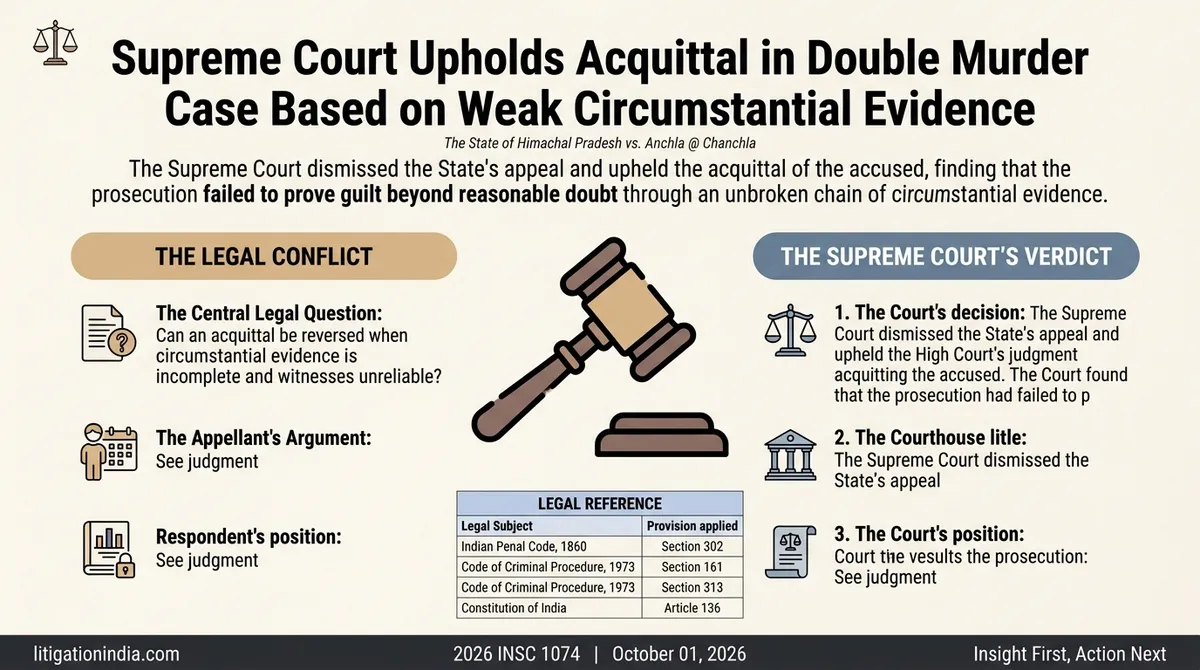
Supreme Court Upholds Acquittal in Double Murder Case Based on Weak Circumstantial Evidence — infographic summary

What this case means

The State of Himachal Pradesh challenged the High Court's acquittal of Anchla, accused of murdering her stepmother and stepbrother. The Supreme Court dismissed the appeal, finding that the prosecution failed to prove the charge beyond reasonable doubt as key witnesses were unreliable and circumstantial evidence was inconclusive. The judgment underlines that a chain of circumstances must entirely exclude every hypothesis of innocence before conviction.

What the Supreme Court held

The Supreme Court dismissed the State's appeal and upheld the High Court's judgment acquitting the accused. The Court found that the prosecution had failed to prove the charge of murder beyond reasonable doubt as no individual circumstance or collective chain of circumstances unerringly pointed to the guilt of the accused to the exclusion of all hypothesis of innocence. No interference was warranted with the order of acquittal.

Case: The State of Himachal Pradesh vs. Anchla @ Chanchla (2026) Citation: 2026 INSC 1074

Want the full legal reasoning, citations and case documents?

Read the full judgment analysis
State of Himachal Pradesh vs Anchla
Section 302 IPC
murder
circumstantial evidence
appeal against acquittal
last seen theory
DNA evidence
disclosure statement
strangulation
wrongful acquittal
Section 302, Indian Penal Code, 1860
Section 161, Code of Criminal Procedure, 1973
Section 313, Code of Criminal Procedure, 1973
Article 136, Constitution of India