Institutionalising Judicial Health: Supreme Court Establishes Standing Committee on Judicial Well-Being
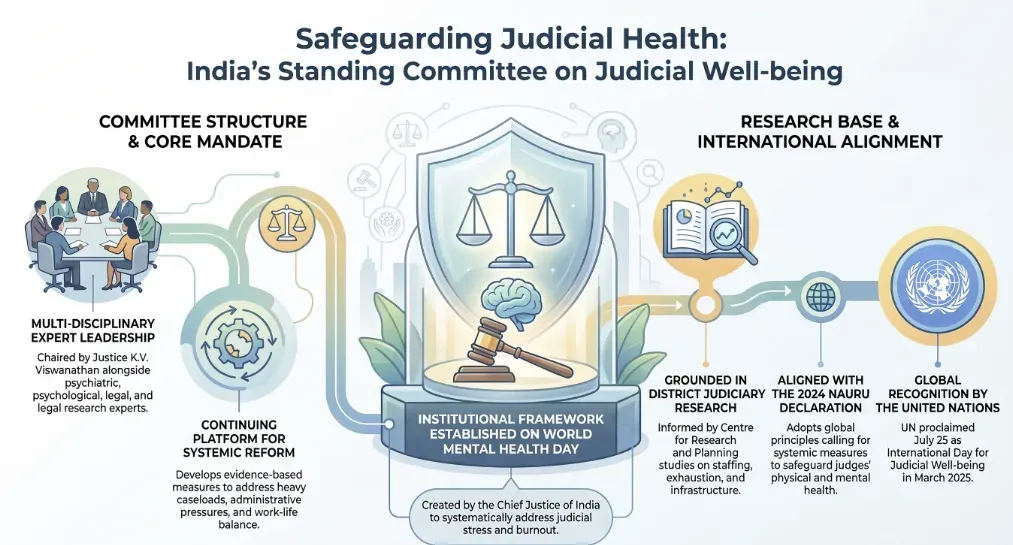
On 10 October 2026, coinciding with World Mental Health Day, Chief Justice of India Hon’ble Mr. Justice Surya Kant constituted a Standing Committee on Judicial Well-being under the aegis of the Supreme Court of India. The initiative marks an institutional recognition that the physical and mental health of judicial officers is integral to the independence, efficiency, and sustainability of the justice delivery system.
"The initiative reinforces a fundamental principle: the well-being of those entrusted with delivering justice is integral to the strength, effectiveness and long-term sustainability of the judicial system."
Multi-Disciplinary Composition of the Committee
The Standing Committee is designed to bring together judicial experience, mental health scholarship, legal practice, and administrative planning. It is chaired by Hon’ble Mr. Justice K.V. Viswanathan, Judge of the Supreme Court of India.
The Committee comprises four additional members:
- Dr. Savita Malhotra, Former Dean, PGIMER Chandigarh, and former Professor & Head, Department of Psychiatry
- Mr. Rajat Mitra, Psychologist, Director, and Co-founder of Swanchetan Society for Mental Health
- Ms. Mrinal Kanwar, Advocate-on-Record, Supreme Court of India
- Ms. Aarti Singh, Registrar (J), Centre for Research and Planning, Supreme Court of India
Confronting Occupational Stress in the Judiciary
Judicial officers across the country discharge their duties under extraordinarily demanding working conditions. The institutional framework acknowledges that judges regularly confront:
- Excessive caseloads and prolonged working hours
- Complex decision-making and administrative responsibilities
- Emotional strain resulting from exposure to sensitive and challenging cases
Rather than treating well-being as a private welfare concern, the Supreme Court has affirmed that judicial health directly shapes the quality and efficacy of judicial administration.
Grounded in Research: The District Judiciary Study
The constitution of the committee builds directly upon empirical research carried out by the Centre for Research and Planning of the Supreme Court of India, focusing on judges serving in the District Judiciary.
This research examined multiple systemic stressors across judicial tenures:
- Workload and exhaustion: Severe occupational stress, mental fatigue, and physical burnout.
- Operational hurdles: Critical staffing shortages and infrastructural constraints.
- Institutional pressures: Frequent transfers, administrative burdens, and strained work-life balance.
- Welfare deficits: Gaps in existing institutional support mechanisms.
The findings provide an evidence-based foundation to formulate concrete, sustainable institutional reforms.
Mandate: Moving Beyond Ad-Hoc Interventions
The Standing Committee is established as a continuing institutional platform to transition from episodic welfare measures to an institutionalised support framework.
Key responsibilities entrusted to the Committee include:
- Identifying specific operational and systemic areas requiring direct institutional intervention.
- Coordinating welfare policies and initiatives for judicial officers across states.
- Formulating actionable guidance and uniform benchmarks on judicial well-being.
- Conducting periodic reviews to evaluate and refine ongoing welfare programmes.
Alignment with Global Declarations
The Supreme Court’s initiative aligns the Indian judicial system with an accelerating global consensus on judicial wellness:
- The Nauru Declaration on Judicial Well-being (25 July 2024): Adopted internationally to urge systemic, evidence-based measures protecting the physical and mental health of judges.
- United Nations General Assembly Resolution (March 2025): Officially proclaimed 25 July as the International Day for Judicial Well-being, establishing the health of adjudicators as an institutional imperative worldwide.
By introducing high-level oversight through a dedicated Supreme Court Standing Committee, the Indian judiciary has taken a decisive step toward fostering a sustainable, supportive working environment for the judicial officers upholding the rule of law.