
All insights

Can compassionate or temporary appointees claim seniority over direct recruits in government service?

Supreme Court settles seniority order among direct recruits, special appointees and compassionate appointees in Tamil Nadu Ministerial Service.

This case concerned a seniority dispute among three categories of Tamil Nadu government employees: direct recruits (selected by competitive exam), special appointees (regularised temporary staff), and

Litigation India Editorial 9 October 2026 1 min read 2026 INSC 1105

Story

Case at a glance1 / 6

Supreme Court of India

Seniority in Tamil Nadu Government Service: Who Ranks First?

M. Prema vs. State of Tamil Nadu & Ors. | 2026 INSC 1105

Court: Supreme Court of India | Date: 09 October 2026Bench: Justice S.V.N. Bhatti and Justice Shree ChandrashekharArea of Law: Service Law — inter se seniority in government serviceThree categories in dispute: Direct recruits, Special appointees, Compassionate appointees
Who ranks highest — a competitive exam selectee, a regularised temporary employee, or a compassionate appointee?
Supreme Court settles seniority order among direct recruits, special appointees and compassionate appointees in Tamil Nadu Ministerial Service. · 2026 INSC 11052026-10-09T12:41:25.605376+00:00
The legal question2 / 6

Can Compassionate or Temporary Appointees Outrank Direct Recruits?

The core seniority question before the Supreme Court

  • Appellant (Special appointees): Seniority should run from initial date of appointment, not regularisation date.
  • Appellant (Direct recruits): Compassionate appointees cannot be placed above those selected through competitive exam.
  • Respondent (Compassionate appointees): G.O. dated 14.09.1984 entitles them to seniority based on date of appointment among direct recruits.
  • Respondent (State): Compassionate appointees cannot claim seniority over direct recruits as their appointment is an exception to Articles 14 and 16.
Supreme Court settles seniority order among direct recruits, special appointees and compassionate appointees in Tamil Nadu Ministerial Service. · 2026 INSC 11052026-10-09T12:41:25.605376+00:00
Statutory comparison3 / 6

Three Categories of Appointees: Key Distinctions

How each category entered service and what seniority rule applies

CategoryMode of EntrySeniority Rule Applied by Court
Direct Recruits (1983 Batch)TNPSC competitive exam (Nov 1983); appointed 1985-87Rank highest; seniority from date of substantive appointment
Special AppointeesRule 10(a)(i) TN Service Rules; temporary; regularised from 26.06.1984Rank below all Direct recruits; governed by Clause 10, Special Absorption Rules 1987
Compassionate AppointeesRule 48 TN Service Rules; exception to Arts. 14 & 16; regularised from date of initial appointmentRank below Direct recruits; inter se seniority with Special appointees by date of regularisation
Supreme Court settles seniority order among direct recruits, special appointees and compassionate appointees in Tamil Nadu Ministerial Service. · 2026 INSC 11052026-10-09T12:41:25.605376+00:00
The Court's reasoning4 / 6

Court's Step-by-Step Reasoning on Seniority

  1. 1Step 1: Special appointees entered via Rule 10(a)(i) — purely temporary; no seniority from date of temporary service.
  2. 2Step 2: Clause 10, Special Absorption Rules 1987 expressly ranks Special appointees below all 1983 TNPSC Direct recruits; rule is valid and binding.
  3. 3Step 3: Compassionate appointment is an exception to Articles 14 and 16; G.O. of 14.09.1984 (executive order) cannot override service rules to give them seniority over Direct recruits.
  4. 4Step 4: Direct recruits appointed by due process hold a legitimate expectation of seniority; regularisation of others cannot render them junior.
  5. 5Step 5: Inter se seniority between Special and Compassionate appointees — determined by date of regularisation, the most practical common criterion.
Supreme Court settles seniority order among direct recruits, special appointees and compassionate appointees in Tamil Nadu Ministerial Service. · 2026 INSC 11052026-10-09T12:41:25.605376+00:00
The verdict5 / 6

The Supreme Court's Final Order

  • The Fact: Three categories of Tamil Nadu Ministerial Service employees disputed seniority; the High Court's 2006 ruling had placed Compassionate appointees above Direct recruits.
  • The Law: Direct recruits appointed through competitive exam rank highest; Clause 10, Special Absorption Rules 1987 validly places Special appointees below Direct recruits; Compassionate appointees, being exceptions to Articles 14 and 16, cannot outrank Direct recruits.
  • The Result: Civil Appeal 8755/2013 allowed — Compassionate appointees cannot rank above 1983 Direct recruits; TC(C) Nos. 50, 51, 52/2013 dismissed; seniority between Special and Compassionate appointees by date of regularisation.
Compassionate appointees S. Prem Kumar and T.A. Kannappa shall not rank above Direct recruits of 1983 batch.
Supreme Court settles seniority order among direct recruits, special appointees and compassionate appointees in Tamil Nadu Ministerial Service. · 2026 INSC 11052026-10-09T12:41:25.605376+00:00
Why it matters6 / 6

What This Means for Government Employees

  • Competitive exam selections are protected: passing a public exam and waiting for appointment does not cost you your seniority.
  • Regularisation of temporary or compassionate staff does not push regular recruits down in the seniority list.
  • Where no specific seniority rule exists, seniority among regularised employees is counted from the date of regularisation — a simple, fair standard.
  • Employers (state governments) have wide power to frame seniority rules; courts will not strike them down merely because they cause hardship to one class.
Employees selected through regular competitive process cannot be made junior by later regularisation of temporary or compassionate appointees.
Supreme Court settles seniority order among direct recruits, special appointees and compassionate appointees in Tamil Nadu Ministerial Service. · 2026 INSC 11052026-10-09T12:41:25.605376+00:00
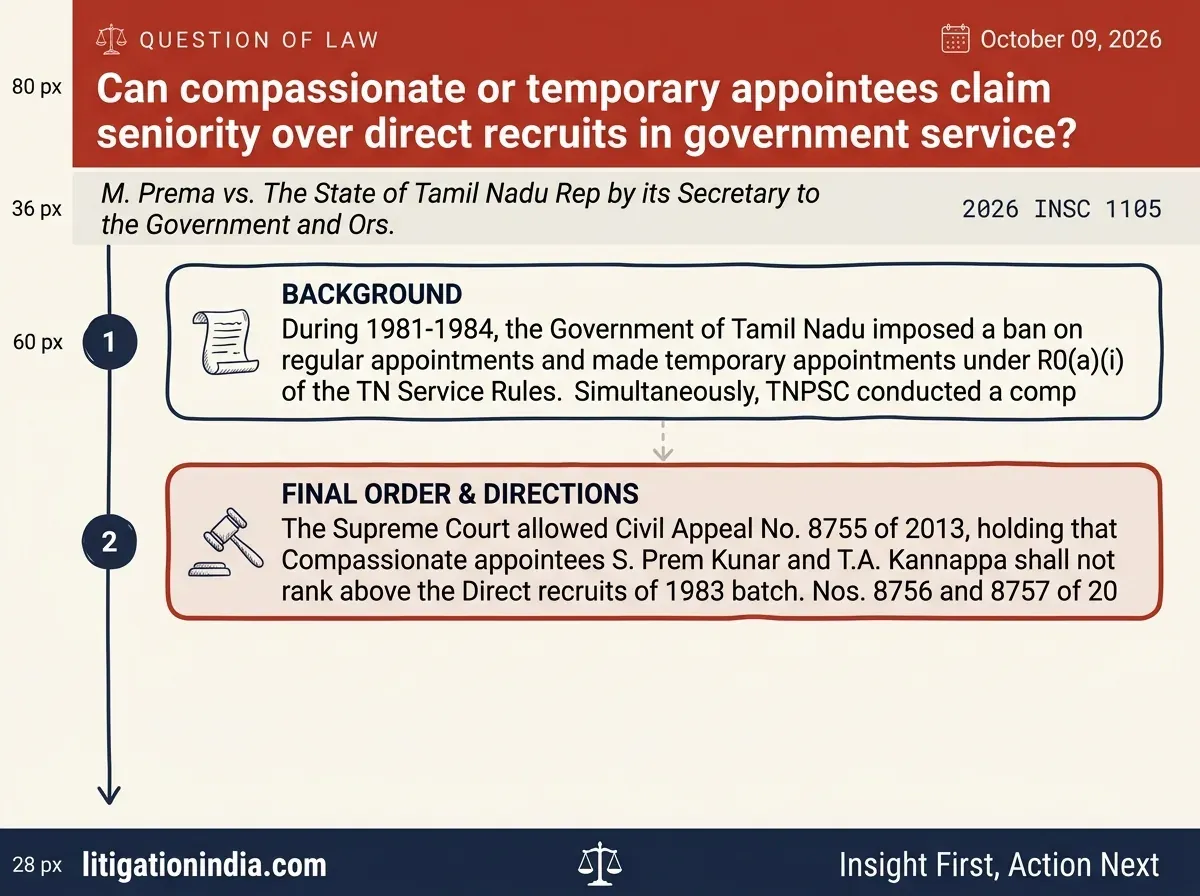
Supreme Court settles seniority order among direct recruits, special appointees and compassionate appointees in Tamil Nadu Ministerial Service. — infographic summary

What this case means

This case concerned a seniority dispute among three categories of Tamil Nadu government employees: direct recruits (selected by competitive exam), special appointees (regularised temporary staff), and compassionate appointees (dependents of deceased government employees). The Supreme Court held that direct recruits rank above both special and compassionate appointees, and seniority between special and compassionate appointees is determined by date of regularisation. The ruling affirms that employees appointed through regular competitive selection cannot be rendered junior by later regularisation of temporary or compassionate appointees.

What the Supreme Court held

The Supreme Court allowed Civil Appeal No. 8755 of 2013, holding that Compassionate appointees S. Prem Kumar and T.A. Kannappa shall not rank above the Direct recruits of 1983 batch. Civil Appeal Nos. 8756 and 8757 of 2013 were disposed of with directions that inter se seniority between Special and Compassionate appointees shall be determined by date of regularisation. Transferred Case Nos. 50, 51 and 52 of 2013 challenging Clause 10 of the Special Absorption Rules were dismissed, and the High Court's judgment of 3rd April 2006 was modified accordingly.

Case: M. Prema vs. The State of Tamil Nadu Rep by its Secretary to the Government and Ors. (2026) Citation: 2026 INSC 1105

Want the full legal reasoning, citations and case documents?

Read the full judgment analysis
seniority dispute
direct recruits
special appointees
compassionate appointees
Tamil Nadu Service Rules
Special Absorption Rules 1987
Rule 10(a)(i)
regularisation
service jurisprudence
Tamil Nadu Ministerial Service
inter se seniority
M. Prema vs State of Tamil Nadu
Rule 10(a)(i), Rule 35(a), Rule 35(aa), Rule 2(1), Rule 6, Rule 48, Tamil Nadu State and Subordinate Services Rules, 1955
Clause 3, Clause 7, Clause 9, Clause 10, Special Absorption Rules, 1987 (Tamil Nadu)