Full text of the judgment
Text extracted from M. Prema vs. The State of Tamil Nadu Rep by its Secretary to the Government and Ors.. For the authoritative version refer to the Supreme Court of India's official website.
2026 INSC 1105 Page 1 of 22
IN THE SUPREME COURT OF INDIA CIVIL APPELLATE JURISDICTION
CIVIL APPEAL NO.8757 OF 2013
…Appellant(s) Vs.
THE STATE OF TAMIL NADU REP BY ITS SECRETARY TO THE GOVERNMENT AND ORS.
…Respondent(s)
CIVIL APPEAL NO.8755/2013
H. NAGARAJAN & ORS.
…Appellant(s) Vs.
STATE OF T.N. & ORS.
…Respondent(s)
CIVIL APPEAL NO.8756/2013
R. KANTHIMATHI & ORS.
…Appellant(s)
STATE OF TAMIL NADU & ORS.
…Respondent(s)
T.C.(C) NO. 50/2013
…Applicant(s)
THE SECRETARY TO GOVERNMENT, HOME DEPARTMENT, CHENNAI AND ORS.
…Respondent(s)
Digitally signed by NISHA KHULBEY Date: 2026.10.09 16:21:32 IST Reason: Signature Not Verified
Page 2 of 22
T.C.(C) NO. 51/2013
R. KANTHIMATHI
…Applicant(s) Vs. THE SECRETARY TO GOVERNMENT, HOME DEPARTMENT, CHENNAI AND ORS.
…Respondent(s)
T.C.(C) NO. 52/2013
A. GOVINDARAJAN
…Applicant(s) Vs. THE SECRETARY TO GOVERNMENT, HOME DEPARTMENT, CHENNAI AND ORS.
…Respondent(s)
J U D G M E N T
SHREE CHANDRASHEKHAR, J.
These Civil Appeals and Transferred Cases involve inter se seniority dispute between different category of appointees. The Direct recruits and Special appointees are claiming seniority over each other and together both claim higher position in the seniority list above the Compassionate appointees. The Direct recruits and Special appointees have challenged the decision of the Division Bench of the High Court of Judicature at Madras delivered in W.P. No. 21654 of 2004 with W.P. Nos. 3822 and 3823 of 2006. 2. By a common judgment dated 3rd April 2006, the Division Bench of the High Court partly allowed W.P. No. 21654 of 2004 filed by the Direct recruits and held that the Direct recruits irrespective of their date of joining
Page 3 of 22
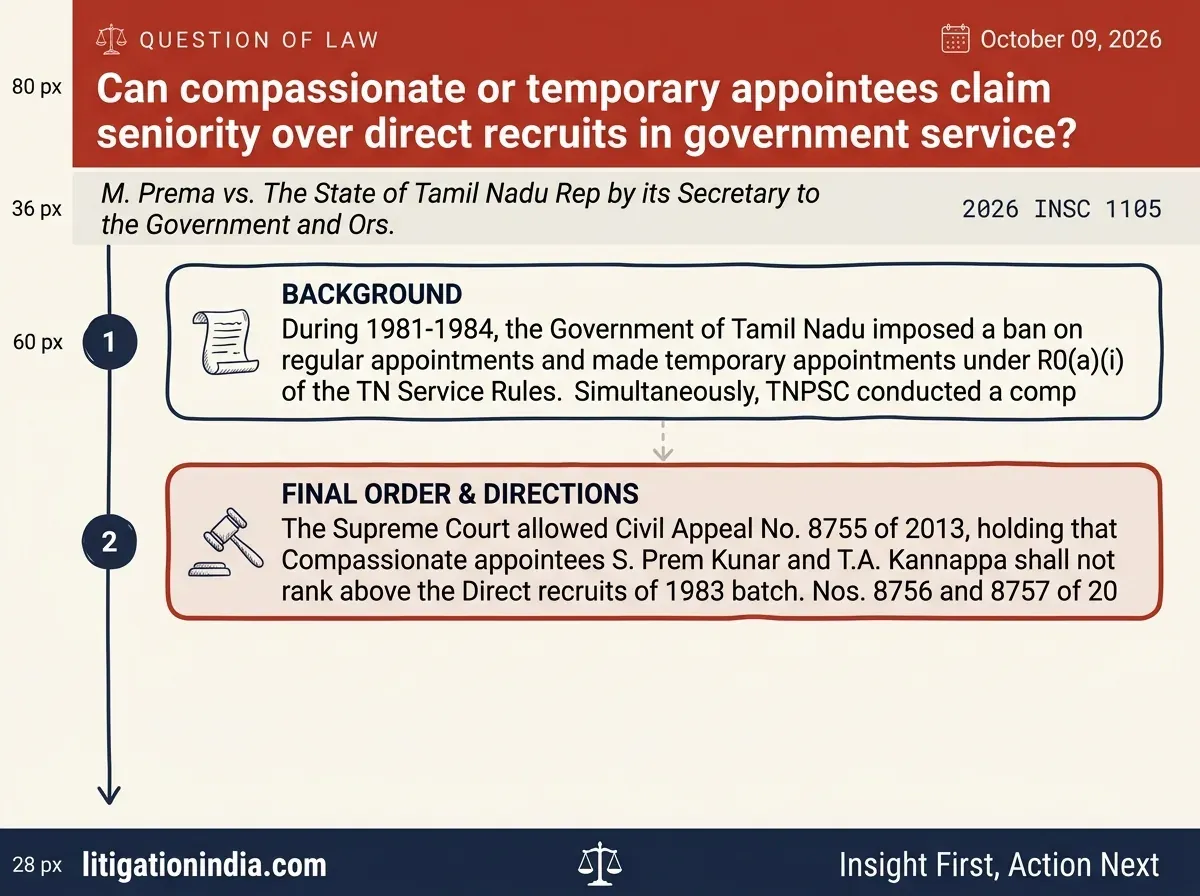
shall be placed above the Special appointees in the combined seniority list. However, W.P. Nos. 3822 and 3823 of 2006 filed by the Government of Tamil Nadu against the decision of the Tamil Nadu Administrative Tribunal in O.A. Nos. 3317 of 1992 and 5691 of 1993 were dismissed. The decision of the Tribunal was to the effect that the seniority of the Compassionate appointees, namely, S. Prem Kumar and T.A. Kannappa shall be reckoned above the Direct recruits of 1983 batch who were appointed after them and the Special appointees who were regularised in service with effect from 25th June 1984. 3. The facts of this case are not complex and are briefly stated thus: 3.1 During 1981-83, the Government of Tamil Nadu imposed a ban on the appointment of Junior Assistants and other Ministerial staff. However, temporary appointments were made under Rule 10(a)(i) of the “General Rules” which fall under Part II of the Tamil Nadu State and Subordinate Services Rules, 1955 (in short, TN Service Rules). 3.2 M. Prema and 13 other persons were appointed under Rule 10(a)(i) during 1981-84. In the meantime, the Tamil Nadu Public Service Commission (in short, Commission) issued an advertisement for appointment on Five thousand posts of Group IV employees through competitive examination which was conducted on 27th November 1983. The result of the said written examination was published on different dates and the appointments were made during 1985-87. The selected candidates of this recruitment exercise are commonly identified as Direct recruits of 1983 Batch. 3.3 Around the year 1984, the Government of Tamil Nadu took a decision to regularise the services of the Junior Assistants, Typists and Steno-typists, who were appointed on compassionate grounds.
Page 4 of 22
Subsequently, G.O. dated 14th September 1984 was issued by the order of the Governor under which the Compassionate appointees were placed in the seniority list of Direct recruits as per their date of appointment. 3.4 The Special appointees like M. Prema, R. Kanthimathi etc. were regularised in service with effect from 26th June 1984 vide G.O. dated 22nd September 1984. However, their seniority etc. have been fixed under Clause 10 of the Special Absorption Rules, 1987 which were published through G.O. dated 19th June 1987. 3.5 M. Prema, who was appointed on 1st December 1983 as Junior Assistant / Typist, continuously worked as a Junior Assistant / Typist and absorbed in service with effect from 26th June 1984. She was aggrieved by the provisional seniority list of Assistants / Typists published under the authority of the Director General of Police wherein she was placed below the Direct recruits. She approached the Tamil Nadu Administrative Tribunal, Chennai Bench, in O.A. No. 4656 of 2001 seeking quashing of Clause 10 of the Special Absorption Rules. While O.A. No. 4656 of 2001 filed by her was pending consideration before the Tribunal, a bunch of Direct recruits approached the High Court in W.P. No. 21654 of 2004 claiming seniority over the Compassionate appointees, Special appointees and other class of employees. 3.6 To complete the factual matrix of the case, we indicate that the validity of Clause 10 of the Special Absorption Rules was challenged by the Special appointees in O.A. Nos. 4656 of 2001, 4657 of 2001 and 5304 of 2001 before the Tamil Nadu Administrative Tribunal which were transferred to the High Court upon abolition of the Tribunal and re-numbered as W.P. Nos. 3701 of 2007, 3702 of 2007 and 3565 of 2007. Pursuant to an order of this Court dated 10th November 2010, these cases have been transferred to this Court and re-numbered as Transferred Case (C) Nos. 50 of 2013, 51 of 2013 and 52 of 2013.
Page 5 of 22
4. In the aforesaid background, the Division Bench of the High Court rendered the impugned decision which has affected the seniority of Direct recruits and Special appointees vis-à-vis Compassionate appointees. The Division Bench extensively referred to a previous order passed in W.P. No. 7730 of 1987 which was filed by 23 Compassionate appointees to challenge their ouster from service by an order dated 11th July 1987 while retaining 157 Special appointees on the ground that those Compassionate appointees were junior-most and below the Special appointees and the Direct recruits. This writ petition was allowed with a direction to prepare a seniority list in which a Direct recruit shall be placed below the Compassionate appointee if both had come in service together. The writ Court had issued the following directions: “9. To work out the inter se seniority for the concerned year, the procedure to be followed is as follows:-
1. All those who have taken up appointments in the concerned year through Commission have to be listed according to the dates on which they joined duty i.e., when they discharged the duty in the post for the first time. 2. Another list of all those who have been appointed on compassionate grounds in that year with their respective dates of regularisation of service to be prepared. 3. Taking each name in the Commission candidates’ list, he or she will have to be fitted in the list of candidates appointed on compassionate grounds, immediately below or preceding date on which the candidates appointed on compassionate grounds had been regularized. 4. In such of those cases where on the same day, the service is to be computed, then the candidate appointed on compassionate grounds will be placed above the Commission candidate.
10. In the combined seniority list of personnel drawn from three sources, these two sources will be included in the beginning in this order, and thereafter all the candidates appointed under Absorption Rules will be ranked below.”
5. W.A. No. 787 of 1988 titled “The State of Tamil Nadu & Ors. v. M. Albert Rosario & Ors.” was dismissed by the Division Bench by an order dated
Page 6 of 22
27th September 1988 and the aforesaid order passed by the writ Court in W.P. No. 7730 of 1987 has been affirmed observing as under: “2. The 157 persons having been absorbed under the Special Absorption Rules, the rule of seniority set out in rule 10 of the Special Absorption Rules alone must govern and if it so governs, the petitioners, who are appointed in accordance with the special rules, must have their seniority placed above the 157 persons. Apart from the other reasons, expressed by the learned single Judge, in countenancing the grievances of the petitioners, with which we agreed, in our view the above feature by itself convincingly supports the case of the petitioners. We are not persuaded to interfere in Writ Appeal and accordingly the Writ Appeal fails and the same is dismissed. We make no order as to costs.”
6. After noting the decisions in W.P. No. 7730 of 1987 and W.A. No. 787 of 1988 and Clause 10 of the Special Absorption Rules, the Division Bench delivered the impugned judgment dated 3rd April 2006 holding as under:
“10. The main contention raised by the counsel for the State Government in W.P. Nos. 3822 and 3823 of 2006 is to the effect that the candidates selected through Tamil Nadu Public Service Commission must be ranked above those appointed under Special Rules, which would also include any appointment on compassionate ground, as evident from Rule 10 of G.O.Ms.No.548 dated 19.6.1987. 11. After going through the provisions contained in the said G.O., and particularly keeping in view the interpretation given by the learned Single Judge which has been specifically approved by the Division Bench, which has become final, we are unable to accept the contention raised by the learned counsel appearing for the State Government. As rightly observed by the learned Single Judge, G.O. Ms.No.548 does not deal with the question of seniority of those appointed on compassionate ground. It only refers to question of seniority between General Rules 10(a)(i) appointees and regular appointees who had been selected through Tamil Nadu Public Service Commission in the examination held in November, 1983. As per such Rules under Article 309 of the Constitution of India, the seniority of the appointees under General Rules 10(a)(i) who had been subsequently regularized, had been depressed and kept below the last candidate selected on the basis of November, 1983 examination. Since the validity of such rule has not been challenged, as per such rules it is apparent that General Rules 10(a)(i) candidates have to be ranked below the candidates who have been selected as per the examination held in November, 1983. In such rule, however, nowhere it is indicated that the seniority of the TNPSC candidate has to be advanced to the year of examination that is to say 1983. It is also nowhere indicated that such persons shall be deemed to have been appointed in 1983. 12. It is, therefore, obvious that the seniority of a person appointed on the basis of November, 1983 examination, has to be fixed on the basis of the date of
Page 7 of 22
substantive appointment and not on the basis of the date of the examination. As a matter of fact, this aspect has been very elaborately clarified by Justice Sathiadev, in the decision dated 8.4.1988, which has been specifically approved by the Division Bench. Hence, we are not inclined to take any different view of the matter. In view of the direction clearly indicated in paragraph 9 of the judgement of the learned Single Judge, which has been specifically approved by the Division Bench, it is apparent that the question of seniority of the person appointed through (illegible) compassionate grounds has to be fixed on the basis of the date of appointment. 13. So far as General Rules 10(a)(i) candidates are concerned, obviously such candidates have to be ranked below the TNPSC candidates irrespective of the date of appointment of such TNPSC candidates and the Special Absorption Rules candidates. In other words, 10(a)(i) appointees have to be ranked below the last TNPSC candidate selected on the basis of the examination held in November, 1983. Since the validity of such rules has not at all been challenged, the General Rules 10(a)(i) candidates are deemed to be below all candidates selected on the basis of November, 1983 examination held by the TNPSC. 14. For the aforesaid reason, the writ petition Nos. 3822 and 3823 of 2006 filed by the Government, are dismissed. Writ petition No. 21654 of 2004 is partly allowed, and it is directed that the candidates selected by the TNPSC on the basis of the examination held in November, 1983, shall rank above General Rules 10(a)(i) candidates; but, so far as compassionate appointees are concerned, the inter se rank of the compassionate appointees and TNPSC candidates shall depend according to the date of their initial appointment, as has been held in paragraph 9 of the judgment in W.P. No. 7730/87 and W.A. No. 787/88. No costs. Consequently, connected WPMPs are closed.”
7. Aggrieved by the decision of the Division Bench that the Direct recruits shall rank above the Special appointees, M. Prema came to this Court in SLP (C) No. 12169 of 2007, now converted into Civil Appeal No. 8757 of 2013. She had also filed a Review Petition before the High Court seeking review of the judgment dated 3rd April 2006 on the ground that she was not made a party before the Division Bench of the High Court and the pendency of O.A. No. 4656 of 2001 was not disclosed to the Division Bench. The said Review Petition has since been withdrawn by her, as reflected in the order dated 10th July 2007 passed by this Court.
Page 8 of 22
8. Civil Appeal No. 8756 of 20131 has been filed by 13 Special appointees who are also aggrieved as M. Prema, inasmuch as, the Special appointees shall now rank below the Direct recruits and also below the Compassionate appointees in the combined seniority list of Junior Assistant / Typist, Steno-typist etc. 9. In Civil Appeal No. 8755 of 20132, the Direct recruits represented through H. Nagarajan and 9 other such appointees have also laid a challenge to the impugned decision of the Division Bench to the extent it holds that inter se seniority of the Compassionate appointees with the Direct recruits shall be counted from the date of their initial appointment. 10. There are two Compassionate appointees who are involved in this inter se seniority dispute. S. Prem Kumar was appointed on 25th November 1985 and T.A. Kannappa was appointed on 5th August 1985, both as Junior Assistants on compassionate grounds under Rule 48 under Part II of the TN Service Rules. They were regularised in service by an order dated 19th February 1987 with effect from their initial date of appointment. They claim that they are Direct recruits within the meaning of Rule 2(14) of the TN Service Rules and they are not temporary appointees. The learned counsel for the Compassionate appointees relied on G.O. dated 14th September 1984 which provided that the seniority of such appointees
1 Civil Appeal No. 8756 of 2013 corresponding to Special Leave Petition(C) No. 5772 of 2007 arising out of W.P. No. 21654 of 2004 titled “H. Nagarajan and Ors. v. The State of Tamil Nadu and Ors.” dated 3rd April 2006 2 Civil Appeal No. 8755 of 2013 corresponding to Special Leave Petition(C) No. 19902 of 2006 arising out of W.P. No. 21654 of 2004 titled “H. Nagarajan and Ors. v. The State of Tamil Nadu and Ors.” dated 3rd April 2006
Page 9 of 22
shall be determined on the basis of their date of appointment and they shall be placed in the seniority list among the Direct recruits. The learned counsel further contended that G.O. dated 14th September 1984 was not challenged by the Direct recruits or by the Special appointees and, as a consequence thereof, the Compassionate appointees must rank above in seniority to the Direct recruits who were appointed after them. The parties have elaborated upon the effect of G.O. (Standing) No.951 dated 14th September 1984, which is reproduced below: “Tamil Nadu Ministerial Service - Appointment (Direct) - Appointed on the basis of Compassionate or Clemency Grounds - Fixing of Seniority
Personnel and Administrative Reforms (Personnel - B) Department
G.O. (Standing) No.951
Dated : 14.09.1984 Read : - Tamil Nadu Public Service Commission Letter No.4911/E2/84 dated 27.06.1984. ORDER : -
***** An eligible family member of the Government servant, who died while in service, may be appointed in Government service on compassionate grounds. The person who is appointed on such grounds, may be given posting on the basis of educational qualification. On compassionate grounds, many persons have been appointed as Junior Assistants, Typists, Steno-Typists and other such posts in Tamil Nadu Ministerial Service. They have been taken in service in the said posts on temporary basis first and thereafter their services would be regularized after getting concurrence of the Tamil Nadu Public Service Commission. The seniority of the persons who are recruited on the above basis in Junior Assistants, Typists, Steno-Typists and other such posts, has been fixed below the Tamil Nadu Public Service Commission candidates of the particular year. But, there is no provision for this in Tamil Nadu Ministerial Staff Special Rules. It was considered to place the seniority of the candidates appointed on compassionate grounds in between the candidates appointed through Tamil Nadu Public Service Commission on the basis of their date of joining. In the Govt Order (Standing) No.958 of the Personnel and Administrative Reforms (Personnel -I) Department, dated 7-10-1983 it has been ordered that the seniority of Junior Assistants who are recruited on compassionate grounds in the Secretariat may be fixed among the candidates appointed through Tamil Nadu Public Service Commission on the basis of their date of joining. Likewise, it is
Page 10 of 22
considered that the same concession may be given to Junior Assistants, Typists, Steno-Typists and other related posts in Tamil Nadu Ministerial Service. Tamil Nadu Public Service Commission has also given approval for this proposal in the reference cited. 3. Hence, it is ordered that the seniority date of Junior Assistants, Typists, Steno-typists and other such posts may be placed among the seniority of the candidates appointed through Tamil Nadu Public Service Commission on the basis of the date of appointment. This is not applicable to those who had already been appointed. 4. This order will come into effect on the date of publishing of the order. (By the order of the Governor) K.Chokkalingam, Chief Secretary to Government.”
11. The Direct recruits contend that the back-door appointees cannot steal a march over them and the Compassionate appointees cannot be put above them in the seniority list. Mr. V. Prabhakar, the learned senior counsel appearing for the Direct recruits referred to the decision in “K. Madalaimuthu & Anr. v. State of T.N. & Ors”3 and contended that the Direct recruits must be held senior to those who came in the cadre of Junior Assistants, Typists or Steno-typists through other modes of selection. 12. The State respondents have also taken a stand that the Compassionate appointees cannot claim seniority over the Direct recruits for the reason that they were not selected through the competitive examination and their appointment was by way of an exception to Articles 14 and 16 of the Constitution of India. They have referred to an order dated 2nd March 1993 passed in O.A. No. 4176 of 1992 filed by Thiru. S. Ramajayem who was appointed as a Junior Assistant on compassionate ground. The Tribunal in its order dated 2nd March 1993 has held that the
3 K. Madalaimuthu & Anr. v. State of T.N. & Ors : (2006) 6 SCC 558
Page 11 of 22
Compassionate appointee like him cannot seek seniority above the Direct recruits of 1983 batch. According to the State respondents, the order passed in O.A. No. 4176 of 1992 has become final and shall govern the seniority of Compassionate appointees vis-à-vis Direct recruits. 13. The TN Service Rules do not provide any standard formula to fix seniority of a regularly appointed Government employee vis-à-vis other appointees who came in the same cadre through different sources. Therefore, their inter se seniority has to be determined as per the applicable Government Orders and Circulars. The Compassionate appointees were appointed under Rule 48 of the TN Service Rules which vests power in the Governor to deal with the case of any person or the class of persons serving in a civil capacity under the Government of Tamil Nadu for appointment to a service in such manner as may appear to be just and equitable. The Government of Tamil Nadu came out with G.O. dated 14th September 1984 which was issued by the order of the Governor and refers to the Compassionate appointees like S. Prem Kumar and T.A. Kannappa who were taken in service on temporary basis. Under this Government Order, a decision was taken to fix seniority of the Compassionate appointees holding the post of Junior Assistant, Typist or Steno-typist and other persons holding such posts among the seniority of the Direct recruits on the basis of their date of appointment. 14. The G.O. dated 14th September 1984 issued by the order of Governor is in the nature of an Executive Order under Article 162 of the Constitution of India. An Executive Order can supplement the Rules and provide some
Page 12 of 22
method to achieve what has already been provided under the Rules but it cannot operate against the Rules. Strictly speaking, the appointments made on compassionate ground do not fall under any prescribed mode of appointment. Rule 6 under Part II of the TN Service Rules prescribes for only two methods of recruitment, namely, by direct recruitment or recruitment by transfer. Moreover, the appointment on compassionate ground is an exception to Articles 14 and 16 of the Constitution of India. The compassionate appointments are made under a scheme and the dependents of the former employee who died in harness are generally appointed on Class III or Class IV posts depending on their qualification and available vacancies. This is not a regular mode of selection and the Compassionate appointees cannot be put at par with the Direct recruits. The Compassionate appointees form a separate class and they cannot be put above the Direct recruits on the basis of their initial date of appointment. They were appointed on temporary basis and then regularised in service after taking concurrence of the Commission. A Government employee who is appointed through a regular selection process has a legitimate expectation to seniority inter se with the employees who are appointed through regular mode in the subsequent transaction as also with other appointees coming into the cadre through different sources. The persons who were selected through regular mode cannot be rendered junior by regularisation of temporary appointees at a later stage. Therefore, we hold that the Compassionate appointees who are the respondents in these Civil Appeals shall rank below the Direct recruits of 1983 batch. In the
Page 13 of 22
circumstances of the case, any other interpretation of the seniority rule envisaged under G.O. dated 14th September 1984 would cause injustice to the Direct recruits. 15. According to the Special appointees under Rule 10(a)(i), they are also entitled to get their seniority from the date of initial appointment once they are regularised in service. Mr. R. Subramanian, the learned senior counsel for the Special appointees emphasised that the normal rule is that the seniority of a Government servant should be counted from the date of his initial appointment and not from the date of his absorption or regularisation. The learned senior counsel further contended that continuous service rendered by the Special appointees ought to receive due recognition in fixing their seniority vis-à-vis the Direct recruits. 16. The Special appointees were appointed between 1981 to 1984 on temporary vacancies by drawing names from the Employment Exchange. Later, a ban was imposed by the Government on temporary appointment by drawing names from the Employment Exchange, with effect from 25th June 1984. The Government, therefore, decided to regularise their services and G.O. dated 22nd September 1984 was issued for regularising the services of all temporary Junior Assistant, Typist or Steno-typist in the Tamil Nadu Ministerial Service or Tamil Nadu Judicial Ministerial Service and all Typists and Steno-typists in the Tamil Nadu Secretariat Services with effect from 26th June 1984. It is clearly mentioned in this Government Order that the seniority of such Special appointees shall be fixed separately and for that purpose the Rules framed under Proviso to Article 309 of the Constitution
Page 14 of 22
of India were notified through G.O. Ms. No. 548 dated 19th June 1987. These Rules are called the Special Absorption Rules, 1987 and came into force on 25th June 1984 and are made applicable to all candidates appointed through special absorption with effect from 25th June 1984. The regularisation order issued through G.O. dated 22nd September 1984 had contained the following conditions: “5. The services of all the temporary personnel in the (illegible) of Junior Assistant, Typist and Steno Typist in the Tamil Nadu Ministerial Service / Tamil Nadu Judicial Ministerial Service and Typist and Steno Typist in the Tamil Nadu Secretariat Service recruited through Employment Exchange under General Rule 10(a)(i) and who were in temporary service as on 25.6.84 be regularised with effect from 26.6.1984 in the same category and in the Department in which they were working. 6. Orders regarding fixation of seniority, age, educational qualification, pay, leave etc. will be issued separately.”
17. Part II of the TN Service Rules contains the “General Rules” which govern all State and Subordinate Services and apply to the holders of all posts whether temporary or permanent. Rule 10(a)(i) of the General Rules under Part II deals with “Temporary Appointments” and contemplates immediate filling of a vacancy in a post borne on the cadre of a service, class or category if it is necessary in the public interest and such necessity is arising out of an emergency and on account of the fact that there shall be undue delay in making such appointment in accordance with these Rules and the Special Rules. Such appointments are temporary in nature and made of a person who possesses the qualifications prescribed for the post. However, first Proviso to Rule 10(a)(i) puts a restriction on direct recruitment to the extent that any person to be appointed under this Rule must be sponsored by the Commission from its regular or reserve list of
Page 15 of 22
successful candidates. Clause (a)(iii) of Rule 10 indicates that the temporary appointment made under Rule 10(a)(i) shall be terminated and the appointees shall be replaced as soon as possible by a member of a service or an approved candidate qualified to hold the post under the Rules. Furthermore, the appointment under Rule 10(a)(i) can be made strictly for a period not exceeding one year from the date of temporary appointment. 18. Quite clearly, the appointment of the Special appointees was temporary in nature and against the temporary vacancies. They did not face the competitive examination and came to the cadre of Junior Assistant / Typist by virtue of the order of regularisation vide G.O. Ms. No. 996 dated 22nd September 1984. Under Clause 7 of the Special Absorption Rules, it is provided that the Special appointees whose services have been regularised with effect from 1984 shall be on probation for a total period of two years within a continuous period of three years. Under Clause 9, they are also required to pass such test or undergo such training before the expiry of two years’ period, failing which their increments shall be stopped for two years without cumulative effect. It is further provided under Clause 9 that their services shall be terminated if they fail to pass such test or to undergo such training even by the end of fourth year of the service. M. Prema was appointed on 1st December 1983 as Junior Assistant under Rule 10(a)(i) of the TN Service Rules and she completed her probation on 24th June 1986. R. Kanthimathi and A. Govindarajan were also appointed under Rule 10(a)(i) during 1981-82 and then regularised in service. For about 14 years, they did not challenge the Special Absorption Rules under which inter se
Page 16 of 22
seniority between the Direct recruits and the Special appointees was fixed and they approached the Tribunal in the year 2001 to challenge Clause 10 of the Special Absorption Rules, which provided as under: “10. Seniority: - The seniority of a candidate appointed through Special Absorption, in 1984, shall be fixed with reference to the date of first temporary appointment in the departmental unit in which he had been absorbed irrespective of whether he had been subsequently discharged for want of vacancies or appointed again through the Employment Exchange in that departmental unit, and not with reference to the date of first appointment in any other departmental unit where he had acted previously before his absorption in the particulars departmental unit. He shall be ranked below the candidates selected by the Tamil Nadu Public Service Commission on the results of the competitive examination held in November, 1983 irrespective of the date of appointment of these candidates. If more than one candidate is appointed on the same day their seniority shall be fixed with reference to the age as laid down in subrule (a) of rule 35 of the General Rules. The rule of reservation (General Rule 22) shall not apply to these candidates.
Provided that if any person is appointed to the post of Jr. Assistant / Typists / Steno - Typists in accordance with the Special Rules the seniority of such person shall be placed above the candidates appointed through Special Absorption in 1984.
Provided also that if any of the persons appointed to the posts of Junior Assistant / Typist / Steno - Typist in accordance with the Special Absorption Rules, 1987 and whose services were regularized in one department on 25.6.84 and reallotted to a new department for want of vacancy through the Tamil Nadu Public Service Commission shall take his seniority in the new department from the date of his temporary appointment in the department from which he was reallotted.”
19. At this juncture, it is necessary to note that Rule 2(1) under Part I of the TN Service Rules provides that a person is “appointed to a service” if his appointment is in accordance with these Rules or any other Rules applicable at that time. Such a person shall be considered to be appointed to a service on the date when he discharges for the first time the duties of a post borne on the cadre of such service or commences the probation, instruction or training as may be prescribed for the members thereof. Rule 35(a) under Part II is another important provision in the TN Service Rules which needs to be applied to resolve the present inter se seniority dispute.
Page 17 of 22
It provides that the seniority of a person in a service, class, category or grade shall be determined by the rank obtained by him in the list of approved candidates drawn up by the Commission or any other Appointing Authority as the case may be. Clause (aa) provides that the seniority of a person in a service, class, category or grade shall be determined with reference to the date on which he is appointed to the service, class, category or grade where the normal method of recruitment to that service, class, category or grade is by more than one method of recruitment. 20. Having regard to the above rule position, it must be held that the Special appointees did not come to the service till their regularisation in service. In “State of Tamil Nadu & Anr. v. E. Paripoornam & Ors.”4 this Court held that Rule 10(a)(i) provides for making of temporary appointments which are made otherwise than in accordance with the procedure prescribed under the rules. This Court further held that the employees appointed under Rule 10(a)(i) of the TN Service Rules cannot claim seniority in the cadre on the basis of their temporary service prior to regularisation. Rule 10(a)(i) of the TN Service Rules came again for consideration before this Court in “M.P. Palanisamy & Ors. v. A. Krishnan & Ors.”5 wherein it has been held that an ad hoc employee cannot claim seniority above a junior person already in service even if he is the junior-most person in the cadre.
4 State of Tamil Nadu & Anr. v. E. Paripoornam & Ors. : 1992 Supp (1) SCC 420 5 M.P. Palanisamy & Ors. v. A. Krishnan & Ors. : (2009) 6 SCC 428
Page 18 of 22
21. Clause 10 of the Special Absorption Rules provides that the Direct recruits irrespective of their date of appointment shall be placed above the Special appointees in the seniority list. The State of Tamil Nadu has supported Clause 10 of the Special Absorption Rules on the ground that the Direct recruits form part of a separate class and are entitled to be placed above the employees who were appointed otherwise than through a competitive selection procedure and regularised in service. There is a valid reason for according seniority to the Direct recruits above the Special appointees. We find that the delay in appointment of the Direct recruits has been adequately explained by the State. It is stated that the delay in appointment of the Direct recruits was for the reason that the temporary appointees had occupied the post. This is a special feature of this case that the employer has itself recognised that there was no fault on the part of the Direct recruits if they were kept waiting and not appointed in time. The State Government accepting this position has come out with a solution under Clause 10 of the Special Absorption Rules which is just and proper. Clause 10 follows the well-settled norm to fix seniority that the Government employees who are appointed following the regular mode of appointment must rank higher in the seniority list to those who came in the cadre through regularisation. The employer has a right to frame rules for determining inter se seniority of two or more classes of employees in the cadre. The employer is also entitled to devise a methodology to fix seniority of its employees. The Rules framed by the employer are not open to challenge on the ground that it could have been framed in a better manner.
Page 19 of 22
A rule framed by the Government can also not be challenged on the ground that some hardship would be caused to a class or a section of employees. There is another reason to hold the validity of Clause 10. The Special Absorption Rules provide under Clause 3 that the Special Absorption Rules shall have overriding effect and prevail over any repugnant corresponding provision under the General Rules, Special Rules, Fundamental Rules or Tamil Nadu Leave Rules. The Special appointees have not questioned Clause 3 and they are bound by the conditions under G.O. dated 19th June 1987. 22. The Division Bench of the High Court was right in holding that M. Prema and other Special appointees shall rank below the Direct recruits of 1983 batch in the seniority list. Though the Special appointees dispute the observation in the impugned judgment dated 3rd April 2006 that the validity of Clause 10 of the Special Absorption Rules was affirmed by the High Court in a previous proceeding, we are inclined to approve the decision of the Division Bench that the Direct recruits of 1983 batch shall rank higher to the Special appointees in the seniority list. However, the Division Bench committed an error in holding that the Compassionate appointees shall be placed above the Direct recruits in the seniority list on the basis of their date of appointment. By virtue of the impugned judgment, the Compassionate appointees shall be placed above the Direct recruits and the Special appointees in the seniority list. While holding so, the High Court overlooked a fundamental rule in service jurisprudence that the Direct
Page 20 of 22
recruits are entitled to claim seniority over other appointees who came in the cadre through other sources. 23. This is a basic rule of seniority that a Government employee appointed to a post following the due procedure and in accordance with the rules must rank senior to the appointees who entered in service as a temporary or stopgap measure or were appointed owing to some emergency. In “Direct Recruit Class II Engineering Officers' Association v. State of Maharashtra & Ors.”6 this Court held that a Direct recruit is entitled to claim seniority from the date of appointment and his seniority cannot be fixed based on the date of his confirmation in service. It further laid down that a Government employee cannot claim seniority from the date of initial appointment if he is a temporary or ad hoc employee and not appointed through the rules rather was a stopgap arrangement. This position in law has continued till date. There are, though, decisions where this Court has granted benefit of the service rendered by a Government employee on ad hoc or temporary post till the date of regularisation in service, but only for pension purposes (see, “State of Himachal Pradesh and Anr. v. Sheela Devi”7; “S.D. Jayaprakash and Ors. v. Union of India and Ors.”8). This benefit of counting of ad hoc or temporary services is generally extended to the Government employees where the rules provide so, in recognition of their past services. Such benefit has been granted on an understanding that the
6 Direct Recruit Class II Engineering OƯicers' Association v. State of Maharashtra & Ors.: (1990) 2 SCC 715 7 State of Himachal Pradesh and Anr. v. Sheela Devi : 2023 SCC OnLine SC 1272 8 S.D. Jayaprakash and Ors. v. Union of India and Ors. : 2025 SCC OnLine SC 973
Page 21 of 22
past valuable services rendered by the Government employees when they were working on ad hoc or temporary basis should not be wiped out completely after they are regularised in service. However, such past services of the Special appointees or for that matter of the Compassionate appointees rendered as ad hoc or temporary employees cannot be counted to accord them seniority over the Direct recruits of 1983 batch. 24. As to inter se seniority between the Compassionate appointees and the Special appointees, we hold that the same must be decided on the basis of their date of regularisation. This is one criterion which is most suited in the present scenario. Any inter se dispute regarding seniority of two sets of employees should be examined on broad principles with a common sense approach. In every seniority-linked dispute there shall always be one or other factor which may weigh in favor of or against a particular set of employees. The Court is, therefore, required to take a practical view of the matter and should not involve itself in forensic examination of every little fact howsoever insignificant it may be. A Court of law must remember that inter se seniority dispute between two sets of employees in the same cadre need not be examined with mathematical precision. Shortly put, except in cases where the Recruitment Rules are clear and provide a methodology for fixing inter se seniority, the norm of counting seniority from the date of regularisation of temporary, ad hoc or Compassionate appointees should be followed to determine their inter-se seniority. 25. In the result, T.C.(C) Nos. 50 of 2013, 51 of 2013 and 52 of 2013 are dismissed. Civil Appeal Nos. 8756 of 2013 and 8757 of 2013 are disposed
Page 22 of 22
of with the aforesaid direction for fixing inter se seniority of the Special appointees vis-à-vis the Compassionate appointees. Civil Appeal No. 8755 of 2013 is allowed to the extent that the Compassionate appointees, namely, S. Prem Kumar and T.A. Kannappa shall not rank above the Direct recruits of 1983 batch. 26. The judgment dated 3rd April 2006 delivered in W.P. No. 21654 of 2004 with W.P. Nos. 3822 and 3823 of 2006 is modified to the above extent. There shall be no order as to costs.
………...………….……………………….., J. (S.V.N. BHATTI)
………...………….……………………….., J. (SHREE CHANDRASHEKHAR) NEW DELHI; OCTOBER 09, 2026