
All insights

Can a Tribunal review its order to override a binding Supreme Court precedent?

Supreme Court sets aside Electricity Tribunal's illegal review of binding tariff precedent

The Appellate Tribunal for Electricity reviewed its five-year-old order allowing DVC's Sinking Fund as a tariff expense, contradicting a binding Supreme Court precedent. The Supreme Court set aside th

Litigation India Editorial 30 October 2026 1 min read 2026 INSC 1178

Story

Case at a glance1 / 6

Supreme Court of India

Tribunal's Review Cannot Override Supreme Court Precedent

Damodar Valley Corporation v. Maithan Alloys Limited & Ors. | 2026 INSC 1178

Court: Supreme Court of India | Date: October 30, 2026Bench: Justice J. B. Pardiwala and Justice K. Vinod ChandranArea of Law: Electricity tariff determination and review jurisdictionAppeal against APTEL order allowing review of five-year-old tariff decision
A Tribunal cannot use review to disregard a binding Supreme Court precedent under Article 141.
Supreme Court sets aside Electricity Tribunal's illegal review of binding tariff precedent · 2026 INSC 11782026-10-30T19:24:08.969488+00:00
The legal question2 / 6

Can DVC Claim Both Depreciation and Sinking Fund in Tariff?

And can APTEL review its order to override a Supreme Court binding precedent?

  • Appellant: Section 40, DVC Act and Regulation 43 of 2009 Regulations expressly permit both depreciation and Sinking Fund as tariff expenses.
  • Appellant: Bhaskar Shrachi Alloys (2018) is a binding precedent settling this issue; review was not permissible.
  • Respondent: Allowing both depreciation and Sinking Fund on the same bond-funded assets gives DVC an impermissible double benefit.
  • Respondent: Sinking Fund is merely an appropriation from net profit, not a deductible expense, under general accounting principles.
Supreme Court sets aside Electricity Tribunal's illegal review of binding tariff precedent · 2026 INSC 11782026-10-30T19:24:08.969488+00:00
Statutory comparison3 / 6

Statutory Provisions Governing DVC Tariff Determination

How the Court read the DVC Act and Electricity Act together

ProvisionWhat it saysHow the Court applied it
Section 40, DVC Act 1948Mandates provision for depreciation and reserve/other funds at CAG-specified rates before calculating net profitBoth depreciation and Sinking Fund are statutory charges before net profit; not a double benefit but a legislated departure from ordinary accounting
Fourth proviso to Section 14, Electricity Act 2003Deems DVC a licensee; preserves DVC Act provisions not inconsistent with Electricity ActEnsures DVC's special statutory regime survives; upheld as substantive provision, not confined to licensing
Section 174, Electricity Act 2003Electricity Act overrides inconsistent provisions of other lawsDoes not repeal DVC Act entirely; provisions not inconsistent with Electricity Act remain in force
Regulation 43, Tariff Regulations 2009Special provisions for DVC: CAG depreciation rates and Section 40 funds treated as tariff expensesExpressly authorises both depreciation and Sinking Fund as recoverable tariff items for the 2009-2014 period
Section 40, DVC Act creates a statutory exception to ordinary accounting: Sinking Fund is a pre-profit charge, not a post-profit appropriation.
Supreme Court sets aside Electricity Tribunal's illegal review of binding tariff precedent · 2026 INSC 11782026-10-30T19:24:08.969488+00:00
The Court's reasoning4 / 6

Court's Reasoning: Why the Review Was Illegal

Step-by-step reasoning from issue to conclusion

  1. 1Step 1: Bhaskar Shrachi Alloys (2018) already upheld both depreciation and Sinking Fund under Section 40, DVC Act — binding under Article 141.
  2. 2Step 2: APTEL's original 2019 order correctly relied on that precedent; no error apparent on the face of the record existed.
  3. 3Step 3: The alleged 'double allowance' issue was not self-evident and required elaborate reasoning — not a valid ground for review per Kamal Sengupta (2008).
  4. 4Step 4: Para 57 of Bhaskar Shrachi Alloys explicitly addressed both depreciation and Sinking Fund together; the issue had not escaped the Court's notice.
  5. 5Step 5: APTEL's review order was illegal — it effectively sat in appeal over its own judgment using a Supreme Court decision as the trigger, violating Article 141.
A review petition filed after 5 years cannot resurrect a settled legal question decided by the Supreme Court.
Supreme Court sets aside Electricity Tribunal's illegal review of binding tariff precedent · 2026 INSC 11782026-10-30T19:24:08.969488+00:00
The verdict5 / 6

The Court's Final Decision

Facts, law and result

  • The Fact: APTEL allowed a 2019 review petition in 2024, reversing its own order that was based on a binding Supreme Court precedent, on grounds of alleged double allowance.
  • The Law: Section 40, DVC Act and Regulation 43 of Tariff Regulations 2009 expressly authorise both depreciation and Sinking Fund as tariff expenses; review jurisdiction does not permit overriding Article 141 precedents.
  • The Result: Review order set aside; APTEL's original 17.05.2019 order restored; Rs. 2 lakh costs on first respondent and Rs. 1.5 lakh on SAIL, payable to DVC within one month.
Appeal allowed with costs; review order set aside; APTEL's 2019 order restored; Rs. 3.5 lakh total costs imposed.
Supreme Court sets aside Electricity Tribunal's illegal review of binding tariff precedent · 2026 INSC 11782026-10-30T19:24:08.969488+00:00
Why it matters6 / 6

Why This Judgment Matters

Practical significance for consumers, utilities and tribunals

  • Electricity consumers cannot use delayed review petitions to re-agitate tariff issues already settled by the Supreme Court.
  • Tribunals must follow Supreme Court precedents under Article 141; departing from them in review is a breach of judicial discipline.
  • Public sector undertakings with special statutory mandates may have tariff structures that deviate from ordinary accounting principles, if expressly authorised by statute.
  • Misuse of review jurisdiction invites exemplary costs — here Rs. 3.5 lakh imposed on the review petitioner and an intervening PSU.
Finality and closure are the expedient need in litigation — review cannot become a second appeal dressed in different clothes.
Supreme Court sets aside Electricity Tribunal's illegal review of binding tariff precedent · 2026 INSC 11782026-10-30T19:24:08.969488+00:00
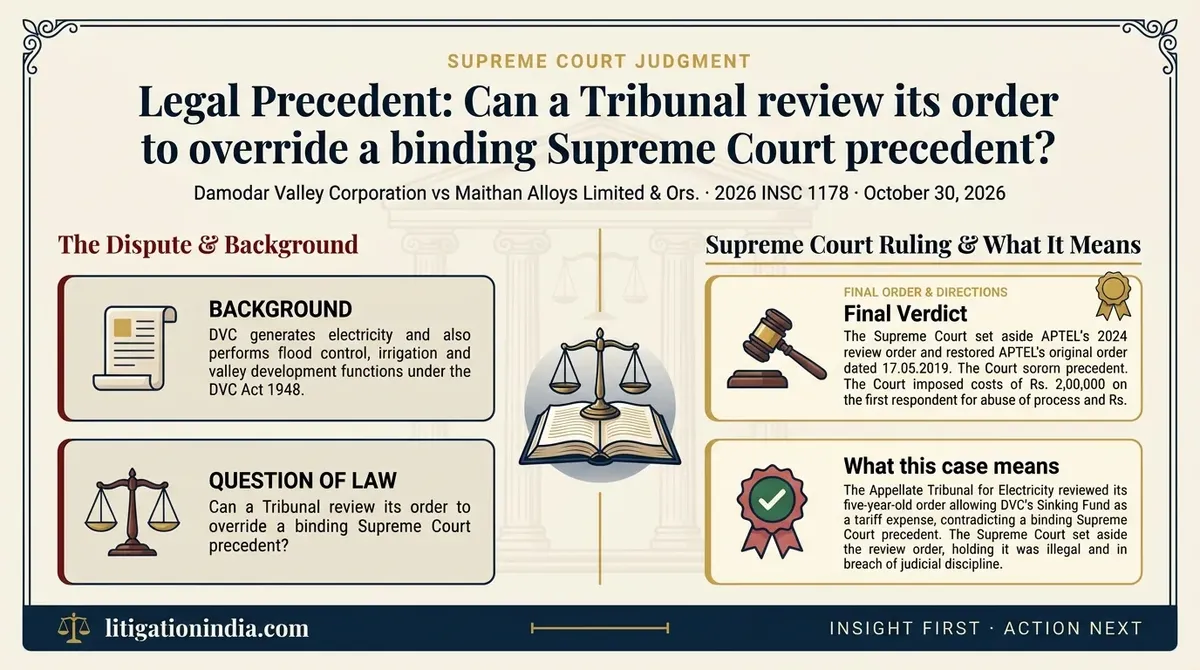
Supreme Court sets aside Electricity Tribunal's illegal review of binding tariff precedent — infographic summary

What this case means

The Appellate Tribunal for Electricity reviewed its five-year-old order allowing DVC's Sinking Fund as a tariff expense, contradicting a binding Supreme Court precedent. The Supreme Court set aside the review order, holding it was illegal and in breach of judicial discipline. The case reinforces that tribunals cannot use review jurisdiction to overrule binding Supreme Court decisions.

What the Supreme Court held

The Supreme Court set aside APTEL's 2024 review order and restored APTEL's original order dated 17.05.2019. The Court imposed costs of Rs. 2,00,000 on the first respondent for abuse of process and Rs. 1,50,000 on Steel Authority of India Limited for supporting the illegal review order, both payable to DVC within one month, failing which interest at 18% per annum applies.

Case: Damodar Valley Corporation vs Maithan Alloys Limited & Ors. (2026) Citation: 2026 INSC 1178

Want the full legal reasoning, citations and case documents?

Read the full judgment analysis
Damodar Valley Corporation
Sinking Fund
tariff determination
Electricity Act 2003
DVC Act 1948
review jurisdiction
Article 141
double allowance
CERC
Appellate Tribunal for Electricity
Bhaskar Shrachi Alloys
depreciation
Section 14 (fourth proviso), Sections 61, 62, 64, 79, 122(f), 173, 174, Electricity Act, 2003
Sections 32, 37, 38, 39, 40, 58, Damodar Valley Corporation Act, 1948