
Full text of the judgment
Text extracted from Damodar Valley Corporation vs Maithan Alloys Limited & Ors.. For the authoritative version refer to the Supreme Court of India's official website.
2026 INSC 1178 Civil Appeal No.11106 of 2024 Page 1 of 27
IN THE SUPREME COURT OF INDIA CIVIL APPELLATE JURISDICTION
Civil Appeal No.11106 of 2024
Damodar Valley Corporation
…. Appellant Versus Maithan Alloys Limited & Ors.
…. Respondents
J U D G M E N T
K. VINOD CHANDRAN, J.
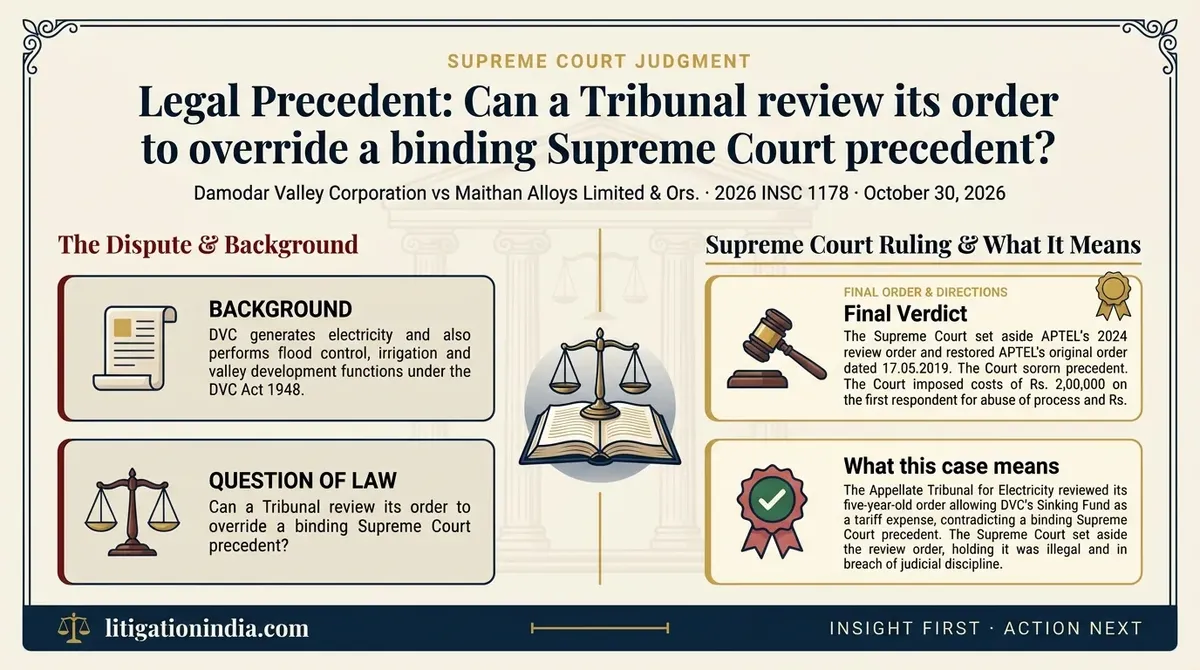
It is not often, but we do come across orders akin to the one impugned, which is in blatant breach of judicial discipline and in clear violation of Article 141 of the Constitution of India. It raises serious doubts in our minds about independence vis-à-vis accountability. We cannot but recall the sagacious words of Justice Benjamin Cordozo that a judge “… (He) is not a knighterrant roaming at will in pursuit of his own ideal of beauty or of goodness. He is to draw his inspiration from consecrated principles” (sic-The Nature of the Judicial Process)”. However, here we have a Tribunal ‘innovating at pleasure’ (sic-supra). The impugned order Digitally signed by VISHAL ANAND Date: 2026.10.30 14:57:33 IST Reason: Signature Not Verified
Civil Appeal No.11106 of 2024 Page 2 of 27
was passed in a petition seeking review of an order of the year 2019, which was allowed in 2024, after more than five years. That too, against established orders of tariff fixation under the Electricity Act, 2003, also on the strength of a decision of this Court in Bhaskar Shrachi Alloys Limited & Ors. v. Damodar Valley Corporation & Ors.1, a binding precedent under Article 141 of the Constitution of India. 2. The respondent herein was also a party in the earlier proceedings, which determined the tariff between 01.04.2006 to 31.06.2009, by allowing a two-year transition period to the Damodar Valley Corporation (DVC), the appellant herein, from 01.04.2004 to 31.03.2006. In the instant case, we are concerned with the period 2009 to 2014, for which the Central Electricity Regulatory Commission (CERC) fixed the tariff of DVC based on the statutory provisions of the Electricity Act, 2003 (the Act of 2003), the Damodar Valley Corporation Act, 1948 (the DVC Act) and the Central Electricity Regulatory Commission (Terms and Conditions of Tariff) Regulations, 2009 (the Tariff Regulations of 2009). The very same issue of whether the ‘Sinking Fund’ which
1 (2018) 8 SCC 281
Civil Appeal No.11106 of 2024 Page 3 of 27
refers to a portion of the profits appropriated for the purpose of redeeming the bonds issued by the DVC, was entitled to be factored in the tariff of the power generated and supplied by the DVC was considered and upheld in the cited decision of this Court, which considered the issue on the basis of the enactments above referred and the Tariff Regulations of 2004. 3. The CERC, for the subsequent period, passed an order in the year 2013, which is produced as Annexure A7 when the matter was pending before this Court. When the orders were passed by the Appellate Tribunal for Electricity at New Delhi, in the appeal filed by the consumers, the above cited decision had been delivered. The Tribunal by Annexure A12 judgment upheld the order of the CERC on its own reasoning and based on the binding precedent of the cited decision of this Court. None challenged the appellate order, and a review was filed by one of the appellants, which was pending before the Tribunal for 5 years, disposed of by the impugned order. The DVC has filed the above appeal in which a Public Sector Undertaking, Steel Authority of India Limited has intervened to add fuel to the fire. 4. We heard Sri Vikas Singh and Dr. Abhishek Manu Singhvi, learned Senior Counsel appearing for the appellant, Sri Rajiv
Civil Appeal No.11106 of 2024 Page 4 of 27
Shakdher, learned Senior Counsel appearing for the Steel Authority of India Limited and Sri Rajiv Yadav, learned AoR appearing for the first respondent, who was the review petitioner before the Tribunal. 5. The appellants first took umbrage at the review of an order passed five years back that too after noticing the binding precedent, but finding an error apparent on the record, in the order in review, which was based also on the decision of this Court. It was also pointed out that apart from accounting principles ‘Sinking Fund’ is an expense permissible for tariff determination as enabled by the statutory provisions. We were taken through the specific provisions of the Act of 2003, the DV Act as also the Tariff Regulations of 2009. In addition to power generation, the DVC is statutorily enjoined to ensure flood control, irrigation and development of the area. 6. On the other hand, the respondents would assert that there is clearly a double benefit conferred by permitting depreciation of the assets and then permitting the Sinking Fund to be factored in the tariff as an expense, which puts an undue burden on the consumer and enables an illegal enrichment to the DVC. The provisions of the Companies Act are pointed out to urge the
Civil Appeal No.11106 of 2024 Page 5 of 27
contention that depreciation is in the nature of a charge on the profits of the company, categorized as expenses, reckoning the wear and tear of the capital assets; ensuring that within a period, the company gets back the same so as to refurbish the worn out assets. The Bonds issued by the DVC is also for the purpose of building infrastructure, which are capital assets and a reserve fund created for the purpose of redemption of such bonds can only be appropriated from profits, which cannot be factored as expenses for the purposes of tariff determination, especially when the capital assets procured on the strength of the amounts derived from the bonds is also granted depreciation. 7. We see that the impugned order has proceeded on the premise that at the earlier stage the Appellate Tribunal had not considered the issue of a double benefit having been conferred by allowing depreciation, while also factoring the Sinking Fund for the purpose of tariff determination. The impugned order, hence, ruled that the DVC can claim only one of the two elements; either the contribution to the Sinking Fund to be factored in the tariff determination or depreciation of capital assets created by utilizing the bond amount, as passthrough in tariff. The Tribunal, in the impugned order, has also noticed the judgment of this Court
Civil Appeal No.11106 of 2024 Page 6 of 27
and has found the specific issue having escaped the notice of this Court also; which in any event, we would think had to be agitated before this Court in a properly constituted appeal, if at all. 8. However, the contention being that, the earlier decision had not considered the issue of double benefit we looked at the cited decision only for our satisfaction, since, if the Coordinate Bench had actually committed an error, we could refer it to a Larger Bench. This Court in Bhaskar Shrachi Alloys Limited1 was concerned with two sets of appeals. One, from the initial common order of the CERC in the appeals filed by the DVC; insofar as exclusion of the provisions of the DVC Act while determining the tariff and refusal to grant the claims of certain expenses thereunder, the appeals of the consumers; one of whom was the first respondent herein, insofar as the transitory period of two years granted to the DVC for bringing in the rigor of the Electricity Act and the appeals filed by the State of Jharkhand and West Bengal Electricity Regulatory Commission against excluding the State Regulatory Commission to determine the Intra-State Transmission of electricity, which common order was challenged before this Court as against the five counts, finalised by the CERC. The second; from the order after remand made by
Civil Appeal No.11106 of 2024 Page 7 of 27
the very same common order, which directed de novo consideration of five other aspects which order on remand was passed when the appeal from the common order was pending here. 9. We are only concerned with the ‘Sinking Fund’, which even at that point was allowed by the CERC and affirmed by the Appellate Tribunal. On going through the judgment, we find that this Court had laid emphasis, as had the CERC on the fourth proviso to Section 14 of the Act of 2003, which preserved the continued application of the provisions of the DVC Act, which were not inconsistent with the provisions of the Electricity Act. It was held that the positive provision enabling the continued application of the DVC Act, had overriding effect over the inconsistent provisions of the Tariff Regulations of 2004, therein. One of the contentions urged by the consumers was that the Tariff Regulations of 2004 being statutory, as empowered under the Electricity Act, should override the provisions of the DVC Act, which was not accepted. Immediately, we should notice that the aspect of depreciation and the eligibility of the Sinking Fund to be factored in the expenses have been clearly specified as a special
Civil Appeal No.11106 of 2024 Page 8 of 27
provision under the Regulations of 2009; while the Tarriff Regulations of 2004 makes no special reference to DVC. 10. In Bhaskar Shrachi Alloys Limited1, this Court laid emphasis on the 4th proviso to Section 14 of the Electricity Act, which we agree with fully. In this context, we have to extract Section 173 and 174 of the Electricity Act, 2003, which are as under :- “173. Inconsistency in laws. – Nothing contained in this Act or any rule or regulation made thereunder or any instrument having effect by virtue of this Act, rule or regulation shall have effect in so far as it is inconsistent with any other provisions of the Consumer Protection Act, 1986 (68 of 1986) or the Atomic Energy Act, 1962 (33 of 1962) or the Railways Act, 1989 (24 of 1989). 174. Act to have overriding effect. – Save as otherwise provided in section 173, the provisions of this Act shall have effect notwithstanding anything inconsistent therewith contained in any other law for the time being in force or in any instrument having effect by virtue of any law other than this Act.”
11. We have to also extract Section 58 of the DVC Act, which is as under: “58. Effect of other laws. – The provisions of this Act or any rule made thereunder shall have effect notwithstanding anything contained in any enactment other than this Act or any instrument having effect by virtue of any enactment other than this Act.”
12. Section 173 of the Electricity Act of 2003 gives overriding effect to the provisions of the Consumer Protection Act, 1986,
Civil Appeal No.11106 of 2024 Page 9 of 27
Atomic Energy, 1962 or the Railways Act 1989 as against the provisions of the Electricity Act, 2003 and any rule or regulation made thereunder or any instrument by virtue of the Act of 2003. It was argued by the consumers that the DVC Act not having been included therein, despite recommendations of the Parliamentary Standing Committee for such inclusion, Section 174 gives overriding effect to the Tariff Regulations of 2004 framed under the Act of 2003. Section 174 clearly provides that the provisions of the Electricity Act of 2003 will have effect notwithstanding anything inconsistent in any other law for the time being in force; which we would think would normally include the DV Act of 1948, which was enacted long before the Act of 2003 came into force. Despite Section 58 of the DV Act, in which the absence of the words ‘any other law for the time being in force’ is striking and patently obvious, Section 174 would nullify the provisions in the DVC Act which are inconsistent with the Act of 2003, but it would not repeal the DVC Act and those provisions which are not inconsistent with the Act of 2003 remains in force. 13. However, the legislature, presumably as abundant caution, brought in the 4th proviso, which though is a proviso to the provision providing for licences emphasises that the provisions of
Civil Appeal No.11106 of 2024 Page 10 of 27
the DV Act prevail, which are not inconsistent with the provisions of the Electricity Act. We extract hereunder the fourth proviso to Section 14: ‘Provided also that the Damodar Valley Corporation, established under sub-section (1) of section 3 of the Damodar Valley Corporation Act, 1948 (14 of 1948), shall be deemed to be a licensee under this Act but shall not be required to obtain a licence under this Act and the provisions of the Damodar Valley Corporation Act, 1948, in so far as they are not inconsistent with the provisions of this Act, shall continue to apply to that Corporation:’
It is to ensure that the DVC Act prevails, that the proviso was brought under the provision with the nominal heading ‘Grant of Licence’; which proviso by the first limb, exempted DVC from obtaining a licence under the Act of 2003 and deemed it to be a licensee under the Act and in the second limb, declared the continued application of the DVC Act, to that Corporation to the extent they are not inconsistent with the Act of 2003; which Section 174 also does not detract from. 14. There was also a contention raised in the earlier round that the proviso giving effect to the provisions of the DVC Act, which are not inconsistent with the Electricity Act, having been introduced under Section 14, specifically referring to grant of
Civil Appeal No.11106 of 2024 Page 11 of 27
licences, is restrained or confined in this effect to licenses. We cannot accept the said argument since the grant of licence is the first step in transmitting, distributing and undertaking trading in electricity as distinguished from generation of electricity in Part III. The proviso, hence, while deeming the DVC to be a deemed licensee under the Electricity Act, not requiring to obtain a licence under the Act by the very same proviso, set at naught the provisions in the DV Act, which were inconsistent with the Act of 2003 and enabled the other provisions to continue in its application to the DVC. Thus, making the Electricity Act applicable to the DVC on all other aspects including tariff determination, despite DVC not being required to specifically obtain a licence. The licence is the sine qua non for engaging in transmitting, distributing or trading in electricity, which alone can enable inter alia a generator who carries on any of these functions to approach the appropriate Electricity Regulatory Commission for tariff determination. It is hence that Sections 61, 62 & 64 and Section 79 have overriding effect and the DVC could not have determined its own tariff under Section 20 of the DVC Act. However, our reasoning does not enable a different conclusion from the earlier judgment on the provisions of the DVC Act having
Civil Appeal No.11106 of 2024 Page 12 of 27
effect even after the Electricity Act came into force, to the extent they are not inconsistent with the provisions of the Electricity Act and hence, we find absolutely no reason to doubt the earlier decision. 15. Our finding insofar as the effect of fourth proviso to Section 14, is in tandem with the decision of this Court in Bhaskar Shrachi Alloys Limited1. We also concur with Bhaskar Shrachi Alloys Limited1, insofar as finding the proviso to Section 14, in its second limb, to be a substantive provision, especially considering the background of the constitution of the DVC. This Court had already noticed that the DVC was constituted, on the lines of Tennessee Valley Authority in the USA, so as to control the floods of the Damodar River and by channelising the potential of the river, to develop the lands in the Valley. The Tennessee Valley Authority Act had been enacted to improve the navigability and to provide for flood control of the Tennessee River, for reforestation and proper use of marginal lands in the Tennessee Valley, to enable agricultural and industrial development of the valley and to provide for the national defence by creation of a corporation for the operation of the government properties near the Muscle Shoals in the State of Alabama and for other purposes. The objects
Civil Appeal No.11106 of 2024 Page 13 of 27
and reasons of the DVC Act specifically refer to the Tennessee Valley Authority and constitute the Corporation as an autonomous body to carry out the functions of flood control in the Damodar River, generate electric power, provide water for irrigation and other purposes. In addition, the Corporation was also constituted to endeavour promotion of economic development of the Damodar Valley and the adjoining areas, as was argued before us by the appellants. So was it argued at the earlier point that the major areas of activity undertaken by the Corporation were power generation, transmission and distribution, flood control, irrigation and some connected activities like soil conservation, afforestation etc. 16. Presently, it was argued that the other purposes also take in the establishment of a township and ancillary activities connected with the development of Damodar Valley. The Corporation is statutorily mandated to perform the social welfare activities, which are over and above the electricity generation and transmission, which has led to the DVC being given a special status, even insofar as the tariff determination, since electricity generation is the income earning operation of the Corporation, whose profits are to be used for other activities too, required in
Civil Appeal No.11106 of 2024 Page 14 of 27
addition to the grants made by the State Governments, the resultant profits from which are to be apportioned to the State Governments, in proportion to their contribution. 17. We have to specifically notice the relevant provisions of the DVC Act, which provides for the expenditure, apportionment of profits, payment of interest, reduction of capital cost and provision for depreciation and for reserve and other funds, We extract the same as hereunder: 32. Expenditure on objects other than irrigation, power and flood control: - The Corporation shall have power to spend such sums as it thinks fit on objects authorized under this Act other than irrigation, power and flood control and such sums shall be treated as common expenditure payable out of the fund of the Corporation before allocation under section 32.
37. Disposal of profits and deficits: - (1) Subject to the provisions of sub-section (2) of section 40, the net profit, if any, attributable to each of the three main objects, namely, irrigation, power and flood control, shall be credited to the participating Governments in proportion to their respective shares in the total capital cost attributed to that object. (2) The net deficit, if any, in respect of any of the objects shall be made good by the Governments concerned in the proportion specified in sub-section (1):
Civil Appeal No.11106 of 2024 Page 15 of 27
Provided that the net deficit in respect of flood control shall be made good entirely by the Government of West Bengal and the Central Government shall have no share in such deficit.
38. Payment of interest: - The Corporation shall pay interest on the amount of capital provided by each participating Government at such rate as may, from time to time, be fixed by the Central Government and such interest shall be deemed to be part of the expenditure of the Corporation.
39. Interest charge and other expenses to be added to and receipts taken for reduction of capital cost: - For a period, not exceeding fifteen years, from the establishment of the Corporation, if the Corporation runs in deficit, the interest charges and all other expenditure shall be added to the capital cost and all receipts shall be taken in reduction of such capital cost. 40. Provisions for depreciation and reserve and other funds: - (1) The Corporation shall make provision for depreciation and for reserve and other funds at such rates and on such terms as may be specified by the Auditor-General of India in consultation with the Central Government. (2) The net profit for the purposes of section 37 shall be determined after such provision has been made.
18. Sub-section (2) of Section 40 requires the net profit, for the purpose of Section 37, to be determined after provision has been made under sub-section (1), which includes depreciation,
Civil Appeal No.11106 of 2024 Page 16 of 27
reserve and other funds as specified by the Auditor-General of India. Section 37 is subject to the provisions of sub-section (2) of Section 40, which requires the net profit, if any attributable to each of the main objects namely, irrigation, power and flood control; to be credited to the participating Governments in proportion to their respective shares in the total capital cost attributed to that object. The net deficit is made good by the Governments in the proportion specified in sub-section (1), except insofar as the flood control is concerned, where the deficit has to be made good entirely by the Government of West Bengal. The statutory provision is a clear departure from the general accounting principles. Insofar as depreciation is concerned as per normal accounting principles, it is a charge on the profits, which permits the depreciation to be deducted, before the net profit is arrived at, as expenses. Whereas, a reserve fund, herein for redemption of bonds, as pointed out by the respondents, would be a capital expenditure, which cannot be deducted to arrive at the net profit and the amounts kept apart for reserve, normally has to be appropriated from the net profit; in accounting parlance. Insofar as the capital assets brought in, expending the money raised on such bonds, the DVC Act, as per Section 42, enables the net profit
Civil Appeal No.11106 of 2024 Page 17 of 27
to be determined after making provision for not only depreciation, but also after deducting reserve funds and any other fund at such rate and on such terms as specified by the Auditor General of India in consultation with the Central Government. 19. Section 40 is not inconsistent with the Electricity Act, since Section 61, which speaks of tariff regulations, empowers the appropriate commission to specify the terms and conditions for determination of tariff by taking into account, inter alia, the factors, which would encourage efficiency, economical use of resources, good performance and optimum investments (clause c); safeguarding of consumers’ interests, and at the same time, recovery of the cost of electricity in a reasonable manner (clause d); the tariff progressively reflecting the cost of supply of electricity and reduces cross-subsidies in the manner specified by the Appropriate Commission (clause g). 20. The Electricity Regulatory Commission has specified Regulation 43 by Regulations of 2009, which is extracted hereunder: ‘43. Special Provisions relating to Damodar Valley Corporation.
Civil Appeal No.11106 of 2024 Page 18 of 27
(1) Subject to clause (2), these regulations shall apply to determination of tariff of the projects owned by Damodar Valley Corporation (DVC).
(2) The following special provisions shall apply for determination of tariff of the projects owned by DVC:
(i) Capital Cost: The expenditure allocated to the object 'power', in terms of sections 32 and 33 of the Damodar Valley Corporation Act, 1948, to the extent of its apportionment to generation and inter-state transmission, shall form the basis of capital cost for the purpose of determination of tariff:
Provided that the capital expenditure incurred on head office, regional offices, administrative and technical centers of DVC, after due prudence check, shall also form part of the capital cost.
(ii) Debt Equity Ratio: The debt equity ratio of all projects of DVC commissioned prior to 01.01.1992 shall be 50:50 and that of the projects commissioned thereafter shall be 70:30.
(iii) Depreciation: The depreciation rate stipulated by the Comptroller and Auditor General of India in terms of section 40 of the Damodar Valley Corporation Act, 1948 shall be applied for computation of depreciation of projects of DVC.
(iv) Funds under section 40 of the Damodar Valley Corporation Act, 1948: The Fund(s) established in terms of section 40 of the Damodar Valley Corporation Act, 1948 shall be considered as items of expenditure to be recovered through tariff.
21. The regulation specifically enables depreciation, at the rate stipulated by the Comptroller and Auditor General of India, in
Civil Appeal No.11106 of 2024 Page 19 of 27
terms of Section 40 of the DVC Act and permits the funds established in terms of Section 40 of the DVC Act to be considered as items of expenditure to be recovered through tariff. Annexure A1 produced along with the appeal, allows appropriation of the Corporation power surplus insofar as an allotment of Sinking Fund as a first charge, which is before any allocation for the Investment Allowance Reserve, categorized as General Reserve. Hence, in a departure from the accounting principles of allowing depreciation as a first charge on the gross profits and appropriation from the net profits towards general reserves; the ‘Sinking Fund’, which is also in the nature of a reserve fund, constituted only to redeem the bonds, is allowed to be treated as a first charge, thus, making it an expense deductible from the gross profits before arriving at the net profit and consequently enabled to be factored in the tariff as an expenditure for the purposes of generation, transmission and supply of power. 22. Now, we come to the disturbing issue of the review and we extract paragraph 57 from Bhaskar Shrachi Alloys Limited1 as under: ‘57. Insofar as the questions under the last two issues at (g) and (h) above are concerned, the same have already been dealt with in the present order. Of the
Civil Appeal No.11106 of 2024 Page 20 of 27
remaining heads of tariff fixation, it appears that so far as the “depreciation rate” and “sinking fund” is concerned it is the provisions of Section 40 of the 1948 Act which have been held to be determinative. We have gone through the reasoning adopted by the learned Appellate Tribunal in this regard. Having clarified the manner in which the fourth proviso to Section 14 of the 2003 Act has to be understood, we do not find the reasoning adopted by the learned Appellate Tribunal on the issues relating to “depreciation” and “sinking fund” to be fundamentally flawed in any manner so as to give rise to a substantial question of law requiring our intervention/interference under Section 125 of the 2003 Act.’
23. In the review filed by the 1st respondent, paragraph 7 categorically states that they did not impugn the allowance of contribution to Sinking Fund as a pass through in tariff since the issue is no more res integra after the decision in Bhaskar Shrachi Alloys Limited1. They also put forth the contention that they were only aggrieved by the double allowance of the principal component of Sinking Fund contribution by not reducing a corresponding amount from the capital cost for the purpose of allowance of depreciation amount, which is accounted for towards loan repayments as per the Tariff Regulations of 2009. In the written submissions, however the emphasis is on Sinking Fund not being a cost but only appropriation of the net profit; which we have answered. The SAIL also in their written submissions
Civil Appeal No.11106 of 2024 Page 21 of 27
emphasized the said aspect. The above extract clearly indicates that the Appellate Tribunal’s findings on the issue relating to depreciation and Sinking Fund, are perfectly in order and there was no scope for a review from the order which relied on Bhaskar Shrachi Alloys Limited1. 24. There is no room for any doubt that the allowance of depreciation, as juxtaposed with the Sinking Fund also being factored as an item of expenditure, to be recovered through tariff as enabled by Section 40, was specifically considered and upheld. We also notice from the original decision of the Tribunal which is reviewed, that it had dealt specifically with the contention of double allowance; allowance one, being on interest on normative loan of at least 70% or more of actual capital cost, depreciation for payment of principal and allowance, two; being contribution to Sinking Fund created for redemption of bonds, which factors both the interest on relevant bonds and the principal amount realized through the bonds issued. It was held that Section 40 of the DVC Act, referred to in Regulation 43, is consistent with the Electricity Act insofar as the capital cost incurred by utilizing the amount received from bonds, is recovered from Sinking Fund contribution, without any allowance
Civil Appeal No.11106 of 2024 Page 22 of 27
thereof as part of interest on loan and depreciation allowed. The assets acquired by virtue of the amounts generated by the Bonds, to redeem which a Sinking Fund is constituted, enables benefit of depreciation on the assets so acquired and the amounts appropriated from profits for the Sinking Fund being factored as expenses to be included in the tariff. 25. The impugned judgment of the Tribunal in the Review Petition refers to a number of decisions on the contours of review and finds that allowing depreciation on capital assets created by utilizing bond amounts clearly makes out a case of duplication or double allowance, which cannot be permitted and the Tribunal at the first instance having fallen into a patent error in not recognizing the same. The Tribunal, in review, sought to draw a distinction between capital assets created with the use of bond funds and those from other sources; depreciation being permissible only insofar the latter one and not with respect to the former. The impugned decision also refers to Bhaskar Shrachi Alloys Limited1 and expressed, according to us, vehemently, but erroneously that the concept of duplication or double allowance was not brought before the Tribunal and before this Court, and
Civil Appeal No.11106 of 2024 Page 23 of 27
therefore, the same is alive for consideration in review; definitely overstepping the contours of review. 26. As we noticed from the above extract, though, the words ‘duplication’ or ‘double allowance’ has not been used, this Court had found the provision for Sinking Fund to be permissible to be considered as an item of expenditure, and hence, possible of recovery through tariff, while accepting the allowance on depreciation; both under the statutory imprimatur of Section 40 of the DVC Act. 27. We cannot but observe that the Tribunal has gone haywire; we are apologetic for the expression but we find no substitute to express our angst in allowing the review, that too, when the very same issue, for the earlier years, was settled by this Court in Bhaskar Shrachi Alloys Limited1, based on which, the original order was passed by the Tribunal. In this context, we only notice the decision of this Court in State of West Bengal and Others v. Kamal Sengupta and Another2, which specifically considered the power of review conferred under the Administrative Tribunals Act, 1985, by Section 22(3)(f), which is in pari materia with Section
2 (2008) 8 SCC 612
Civil Appeal No.11106 of 2024 Page 24 of 27
122(f) of the Electricity Act. We specifically extract paragraph 22 from the said decision as under: ‘22. The term “mistake or error apparent” by its very connotation signifies an error which is evident per se from the record of the case and does not require detailed examination, scrutiny and elucidation either of the facts or the legal position. If an error is not selfevident and detection thereof requires long debate and process of reasoning, it cannot be treated as an error apparent on the face of the record for the purpose of Order 47 Rule 1 CPC or Section 22(3)(f) of the Act. To put it differently an order or decision or judgment cannot be corrected merely because it is erroneous in law or on the ground that a different view could have been taken by the court/tribunal on a point of fact or law. In any case, while exercising the power of review, the court/tribunal concerned cannot sit in appeal over its judgment/decision.’
(underlining supplied by us for emphasis)
28. Noticing numerous decisions of this Court on the contours of review, the principles culled out, are available in paragraph 35, which is also extracted hereunder: ‘35. The principles which can be culled out from the above noted judgments are:
(i) The power of the Tribunal to review its order/decision under Section 22(3)(f) of the Act is akin/analogous to the power of a civil court under Section 114 read with Order 47 Rule 1 CPC.
(ii) The Tribunal can review its decision on either of the grounds enumerated in Order 47 Rule 1 and not otherwise.
Civil Appeal No.11106 of 2024 Page 25 of 27
(iii) The expression “any other sufficient reason” appearing in Order 47 Rule 1 has to be interpreted in the light of other specified grounds.
(iv) An error which is not self-evident and which can be discovered by a long process of reasoning, cannot be treated as an error apparent on the face of record justifying exercise of power under Section 22(3)(f).
(v) An erroneous order/decision cannot be corrected in the guise of exercise of power of review.
(vi) A decision/order cannot be reviewed under Section 22(3)(f) on the basis of subsequent decision/judgment of a coordinate or larger Bench of the tribunal or of a superior court.
(vii) While considering an application for review, the tribunal must confine its adjudication with reference to material which was available at the time of initial decision. The happening of some subsequent event or development cannot be taken note of for declaring the initial order/decision as vitiated by an error apparent.
(viii) Mere discovery of new or important matter or evidence is not sufficient ground for review. The party seeking review has also to show that such matter or evidence was not within its knowledge and even after the exercise of due diligence, the same could not be produced before the court/tribunal earlier.’
The impugned decision of the Tribunal in the present case does not fall under any of the principles as culled out hereinabove. 29. We find the review to be clearly illegal, totally misplaced and blatantly in breach of the principles of judicial discipline. We also have to emphasize the travesty insofar as violation of Article 141
Civil Appeal No.11106 of 2024 Page 26 of 27
of the Constitution of India. Our judicial system with the hierarchy of Courts thrives on the sanctity of the decisions of the appellate, revisional and supervisory jurisdictions to be given due weightage. As far as Article 141 is concerned it’s a Constitutional imprimatur which ensures the decisions of the highest court of the land to be followed, without which there will be mayhem. We are conscious of the criticism that the Supreme Court’s decisions are supreme not because it is infallible but only because it is the final Court. However, finality and closure is the expedient need in litigation. 30. We set aside the impugned decision and restore the order of the Appellate Tribunal at the first instance dated 17.05.2019. We also observe with some consternation that there were no appeals filed from the earlier order to this Court and one of the appellants before the Appellate Tribunal had filed for a review and waited for five years to get it heard. We find the said action to be clearly an abuse of process of law and impose a cost of Rs.2,00,000/- (Rupees Two Lakh) on the 1st respondent. We cannot also ignore that a Public Sector Undertaking, who claims to be a Maharatna Company, has willingly participated in the attempt to canvas for upholding an order passed clearly in breach of judicial discipline
Civil Appeal No.11106 of 2024 Page 27 of 27
and violating Article 141 of the Constitution of India and sought intervention in the matter. The Public Sector Undertaking has been ill-advised, and in that circumstance, we impose a cost of Rs.1,50,000/- (Rupees One Lakh and Fifty Thousand) on the Steel Authority of India Limited. The cost shall be paid to the Damodar Valley Corporation within a period of one month from today, failing which, interest @18% per annum shall be applied. 31. The appeal is allowed with costs, in addition to the exemplary costs awarded hereinabove. 32. Pending application(s), if any, shall stand rejected.
.……………………………... J. (J. B. PARDIWALA)
..………….…………………. J. (K. VINOD CHANDRAN)
NEW DELHI; OCTOBER 30, 2026.