
All insights

Can an employer dismiss an employee without fresh notice after a defective enquiry is re-tried?

Supreme Court Sets Aside Disproportionate Dismissal of MSEDCL Employee After Defective Enquiry

A clerk employed with MSEDCL was dismissed after a disciplinary enquiry that was later found defective, and misconduct was re-proved before the Labour Court. The Supreme Court held that the dismissal

Litigation India Editorial 24 October 2026 1 min read 2026 INSC 639

Story

Case at a glance1 / 6

Supreme Court of India

Dismissal Set Aside: Fair Process and Proportionality in Disciplinary Action

Surekha Domaji Bele vs Executive Engineer, MSEDCL | 2026 INSC 639

Court: Supreme Court of India | Date: 11 June 2026Bench: Justice Sanjay Karol and Justice Nongmeikapam Kotiswar SinghArea of law: Service law, disciplinary proceedings, labour lawMSEDCL clerk dismissed after 21 years of service; suspension lasted nearly 11 years
Dismissal order set aside as wholly disproportionate; finding of misconduct undisturbed.
Supreme Court Sets Aside Disproportionate Dismissal of MSEDCL Employee After Defective Enquiry · 2026 INSC 6392026-10-24T18:35:08.276232+00:00
The legal question2 / 6

Can an Employer Dismiss Without Fresh Notice After a Defective Enquiry Is Re-tried?

Core legal question before the Supreme Court

  • Appellant: Original show-cause notice was based on defective domestic enquiry; fresh notice mandatory under Regulation 88(j) after Labour Court's de novo findings.
  • Appellant: Subsistence allowance cannot be denied for 11 years merely for not reporting at Warora when transfer there was already set aside.
  • Appellant: Treating suspension as punishment in addition to dismissal is an impermissible double penalty for the same misconduct.
  • Respondent: Misconduct proved before Labour Court attained finality; original show-cause notice was held legal and proper; reporting condition justified denial of subsistence allowance.
Supreme Court Sets Aside Disproportionate Dismissal of MSEDCL Employee After Defective Enquiry · 2026 INSC 6392026-10-24T18:35:08.276232+00:00
Statutory comparison3 / 6

Key Provisions: How the Court Applied Them

MSEDCL Employees Service Regulations 2005

ProvisionWhat it saysHow the Court applied it
Regulation 88(j)After enquiry, authority must issue notice of findings and call for show cause on proposed punishment.Fresh notice mandatory after Labour Court's de novo findings; original notice founded on defective enquiry was insufficient.
Regulation 88(a)(ii)Suspension beyond six months must be reviewed by next higher authority.No review shown on record; Appellant held entitled to subsistence allowance for the post-six-month period till dismissal.
Regulation 88(a)(iii)Subsistence allowance payable during suspension subject to compliance with reporting condition.Reporting condition cannot indefinitely deny subsistence allowance without review of suspension under Regulation 88(a)(ii).
Regulation 88(a)(v)When suspension treated as punishment, arrears of pay denied but subsistence already paid or payable protected.Treating suspension as additional punishment alongside dismissal impermissible; subsistence allowance payable cannot be forfeited.
Regulation 91(2)Lists punishments for misconduct including suspension (d), removal (f) and dismissal (g) as separate penalties.Authority cannot impose both dismissal and suspension as punishment for same misconduct in the same proceedings.
Supreme Court Sets Aside Disproportionate Dismissal of MSEDCL Employee After Defective Enquiry · 2026 INSC 6392026-10-24T18:35:08.276232+00:00
The Court's reasoning4 / 6

Court's Reasoning: From Defective Enquiry to Setting Aside Dismissal

Five-step reasoning path

  1. 1Step 1: Domestic enquiry found defective; management allowed to re-prove misconduct before Labour Court — misconduct finding is final and undisturbed.
  2. 2Step 2: Regulation 88(j) requires a notice on proposed punishment based on findings that ultimately survive — the original notice based on the defective enquiry was inadequate for imposing dismissal.
  3. 3Step 3: Eleven-year suspension without review under Regulation 88(a)(ii) means reporting condition alone cannot deny subsistence allowance for the post-six-month period.
  4. 4Step 4: Treating suspension as punishment in addition to dismissal imposes two separate penalties for the same misconduct — impermissible under Regulation 91 and S.C. Parashar (2006).
  5. 5Step 5: No corruption, moral turpitude or financial loss — dismissal disproportionate; remitted for fresh punishment order other than dismissal.
Supreme Court Sets Aside Disproportionate Dismissal of MSEDCL Employee After Defective Enquiry · 2026 INSC 6392026-10-24T18:35:08.276232+00:00
The verdict5 / 6

The Verdict

What the Supreme Court decided

  • The Fact: MSEDCL clerk suspended for 11 years, dismissed without fresh show-cause notice after de novo Labour Court proceedings proved misconduct.
  • The Law: Regulation 88(j) mandates a fresh notice on punishment based on surviving findings; suspension cannot be used as an additional penalty alongside dismissal; subsistence allowance payable after 6-month review period lapses.
  • The Result: Dismissal order set aside as wholly disproportionate; finding of misconduct undisturbed; matter remitted for fresh penalty (other than dismissal) with subsistence allowance to be paid.
Dismissal order dated 12.07.2017 set aside; competent authority to issue fresh show-cause notice within four weeks and pass reasoned order on penalty within eight weeks.
Supreme Court Sets Aside Disproportionate Dismissal of MSEDCL Employee After Defective Enquiry · 2026 INSC 6392026-10-24T18:35:08.276232+00:00
Why it matters6 / 6

Why This Judgment Matters

Practical significance for employees in disciplinary proceedings

  • When a domestic enquiry fails and misconduct is re-proved before a tribunal, the employer must issue a fresh notice on punishment — the original notice does not automatically carry forward.
  • Suspension cannot be used as a device for indefinite economic hardship; if it continues beyond six months without review, the employee is entitled to subsistence allowance regardless of a reporting condition.
  • Employers cannot impose two separate substantive penalties — such as dismissal and suspension — for the same misconduct in the same proceeding.
  • Dismissal must be reserved for the most serious misconduct involving corruption, dishonesty or financial loss; long unblemished service is a factor that must be weighed before imposing the severest penalty.
A dismissal without fresh notice on punishment, after a defective enquiry is re-tried, and without weighing long service and absence of corruption, cannot stand.
Supreme Court Sets Aside Disproportionate Dismissal of MSEDCL Employee After Defective Enquiry · 2026 INSC 6392026-10-24T18:35:08.276232+00:00
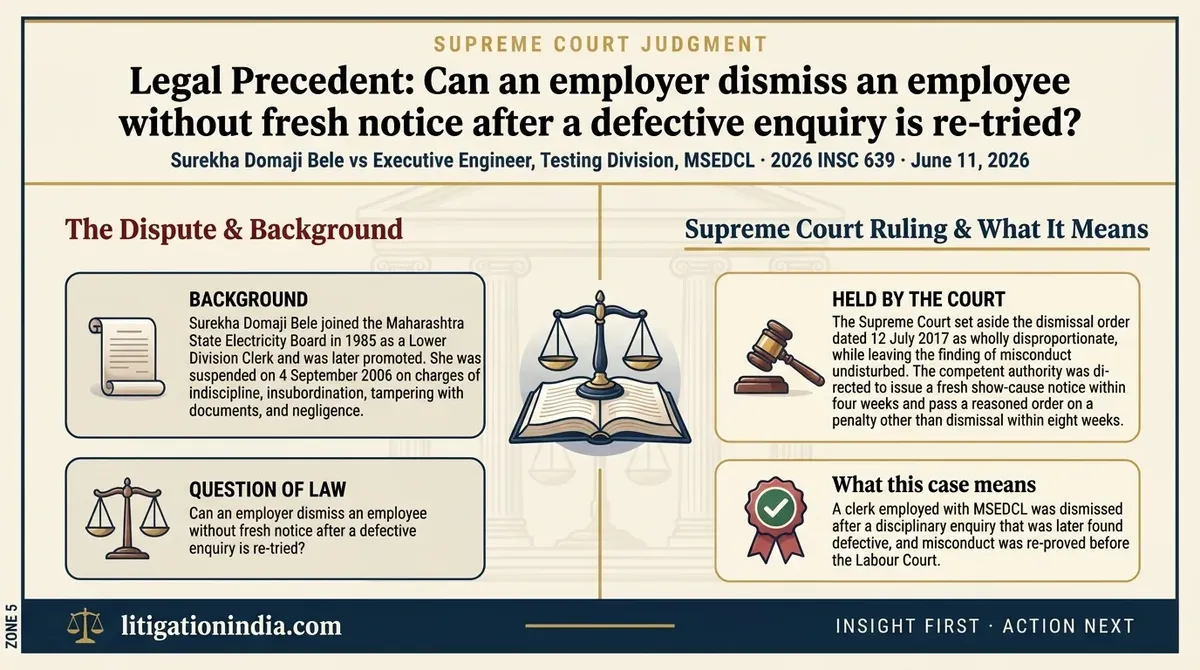
Supreme Court Sets Aside Disproportionate Dismissal of MSEDCL Employee After Defective Enquiry — infographic summary

What this case means

A clerk employed with MSEDCL was dismissed after a disciplinary enquiry that was later found defective, and misconduct was re-proved before the Labour Court. The Supreme Court held that the dismissal was disproportionate, that a fresh show-cause notice on punishment was required, and that subsistence allowance could not be denied for nearly eleven years of suspension. The case clarifies key procedural safeguards employees are entitled to in disciplinary proceedings.

What the Supreme Court held

The Supreme Court set aside the dismissal order dated 12 July 2017 as wholly disproportionate, while leaving the finding of misconduct undisturbed. The competent authority was directed to issue a fresh show-cause notice within four weeks and pass a reasoned order on a penalty other than dismissal within eight weeks. The Appellant was held entitled to subsistence allowance for the period after 3 March 2007 till 12 July 2017, and the direction treating the suspension period as an additional punishment was set aside.

Case: Surekha Domaji Bele vs Executive Engineer, Testing Division, MSEDCL (2026) Citation: 2026 INSC 639

Want the full legal reasoning, citations and case documents?

Read the full judgment analysis
Surekha Domaji Bele
MSEDCL
dismissal from service
show-cause notice
subsistence allowance
suspension as punishment
proportionality of penalty
Regulation 88
MSEDCL Employees Service Regulations 2005
de novo proceedings
Labour Court
disciplinary authority
Regulation 86, Regulation 88(a)(i), Regulation 88(a)(ii), Regulation 88(a)(iii), Regulation 88(a)(v), Regulation 88(j), Regulation 91(2), MSEDCL Employees Services Regulations, 2005
Article 311(1), Constitution of India