
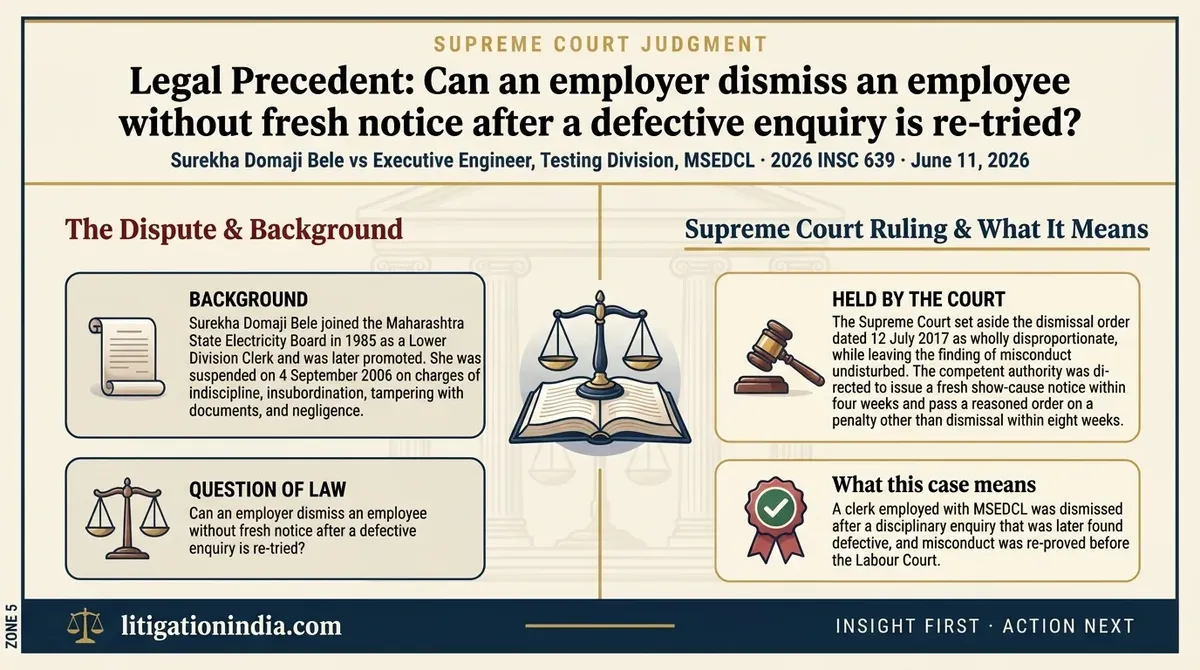
Full text of the judgment
Text extracted from Surekha Domaji Bele vs Executive Engineer, Testing Division, MSEDCL. For the authoritative version refer to the Supreme Court of India's official website.
2026 INSC 639 Page 1 of 65 REPORTABLE
IN THE SUPREME COURT OF INDIA (CIVIL APPELLATE JURISDICTION)
CIVIL APPEAL NO. OF 2026 (@ SPECIAL LEAVE PETITION(C) NO. ________ OF 2026) (@DIARY NO. 11294 OF 2025)
SUREKHA DOMAJI BELE ...APPELLANT
EXECUTIVE ENGINEER, TESTING DIVISION, MSEDCL ...RESPONDENT
J U D G M E N T NONGMEIKAPAM KOTISWAR SINGH, J. 1. IA No. 61680 of 2025 seeking exemption from payment of court fee is allowed. 2. Leave granted. 3. The present appeal arises out of the judgment and order dated 05.04.2024 passed by the High Court of Judicature at Digitally signed by MINI Date: 2026.06.11 16:58:27 IST Reason: Signature Not Verified
Page 2 of 65 Bombay, Nagpur Bench, in Writ Petition No. 1200 of 2023, whereby the writ petition preferred by the Appellant came to be dismissed. The Appellant also assails the order dated 11.11.2024 passed by the High Court in MCA No. 357 of 2024, by which the review application preferred by her was also rejected. 4. The dispute arises from the disciplinary proceedings initiated against the Appellant, who was employed with the Maharashtra State Electricity Distribution Company Limited (hereinafter referred to as “MSEDCL”). The proceedings culminated in the order dated 12.07.2017, by which the Appellant was dismissed from service and the period of suspension was directed to be treated as punishment. The order of dismissal has been upheld by the Labour Court, the Industrial Court and the High Court. Having failed before the said fora, the Appellant has approached this Court. FACTUAL BACKGROUND 5. The Appellant, Surekha Domaji Bele, was appointed as a Lower Division Clerk in the erstwhile Maharashtra State Electricity Board, O&M Circle, Chandrapur, pursuant to the
Page 3 of 65 appointment order dated 01.04.1985. She joined the service on 02.04.1985. She was thereafter promoted as an Upper Division Clerk with effect from 11.04.1988. The Appellant was in the service of the Respondent-management for more than two decades before the disciplinary proceedings that form the subject matter of the present appeal were initiated, resulting in her dismissal from service. 6. The record indicates that certain service disputes had arisen between the Appellant and the management of MSEDCL much before the disciplinary action in issue was initiated. The Appellant had been reverted to the post of Lower Division Clerk on 29.09.1995, which she challenged. She was thereafter transferred from Ballarsha to the Warora Pole Factory on 16.01.2002, which she successfully challenged, and the said transfer order was set aside on 24.06.2003. The Appellant also stated that she had initiated proceedings under the Payment of Wages Act and other proceedings in respect of her service grievances. According to the Appellant, the subsequent disciplinary action was a counterblast to the proceedings she initiated against the management. The Respondent, however, has maintained that
Page 4 of 65 the disciplinary proceedings were founded upon acts of misconduct affecting discipline and office functioning. 7. On 04.09.2006, the Appellant was placed under suspension pending enquiry. The suspension order alleged acts of indiscipline, insubordination, disobedience of superior officers, tampering with official documents and negligence. The suspension order also recorded that during the period of suspension the Appellant would be entitled to the subsistence allowance as per rules. It further directed her to mark attendance once every week, on Wednesday, at the office of the Executive Engineer, O&M Division, MSEDCL, Warora. The Appellant’s case is that the direction to report at Warora was unjustified because her earlier transfer to Warora had already been set aside. The Respondent’s case is that the reporting condition was validly imposed under the Service Regulations and that the Appellant did not comply with the same. 8. A charge-sheet dated 19.09.2006 was then issued to the Appellant. Broadly stated, the charges alleged indiscipline, insubordination or misbehaviour, disobedience of superior officers, tampering with official documents,
Page 5 of 65 negligence in the discharge of duty, and misuse of company property. The Appellant did not file a reply to the chargesheet, but instead sought copies of certain documents. According to her, although she requested those documents on 26.11.2006, they were supplied only on 18.02.2008. 9. The domestic enquiry was thereafter taken up in March 2008. The Appellant’s case is that the enquiry was scheduled on 24.03.2008, but she was required to appear as a witness in another proceeding on that date. The enquiry then was adjourned to 25.03.2008. On 25.03.2008, the Appellant appeared before the Enquiry Officer and sought further time of 8 to 10 days to participate in the enquiry. However, the request was declined. The Enquiry Officer then proceeded ex parte, examined five witnesses in the absence of the Appellant and closed the enquiry. 10. The Enquiry Officer submitted his report on 25.04.2008. Based on the said enquiry report, the Respondent issued a show-cause notice dated 25.04.2008 proposing dismissal from service. The Appellant challenged the said show-cause notice by filing Complaint (ULP) No. 34 of 2008 before the Labour Court, Chandrapur.
Page 6 of 65 11. The Labour Court, by order dated 29.11.2014, held that the enquiry was not fair and the finding was perverse. The Respondent-management then challenged the said order of the Labour Court before the Industrial Court by filing Revision (ULP) No. 4 of 2015. By order dated 14.08.2015, the Industrial Court set aside the Labour Court’s order dated 29.11.2014 and remanded the matter to the Labour Court by permitting the Respondent-management to establish the misconduct by leading evidence before the Labour Court, since the domestic enquiry had been found not to be fair. 12. After remand, proceedings in Complaint (ULP) No. 34 of 2008 resumed before the Labour Court. The Respondentmanagement led evidence before the Labour Court to prove the misconduct. The Appellant sought an opportunity to respond to the charge-sheet in view of the post-remand proceedings, but the said request was declined. Upon consideration of the evidence adduced before it, the Labour Court, by judgment dated 27.06.2017, held that the misconduct stood proved. The Labour Court also held that the show-cause notice dated 25.04.2008 was legal and proper
Page 7 of 65 and accordingly, dismissed the Complaint (ULP) No. 34 of 2008. 13. The judgment dated 27.06.2017 of the Labour Court is material for the present appeal because the misconduct was ultimately sustained in a manner different from the earlier domestic enquiry. The show-cause notice dated 25.04.2008 had been issued based on the domestic enquiry. That enquiry, however, did not remain the effective foundation for sustaining the misconduct, since it was held to be perverse and the management was thereafter permitted by the Industrial Court to prove the charges by leading evidence before the Labour Court after remand. The misconduct was ultimately held proved based on such evidence led before the Labour Court. Thus, though the finding of misconduct has attained finality, the foundation on which such finding rested was the post-remand adjudication before the Labour Court, and not the earlier domestic enquiry report. This distinction has to be kept in mind while we examine the Appellant’s grievance regarding Regulation 88(j) of the MSEDCL Employees Services Regulations, 2005 (hereinafter referred to as “Service Regulations”).
Page 8 of 65 14. After the Labour Court dismissed the Complaint (ULP) No. 34 of 2008 on 27.06.2017, the Respondent passed the order dated 12.07.2017 dismissing the Appellant from service. By the same order, the Respondent directed that the period of suspension shall be treated as punishment. The dismissal order records that the Appellant had not submitted any explanation to the show-cause notice dated 25.04.2008. The Appellant’s grievance is that the Respondent relied on that earlier show-cause notice, though the misconduct was ultimately sustained on the basis of evidence led before the Labour Court after remand. No fresh notice was issued after the findings recorded in the de novo proceedings before the Labour Court. 15. The Appellant challenged the Labour Court’s judgment dated 27.06.2017 by filing Revision (ULP) No. 37 of 2017 before the Industrial Court. The said revision was dismissed by the Industrial Court on 08.06.2018. The Appellant did not challenge that order further. 16. The Appellant subsequently challenged the dismissal order dated 12.07.2017 by filing Complaint (ULP) No. 28 of 2017 before the Labour Court. In the said complaint, she
Page 9 of 65 questioned the dismissal order on several grounds, including the competence of the disciplinary authority to pass the dismissal order, absence of proper post-enquiry show-cause notice, non-payment of subsistence allowance, illegal treatment of the suspension period as punishment, and disproportionality of the penalty of dismissal. 17. By judgment dated 08.08.2019, the Labour Court dismissed the Complaint (ULP) No. 28 of 2017. It held that the Appellant could not reopen the finding of misconduct, since the said finding had already been recorded in Complaint (ULP) No. 34 of 2008 and affirmed in revision by the Industrial Court. The Labour Court further held that the Executive Engineer was competent to impose the punishment of dismissal, that no fresh show-cause notice was required, that the treatment of the suspension period as punishment was valid, and that the punishment of dismissal could not be said to be shockingly disproportionate. 18. The Appellant carried the matter in Revision (ULP) No. 14 of 2019 before the Industrial Court. By judgment dated 18.01.2023, the Industrial Court dismissed the revision and affirmed the Labour Court’s judgment dated 08.08.2019. The
Page 10 of 65 Industrial Court held that the issue of misconduct had attained finality, that the dismissal order was passed by the competent disciplinary authority, and that no interference was warranted with the punishment imposed. 19. The Appellant thereafter filed a writ petition, viz., Writ Petition No. 1200 of 2023 before the High Court of Judicature at Bombay, Nagpur Bench. The High Court, by judgment dated 05.04.2024, dismissed the writ petition. It upheld the concurrent findings of the Labour Court and the Industrial Court. The High Court rejected the Appellant’s contentions regarding lack of competency of the disciplinary authority, non-conformity to the prescribed format of the dismissal order, show-cause notice, treatment of suspension period and proportionality of punishment. The review application filed by the Appellant in MCA No. 357 of 2024 was also dismissed by the High Court on 11.11.2024. 20. The Appellant had earlier approached this Court in SLP(C) No. 1400 of 2025. By order dated 14.02.2025, this Court permitted withdrawal of the said petition with liberty to file a fresh petition on the same and subsequent cause of actions and further directed that delay would not come in the
Page 11 of 65 way if the fresh petition was filed within the time indicated. The present appeal arises in this background. 21. The material sequence may therefore be stated briefly. The Appellant was suspended on 04.09.2006. She was charge-sheeted on 19.09.2006 and was served with a showcause notice dated 25.04.2008 after the domestic enquiry. The domestic enquiry was thereafter found not to be fair. In revision, the Industrial Court remanded the matter to the Labour Court on 14.08.2015 and permitted the Respondentmanagement to prove the misconduct before the Labour Court rather than hold a fresh domestic enquiry. Upon remand, evidence was led before the Labour Court and misconduct was held proved by judgment dated 27.06.2017. The Respondent thereafter passed the dismissal order dated 12.07.2017 relying on the earlier show-cause notice dated 25.04.2008. The Appellant’s challenge to the finding of misconduct in Revision (ULP) No. 37 of 2017 failed and was not carried further. Her separate challenge to the dismissal order also failed before the Labour Court, the Industrial Court and the High Court.
Page 12 of 65 22. The finding of misconduct has, therefore, attained finality and is not being reopened in the present appeal. The question before us is narrower. It is whether, after the domestic enquiry was found defective and the misconduct was thereafter proved before the Labour Court in the de novo proceedings, the Respondent could impose dismissal by relying substantially on the earlier show-cause notice dated 25.04.2008 which was based on the domestic enquiry was earlier found to be vitiated by the Labour Court. The connected questions relate to the competence of the disciplinary authority, denial of subsistence allowance, treatment of the suspension period as punishment, and proportionality of the dismissal order. SUBMISSIONS OF THE PARTIES 23. The Appellant submitted that the order of dismissal is without the authority of law. According to her, she was appointed by the Superintending Engineer and, therefore, could not have been dismissed by the Executive Engineer a post lower to Superintending Engineer. It was urged that the courts below failed to appreciate that the punishment of
Page 13 of 65 dismissal could not be imposed by an authority lower than the appointing authority. 24. The Appellant submits that the Regulation 88(j) of the MSEDCL Employees Service Regulations contemplates a notice after the departmental enquiry is completed, communicating the findings of the competent authority and calling upon the employee to show cause against the contemplated punishment. The show-cause notice dated 25.04.2008 was issued based on the domestic enquiry, but the Labour Court subsequently found that enquiry defective. Pursuant to the remand by the Industrial Court, the Respondent-management led evidence before the Labour Court and the misconduct was proved in the de novo proceedings before the Labour Court and not by way of a domestic enquiry. According to the Appellant, once the finding was based on the de novo adjudication before the Labour Court, a fresh notice under Regulation 88(j) was mandatory before imposing the penalty of dismissal. It is urged that reliance on the earlier show-cause notice, which was based on a domestic enquiry that was held defective, is contrary to the mandate of Regulation 88(j).
Page 14 of 65 25. The Appellant has also urged that she was not paid subsistence allowance during suspension from 04.09.2006 till the date of dismissal on 12.07.2017, a period of nearly eleven years. It is submitted that subsistence allowance is a means of survival and of effective defence. While the Appellant acknowledges that the suspension order required reporting at Warora, she contends that complete denial of subsistence allowance for such a long period could not be mechanically justified merely on that basis, especially when there is no finding of gainful employment elsewhere and when the Service Regulations themselves require review of suspension beyond six months. 26. The Appellant also submits that the punishment of dismissal was grossly disproportionate, and that, in addition, the dismissal order also treated the period of suspension as punishment, thereby imposing two consequences by way of punishment for the same misconduct arising out of the same proceeding. She also submitted that she had rendered about twenty-one years of service before the disciplinary proceedings were initiated. It is submitted that several allegations resemble minor lapses under Schedule A of
Page 15 of 65 Regulation 86, and that there was no allegation of financial misappropriation, corruption, moral turpitude or pecuniary loss to the employer, and that the competent authority did not apply its mind to the long service, previous conduct and the possibility of imposing a lesser penalty. 27. Per contra, the Respondent supports the judgments of the Labour Court, the Industrial Court and the High Court. The Respondent submits that the misconduct had been proved before the Labour Court after the management led the evidence. That finding of the Labour Court was tested in revision before the Industrial Court and attained finality. The Respondent submits that the Appellant cannot now be permitted to reopen the finding of misconduct in the later proceedings challenging the dismissal order. 28. The Respondent further submits that no fresh showcause notice was required, since the earlier show-cause notice had been held legal and proper by the Labour Court and Industrial Court. On the quantum of punishment, it is submitted that the charges were serious, related to discipline and office functioning, and therefore dismissal could not be said to be disproportionate. On the issue of subsistence
Page 16 of 65 allowance, the Respondent relies on the reporting condition in the suspension order and contends that the Appellant did not comply with the said condition. ISSUES FOR CONSIDERATION 29. Upon considering the record and the rival submissions, the following questions arise for consideration: Firstly, whether the dismissal order dated 12.07.2017 was passed by the competent authority; Secondly, whether a fresh show-cause notice for punishment was required after the de novo proceedings before the Labour Court; Thirdly, whether the plea relating to subsistence allowance requires reconsideration; Fourthly, whether the direction treating the suspension period as punishment is valid; and Fifthly, whether the punishment of dismissal is disproportionate.
Page 17 of 65 FIRST ISSUE - WHETHER THE DISMISSAL ORDER DATED 12.07.2017 WAS PASSED BY THE COMPETENT AUTHORITY 30. The Appellant has laid considerable emphasis on the fact that she was appointed by the Superintending Engineer but dismissed by the Executive Engineer. According to her, the dismissal order is invalid because it was passed by an authority lower than the appointing authority. 31. The courts below examined the applicable MSEDCL Employees Service Regulations and found that the Appellant was a Pay Grade-III employee. They further held that, under the relevant regulations and schedules governing disciplinary action, the Executive Engineer was competent to impose punishment on an employee belonging to that category. The High Court also considered the Appellant’s reliance on the schedule relating to transfers and held that the said schedule did not govern dismissal from service. 32. The question of competence has to be determined with reference to the service regulations governing the employee. If the regulations empower a particular authority to impose punishment on a specified category of employees,
Page 18 of 65 the order cannot be set aside merely on a general proposition that the authority that passed the punishment order should not be below the authority that issued the appointment order. The Appellant has not established that the Executive Engineer was excluded from exercising the power of disciplinary authority under the applicable Regulations. 33. The relevant entry in the Service Regulations expressly deals with the authority competent to dismiss or remove an employee from service. The relevant entry reads as follows: “Sr. No. 44 - Regulation No. 25 - To dismiss or remove from service after following the prescribed procedure. Competent Authority: Appointing Authority as prescribed in Third Schedule. OR The Competent Authority prescribed in Schedule ‘C’.” 34. Relevant portion of Schedule ‘C’ reads as follows: Sr. No.
Category of employees Competent Authority Appellate Authority (for 1st Appeal)
2nd Appellate Authority if 2nd appeal is permitted by the Appellate Authority
Page 19 of 65 iii) Employees in Pay Gr.III in the Field (excluding employees in Security Deptt.) Officers of the rank of E.E./A.C.P. O./ E.E.(Stores) / A.C.O.S. or equivalent & above. Officers of the rank of S.E. or equivalent & above. Head of Department.
35. The Appellant’s challenge to the competence of the Executive Engineer also rests substantially on the protection contained in Article 311(1) of the Constitution of India. There can be no dispute that if Article 311(1) applies, no service regulation can override that constitutional protection. However, the threshold question is whether the Appellant, being an employee of MSEDCL, has established that she held a civil post under the Union or the State. In S.L. Agarwal v. General Manager, Hindustan Steel Ltd., (1970) 1 SCC 177, a Constitution Bench of this Court considered whether an employee of Hindustan Steel Ltd. could claim protection under Article 311. The relevant portion reads as follows: “6. The question that arises in this case is : whether the employees of a Corporation such as the Hindustan Steel Ltd., are entitled to the protection of Art. 311? This question can only be answered in favour of the Appellant if we hold that the Appellant held a civil post under the Union. It was conceded
Page 20 of 65 before us that the Appellant could not be said to belong to the civil service of the Union or the State. Art. 311, on which this contention is based, reads as follows : ‘311. Dismissal, removal or reduction in rank of persons employed in civil capacities under the Union or a State. (1) No person who is a member of a civil service of the Union or an all-India service or a civil service or a State or holds a civil post under the Union or a State shall be dismissed or removed by an authority subordinate to that by which he was appointed.”
The Constitution Bench thereafter rejected the argument that employment under a Government-controlled company would, by itself, amount to holding a civil post under the Union. The relevant concluding paragraph reads as follows: “10…The existence of shareholders, of capital raised by the issuance of shares, the lack of connection between the finances of the corporation and the consolidated fund of the Union rather make out a greater independent existence than that of the corporation in the English case. We must, therefore, hold that the corporation which is Hindustan Steel Limited in this case is not a department of the Government nor are the servants of it holding posts under the State. It has its independent existence and by law relating to Corporations it is distinct even from its members. In these circumstances, the Appellant, who was an employee of Hindustan Steel Limited, does not answer the description of a holder of ‘a civil post under the Union’ as stated in the article. The
Page 21 of 65 Appellant was not entitled to the protection of Art. 311. The High Court was therefore right in not affording him the protection. The appeal fails and is dismissed but in the circumstances of the case we make no order about costs.”
36. The broader principle is that a corporation or company having a legal personality distinct from the Government is not, merely because of Government ownership or control, is to be treated as a Government department for the purpose of Article 311. What is material is whether the employee holds a civil post under the Union or State or not. In the present case, it has not been established that the Appellant holds a civil post thus, entitled to the protection as envisaged in Article 311 of the Constitution. 37. We therefore find no error in the concurrent finding that the Executive Engineer was competent to pass the order of dismissal. SECOND ISSUE - WHETHER A FRESH SHOW-CAUSE NOTICE FOR PUNISHMENT WAS REQUIRED AFTER THE DE NOVO PROCEEDINGS BEFORE THE LABOUR COURT 38. The Appellant’s principal submission is that the show-cause notice dated 25.04.2008 was issued on the basis
Page 22 of 65 of the domestic enquiry. That enquiry was thereafter found to be not fair. The Industrial Court, by order dated 14.08.2015, remanded the matter to the Labour Court and permitted the Respondent-management to establish the misconduct before the Labour Court. According to the Appellant, once misconduct was proved in the de novo proceedings before the Labour Court, the Respondent could not have mechanically acted upon the earlier show-cause notice issued based on the earlier domestic enquiry which was found to be defective. 39. The submission requires consideration in the light of Regulation 88(j) of the MSEDCL Service Regulations. Regulation 88(j), titled “Show Cause Notice”, reads as follows: “After the enquiry is completed, the Competent Authority shall serve a notice on the employee communicating to him its findings and asking him to show cause within a specified time as to why the contemplated punishment involving dismissal, removal or reversion or withholding of increment/s should not be inflicted on him. The employee may be supplied with a copy of the findings of the Competent Authority or of those of the Enquiry Officer, as the case may be, or he may be given an opportunity to take a copy of such findings.”
40. The language of Regulation 88(j) is significant. It contemplates a notice to be issued after the enquiry is
Page 23 of 65 completed. The purpose of such notice is not an empty formality. The employee must be informed of the findings based on which the competent authority proposes to impose punishment and must be given an opportunity to show cause why the contemplated punishment should not be inflicted. 41. The rationale underlying such opportunity was stated by this Court in Khem Chand v. Union of India, AIR 1958 SC 300, where this Court observed as follows: “18. In addition to showing that he has not been guilty of any misconduct so as to merit any punishment, it is reasonable that he should also have an opportunity to contend that the charges proved against him do not necessarily require the particular punishment proposed to be meted out to him. He may say, for instance, that although he has been guilty of some misconduct it is not of such a character as to merit the extreme punishment of dismissal or even of removal or reduction in rank and that any of the lesser punishments ought to be sufficient in his case…” and “19. To summarise: the reasonable opportunity envisaged by the provision under consideration includes- (a) an opportunity to deny his guilt and establish his innocence... (b) an opportunity to defend himself by crossexamining the witnesses produced against him... and finally
Page 24 of 65 (c) an opportunity to make his representation as to why the proposed punishment should not be inflicted on him…”
42. We are conscious that a second opportunity against proposed punishment is not a mandate in every disciplinary proceeding. However, where the applicable service regulation expressly provides for a post-enquiry notice communicating the findings and calling upon the employee to show cause against the contemplated punishment, the authority must comply with that regulation. In the present case, therefore, the issue arises not as an abstract constitutional requirement, but from the express language of Regulation 88(j). 43. In Managing Director, ECIL v. B. Karunakar, (1993) 4 SCC 727, this Court emphasized the importance of giving the delinquent employee an opportunity to meet the findings which may influence the disciplinary authority. The relevant passage reads as follows: “57. The findings or recommended punishment by the enquiry officer are likely to affect the mind of the disciplinary authority in his concluding the guilt or penalty to be imposed. The delinquent is, therefore, entitled to meet the reasoning, controvert the conclusions reached by the enquiry officer or is
Page 25 of 65 entitled to explain the effect of the evidence recorded... Even if the disciplinary authority comes to the conclusion that charge or charges is/are proved, the case may not warrant imposition of any penalty. He may plead mitigating or extenuating circumstances to impose no punishment or a lesser punishment. For this purpose the delinquent needs reasonable opportunity or fair play in action.”
44. The Respondent is correct in submitting that where a domestic enquiry is found defective, the employer may be permitted to prove the misconduct before the Labour Court. In Workmen of Firestone Tyre & Rubber Co. of India (P) Ltd. v. Management, (1973) 1 SCC 813, this Court held that: “37…Therefore, the position is that even now the employer is entitled to adduce evidence for the first time before the Tribunal even if he had held no enquiry or the enquiry held by him is found to be defective. Of course, an opportunity will have to be given to the workman to lead evidence contra... This right in the management to sustain its order by adducing independent evidence, before the Tribunal, if no enquiry has been held or if the enquiry is held to be defective, has been given judicial recognition over a long period of years.”
Page 26 of 65
45. This Court further held in Workmen of Firestone (supra) that, when such evidence is adduced before the Tribunal, it is the Tribunal which has to be satisfied on the question of guilt. The relevant paragraph reads as follows: “39. Having held that the right of the employer to adduce evidence continues even under the new section, it is needless to state that, when such evidence is adduced for the first time, it is the Tribunal which has to be satisfied on such evidence about the guilt or otherwise of the workman concerned... 40. It has to consider the evidence and come to a conclusion one way or other.”
46. The principle in Workmen of Firestone (supra) enables the employer to sustain the charge of misconduct by leading evidence before the Labour Court where the domestic enquiry is defective. That principle, however, operates at the stage of proving misconduct. It does not dispense with the disciplinary authority’s duty to consider the findings that ultimately survive and to decide the appropriate penalty under the applicable Service Regulations. The Labour Court decides whether misconduct is proved. The competent
Page 27 of 65 disciplinary authority decides what punishment should follow. 47. The Appellant’s submission has to be examined from this limited perspective. After the domestic enquiry was found defective, the Respondent-management was permitted to adduce evidence before the Labour Court. The Appellant was a party to those proceedings. The Labour Court considered the evidence and held that the misconduct stood proved. That finding was carried in revision before the Industrial Court and attained finality. The Appellant cannot, therefore, reopen the finding of misconduct merely on the ground that no fresh notice was issued after the Labour Court recorded its finding. The issue is whether the disciplinary authority, while imposing dismissal on 12.07.2017, could rely substantially on the earlier show-cause notice dated 25.04.2008, though misconduct was ultimately proved in a different manner, namely by adducing evidence adduced before the Labour Court after remand. 48. The show-cause notice dated 25.04.2008 was undoubtedly issued after the domestic enquiry. But the foundation of that notice was the domestic enquiry report.
Page 28 of 65 Once the domestic enquiry was found defective, the legally sustainable basis for holding misconduct proved was no longer the domestic enquiry report, but the finding recorded by the Labour Court after evidence was led before it. 49. We are conscious that the Labour Court and the Industrial Court are adjudicatory bodies, that the Appellant had participated in the proceedings before those fora, and that the show-cause notice dated 25.04.2008 was not invalidated. Therefore, the absence of a fresh notice after the Labour Court’s finding cannot be treated as causing prejudice in relation to the adjudication of guilt or misconduct. 50. However, the question of punishment stands on a different footing. The disciplinary authority was required to consider the findings which ultimately survived, namely the findings recorded in the de novo adjudication before the Labour Court, and thereafter apply its mind to the appropriate punishment. This consideration necessarily included the gravity of the misconduct, the nature of the charges proved, the Appellant’s long service, past record,
Page 29 of 65 absence or presence of financial loss or dishonesty, and whether a lesser penalty would meet the ends of justice. 51. The dismissal order dated 12.07.2017 proceeds substantially on the footing that a show-cause notice had already been issued after the departmental enquiry and that no explanation had been received from the Appellant. Such an approach does not sufficiently reflect independent consideration by the competent authority of the findings recorded after remand by the Labour Court, or of the factors relevant to the quantum of punishment. The Appellant’s failure to reply to the earlier show-cause notice could not have been treated as conclusive when the enquiry on which that notice was founded had itself been found defective and the misconduct was subsequently thereafter established through a separate adjudicatory process and not before the departmental forum. 52. The Labour Court, in Complaint (ULP) No. 34 of 2008, held that misconduct stood proved and that the show-cause notice dated 25.04.2008 was legal and proper. That finding was affirmed in revision. But the question before us is not merely whether the earlier show-cause notice was valid when
Page 30 of 65 issued. The question is whether the disciplinary authority could impose dismissal by relying substantially on the earlier notice, without independently considering the findings which ultimately survived after remand and without giving the Appellant an opportunity to place her explanation on the quantum of punishment in the light of those later findings. 53. We also clarify the role of the Labour Court in the post-remand proceedings. Once the domestic enquiry was found defective and the Respondent-management was permitted to prove the misconduct before the Labour Court, the Labour Court was required to decide whether the charges stood proved on the evidence adduced before it. Any observation by the Labour Court describing the misconduct as grave or serious could not substitute the independent satisfaction of the competent authority on the question of penalty. Similarly, the finding that the earlier show-cause notice dated 25.04.2008 was legal and proper could not relieve the competent authority of its obligation to consider the findings which ultimately survived after remand and to apply its own mind on the quantum of punishment.
Page 31 of 65 54. Regulation 88(j) contemplates that, after the enquiry is completed, the competent authority shall communicate its findings and call upon the employee to show cause against the contemplated punishment. In the peculiar facts of the present case, the enquiry which ultimately sustained the charges was the de novo adjudication before the Labour Court after the earlier enquiry was found defective. Therefore, the decision-making process on punishment could not be treated as complete merely because the earlier show-cause notice was held valid. 55. We, therefore, clarify that our concern is limited to the decision-making process before imposing punishment. Since the disciplinary authority proceeded substantially on the earlier show-cause notice founded on the defective domestic enquiry and did not undertake a fresh consideration of punishment on the basis of the findings by the Labour Court which ultimately survived after remand, the order of dismissal dated 12.07.2017 cannot be sustained. Even if the show-cause notice dated 25.04.2008 was held valid, the seven days’ time granted under that notice had long expired. The Respondent under the circumstances ought to have
Page 32 of 65 called upon the Appellant afresh to submit her response against the proposed punishment in the light of the findings recorded by the Labour Court after remand. 56. We, accordingly, hold that non-service of a fresh notice after the Labour Court’s de novo finding does not vitiate the finding of misconduct, since the Appellant was a party to the adjudicatory proceedings before the Labour Court and the Industrial Court. However, the disciplinary authority was required to apply its independent mind to the findings which ultimately survived after remand to the question of appropriate punishment and issue a fresh showcause notice on the proposed punishment, for the period of reply in terms of the earlier show-cause notice dated 25.04.2008 had long expired and the basis of it also does not exist. 57. Accordingly, while the finding of misconduct remains undisturbed, the matter deserves to be remitted to the competent authority for fresh consideration as regards the quantum of punishment by issuing a fresh show-cause notice. The Appellant shall be given an opportunity to place her explanation as regards the punishment. The competent
Page 33 of 65 authority shall thereafter pass a reasoned order about the punishment proposed to be imposed on the Appellant. THIRD ISSUE - WHETHER THE PLEA RELATING TO SUBSISTENCE ALLOWANCE REQUIRES RECONSIDERATION 58. The Appellant has urged that she was not paid subsistence allowance during the entire period of suspension, i.e. from 04.09.2006 till the order of dismissal dated 12.07.2017. The period of suspension continued for nearly eleven years. The grievance cannot be treated as a mere monetary claim of a routine nature. Subsistence allowance is intended to preserve the suspended employee’s minimum means of survival and to enable her to effectively defend herself in the disciplinary proceedings. 59. In State of Maharashtra v. Chandrabhan Tale, (1983) 3 SCC 387, this Court explained that subsistence allowance is the bare minimum required for maintenance. This Court held that; “20…If the civil servant under suspension, pending a departmental enquiry or a criminal trial started against him, is entitled to subsistence allowance at
Page 34 of 65 the normal rate which is a bare minimum required for the maintenance of the civil servant and his family, he should undoubtedly get it... Whether he is lodged in prison or released on bail on his conviction pending consideration of his appeal, his family requires the bare minimum by way of subsistence allowance. Subsistence allowance provided for... at the nominal rate of Re. 1 per month is illusory and meaningless.”
60. This Court further observed in the same decision that it would be impossible for a civil servant under suspension, who has no other means of subsistence, to defend himself effectively without payment of subsistence allowance. The principle is that the subsistence allowance must be real and meaningful because the employee is kept away from work and is not permitted to earn a regular salary during suspension; hence, it ordinarily cannot be denied. 61. In O.P. Gupta v. Union of India (1987) 4 SCC 328, this Court emphasized that suspension cannot be continued indefinitely and that disciplinary proceedings must be concluded with reasonable diligence. The relevant principle was stated thus: “15…It is a clear principle of natural justice that the delinquent officer when placed under suspension is entitled to represent that the departmental proceedings should be concluded with reasonable
Page 35 of 65 diligence and within a reasonable period of time. If such a principle were not recognised, it would imply that the executive is being vested with a totally arbitrary and unfettered power of placing its officers under disability and distress for an indefinite duration.”
62. In Ajay Kumar Choudhary v. Union of India, (2015) 7 SCC 291, this Court again cautioned against unduly prolonged suspension. It directed: “21. We, therefore, direct that the currency of a Suspension Order should not extend beyond three months if within this period the Memorandum of Charges/Chargesheet is not served on the delinquent officer/employee; if the Memorandum of Charges/Chargesheet is served a reasoned order must be passed for the extension of the suspension.”
63. The above decisions do not mean that every suspension beyond a particular period will be automatically void in all cases, but they underline an important principle that suspension is not to become an indefinite condition of civil and economic disability. 64. At the same time, the Respondent is right in submitting that the reporting condition in the present case cannot be ignored altogether. Regulation 88(a)(i) of the Service Regulations empowers the competent authority to
Page 36 of 65 direct a suspended employee to report to it or to any other officer at such intervals as may be deemed necessary during the period of suspension. Regulation 88(a)(i) reads as follows: “An employee charged for an act of misconduct or against whom a case in respect of criminal offence is under investigation, enquiry or trial is liable to be suspended by the Competent Authority if his continuance in the post held by him or in the office in which he is working is likely to vitiate the enquiry or to become otherwise detrimental to the proceedings or to the interest of the Organization. The Competent Authority may in its discretion direct an employee who has been suspended to report to it or to any other Officer at such interval as may be deemed necessary by it during the period of suspension.”
65. Regulation 88(a)(ii), however, is equally material. It shows that suspension is not contemplated to be an indefinite state of suspension and continuation beyond six months requires review. Regulation 88(a)(ii) reads as follows: “(a) In case where an employee is suspended as provided in S.R.88(a)(i), the Competent Authority, who ordered suspension shall revoke the suspension, if preliminary enquiries instituted against him are completed and also disciplinary action completed within a period of six months. (b) In case, where the preliminary enquiries are not completed and disciplinary action is yet to start and the suspension of an employee is continued beyond six months, then the case shall be referred to the next higher authority of
Page 37 of 65 the Suspending Authority with a detailed report giving the reasons for delay, if any, together with specific recommendations of the Suspending Authority for review of suspension. On receipt of such report, the next higher authority of the Suspending Authority shall consider the matter and take the appropriate decision as to whether the suspension is to be continued or revoked.”
66. Regulation 88(a)(iii), which deals with subsistence allowance, reads as follows: “An employee shall, during the period of suspension, be eligible to a Subsistence Allowance as the Competent Authority may decide which shall in no case exceed 50 percent of the Basic Pay that he was drawing prior to his suspension in addition to the full Dearness Allowance. Entitlement to Subsistence Allowance shall be dependent upon compliance by the employee under suspension or reporting his presence as directed in his suspension order subject to leave of absence that may be granted to him by the Competent Authority.”
67. The suspension order dated 04.09.2006 also contained two relevant clauses. First, it recorded that during suspension the Appellant would be entitled, as per MSEDCL rules, to subsistence allowance. Secondly, it directed the Appellant to mark attendance once in a week at Warora. The relevant portions read as follows:
Page 38 of 65 “As per rules of the MSEDCL, during the period of suspension you will be entitled to get 50% basic pay + other allowances as per rule, subsistence allowance.” and “...you are directed to mark your attendance once in a week on Wednesday or if there is public holiday on Wednesday, on that second day in the office of E.E. O&M Dn. MSEDCL, Warora at 10.00 a.m.”
68. Thus, the reporting condition had a regulatory foundation and cannot be treated as wholly extraneous. However, the existence of a reporting condition does not mean that subsistence allowance can be mechanically denied for the entire period of nearly eleven years without examining the effect of the remaining parts of Regulation 88. The object of requiring a suspended employee to report is to ensure that the employee remains available to the employer, does not evade the proceedings, and does not take advantage of suspension by engaging in gainful employment elsewhere or becoming unavailable. In the present case, there is no finding before us that the Appellant was gainfully employed elsewhere during the period of suspension.
Page 39 of 65 69. A conjoint reading of Regulation 88(a)(i), Regulation 88(a)(ii) and Regulation 88(a)(iii) is therefore necessary. Regulation 88(a)(i) permits the competent authority to impose a reporting condition during suspension. Regulation 88(a)(iii) makes entitlement to subsistence allowance dependent upon compliance with such reporting direction, subject to leave of absence that may be granted by the competent authority. However, these provisions cannot be read apart from Regulation 88(a)(ii), which requires review if suspension continues beyond six months. The Regulations do not contemplate that an employee may remain under suspension indefinitely on the strength of the original suspension order alone. Once the suspension crosses six months, its continuation must be reviewed in the manner contemplated by Regulation 88(a)(ii). In the absence of such review, continued reliance on the original suspension order would be contrary to the Regulations. 70. The present case is not an ordinary case of short suspension. The Appellant was suspended on 04.09.2006. The first period of six months expired on 03.03.2007. She nevertheless continued under suspension till the dismissal
Page 40 of 65 order dated 12.07.2017, i.e., for nearly eleven years. During this period, she was required to defend herself in the departmental process, before the Labour Court, and in connected proceedings. Denial of subsistence allowance for such a prolonged period directly affects the employee’s ability to survive and to defend herself effectively. 71. For the period from 04.09.2006 to 03.03.2007, the original reporting condition in the suspension order may be relevant while considering the Appellant’s entitlement to subsistence allowance, including whether leave of absence from reporting ought to have been sought or granted. However, for the period after 03.03.2007, the Respondent cannot rely solely on the original reporting condition to deny subsistence allowance for the entire remaining period up to 12.07.2017. 72. The words “subject to leave of absence that may be granted to him by the Competent Authority” in Regulation 88(a)(iii) must also be understood in the same regulatory setting. The question of leave of absence from reporting would properly arise during the subsistence of a valid suspension order and reporting direction. Once the first six-month period
Page 41 of 65 expired, the Respondent was required to show that the suspension was reviewed and continued in accordance with Regulation 88(a)(ii). The original reporting condition cannot operate perpetually as a ground to deny subsistence allowance for the post-six-month period, which unfortunately is not on record nor justified by the Respondent. 73. We are, therefore, of the view that even if the Appellant’s non-reporting at Warora is treated as relevant for the first six months, the position after 03.03.2007 stands on a different footing. In the absence of any order reviewing or validly continuing the suspension beyond six months being shown on record, the Appellant shall be treated as eligible for subsistence allowance for the period after 03.03.2007 till 12.07.2017. 74. With respect to the first six months, i.e., 04.09.2006 to 03.03.2007, the Appellant’s explanation for not reporting at Warora also requires consideration. Her case is that the direction to report at Warora was unjustified because her earlier transfer to Warora had already been set aside. Whether this explanation was sufficient for the initial sixmonth period, and whether leave of absence from reporting
Page 42 of 65 ought to have been granted, are matters which the competent authority was required to examine. 75. Regulation 88(a)(v) further supports this view. It reads as follows: “When an employee has not been wholly exonerated and the period of suspension has been treated as punishment, the employee shall not be eligible to any arrears of pay and allowances for the period of suspension nor shall the Subsistence Allowance already paid or payable to the employee on any account be recoverable from the employee.”
76. Regulation 88(a)(v), extracted above, uses the expression “Subsistence Allowance already paid or payable”. The expression “payable” is important. It shows that subsistence allowance occupies a separate position from arrears of pay and allowances. Therefore, even where the employee is not wholly exonerated and the suspension period is not treated as duty, the subsistence allowance which was payable under the Regulations cannot be denied merely because the suspension period is later treated as punishment.
Page 43 of 65 77. Accordingly, the claim for subsistence allowance shall be determined in two parts. For the period from 04.09.2006 to 03.03.2007, the authority shall consider the original reporting condition, the Appellant’s explanation for nonreporting at Warora, the effect of her earlier transfer to Warora having been set aside, and whether leave of absence from reporting ought to have been granted. For the remaining period after 03.03.2007 till 12.07.2017, the Appellant shall be treated as eligible for subsistence allowance. FOURTH ISSUE - WHETHER THE DIRECTION TREATING THE SUSPENSION PERIOD AS PUNISHMENT IS VALID 78. The Appellant next contends that the dismissal order dated 12.07.2017 could not have further directed that the period of suspension shall be treated as punishment. According to the Appellant, this direction amounts to imposing an additional punishment for the same misconduct arising out of the same disciplinary proceeding. This contention has to be considered in the context of the fact that the Appellant remained under suspension from 04.09.2006 till 12.07.2017, i.e., for nearly eleven years.
Page 44 of 65 79. Treating the entire suspension period as punishment may deprive the employee of the ordinary service and monetary benefits attached to that period, including arrears of pay and allowances, continuity-related benefits, increments or other service advantages depending on the rules, and consequential retiral or terminal benefits. In the present case, this consequence is particularly severe because the suspension period was for nearly eleven years. Therefore, treating the entire period as punishment is not a routine consequential adjustment. It has the practical effect of depriving the Appellant of the standard service benefits for a substantial part of her remaining service, apart from the subsistence allowance which Regulation 88(a)(v) expressly protects if it was already paid or payable. 80. At the outset, it is necessary to distinguish between two concepts of suspension in service jurisprudence. First, suspension pending enquiry, which is an interim departmental arrangement to facilitate proper enquiry and is not, by itself, a form of punishment. Secondly, suspension as a substantive form of punishment, where the applicable rules
Page 45 of 65 expressly prescribe suspension as one of the penalties which may be imposed after misconduct is proved. 81. Therefore, the Appellant’s suspension from 04.09.2006 was not, by itself, a punishment. It was a suspension pending enquiry. The present issue arises because, after imposing the penalty of dismissal from service, the disciplinary authority further directed that the entire period already spent under suspension shall also be treated as punishment. 82. Regulation 91 of the MSEDCL Employees Service Regulations prescribes punishments for minor lapses and acts of misconduct. Insofar as acts of misconduct are concerned, Regulation 91(2) includes suspension, reversion, removal and dismissal as separate punishments. The relevant portion reads: “2. Acts of misconduct (a) As in (d) above but for loss in excess of Rs.50,000/- according to the gravity of the offence and the loss incurred by the Company. (b) Withholding of increment with cumulative effect. (c) Stoppage of promotion. (d) Suspension.
Page 46 of 65 (e) Reversion to a lower post. (f) Removal from service. (g) Dismissal.”
83. Thus, while Regulation 91(2)(d) contemplates suspension as an independent penalty, Regulation 88(a)(v) deals with the consequences where an employee is not wholly exonerated and the suspension period is treated as punishment. The Regulation 88(a)(v) has been already quoted under para 75 (supra). 84. The aforesaid provision does contemplate that, where an employee is not wholly exonerated, the period spent under suspension may be treated as punishment if the disciplinary authority chooses to treat the period of suspension as punishment for the misconduct proved. However, it does not create an independent second substantive penalty under Regulation 91 over and above the penalty of dismissal imposed for the proved misconduct. The effect of such punishment of suspension being imposed is that arrears of pay and allowances for the suspension period, will be denied but subsistence allowance already paid or payable cannot be forfeited or denied.
Page 47 of 65 The said provision explains what would be the effect when the disciplinary authority imposes the penalty of punishment by treating the period of suspension as punishment. 85. If the authority describes the entire past suspension period as punishment, in addition to imposing of the punishment of dismissal, a question will arise whether imposition of such additional punishment will be permissible under law. 86. In Union of India v. S.C. Parashar, (2006) 3 SCC 167, this Court considered a case where the disciplinary authority had imposed an amalgam of penalties in the same disciplinary proceeding. The employee had been visited with reduction in pay, loss of seniority and recovery of loss. This Court held as follows: “12. The penalty imposed upon the Respondent is an amalgam of minor penalty and major penalty. The Respondent has been inflicted with three penalties : (1) reduction to the minimum of the time-scale of pay for a period of three years with cumulative effect; (2) loss of seniority; and (3) recovery of 25% of the loss incurred by the Government to the tune of Rs.74,341.89p., i.e., Rs.18,585.47p. on account of damage to the Gypsy in 18 (eighteen) equal monthly
Page 48 of 65 instalments. Whereas reduction of time-scale of pay with cumulative effect is a major penalty within the meaning of clause (v) of Rule 11 of the CCS Rules, loss of seniority and recovery of amount would come within the purview of minor penalty, as envisaged by clause (iii) and (iii)(a) thereof. The Disciplinary Authority, therefore, in our opinion acted illegally and without jurisdiction in imposing both minor and major penalties by the same order. Such a course of action could not have been taken in law.”
87. The principle emerging from the aforesaid decision is that where the service rules prescribe distinct penalties, the disciplinary authority cannot impose an amalgam of separate substantive penalties for the same misconduct unless the rules authorise such a course. The order of punishment must therefore be tested with reference to the penalties prescribed under the governing Regulations. 88. Accordingly, we hold that the Appellant cannot be visited with both dismissal under Regulation 91(2)(g) and a separate punishment of suspension under Regulation 91(2)(d) for the same misconduct. The direction in the dismissal order dated 12.07.2017 treating the suspension period as punishment shall not operate as an independent or additional penalty over and above the harsher penalty finally imposed.
Page 49 of 65 89. The competent authority shall, while passing the fresh order on punishment, separately decide the service and monetary consequences of the suspension period from 04.09.2006 to 12.07.2017 only in accordance with Regulation 88(a)(v). While doing so, it shall keep in mind that subsistence allowance already paid or payable stands protected under the said provision, and that the past suspension period cannot be treated as an independent additional punishment for the same misconduct, if the disciplinary authority chooses a more severe punishment. FIFTH ISSUE - WHETHER THE PUNISHMENT OF DISMISSAL IS DISPROPORTIONATE 90. The Appellant has urged that the punishment of dismissal is grossly disproportionate to the charges proved. 91. The Appellant has submitted that several allegations, even if accepted, would fall within the category of minor lapses under Regulation 86(2) read with Schedule A of the MSEDCL Employees Service Regulations, 2005. She has relied upon entries such as late attendance, irregular attendance, absence without prior permission, minor
Page 50 of 65 negligence, lack of courtesy towards colleagues and lack of respect towards superiors not amounting to insubordination. 92. Regulation 86 classifies offences as follows: “86. CLASSIFICATION OF OFFENCES (1) Offences are classified in two categories as shown below- (a) Minor lapses, and (b) Acts of misconduct (2) Minor lapses are those mentioned in Schedule ‘A’ (with any modification that may be effected by the Company) which may result in a punishment upto the limit prescribed in (1) of the Statement below Regulation 91. (3) Acts of misconduct are those which have been listed in Schedule ‘B’ (with such modifications as may be specified by the Company from time to time) for which maximum penalty is as prescribed in (2) of the Statement below Service Regulation 91 according to the gravity of the misconduct. (4) Any minor lapse may be treated as an act of misconduct if repeated for a third time within the period of one year and may be dealt with accordingly. Note: Schedules A and B appended to the Service Regulations are only indicative of what could be deemed as a minor lapse or act of misconduct. The list is neither complete nor exhaustive. Such of the irregularities or offences committed by an employee not included in the list but commonly or generally known or understood to be against the cannon of good behavior and discipline, may be deemed to have been included in either of the two schedules according to the nature and gravity of
Page 51 of 65 the offence committed, at the discretion of the authority competent to order departmental proceedings.”
93. Schedule A, on which the Appellant relies, enumerates minor lapses. The relevant entries charged against Appellant are extracted hereunder: “SCHEDULE ‘A’ MINOR LAPSES [See Service Regulation 86(2)] 1.Late attendance on more than 3 occasions in a month. 2.Irregular attendance. 4.Absence without prior permission. 6.Instances of carelessness of minor nature. 7.Minor negligence in the discharge of duties assigned. 8.Instances of lack of normal courtesy towards colleagues and subordinates. 14.Lacking in sense of respect towards superiors (not amounting to disrespect or insubordination).
Note: Any of the above instances of misbehavior may, at the discretion of the Competent Authority, be treated as an act of misconduct according to the circumstances and gravity of the misbehavior.”
94. Schedule B deals with acts of misconduct. The entries relevant to the present case are as follows:
Page 52 of 65 “SCHEDULE ‘B’ ACTS OF MISCONDUCT [See Service Regulation 86(3)] 9.Indiscipline. 12.Insubordination, insolence, impertinence, rude and uncivil behavior or commission of any act subversive of good behavior. 13.Disobedience of any order of the superior officer or a senior officer. 14.Theft, embezzlement, fraud, falsification of account, tampering with official documents, breach of trust, misappropriation or dishonesty in connection with the affairs or property of the Company. 22.Breach of any Rules, Regulation, Circulars, Orders or Instructions. 23.Negligence or neglect of work.”
95. Regulation 91 prescribes the punishments for minor lapses and acts of misconduct. The material portion reads as follows: “91. PUNISHMENTS FOR MINOR LAPSES AND ACTS OF MISCONDUCT The following punishments are prescribed for minor lapses and acts of misconduct. 1.Minor lapses (a) Warning (b) Reprimand (c) Fine up to 1/3rd of the gross salary of the employee. (d) Recovery from gross salary / or an
Page 53 of 65 encashment of leave at the time of retirement to make up wholly or partly the pecuniary loss caused to the Company due to negligence or breach of orders (amounts less than Rs.50,000/- ). (e) Withholding of increment without cumulative effect. 2.Acts of misconduct (a) As in (d) above but for loss in excess of Rs.50,000/- according to the gravity of the offence and the loss incurred by the Company. (b) Withholding of increment with cumulative effect. (c) Stoppage of promotion. (d) Suspension. (e) Reversion to a lower post. (f) Removal from service. (g) Dismissal.” 96. Note 4 below Regulation 91 is also relevant. It reads: “Note 4: The act of grave misconduct like theft of energy / abetment in theft of energy, obtaining or attempting to obtain illegal gratification, misappropriation of Company’s property or money or stores, theft, fraud, falsification of account, tampering with official document, gross irregularity or negligence in discharging of official duties with a dishonest motive, act of disloyalty, sabotage etc. (The list is illustrative and not exhaustive and is intended to serve as guide) shall necessarily merit action of imposing one of the major penalties as prescribed for the acts of misconduct and the Competent Authority shall not have any discretion to convert the act of misconduct into minor lapses and impose the punishment prescribed for the minor lapses.”
Page 54 of 65 97. The above scheme shows that Schedule A and Schedule B are not rigid watertight compartments. The Note to Regulation 86 expressly states that the Schedules are indicative and not exhaustive. It further permits irregularities or offences to be treated either as minor lapses or as acts of misconduct depending on their nature and gravity. Schedule A itself provides that even instances mentioned therein may, at the discretion of the competent authority, be treated as acts of misconduct according to the circumstances and gravity of the misbehaviour. 98. In the present case, the charge-sheet did not proceed merely on isolated late attendance or a single absence. The charges were framed under Regulation 86(3) read with Schedule B. The Schedule B heads invoked against the Appellant included indiscipline, insubordination or misbehaviour, disobedience of orders of superior officers, tampering with official documents, negligence and misuse of company property. The Labour Court also recorded that the main proved charges related to indiscipline, misbehaviour, disobedience of superior officers, tampering with official documents and negligent discharge of duty.
Page 55 of 65 99. Therefore, the proved acts cannot be reclassified by this Court as only minor lapses under Schedule A. The finding that misconduct stood proved shall remain undisturbed. However, the Appellant’s submission is relevant while considering the proportionality of punishment. The fact that some components of the charge resemble minor lapses, the absence of financial misappropriation, the long service of the Appellant, and the period to which the allegations substantially relate, are all matters which the competent authority must consider while deciding the appropriate penalty. 100. The Appellant had rendered long service before disciplinary proceedings were initiated. She joined service in 1985, and she was dismissed from service on 12.07.2017. Her case is that there were no allegations of misconduct for about 21 years of service and that the allegations arose substantially during a limited period in 2006. She has also contended that the punishment was a counterblast to the proceedings she instituted regarding her service grievances. 101. The Respondent has maintained that the proved charges were serious and related to discipline and office
Page 56 of 65 functioning. While we are not inclined to reopen the finding of misconduct, the question of punishment stands on a different footing. The punishment must bear a reasonable relationship with the gravity of the misconduct, the past service record, the surrounding circumstances and the impact of the misconduct on the establishment as also observed by the Labour Court while referring the finding of the alleged misconduct proved. 102. The Labour Court in its final order dated 27.06.2017 passed in Complaint ULP No. 34/2008 observed in paragraph 49 of the order as follows: “49. As such, in present case in hand considering above discussion, disciplinary authority cannot be prevented from imposing proper punishment on complainant by allowing her complaint. Needless to say, that while determining appropriate punishment according to law, disciplinary authority has to consider length of service of complainant, her past service record, gravity of misconduct proved against her and reply filed to the impugned show cause notice. 103. On the issue of proportionality, this Court in Ranjit Thakur v. Union of India, (1987) 4 SCC 611, held that: “25. Judicial review generally speaking, is not directed against a decision, but is directed against
Page 57 of 65 the decision-making process. The question of the choice and quantum of punishment is within the jurisdiction and discretion of the Court-Martial. But the sentence has to suit the offence and the offender. It should not be vindictive or unduly harsh. It should not be so disproportionate to the offence as to shock the conscience...”
104. In B.C. Chaturvedi v. Union of India, (1995) 6 SCC 749, this Court noted the limited scope of interference with punishment, while recognizing that the Court may mould relief in an appropriate case. It held that: “18…The High Court/Tribunal, while exercising the power of judicial review, cannot normally substitute its own conclusion on penalty and impose some other penalty. If the punishment imposed by the disciplinary authority or the appellate authority shocks the conscience of the High Court/Tribunal, it would appropriately mould the relief, either directing the disciplinary/appellate authority to reconsider the penalty imposed, or to shorten the litigation, it may itself, in exceptional and rare cases, impose appropriate punishment with cogent reasons in support thereof.”
105. In Chairman-cum-Managing Director, Coal India Ltd. v. Mukul Kumar Choudhuri, AIR 2010 SC 75, this Court reiterated that punishment, which is grossly excessive, disproportionately high or unduly harsh cannot claim immunity from judicial scrutiny. It observed that:
Page 58 of 65 “24. So far as our legal system is concerned, the doctrine is well settled. Even prior to CCSU, this Court has held that if punishment imposed on an employee by an employer is grossly excessive, disproportionately high or unduly harsh, it cannot claim immunity from judicial scrutiny, and it is always open to a court to interfere with such penalty in appropriate cases.”
106. Dismissal from service is the severest form of penalty which can be inflicted on a delinquent employee in service jurisprudence. It brings the relationship of employer and employee to an end permanently, and ordinarily deprives the employee of the incidents of past service, including retiral benefits. It does not lead merely to the loss of the existing source of income for the employee but also for the dependent family members. Thus, it will have a devastating effect not only on the dismissed employee but also on all those who are dependant on the employee. Because of the severity of its impact not only on the employee but also to his dependents, the disciplinary authority must be very careful in seeking to impose the severest form of punishment of dismissal. It further carries consequences beyond immediate cessation of employment. It leaves a permanent stigma on the service record of the employee concerned, and may impair
Page 59 of 65 future employment prospects, particularly in public employment, statutory bodies, public sector undertakings and other regulated establishments where antecedents and service record are material. For this reason, dismissal must remain reserved for cases where the misconduct is of the most serious nature where elements of synthetic consideration would be undesirable and inappropriate. 107. The misconduct found proved against the Appellant relates to indiscipline, insubordination, and the consequent tampering with documents. We are not minimizing the importance of discipline in an office establishment. However, the material presently noticed does not show corruption, illegal gratification, moral turpitude, misappropriation of funds, proved pecuniary loss to the employer, public scandal, or conduct bringing the institution into public disrepute. The allegations substantially appear to arise out of internal office functioning and service-related conflict and did not play out in the public domain. 108. In the present case, we do not find that the competent authority undertook such an exercise of evaluating various
Page 60 of 65 relevant factors. The order does not reflect consideration of the Appellant’s long service, past record, age, absence or presence of dishonesty, or absence or presence of actual loss as also commended by the Labour Court. 109. Even where the Regulations include dismissal as one of the permissible punishments for acts of misconduct, the authority is not relieved of its duty to consider all relevant factors to see whether the facts of the case truly warrant the most extreme form of penalty. The mere fact that a proved act falls within the broad category of “misconduct” under the Regulations does not mean that dismissal must follow as a matter of course. 110. Dismissal is ordinarily justified where the misconduct is of such gravity that continuance of the employee would be wholly incompatible with discipline, trust or institutional functioning. Cases involving corruption, illegal gratification, moral turpitude, misappropriation, acts causing substantial loss to the employer, or conduct showing complete unfitness for continued service stand on a different footing. However, where the misconduct does not involve corruption, moral
Page 61 of 65 turpitude, financial misappropriation or proved loss to the employer, and where there is long service without much blemish, the disciplinary authority must carefully examine whether any lesser punishment would meet the ends of justice. CONCLUSION & DIRECTIONS 111. For the reasons discussed above, the appeal is partly allowed in the following terms. 111.1. We hold that imposition of the second punishment of treating the suspension undergone as punishment was not permissible and accordingly, the same is set aside. 111.2 With respect to the punishment of dismissal which we consider wholly disproportionate to the charges proved, the competent authority shall consider any punishment other than the ultimate penalty of dismissal from service, after considering the Appellant’s long service, past record, age, nature of misconduct, absence or presence of financial loss, and other relevant circumstances. 111.3. It shall also decide the service and monetary consequences of the suspension period in accordance with
Page 62 of 65 the Regulations as discussed above including payment of subsistence allowance in terms of our observations above. 111.4. The finding that misconduct stood proved against the Appellant shall remain undisturbed and we are not reopening the adjudication of misconduct recorded in Complaint (ULP) No. 34 of 2008 by the Labour Court, which was also affirmed in Revision (ULP) No. 37 of 2017 by the Industrial Court. The Appellant was a party to the adjudicatory proceedings before the Labour Court where the misconduct was recorded and had the opportunity to lead and in fact led the evidence in her favour. 111.5. We also find no error in the concurrent finding that the Executive Engineer was competent under the applicable MSEDCL Employees Service Regulations to pass an order of punishment against the Appellant, who was a Pay Grade-III employee. The challenge to the dismissal order on the ground of lack of competence is therefore rejected. 111.6. However, regarding the dismissal order dated 12.07.2017, the disciplinary authority proceeded substantially on the earlier show-cause notice dated 25.04.2008, which was based on the domestic enquiry that
Page 63 of 65 was subsequently found not to be valid. After remand, the misconduct was still established, but in a different manner before the new forum, i.e., based on the evidence led before the Labour Court. The disciplinary authority was, therefore, required to give another show cause notice with fresh application of mind to enable the Appellant to submit her representation as regards the nature of punishment. 111.7. Before imposing the penalty of dismissal from service, the disciplinary authority failed to consider the relevant factors bearing on punishment, including the nature and gravity of the misconduct, the Appellant’s long service, past record, age, absence of financial loss to the Respondent – Company, or dishonesty, and the possibility of imposing a lesser penalty. The dismissal order dated 12.07.2017 is, therefore, set aside as wholly disproportionate, while leaving the finding of misconduct undisturbed. 111.8. The competent authority shall, within four weeks from the date of receipt of this judgment, issue a proper show-cause notice to the Appellant based on the findings of the Labour Court in Complaint (ULP) No. 34 of 2008, as
Page 64 of 65 regards the penalty proposed to be imposed other than dismissal, having regard to the gravity of the misconduct. Thereafter, the competent authority shall pass a reasoned order on penalty within eight weeks. 111.9. The competent authority shall determine the Appellant’s claim for subsistence allowance in two parts. For the period from 04.09.2006 to 03.03.2007, the authority shall consider the original reporting condition, the Appellant’s explanation for non-reporting at Warora, the effect of her earlier transfer to Warora having been set aside, and whether leave of absence from reporting ought to have been granted. For the period after 03.03.2007 till 12.07.2017, the Appellant shall be treated as eligible for subsistence allowance. The said amount shall be paid to the Appellant irrespective of the nature of punishment that may be passed. 111.10. Since the Appellant has already crossed the age of superannuation, no direction for reinstatement can be issued at this stage. The monetary and retiral consequences, if any, shall abide by the fresh order to be passed by the competent
Page 65 of 65 authority in terms of this judgment and the applicable Regulations. 112. Consequently, the impugned judgment and order dated 05.04.2024 passed by the High Court of Judicature at Bombay, Nagpur Bench in Writ Petition No. 1200 of 2023 is set aside in terms of the directions and observations made above. As a sequel, the order dated 11.11.2024 passed by the High Court in MCA No. 357 of 2024 is also set aside. Pending applications, if any, shall stand disposed of.
……………………………J. (SANJAY KAROL)
……………………………………….…………J. (NONGMEIKAPAM KOTISWAR SINGH)
NEW DELHI; JUNE 11, 2026.