Story
Functional vs. Physical Disability: A Mason's Right to Fair Compensation
The Supreme Court rules that loss of earning capacity for a manual labourer after amputation should be assessed at 100%, not just the certified physical disability percentage.
Supreme Court rules 100% functional disability for manual labourer after leg amputation
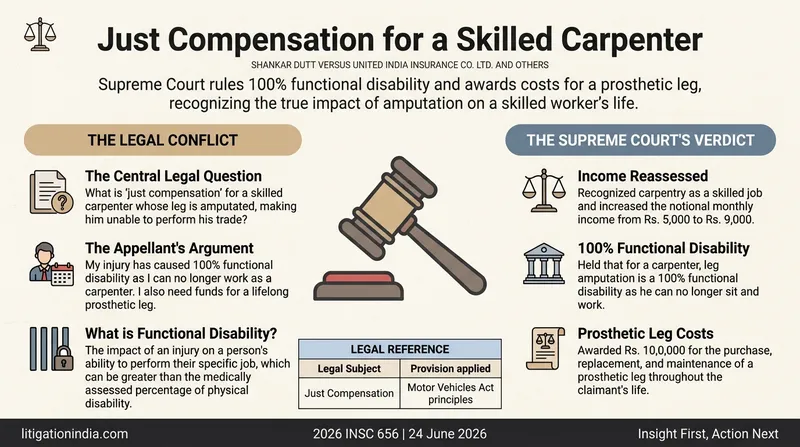
The Central Legal Question
In a motor accident claim, should a manual labourer's loss of earning capacity be limited to their certified physical disability percentage?
Appellant's Argument
My right leg was amputated, making it impossible for me to work as a mason. My functional disability is 100%, not the 70% stated in the certificate.
What is Functional Disability?
The effect of a physical injury on a person's ability to perform their specific job or daily activities, which can be different from the medical percentage of physical disability.
Disability Reassessed
The Court distinguished between physical and functional disability, assessing the latter at 100% for a mason who lost a leg.
Compensation Enhanced
Recalculated loss of income based on 100% disability and corrected other calculation errors, significantly increasing the total award.
Context is Key
The effect of an injury on a person's specific avocation is crucial for determining just compensation, not just a mechanical application of percentages.
Legal Reference
| Legal Subject | Provision Applied |
|---|---|
| Compensation Assessment | Motor Vehicles Act, 1988 |
What this case means
A mason whose leg was amputated in an accident sought more compensation. The Supreme Court ruled that for a manual worker, such an injury is a 100% functional disability, not just the 70% physical disability on the certificate. This decision significantly increases compensation by linking disability to a person's ability to work.
What the Supreme Court held
The Supreme Court partly allowed the appeal, enhancing the total compensation to Rs. 40,29,730. It held that the appellant's functional disability as a mason was 100%, not 70%, and directed the insurance company to deposit the enhanced amount with interest.
Case: M. PARAMESH VERSUS VRL LOGISTICS LTD. AND ANOTHER (2026) Citation: 2026 INSC 655
Want the full legal reasoning, citations and case documents?
Read the full judgment analysis