
All insights

Can a suspicious will with unexplained cuttings and incorrect recitals disinherit a widow?

Supreme Court restores widow's inheritance rights by invalidating suspicious will

A widow challenged a registered will made by her late husband that disinherited her in favour of distant non-relatives, claiming it was forged. The Supreme Court found the will was shrouded in suspici

Litigation India Editorial 11 September 2026 1 min read 2026 INSC 669

Story

Key points1 / 7

Case at a Glance

  • Widow Bhambo Devi challenged a 1974 registered will disinheriting her.
  • Will allegedly executed by her illiterate husband Chhajju Ram in favour of non-relatives.
  • Trial court and first appellate court discarded the will; High Court reversed.
  • Supreme Court citation: 2026 INSC 669.
Supreme Court restores widow's inheritance rights by invalidating suspicious will · 2026 INSC 6692026-09-11T20:11:16.343622+00:00
Key points2 / 7

What Happened

  • Chhajju Ram, illiterate agriculturist, died in 1992 leaving no children.
  • Defendants claimed property via a registered will dated 06.11.1974.
  • Will disinherited his wife claiming she had jewellery and cash.
  • Mutation of revenue records was done in defendants' favour based on the will.
Supreme Court restores widow's inheritance rights by invalidating suspicious will · 2026 INSC 6692026-09-11T20:11:16.343622+00:00
Key points3 / 7

The Legal Question

  • Were there genuine suspicious circumstances surrounding execution of the will?
  • Did the propounder satisfactorily explain those suspicious circumstances?
  • Did the High Court exceed its jurisdiction under Section 100 CPC?
  • Can a plaintiff's non-examination defeat an intestate succession suit?
Supreme Court restores widow's inheritance rights by invalidating suspicious will · 2026 INSC 6692026-09-11T20:11:16.343622+00:00
Key points4 / 7

Arguments on Both Sides

  • Appellant: Will was forged; suspicious circumstances not explained by propounder.
  • Appellant: High Court exceeded Section 100 CPC jurisdiction over findings of fact.
  • Respondents: Attesting witness proved execution under Section 63; burden shifted to plaintiff.
  • Respondents: Cuttings only on back of will; front page with thumb mark is valid.
Supreme Court restores widow's inheritance rights by invalidating suspicious will · 2026 INSC 6692026-09-11T20:11:16.343622+00:00
Key points5 / 7

What the Court Decided

  • Will rightly discarded; unexplained suspicious circumstances remained.
  • Illiterate testator plus incorrect will recitals = serious doubt about free execution.
  • Uninitialed cuttings on registration endorsement removed presumption of due registration.
  • High Court exceeded Section 100 CPC jurisdiction; trial court decree restored.
Supreme Court restores widow's inheritance rights by invalidating suspicious will · 2026 INSC 6692026-09-11T20:11:16.343622+00:00
Key points6 / 7

Why It Matters

  • Proving a will requires satisfying court's conscience, not just proving attestation.
  • Illiterate testators need stronger scrutiny to ensure free and informed will execution.
  • Widows cannot be disinherited by suspicious wills favouring distant non-relatives.
  • High Courts cannot reappraise concurrent findings of fact under Section 100 CPC.
Supreme Court restores widow's inheritance rights by invalidating suspicious will · 2026 INSC 6692026-09-11T20:11:16.343622+00:00
Key points7 / 7

Key Legal Takeaways

  • Alternative/inconsistent pleas in a plaint are permissible under CPC.
  • Untraversed factual allegations in plaint are deemed admitted under Order VIII Rule 5.
  • Facts admitted need not be proved — Section 58, Indian Evidence Act, 1872.
  • Registration Act requires executant's name to be accurately endorsed; uninitialed changes remove presumption.
Supreme Court restores widow's inheritance rights by invalidating suspicious will · 2026 INSC 6692026-09-11T20:11:16.343622+00:00
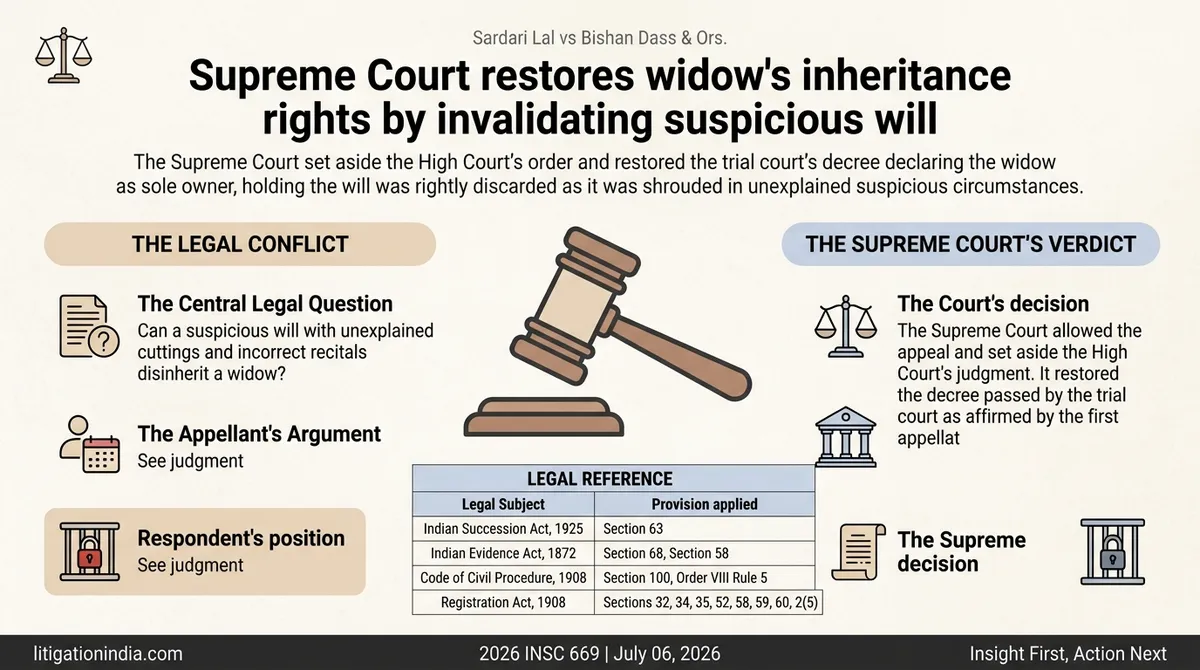
Supreme Court restores widow's inheritance rights by invalidating suspicious will — infographic summary

What this case means

A widow challenged a registered will made by her late husband that disinherited her in favour of distant non-relatives, claiming it was forged. The Supreme Court found the will was shrouded in suspicious circumstances — including unexplained cuttings on the registration endorsement, incorrect recitals, and the testator's illiteracy — which the propounder failed to explain. The Court restored the trial court's decree in the widow's favour, holding the High Court had exceeded its jurisdiction under Section 100 CPC.

What the Supreme Court held

The Supreme Court allowed the appeal and set aside the High Court's judgment. It restored the decree passed by the trial court as affirmed by the first appellate court, declaring the plaintiff as owner in possession of the suit schedule property and granting permanent prohibitory injunction against the defendants. The Court held there was no substantial question of law for the High Court to interfere under Section 100 CPC with the concurrent findings of fact discarding the will.

Case: Sardari Lal vs Bishan Dass & Ors. (2026) Citation: 2026 INSC 669

Want the full legal reasoning, citations and case documents?

Read the full judgment analysis
will validity
suspicious circumstances
testamentary disposition
intestate succession
Indian Succession Act
Section 100 CPC
second appeal jurisdiction
illiterate testator
disinheritance of wife
Registration Act 1908
proof of will
Sardari Lal vs Bishan Dass
Section 63, Indian Succession Act, 1925
Section 68, Section 58, Indian Evidence Act, 1872