
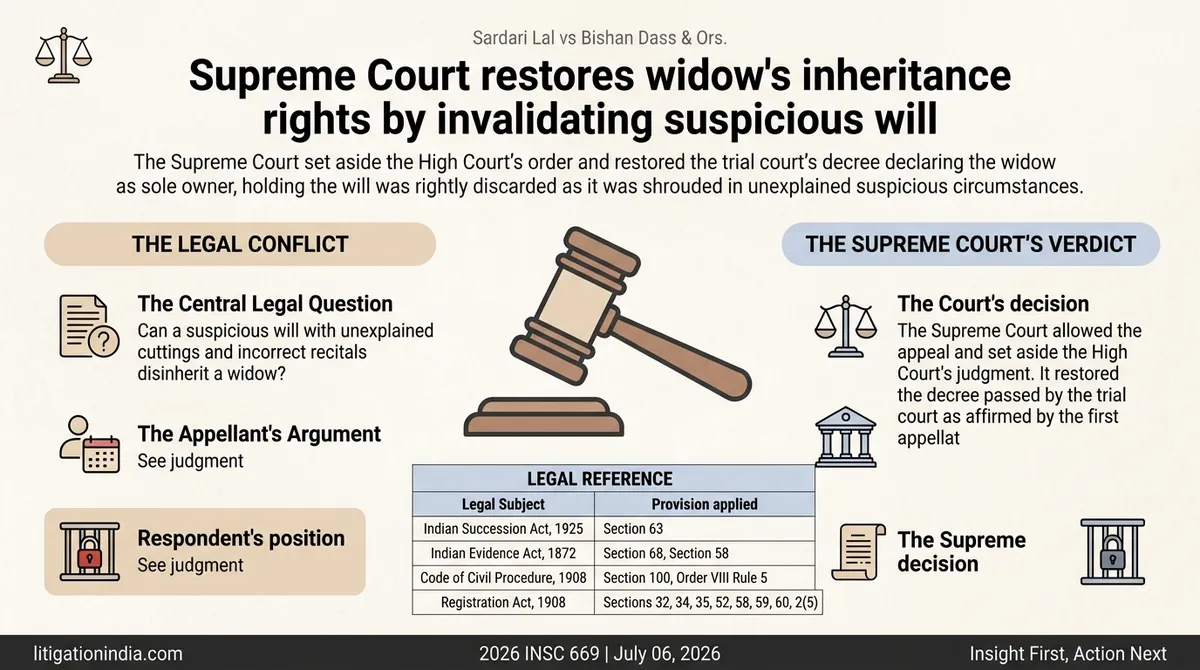
Can a suspicious will with unexplained cuttings and incorrect recitals disinherit a widow?
Supreme Court restores widow's inheritance rights by invalidating suspicious will
Case: Sardari Lal vs Bishan Dass & Ors.Citation: 2026 INSC 669Decided on: July 06, 2026
What this case means
A widow challenged a registered will made by her late husband that disinherited her in favour of distant non-relatives, claiming it was forged. The Supreme Court found the will was shrouded in suspicious circumstances — including unexplained cuttings on the registration endorsement, incorrect recitals, and the testator's illiteracy — which the propounder failed to explain. The Court restored the trial court's decree in the widow's favour, holding the High Court had exceeded its jurisdiction under Section 100 CPC.
“The Supreme Court set aside the High Court's order and restored the trial court's decree declaring the widow as sole owner, holding the will was rightly discarded as it was shrouded in unexplained suspicious circumstances.”
Story Slides
In short
Sardari Lal, as legal representative of the original plaintiff Bhambo Devi (widow of Chhajju Ram), appealed against the High Court of Himachal Pradesh's judgment which had allowed the defendants' second appeal and dismissed the suit. Bhambo Devi had sued Bishan Dass and Ram Singh, claiming she was the sole owner of the suit property as her husband Chhajju Ram's only Class I heir, and that a registered will dated 06.11.1974 purportedly executed by Chhajju in favour of the defendants was forged. The trial court and first appellate court both found the will shrouded in suspicious circumstances: the testator's wife was disinherited without genuine reason; the legatees were not proven to be nephews of the testator; the reasons given for the bequest were found factually incorrect; there were unexplained cuttings on the registration endorsement where the executant's name was changed from 'Laxmi Kant Bassi' to 'Chhajju' without the Sub-Registrar's initials; and the only surviving attesting witness was examined while the second was not. The High Court reversed these findings in second appeal, holding the will was proved by the attesting witness under Section 63 of the Succession Act. The Supreme Court restored the trial court's decree. It held that proving a will is not confined to proving attestation under Section 63; the propounder must satisfy the court's conscience that the testator executed the will with free will and full understanding. The illiteracy of the testator, incorrect recitals in the will, disinheritance of the sole Class I heir in favour of non-relatives, and the uninitialed cuttings on the registration endorsement — which deprived the propounder of the presumption of due registration — together constituted unexplained suspicious circumstances. The High Court had exceeded its jurisdiction under Section 100 CPC by overturning concurrent findings of fact.
Need clarity on a similar legal issue?
Request free pro bono guidance from a Supreme Court Advocate.
Background
Bhambo Devi, widow of Chhajju Ram (an illiterate agriculturist), filed a suit claiming sole ownership of the suit property left by her husband who died intestate in 1992 without issue. The defendants claimed entitlement through a registered will dated 06.11.1974, by which Chhajju allegedly bequeathed all his properties to them, citing their services and nephewhood. Bhambo Devi challenged the will as forged, and after her death during appeal proceedings, Sardari Lal was impleaded as her legal representative.
The Decision
The Supreme Court allowed the appeal and set aside the High Court's judgment. It restored the decree passed by the trial court as affirmed by the first appellate court, declaring the plaintiff as owner in possession of the suit schedule property and granting permanent prohibitory injunction against the defendants. The Court held there was no substantial question of law for the High Court to interfere under Section 100 CPC with the concurrent findings of fact discarding the will.
Why it matters for you
This judgment reinforces that a widow's right to inherit her husband's property cannot be easily defeated by a will that is surrounded by suspicious circumstances, particularly when the testator was illiterate and the will contained factually incorrect recitals. It clarifies that a propounder of a will must do more than merely prove attestation — the court's conscience must be satisfied about the testator's free will and full understanding. It also reaffirms the limits of High Court jurisdiction in second appeals under Section 100 CPC.
Relevant Legal Provisions
Key Acts and sections cited or relied upon in this judgment
“Section 63 prescribes the rules for execution of unprivileged wills, including signature/thumb mark of the testator and attestation by two or more witnesses; the Court held that proving a will under this section is only the first step and does not by itself satisfy the court's conscience when suspicious circumstances exist.”
“Section 68 prescribes the mode of proof of a will by examining an attesting witness; Section 58 provides that facts admitted need not be proved — both provisions were applied to hold that since the plaintiff's status as sole Class I heir was not traversed, it stood admitted, and the burden to prove the will remained on the propounder.”
“Section 100 limits the High Court's jurisdiction in second appeals to substantial questions of law; Order VIII Rule 5 provides that untraversed allegations in the plaint are deemed admitted — the Court held the High Court exceeded its Section 100 jurisdiction by overturning concurrent findings of fact, and the doctrine of non-traverse under Order VIII Rule 5 meant the plaintiff's status as sole heir stood admitted.”
“These provisions require the registering officer to verify the identity of the executant, obtain proper endorsements, and issue a registration certificate; the Court relied on these to hold that uninitialed cuttings replacing the executant's name on the endorsement meant the benefit of presumption of due registration was not available to the propounder of the will.”
AI-assisted summary, reviewed and verified by our editorial team.
In the Court's words
“In cases where the execution of a will is shrouded in suspicion, its proof ceases to be a simple lis between the plaintiff and the defendant. What, generally, is an adversary proceeding becomes in such cases a matter of the court's conscience.”
“A circumstance is 'suspicious' when it is not normal or is 'not normally expected in a normal situation or is not expected of a normal person'. The suspicious features must be 'real, germane and valid' and not merely the 'fantasy of the doubting mind'.”
“Illiteracy of the testator coupled with incorrect statements in the Will raises a serious doubt as to whether the testator executed the Will after fully understanding its content.”
“The use of time-honored phrases like 'the conscience of the Court being satisfied' cannot convert a question of fact into one of law.”
Need help with your case?
Facing a similar legal challenge in the Supreme Court or High Court? Connect with our pro bono volunteer advocates today.
Related Supreme Court services