
All insights

Can a coerced police confession alone justify preventive detention under NSA?

Supreme Court Quashes NSA Detention Based on Coerced Police Confession

The case concerned whether a preventive detention order under the National Security Act could rest on an extra-judicial confession obtained by torture. The Supreme Court held that such a confession, b

Litigation India Editorial 29 September 2026 1 min read 2026 INSC 1067

Story

Case at a glance1 / 6

Supreme Court of India

NSA Detention Quashed: Coerced Confession Cannot Justify Preventive Detention

Mulla Afroz v. Union of India and Ors. — 2026 INSC 1067

Court: Supreme Court of India; Date: 29 September 2026Bench: Justice Dipankar Datta and Justice Sheel NaguArea of Law: Preventive Detention / Constitutional LawDetention under National Security Act, 1980 challenged via habeas corpus
Supreme Court Quashes NSA Detention Based on Coerced Police Confession · 2026 INSC 10672026-09-29T13:29:01.140192+00:00
The legal question2 / 6

Can an NSA Detention Order Rest on a Coerced Police Confession?

Two core legal questions before the Court

  • Appellant: Confession obtained by torture; inadmissible under BSA Section 23 and Article 20(3); cannot ground detention.
  • Appellant: Detention order designed to defeat bail orders; punitive, not preventive; grounds vague and unsupported.
  • Respondent: Detaining authority needs only subjective satisfaction; confessions can be used in non-trial proceedings.
  • Respondent: Pendency of criminal cases and risk of future violence justified the NSA detention independently of bail.
Supreme Court Quashes NSA Detention Based on Coerced Police Confession · 2026 INSC 10672026-09-29T13:29:01.140192+00:00
Statutory comparison3 / 6

Confessional Statements: Criminal Trial vs. Preventive Detention

How the Court distinguished the two contexts

Legal SubjectCriminal Trial (BSA / IEA)Preventive Detention (NSA)
Confession to police officerAbsolutely barred — Section 23 BSA / Section 25 IEACannot alone form basis for detention — held in this judgment
Coerced confessionIrrelevant and excluded under Article 20(3)Equally excluded; must not enter subjective satisfaction of detaining authority
Section 161 CrPC statementNot substantive evidence; only to contradict witness at trialInsufficient alone to sustain detention order — Pebam Ningol Mikoi Devi
Chargesheet filingInitiates trial; accused presumed innocentDoes not confirm guilt or disturbance of public order
Supreme Court Quashes NSA Detention Based on Coerced Police Confession · 2026 INSC 10672026-09-29T13:29:01.140192+00:00
The Court's reasoning4 / 6

Court's Reasoning: From Confession to Quashing Detention

Step-by-step legal analysis

  1. 1Step 1: Article 20(3) and Section 23 BSA bar coerced police confessions from evidence — they are inherently suspect.
  2. 2Step 2: Prior cases (Aruna Kumari, Senthamilselvi) distinguished as obiter dicta; they did not directly challenge confession-based detention.
  3. 3Step 3: An irrelevant ground under Article 22(5) impairs the detenu's right to make an effective representation — detention becomes unsustainable.
  4. 4Step 4: Remaining grounds — unsupplied CCTV footage, unexplained mobile messages, mere chargesheet — each independently invalid.
  5. 5Step 5: Detention designed to defeat bail orders is punitive not preventive; order quashed, Rs. 10 lakh costs imposed on State.
Supreme Court Quashes NSA Detention Based on Coerced Police Confession · 2026 INSC 10672026-09-29T13:29:01.140192+00:00
The verdict5 / 6

The Court's Final Decision

Fact, Law, and Result

  • The Fact: Detention rested on a coerced confession, unsupplied CCTV footage, unexplained mobile messages, and a mere chargesheet — while appellant had already secured bail.
  • The Law: A coerced extra-judicial confession is inadmissible under Article 20(3) and Section 23 BSA and cannot alone sustain the subjective satisfaction for preventive detention under Article 22(5).
  • The Result: High Court judgment, detention order and confirmation order all set aside; appellant to be released forthwith; Madras HC Full Bench decision in Suman overruled to that extent.
Appellant released forthwith; State directed to pay Rs. 10 lakh costs within one month of this judgment.
Supreme Court Quashes NSA Detention Based on Coerced Police Confession · 2026 INSC 10672026-09-29T13:29:01.140192+00:00
Why it matters6 / 6

Why This Judgment Matters for Ordinary Citizens

Practical significance of the ruling

  • A confession obtained by police torture or threats cannot be used to keep you in preventive detention without trial.
  • The government cannot use preventive detention to nullify a bail order lawfully granted by a criminal court.
  • Evidence relied on in a detention order must actually be supplied to the detained person; unsupplied material cannot sustain the order.
  • This ruling overrules a decades-old Madras High Court decision and sets a uniform standard across India on confession-based preventive detention.
Preventive detention must prevent future harm — not punish past acts or override bail orders granted by courts.
Supreme Court Quashes NSA Detention Based on Coerced Police Confession · 2026 INSC 10672026-09-29T13:29:01.140192+00:00
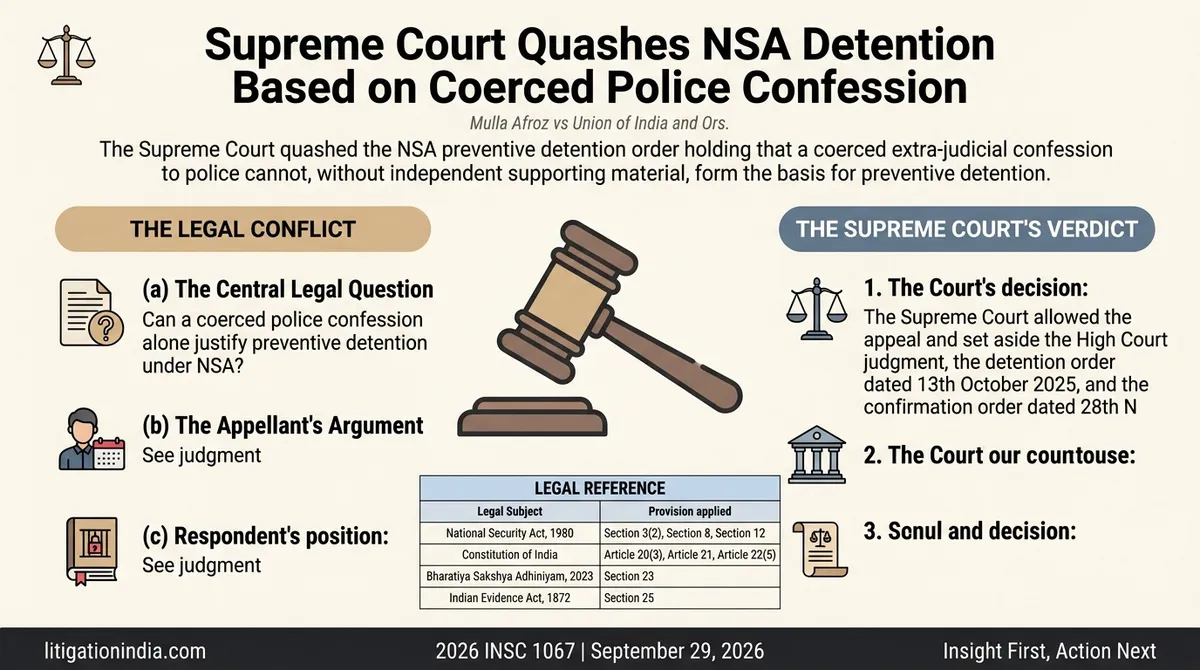
Supreme Court Quashes NSA Detention Based on Coerced Police Confession — infographic summary

What this case means

The case concerned whether a preventive detention order under the National Security Act could rest on an extra-judicial confession obtained by torture. The Supreme Court held that such a confession, being inadmissible in criminal trials, cannot alone form the basis for preventive detention. The court quashed the detention order and directed the appellant's release, also imposing Rs. 10 lakh costs on the State.

What the Supreme Court held

The Supreme Court allowed the appeal and set aside the High Court judgment, the detention order dated 13th October 2025, and the confirmation order dated 28th November 2025. The appellant was directed to be released forthwith unless required in any other case. The Court imposed costs of Rs. 10 lakh on the State, payable to the appellant within one month.

Case: Mulla Afroz vs Union of India and Ors. (2026) Citation: 2026 INSC 1067

Want the full legal reasoning, citations and case documents?

Read the full judgment analysis
Mulla Afroz
Union of India
National Security Act 1980
preventive detention
extra-judicial confession
habeas corpus
Article 22 Constitution
Article 20(3) Constitution
Sambhal riots
Bharatiya Sakshya Adhiniyam 2023
Section 3(2), Section 8, Section 12, National Security Act, 1980
Article 20(3), Article 21, Article 22(5), Constitution of India
Section 23, Bharatiya Sakshya Adhiniyam, 2023
Section 25, Indian Evidence Act, 1872