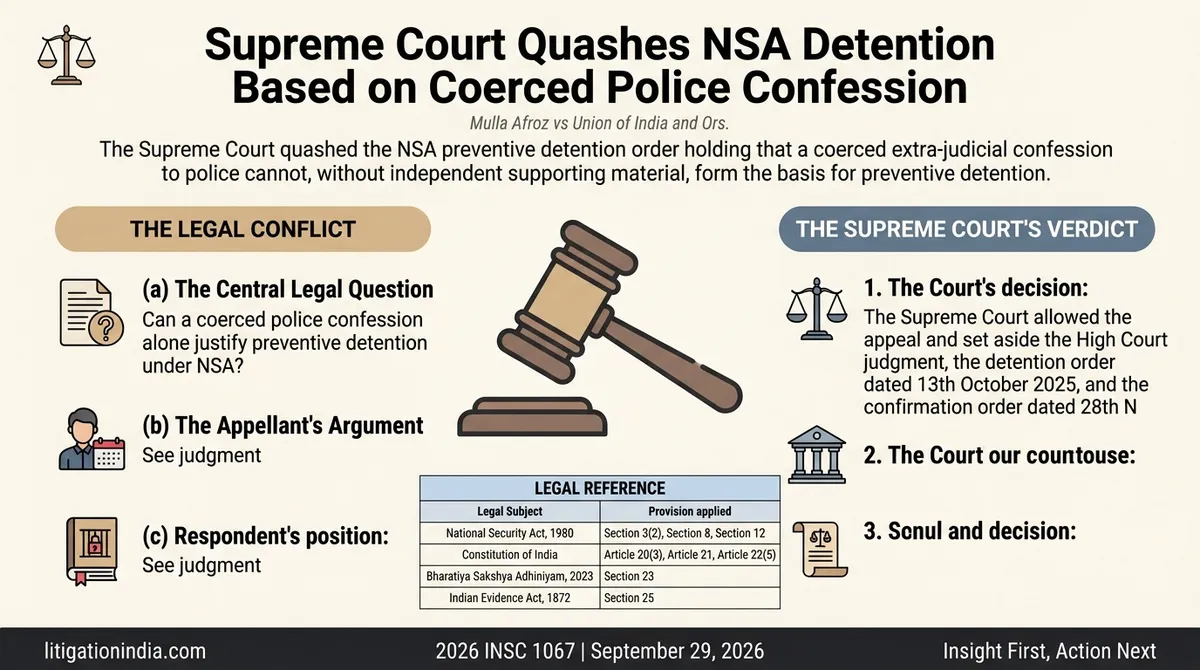
Full text of the judgment
Text extracted from Mulla Afroz vs Union of India and Ors.. For the authoritative version refer to the Supreme Court of India's official website.
2026 INSC 1067 Page 1 of 41 REPORTABLE IN THE SUPREME COURT OF INDIA CRIMINAL APPELLATE JURISDICTION
CRIMINAL APPEAL NO. 4310 OF 2026 [Arising out of SLP (CRL.) NO. 12534 OF 2026]
MULLA AFROZ
UNION OF INDIA AND ORS.
…RESPONDENTS
J U D G M E N T DIPANKAR DATTA, J. I. IN MEMORIAM 1. Human life is fragile. Yet, in the ordinary course of living, we seldom pause to recognise just how fleeting it is; and when life finally confronts us with that fragility, the realisation often comes too late. On that note, at the very outset, we begin on an unconventional premise. One of our dearest Law Clerks-cum-Research Associates, Ritwik Deswal, left for his heavenly abode 4 days short of his 27th birthday, which happens to be today. As we pronounce this judgment, which bears the quiet and indelible imprint of his final labours, we wish to record our deep appreciation for the invaluable research assistance rendered by him in the build-up to the preparation of this judgment. His untimely demise Digitally signed by JATINDER KAUR Date: 2026.09.29 16:41:55 IST Reason: Signature Not Verified
Page 2 of 41 has left an excruciatingly deep void in our lives. Even in his final hours, his thoughts remained firmly anchored in the pursuit of truth and the service of justice. It is, therefore, with profound personal sorrow and grief that we dedicate this final collaboration to his memory, his integrity, his enduring commitment to the law, his love for academia, and his other great qualities of head and heart. II. THE CHALLENGE 2. This appeal, by special leave, challenges the judgment and order dated 8th June, 20261 whereby the High Court of Judicature at Allahabad2 dismissed the writ petition3 filed by the appellant. An order dated 13th October, 20254 issued by the District Magistrate, Sambhal, Uttar Pradesh5 ordering the appellant’s preventive detention under the National Security Act, 19806 assailed in the writ petition was thus upheld. III. FACTUAL MATRIX 3. The genesis of the present proceedings lies in an incident that occurred on 24th November, 2024 in connection with survey of a mosque at Sambhal. During the course of the survey, violence erupted resulting in the death of 4 (four) persons. An FIR, being Case Crime No. 333 of 2024, came to be registered on the same day. Subsequently, several other
1 impugned judgment 2 High Court 3 Habeas Corpus Writ Petition No. 179 of 2026 4 detention order 5 detaining authority 6 NSA
Page 3 of 41 FIRs7 were also lodged in relation to the said incident. Although the appellant was not named in Case Crime No. 333 of 2024, he was arrested approximately 54 (fifty-four) days later, on 17th January, 2025 to be precise, and was also taken into custody in connection with the other FIRs. During the course of such custody, a confessional statement of the appellant is stated to have been recorded. Pursuant thereto, a .32 bore pistol was allegedly recovered. 4. On 9th September, 2025, the appellant was granted bail by the High Court in connection with Case Crime No. 340 of 2024. However, while the appellant continued to remain in judicial custody in relation to the other FIRs, the detaining authority exercising power conferred by Section 3(2)8 of the NSA passed the detention order on 13th October, 2025. Appellant thereafter submitted a representation against the detention order from the district jail, which came to be rejected by the detaining authority on 31st October, 2025 on the ground of delay in its submission. The representations thereafter preferred before the State Government as well as the Central Government also met the same fate.
7 Case Crime Nos. 306, 337, 338, 339 and 340 of 2024 8 (2) The Central Government or the State Government may, if satisfied with respect to any person that with a view to preventing him from acting in any manner prejudicial to the security of the State or from acting in any manner prejudicial to the maintenance of public order or from acting in any manner prejudicial to the maintenance of supplies and services essential to the community it is necessary so to do, make an order directing that such person be detained. Explanation.—For the purposes of this sub-section, “acting in any manner prejudicial to the maintenance of supplies and services essential to the community” does not include “acting in any manner prejudicial to the maintenance of supplies of commodities essential to the community” as defined in the Explanation to sub-section (1) of section 3 of the Prevention of Blackmarketing and Maintenance of Supplies of Essential Commodities Act, 1980 (7 of 1980), and accordingly, no order of detention shall be made under this Act on any ground on which an order of detention may be made under that Act.
Page 4 of 41 5. Subsequently, upon receipt of the report of the Advisory Board, the State Government exercising power under Section 12 of the NSA confirmed the detention order and directed continuance of the detention for a further period of 12 (twelve) months vide its order dated 28th November, 20259. In the meantime, and by June, 2026, the appellant had secured bail from the High Court in all the criminal cases wherein he had been implicated. 6. Aggrieved by the order of detention which he perceived to be illegal and in breach of law, the appellant invoked the writ jurisdiction of the High Court assailing both the detention and confirmation orders. He prayed for issuance of a writ of habeas corpus directing his release from custody forthwith upon quashing of the orders impugned in the writ petition. 7. Before the High Court, the appellant raised several contentions assailing the detention order. It was urged that a bare perusal of the communication addressed by the detaining authority to the Superintendent of Jail would reveal that neither the detention order nor the grounds of detention had been furnished to the appellant, in breach of the mandate of Article 22 of the Constitution and the procedural safeguards engrafted in the NSA. It was further contended that the appellant had been falsely implicated in the criminal cases solely on the basis of an extra-judicial confession allegedly extracted by the police through torture and threats to his life. The appellant also questioned the recovery of a .32 bore pistol pursuant to his arrest, contending that the
9 confirmation order
Page 5 of 41 same did not accord with the medical evidence relating to the deceased persons, whose deaths were attributed to .315 bore bullets. 8. The writ petition, however, came to be dismissed by a Division Bench of the High Court by the impugned judgment. While so dismissing, the High Court examined the scope of Article 22 of the Constitution and relied upon several decisions of this Court governing preventive detention. It observed that whether a particular act threatens the maintenance of public order or the security of the State is necessarily a question to be determined on the facts and circumstances of each case. It further held that since an order of preventive detention is founded on an apprehended threat and not on proof of guilt, no rigid or objective parameters can be prescribed, and the power of detention is to be exercised on the subjective satisfaction of the detaining authority. It also observed that an order of preventive detention partakes the character of an administrative action and, therefore, judicial review is confined to examining the decision-making process and the application of mind by the detaining authority rather than the correctness of the satisfaction recorded. Applying the aforesaid principles, it was held that the subjective satisfaction recorded by the detaining authority was justified and did not disclose non-application of mind. It further noticed that the appellant himself had admitted in the writ petition that 22 (twenty-two) documents forming the basis of the detention order had been supplied to him. On such reasoning, the High Court concluded that the detention order and confirmation order were founded on relevant and objective
Page 6 of 41 material and that no case had been set up warranting exercise of its extraordinary writ jurisdiction. 9. Aggrieved by the aforesaid judgment of the High Court, the appellant has carried the same in appeal before this Court. IV. CONTENTIONS OF THE PARTIES 10. Mr. Divyesh Pratap Singh, learned counsel for the appellant has assailed the impugned judgment as well as the detention and confirmation order on the following grounds: a. Materials referred to in the impugned detention order were not furnished to the appellant. b. The detention order has been resorted to solely to defeat the release of the appellant who has otherwise been granted bail in all the cases registered against him. Reliance was placed on the decision of this Court in Ameena Begum v. State of Telangana10 and Annu @ Aniket v. Union of India11 in support of the aforesaid submission. c. The existence of multiple cases per se is no ground to pass the detention order. Furthermore, the detention order merely contains an ipse dixit regarding the imminent possibility of the appellant being released on bail without any reliable or cogent material supporting such satisfaction and must disclose release having direct nexus with disturbance of public order. Reference in this
10 (2023) 9 SCC 587 11 Criminal Appeal No. 2920 of 2025
Page 7 of 41 regard has been made to Vijay Kumar Rajpoot @ Vijju v. State of Chhattisgarh12, Rekha v. State of Tamil Nadu13 and Roshini Devi v. State of Telangana14. d. There is clear non-application of mind by the detaining authority and the confirming authority along with the State and Central Governments, which rejected the representations made by the detenu. e. The foundation of the detention order as well as the implication and incarceration of the appellant under multiple criminal cases rests on an extra-judicial confession obtained through torture and threat of murder in violation of the mandate of Article 20(3) of the Constitution. Such confessional statement is inadmissible under Section 23 of the Bharatiya Sakshya Adhiniyam, 202315 (erstwhile Section 25 of the Indian Evidence Act, 187216) and cannot form grounds for detention or incarceration. Reliance was placed on Pebam Ningol Mikoi Devi v. State of Manipur17 in support of the aforesaid submission. f. The factual panorama laid out in the FIRs at best constitutes a lawand-order situation and does not amount to breach of public order.
12 (2026) SCC OnLine 1726 13 (2011) 5 SCC 244 14 (2026) 7 SCC 302 15 BSA 16 IEA 17 (2010) 9 SCC 618
Page 8 of 41 Support was sought to be drawn from Dr. Ram Manohar Lohia v. State of Bihar18 in this behalf. g. Lastly, the prolonged incarceration violates right to life and personal liberty of the appellant as enshrined under Article 21 of the Constitution. 11. Per contra, Mr. Nataraj, learned Additional Solicitor General representing the respondents defended the detention and confirmation orders, as well as the judgment of the High Court by arguing as follows: a. The act of the appellant disturbed public order and the occurrence, which forms the basis of criminal cases, led to death of 4 (four) persons as well as injuries to police personnel. It further led to shutting down of internet and other services in the Sambhal area. These acts satisfy the requirements under Section 3(2) of the NSA inasmuch they are acts prejudicial to the maintenance of public order and to the maintenance of supplies and services essential to the community. Reliance was placed upon Arun Ghosh v. State of West Bengal19 to contend that acts of the detenu caused disturbance of public order. b. The pendency of criminal cases or the fact that the detenu has been released on bail is no bar to an order of preventive detention. Reliance was placed on Haradhan Saha v. State of West Bengal20. Furthermore, a detention order may be validly passed
18 AIR 1966 SC 740 19 (1970) 1 SCC 98 20 (1975) 3 SCC 198
Page 9 of 41 against a person in custody in terms of the decision in Kamarunnisa v. Union of India21. c. Detention under the NSA is a preventive and not a punitive action and the detaining authority has only to form subjective satisfaction on the basis of materials before it. Therefore, the judicial scrutiny of the order of the detaining authority would be minimal. Reliance was placed upon Aruna Kumari v. Govt. of A.P22 and State of Punjab v. Sukhpal23 to buttress this point. d. A confessional statement can form the basis of a detention order and the same when relied upon by a detaining authority cannot be equated to confessional statements in judicial proceedings. Reliance was placed on Aruna Kumari (supra) and Khatri (IV) v. State of Bihar24 and a Full Bench decision of Madras High Court in Suman v. State of Tamil Nadu25 in support of this aforesaid submission. e. Where an order of detention has been made on multiple grounds, the order shall be deemed to have been made separately on each of those grounds. Such an order shall not be deemed to be invalid or inoperative merely because one or some of the grounds are vague, non-existent, not relevant, not connected or not
21 (1991) 1 SCC 128 22 (1988) 1 SCC 296 23 (1990) 1 SCC 35 24 (1981) 2 SCC 493 25 1986 SCC OnLine Mad 104
Page 10 of 41 proximately connected with the person detained, or invalid for any other reason. V. ANALYSIS 12. We have heard the parties and perused the impugned judgment, as well as the materials on record. 13. This appeal would have partly succeeded on a couple of technical grounds. Despite Mr. Nataraj’s fair concession, we have proceeded to decide the appeal purely on the merits of the rival contentions. 14. Broadly, two issues arise for our consideration: first, whether an order of detention can be based on an extra-judicial confession; and second, whether procedural safeguards as envisaged under the Constitution and the NSA have been complied with and consequently whether the material relied upon by the detaining authority is legal and valid for passing an order of preventive detention. A. WHETHER AN ORDER OF PREVENTIVE DETENTION CAN BE BASED UPON AN EXTRA-JUDICIAL CONFESSIONAL STATEMENT? 15. At the outset, we consider it essential to bear in mind the constitutional protection given to any accused against self-incrimination. Article 20(3)26 of the Constitution guaranteeing that, apart from being a fundamental right, forms a foundational principle of Indian criminal jurisprudence.
26 20. *** (3) No person accused of any offence shall be compelled to be a witness against himself.
Page 11 of 41 16. That apart, no court while examining a challenge to an order of preventive detention ought to proceed without bearing in mind Article 2227 of the Constitution. 17. After perusing the grounds of detention given by the detaining authority forming part of the reply affidavit filed on behalf of the respondents, it
27 22. Protection against arrest and detention in certain cases.- (1) No person who is arrested shall be detained in custody without being informed, as soon as may be, of the grounds for such arrest nor shall he be denied the right to consult, and to be defended by, a legal practitioner of his choice. (2) Every person who is arrested and detained in custody shall be produced before the nearest magistrate within a period of twenty-four hours of such arrest excluding the time necessary for the journey from the place of arrest to the court of the magistrate and no such person shall be detained in custody beyond the said period without the authority of a magistrate. (3) Nothing in clauses (1) and (2) shall apply— (a) to any person who for the time being is an enemy alien; or (b) to any person who is arrested or detained under any law providing for preventive detention. (4) No law providing for preventive detention shall authorise the detention of a person for a longer period than three months unless— (a) an Advisory Board consisting of persons who are, or have been, or are qualified to be appointed as, Judges of a High Court has reported before the expiration of the said period of three months that there is in its opinion sufficient cause for such detention: Provided that nothing in this sub-clause shall authorise the detention of any person beyond the maximum period prescribed by any law made by Parliament under sub-clause (b) of clause (7); or (b) such person is detained in accordance with the provisions of any law made by Parliament under sub-clauses (a) and (b) of clause (7). (5) When any person is detained in pursuance of an order made under any law providing for preventive detention, the authority making the order shall, as soon as may be, communicate to such person the grounds on which the order has been made and shall afford him the earliest opportunity of making a representation against the order. (6) Nothing in clause (5) shall require the authority making any such order as is referred to in that clause to disclose facts which such authority considers to be against the public interest to disclose. (7) Parliament may by law prescribe— (a) the circumstances under which, and the class or classes of cases in which, a person may be detained for a period longer than three months under any law providing for preventive detention without obtaining the opinion of an Advisory Board in accordance with the provisions of sub-clause (a) of clause (4); (b) the maximum period for which any person may in any class or classes of cases be detained under any law providing for preventive detention; and (c) the procedure to be followed by an Advisory Board in an inquiry under sub-clause (a) of clause (4).
Page 12 of 41 is clear that the extra-judicial confessional statement of the appellant is one of the basic planks on which the detention order rests. 18. The question as to whether such a statement can form the basis of an order of preventive detention has led to decisions which, seemingly, strikes discordant notes. Therefore, we propose to reconcile the seemingly conflicting views in this judgment. 19. Respondents have relied upon the decision in Aruna Kumari (supra) to contend that confessional statements can form the basis for detention orders. Furthermore, they have also relied upon this decision to support the contention that the detaining authority only has to form subjective satisfaction which is not amenable to strict standards of judicial scrutiny. The relevant paragraph from the said decision, on which reliance is heavily placed, is reproduced hereinbelow: 8. … Before examining the point urged on behalf of the petitioner on merits, it must be pointed out that this Court while considering petitioner's writ application is not sitting in appeal over the detention order, and it is not for us to go into and assess the probative value of the evidence available to the detaining authority. Of course, a detention order not supported by any evidence may have to be quashed, but that is not the position here. There was clearly sufficient material before the District Magistrate to justify the forming of his opinion as stated earlier. The question was not raised in the writ petition filed before the High Court, and the plea based upon the brand of cement was belatedly taken in the case and has been dealt with at some length in the judgment of the High Court which is under challenge in the special leave petition. We do not consider it necessary to repeat them but we would mention briefly the argument of the learned Advocate General which appears to be well founded. Our attention was drawn to the gatepass (page 154 of the paperbook of the writ petition) showing the issuance of the levy cement “to the contractor”, that is, Madhava Rao, which was signed by Mohammad Chand on behalf of the Railways and Babu, Madhava Rao's employee. This does not mention the name of Eswara Rao, the other employee of the contractor. It is not denied on behalf of the detenu that he has been executing many contract works for the Railways, and therefore it cannot be presumed that the same
Page 13 of 41 consignment was the subject matter of the gatepass as well as the certificate relied upon on behalf of the petitioner. The point now urged on the basis of the brand of cement was taken on behalf of the petitioner belatedly as mentioned earlier. Besides, the detenu accepted the allegations against himself in his statement recorded under Section 161 of the Code of Criminal Procedure. It is true that it may not be a legally recorded confession which can be used as substantive evidence against the accused in the criminal case, but it cannot be completely brushed aside on that ground for the purpose of his preventive detention. The records further show that the oral evidence of the watchman and the labourer engaged in the house construction proved that it was the levy cement issued to the detenu which was being diverted at his instance. Before closing this chapter it may be re-stated that the sufficiency of the materials available to the detaining authority is not to be examined by the court. (emphasis ours)
20. Respondents have similarly relied upon Khatri (supra) to clarify the usage of statements made before a police officer by referring to the following extract: 3. …If the statement made before a police officer in the course of an investigation under Chapter XII is sought to be used in any proceeding other than an inquiry or trial or even at an inquiry or trial but in respect of an offence other than that which was under investigation at the time when such statement was made, the bar of Section 162 would not be attracted. This section has been enacted for the benefit of the accused, as pointed out by this Court in Tahsildar Singh v. State of U.P. [AIR 1959 SC 1012 : 1959 Supp 2 SCR 875, 890 : 1959 Cri LJ 1231] it is intended “to protect the accused against the user of statements of witnesses made before the police during investigation, at the trial presumably on the assumption that the said statements were not made under circumstances inspiring confidence”. This Court, in Tahsildar Singh case [AIR 1959 SC 1012 : 1959 Supp 2 SCR 875, 890 : 1959 Cri LJ 1231] approved the following observations of Braund, J. in Emperor v. Aftab Mohd. Khan [AIR 1940 All 291 : 188 IC 649 : 41 Cri LJ 647] :
“As it seems to us it is to protect accused persons from being prejudiced by statements made to police officers who by reason of the fact that an investigation is known to be on foot at the time the statement is made, may be in a position to influence the maker of it, and, on the other hand, to protect accused persons from the prejudice at the hands of persons who in the knowledge that an investigation has already started, are prepared to tell untruths”
and expressed its agreement with the view taken by the Division Bench of the Nagpur High Court in Baliram Tikaram Marathe v.
Page 14 of 41 Emperor [AIR 1945 Nag 1 : 46 Cri LJ 448 : 218 IC 294] that “the object of the section is to protect the accused both against overzealous police officers and untruthful witnesses”. Protection against the use of statement made before the police during investigation is, therefore, granted to the accused by providing that such statement shall not be allowed to be used except for the limited purpose set out in the proviso to the section, at any inquiry or trial in respect of the offence which was under investigation at the time when such statement was made. But, this protection is unnecessary in any proceeding other than an inquiry or trial in respect of the offence under investigation and hence the bar created by the section is a limited bar. It has no application, for example in a civil proceeding or in a proceeding under Article 32 or 226 of the Constitution and a statement made before a police officer in the course of investigation can be used as evidence in such proceeding, provided it is otherwise relevant under the Indian Evidence Act. There are a number of decisions of various High Courts which have taken this view and amongst them may be mentioned the decision of Jaganmohan Reddy, J. in Malakala Surya Rao v.G. Janakamma [AIR 1964 AP 198 : (1963) 2 Andh WR 485 : (1964) 1 Cri LJ 504] . The present proceeding before us is a writ petition under Article 32 of the Constitution filed by the petitioners for enforcing their Fundamental Rights under Article 21 and it is neither an “inquiry” nor a “trial” in respect of any offence and hence it is difficult to see how Section 162 can be invoked by the State in the present case. The procedure to be followed in a writ petition under Article 32 of the Constitution is prescribed in Order XXXV of the Supreme Court Rules, 1966, and sub-rule (9) of Rule 10 lays down that at the hearing of the rule nisi, if the court is of the opinion that an opportunity be given to the parties to establish their respective cases by leading further evidence, the court may take such evidence or cause such evidence to be taken in such manner as it may deem fit and proper and obviously the reception of such evidence will be governed by the provisions of the Indian Evidence Act. It is obvious, therefore, that even a statement made before, a police officer during investigation can be produced and used in evidence in a writ petition under Article 32 provided it is relevant under the Indian Evidence Act and Section 162 cannot be urged as a bar against its production or use. The reports submitted by Shri L.V. Singh setting forth the result of his investigation cannot, in the circumstances, be shut out from being produced and considered in evidence under Section 162, even if they refer to any statements made before him and his associates during investigation, provided they are otherwise relevant under some provision of the Indian Evidence Act. (emphasis ours)
21. The Full Bench decision of the Madras High Court in Suman (supra) has extensively dealt with this issue. Relevant paragraphs therefrom are reproduced hereinbelow:
Page 15 of 41 61. The provisions of the Evidence Act do not regulate the consideration of the material which is put before the detaining authority for consideration in order to decide whether it would make an order of detention. If generally the provisions of the Evidence Act are not attracted in the case of an administrative action, there is no reason why only in respect of a statement made by the proposed detenu either the provisions of section 25 or the principle behind section 25 should be brought in by way of regulating the consideration of the material laid before the detaining authority. We must, therefore, hold that the decision in Duraiswamy Mudaliar's case (1985 Cri LJ 1115) does not lay down the correct law and that the confessional statement made to a police officer constituted a relevant material which the detaining authority is entitled to take into consideration for passing an order of detention against the maker of the statement. 62. An argument was then advanced that if a confession is permitted to be used as relevant material for considering whether a person should be detained or not, the detaining authority may make an order of detention solely on a confession. This, to say the least, is an argument of despair. 63. In a given case it is possible that making an order of detention only on the basis of a confession may amount to an abuse of the power. But this power itself cannot be negatived because there is a possibility of its abuse. In such a case, the exercise of the power might alone become bad. This is, however, a question to be determined on facts on which it might arise. 64. Accordingly, the two questions referred to the Full Bench are answered as follows: (1) There is no duty or obligation on the Advisory Board to suo motu adjourn the hearing of the reference made to it when on the date of the hearing the detenu's request for assistance of a legal practitioner is rejected even though the detenu does not request for adjournment. (2) The confessional statement made by the detenu to the police officer can be considered by the detaining authority as material relevant for making an order of detention against the maker of the statement, but the weight to be attached to it is for the said authority to decide. (emphasis ours)
22. Profitable reference may be made to a decision of this Court in Senthamilselvi v. State of T.N. and Another28. While not directly dealing with the issue at hand, this Court did hold the decision to rely
28 (2006) 5 SCC 676
Page 16 of 41 on confessional statement for detaining the accused to be correct. Relevant paragraphs from such decision read as follows: 7. There is also no substance in the plea that the confessional statement of the co-accused was relied upon, but the copy thereof was not supplied. The grounds of detention merely refer to the confession by the co-accused. That does not form foundation for the detention. On the other hand it appears that the detenu himself made a confession and that was the main factor on which the order of detention was founded. There is distinction between a relied-upon document and a document which has been referred to without being relied upon. The distinction has been noticed by this Court in Powanammal v. State of T.N. : (1999) 2 SCC 413. It was observed as follows: “9. However, this Court has maintained a distinction between a document which has been relied upon by the detaining authority in the grounds of detention and a document which finds a mere reference in the grounds of detention. Whereas the non-supply of a copy of the document relied upon in the grounds of detention has been held to be fatal to continued detention, the detenu need not show that any prejudice is caused to him. This is because the non-supply of such a document would amount to denial of the right of being communicated the grounds and of being afforded the opportunity of making an effective representation against the order. But it would not be so where the document merely finds a reference in the order of detention or among the grounds thereof. In such a case, the detenu's complaint of non-supply of document has to be supported by prejudice caused to him in making an effective representation. What applies to a document would equally apply to furnishing a translated copy of the document in the language known to and understood by the detenu, should the document be in a different language.” 8. A bare reading of the grounds of detention in the present case shows that the detenu was not arrested on the basis of the coaccused's statement. On the contrary, it has been clearly stated in the grounds of detention that the detenu was arrested on suspicion. *** (emphasis ours)
23. We may also similarly refer to the decision in E. Subbulakshmi v. State of Tamil Nadu and Others29 where this Court ruled that: 7. The third ground urged by the petitioner is about the reliance placed on alleged confessional statement given by the detenu during the investigation of the ground case. The fact that no signature of the detenu has been noted on the said confessional statement, it
29 (2017) 1 SCC 757
Page 17 of 41 would at best be a ground to discard that document in a criminal trial being inadmissible in evidence. That by itself is not sufficient to question the subjective satisfaction reached by the detaining authority. What is also required to be considered is : whether the said voluntary confessional statement was the sole basis to arrive at the subjective satisfaction. On a fair reading of the grounds of detention, we must hold that the said confessional statement is not the solitary document or circumstance considered by the detaining authority. … Suffice it to observe that the alleged confessional statement is not the sole basis for forming subjective satisfaction of the detaining authority. The detaining authority has considered all aspects of the matter and taking totality of circumstances into account, deemed it necessary to detain the detenu in exercise of powers under Section 3 of the 1982 Act. Further, the fact that the alleged confessional statement does not bear the signature of the detenu will be of no avail, for doubting the subjective satisfaction recorded by the detaining authority. It is well settled that the Court must be loath to question the subjective satisfaction reached by the detaining authority. Hence, even this contention also does not commend to us. (emphasis ours)
24. Before moving on to deal with the merits of the rival contentions, we need to bear in mind the law declared by this Court in K.T.M.T.M. Abdul Kayoom v. CIT30, Regional Manager, Food Corporation of India v. Pawan Kumar Dubey31 and Goodyear India Limited v. State of Haryana32 on how precedents are to be read. 25. Hon’ble Hidayatullah, J. (as the Chief Justice then was), speaking for the majority in K.T.M.T.M. Abdul Kayoom, in the matter of applying precedents cautioned as follows: 21. … Each case depends on its own facts and a close similarity between one case and another is not enough because even a single significant detail may alter the entire aspect. In deciding such cases, one should avoid the temptation to decide cases (as said by Cardozo) by matching the colour of one case against the colour of another. To decide, therefore, on which side of the line a case falls, the broad resemblance to another case is not at all decisive. … .
30 AIR 1962 SC 680 31 (1976) 3 SCC 334 32 (1990) 2 SCC 71
Page 18 of 41 26. In Pawan Kumar Dubey (supra), Hon’ble Beg, J. (as the Chief Justice then was) provided due guidance by holding that: 7. … It is the rule deducible from the application of law to the facts and circumstances of a case which constitutes its ratio decidendi and not some conclusion based upon facts which may appear to be similar. One additional or different fact can make a world of difference between conclusions in two cases even when the same principles are applied in each case to similar facts.
27. Hon’ble Mukharji, J. (as the Chief Justice then was), speaking for the Bench in Goodyear India Limited (supra), succinctly observed that “(A) decision on a question which has not been argued cannot be treated as a precedent”. 28. Informed by the law laid down in the aforesaid two decisions, we need to accordingly read the decisions in Aruna Kumari (supra), Senthamilselvi (supra), Khatri (supra) and Subbulakshmi (supra). We observe that Aruna Kumari (supra) and Senthamilselvi (supra) tend to support the contention that a confessional statement may be relied upon to make an order of preventive detention; interestingly though, in none of the said two cases had the detention order been challenged on the ground that the same were based upon the confessional statement of the detenu. This is a crucial and distinctive fact making a world of difference in terms of how the present issue before us is to be adjudicated. Thus, the observations made in respect of the use of confessional statements in justifying preventive detention orders were merely obiter dicta and cannot be treated as the ratio decidendi. The decisions in Aruna Kumari (supra) and Senthamilselvi (supra) turned on their own facts and are not direct authorities for the
Page 19 of 41 proposition that a confessional statement can form the basis of an order of preventive detention. Similarly, Khatri (supra) too did not deal with this question but was rather limited to the question of usage of statements under Section 161 of the Code of Criminal Procedure, 197333 in writ proceedings, which is not an issue before this Court presently. Reliance on Subbulakshmi (supra) will also not be of any avail to the respondents as it very clearly talks about a voluntary confessional statement being the basis for a preventive detention order. 29. It has been the consistent case of the appellant, both before the High Court as well as before this Court, that he was subjected to torture and threats of death; and, it is under this compulsion that he made the confessional statement. We have perused the reply affidavit as well as the written submissions submitted on behalf of the respondents to trace their response. Neither in the reply affidavit do we find such averment of the appellant being refuted nor do the written submissions shed any light on this aspect. Therefore, by no stretch of imagination, can the confessional statement of the appellant be seen as voluntary in nature. 30. As and when a contention is advanced that a confessional statement made before the police can form the basis of an order of preventive detention, such a contention has to be tested on the twin anvil of Section 23 of the BSA and Article 20(3) of the Constitution. The reason is not far to seek. The protection against self-incrimination is a fundamental right of paramount constitutional significance. It is this constitutional
Page 20 of 41 guarantee that finds statutory reflection in Section 23 of the BSA. Consistently, our criminal jurisprudence has treated confessions made before police officers as inherently suspect and unreliable for the purposes of a criminal trial. If such a confession is considered too tainted to be received in evidence for proving guilt, it follows, a fortiori, that its use as a substantive basis for preventive detention would require a deeper scrutiny. 31. A confession made before a police officer is presumed to be tainted and vulnerable to the influences of coercion, threat, inducement or promise. Section 23 of the BSA unequivocally embodies this principle by providing that no confession made to a police officer shall be proved against an accused. The provision recognises only two limited exceptions, namely, where the confession is made before a magistrate in accordance with law, or where it leads to the discovery of a fact, to the extent permitted by law. The legislative command is, therefore, clear: a confessional statement made before the police is not regarded as trustworthy evidence and is generally excluded from consideration against the maker thereof. 32. Profitable reference may be made to the decision of this Court in Kartar Singh v. State of Punjab34 which had elaborated upon the importance of Article 20(3) as well as Section 25 of the IEA which is analogous to Section 23 of the BSA. The relevant observations are reproduced below:
34 (1994) 3 SCC 569
Page 21 of 41 383. Neither the Evidence Act, 1872 nor the Code, nor its predecessor defined “confession”. This Court in Palvinder Kaur v. State of Punjab : AIR 1952 SC 354 ruled that: “A confession must either admit in terms the offence, or at any rate substantially all the facts which constitute the offence. An admission of a gravely incriminating fact, even a conclusively incriminating fact, is not of itself a confession. A statement that contains self-exculpatory matter cannot amount to a confession, if the exculpatory statement is of some fact, which if true, would negative the offence alleged to be confessed.”
Therefore, confession means an admission of certain facts which constitute an offence or substantially all the facts that constitute the offence, made by a person charged with the offence which is the subject-matter of the statement. In Pakala Narayana Swami v. King- Emperor : AIR 1939 PC 47 Lord Atkin, held at p. 81 thus:
“An admission of a gravely incriminating fact, even a conclusively incriminating fact, is not of itself a confession, e.g., an admission that the accused is the owner of and was in recent possession of the knife or revolver which caused a death with no explanation of any other man's possession.”
Sections 24 to 30 of the Evidence Act deal with provability or relevancy of a confession. A confession made by an accused person is irrelevant if it appears to the court to have been caused by inducement, promise or threat having a reference to the charge proceeding from a person in authority. By Section 25 there is an absolute ban at the trial against proof of a confession to a police officer, as against a person accused of any offence. The partial ban under Section 24 and total ban under Section 25 applied equally with Section 26 that no confession made to any person while the accused is in the custody of a police officer, unless it is made in the immediate presence of a Magistrate, shall be proved as against such person. Section 27 makes an exception to Sections 24, 25 and 26 and provides that when any fact is deposed to as discovered in consequence of information received from a person accused of any offence, in the custody of a police officer, so much of such information, whether it amounts to a confession or not, as relates distinctly to the fact thereby discovered, may be proved. The provisions in Sections 28 to 30 are not relevant for discussion. The fascicule of Sections 24 to 30 aim to zealously protect the accused against becoming the victim of his own delusion or the mechanisation of others to self-incriminate in crime. The confession, therefore, is not received with an assurance, if its source be not omni suspicious mojes, above and free from the remotest taint of suspicion. The mind of the accused before he makes a confession must be in a state of perfect equanimity and must not have been operated upon by fear or hope or inducement. Hence threat or promise or inducement held out to an accused makes the confession irrelevant and excludes it from consideration. A confession made to a police officer while the accused is in the custody or made before he became an accused, is
Page 22 of 41 not provable against him on any proceeding in which he is charged to the commission of the said offence. Equally a confession made by him, while in the custody of the police officer, to any person is also not provable in a proceeding in which he is charged with the commission of the offence unless it is made in the immediate presence of the Magistrate. Police officer is inherently suspect of employing coercion to obtain confession. Therefore, the confession made to a police officer under Section 25 should totally be excluded from evidence. The reasons seem to be that the custody of police officer provides easy opportunities of coercion for extorting confession. Section 25 rests upon the principle that it is dangerous to depend upon a confession made to a police officer which cannot extricate itself from the suspicion that it might have been produced by the exercise of coercion or by enticement. The legislative policy and practical reality emphasise that a statement obtained, while the accused is in police custody, truly be not the product of his free choice. So a confessional statement obtained by the law enforcement officer is inadmissible in evidence. *** 396. In the State of Bombay v. Kathi Kalu Oghad : AIR 1961 SC 180 a Bench of 11 Judges, per majority, interpreting Article 20(3) held on “testimonial compulsion” that, ‘[w]e can see no reason to confine the content of the constitutional guarantee to this barely literal import. So to limit it would be to rob the guarantee of its substantial purpose and to miss the substance for the sound as stated in certain American decisions.’ Indeed every positive act which furnishes evidence is testimony and testimonial compulsion connotes coercion which procures positive oral evidence. The acts of the person, of course, is neither negative attitude of silence or submission on his part, nor is there any reason to think that the protection in respect of the evidence procured is confined to what transpires at the trial in the court room. The phrase used in Article 20(3) is to be a witness and not to appear as a witness. It follows that the protection accorded to an accused insofar as it is related to the phrase “to be a witness” is not merely in respect of the testimonial compulsion in the court room but may well extend to compelled testimony previously obtained from him. The guarantee was, therefore, held to include not only oral testimony given in a court or out of court, but also statements in writing which incriminated the maker when figuring as accused person. In Nandini Satpathy v. P.L. Dani : (1978) 2 SCC 424 it was further held that compelled testimony must be read as evidence procured not merely by physical threat or violence but by psychic torture, atmospheric pressure, environmental coercion, tiring interrogative prolixity, overbearing and intimidatory methods and the like — not legal penalty for violation. (emphasis ours)
33. The aforesaid decision makes two principles abundantly clear. First, an accused enjoys the fundamental right against self-incrimination and
Page 23 of 41 cannot be compelled to be a witness against himself. Secondly, even where a confessional statement is procured by threats, coercion or inducement and recorded before a police officer, such statement is rendered inadmissible and irrelevant for the purposes of a criminal trial. The question which, thus, presents itself is, whether a statement, which the law treats as irrelevant for determining guilt, can nevertheless constitute a ground for forming the subjective satisfaction necessary to sustain an order of preventive detention. We think not! 34. At this juncture, we may also profitably refer to the decision of this Court in Pebam Ningol Mikoi Devi (supra). There, the Court speaking through H.L. Dattu, J. (as the Chief Justice then was) considered the relevance of statements made under Section 161, CrPC and astutely observed as under: 29. Keeping in view these well-settled legal principles, we have perused the grounds of detention and the documents relied on by the detaining authority while passing the order of detention. In our considered view, the grounds on which the detention order is passed has no probative value and were extraneous to the scope, purpose and the object of the National Security Act. This Court in Mohd. Yousuf Rather v. State of J&K : (1979) 4 SCC 370 has observed that under Article 22(5), a detenu has two rights (1) to be informed, as soon as may be, of the grounds on which his detention is based and (2) to be afforded the earliest opportunity of making a representation against his detention. The inclusion of an irrelevant or non-existent ground among other relevant grounds is an infringement of the first right and the inclusion of an obscure or vague ground among other clear and definite grounds is an infringement of the second right. No distinction can be made between introductory facts, background facts and “grounds” as such; if the actual allegations were vague and irrelevant, detention would be rendered invalid. 30. Insofar as the documents on which reliance is placed, in our opinion, none of these documents provide any reasonable basis for passing the detention order. The primary reliance has been on the accused's own statement made to an investigating officer. This
Page 24 of 41 cannot be said to be sufficient to form the subjective satisfaction of the detaining authority. Statements under Section 161, Code of Criminal Procedure, 1973 (hereinafter CrPC) cannot be taken as sufficient grounds in the absence of any supportive or corroborating grounds. Section 161 statements are not considered substantive evidence, but can only be used to contradict the witness in the course of a trial. The same is clear from the wording of Section 162(1) CrPC and has been so held time and again by this Court. 31. In Rajendra Singh v. State of U.P. : (2007) 7 SCC 378 this Court laid down that:
“7. … A statement under Section 161 CrPC is not a substantive piece of evidence. In view of the proviso to sub-section (1) of Section 162 CrPC, the statement can be used only for the limited purpose of contradicting the maker thereof in the manner laid down in the said proviso. Therefore, the High Court committed a manifest error of law in relying upon wholly inadmissible evidence….” (emphasis ours)
35. Thus, following the precedent noted above, the law on the point appears to be that an irrelevant ground, in law, cannot legitimately enter into the subjective satisfaction of the detaining authority. To hold otherwise would be to validate a detention founded, at least in part, upon material that the law itself regards as inherently unreliable. Such an approach would run contrary to the safeguards enshrined in Article 22(5) of the Constitution. The constitutional guarantee embodied therein having conferred on a detenu two valuable rights of being informed, as soon as may be, of the grounds on which the order of detention has been made and of the right to be afforded the earliest opportunity of making a representation thereagainst, these rights can be meaningfully exercised only when the grounds furnished are relevant, definite and capable of being effectively answered. The inclusion of an irrelevant ground, no less than the inclusion of a vague or obscure ground, strikes at the heart of the protection guaranteed by Article 22(5). Ergo, a detenu cannot be
Page 25 of 41 expected to make an effective representation against allegations which, in the eyes of law, are incapable of sustaining the detention itself. Where the subjective satisfaction of the detaining authority is founded, wholly or in part, on material that is legally irrelevant, the constitutional safeguard stands impaired. An order of preventive detention resting upon such irrelevant allegations must, for that reason alone, be rendered unsustainable. 36. Therefore, we are of the considered opinion that a confessional statement made before a police officer cannot, by itself, and in the absence of any independent material lending support thereto, constitute a basis for forming the subjective satisfaction necessary to sustain an order of preventive detention. To permit such a course would be to allow a detention order to rest upon a foundation which the law itself regards with suspicion and excludes from evidentiary consideration. This especially holds true in the facts of the present case where the detenu has consistently stated that his confessional statement has been obtained under threat and torture making it fall squarely in the teeth of Kartar Singh (supra). On facts and in the circumstances, we hold that the confessional statement of the appellant could not have been relied upon by the detaining authority. 37. Lastly, we may now briefly deal with the Full Bench Decision of the Madras High Court in Suman (supra). One of the two questions explicitly framed by the Division Bench while making a reference to the Full Bench was “whether the confessional statement made by the detenu to the
Page 26 of 41 police officer is admissible in cases of detention under a Preventive Detention Act such as Tamil Nadu Act No. 14 of 1982”. The Madras High Court therein answered the question in the affirmative, however, clarified that the weight to be attached to such confessional statement was for the said authority to decide, and remanded the matter back to the Division Bench to finally adjudicate the matter. In Suman (supra), the Full Bench recorded the Division Bench’s observations that the Advocate General, in the hearing before it, conceded that the confessional statement provided by the detenu therein was not considered by the detaining authority; however, the Division Bench therein clarified that it could not examine the detenu’s contention in respect of inadmissibility of the confessional statement, in the absence of an authoritative ruling of the Full Bench. 38. Given our conclusion that a confessional statement by a detenu made before a police officer cannot constitute the sole basis for forming the subjective satisfaction necessary to sustain an order of preventive detention, as well as the fact that the decision in Suman (supra) did not have the benefit of considering the decision of this Court in Kartar Singh (supra) which was rendered later in time, we hold that the conclusion in respect of the question concerning the use of confessional statements in justifying detention orders rendered in Suman (supra) cannot be sustained, and are accordingly overruled to that extent. 39. Law is, however, well settled that if the detaining authority has relied upon other materials apart from the confessional statement, the Court
Page 27 of 41 has to ascertain whether the detention can be upheld based on such other materials. At the same time, we reiterate that a mere confessional statement of the detenu (without any other substantive grounds or material) cannot be relied on as the sole ground for passing an order of detention. B. WHETHER THE GROUNDS AND MATERIAL RELIED UPON BY THE DETAINING AUTHORITY ARE VALID AND REASONABLE TO PASS THE DETENTION ORDER? 40. Notwithstanding that no weight ought to have been attached to the confession in the present case, it becomes necessary for us now to examine whether the remaining material relied upon by the detaining authority furnishes a reasonable and independent basis for the order of detention. We shall, therefore, in the subsequent paragraphs, proceed to consider the other grounds forming the basis of the impugned detention order and determine whether they are sufficient in law to sustain the subjective satisfaction recorded by the detaining authority. 41. We begin by recording our consciousness that the scope of interference of this Court with an order of preventive detention is limited. 42. Reference may again be made to the decision of this Court in Pebam Ningol Mikoi Devi (supra) which had noticed precedents of this Court to clarify the scope of interference, though limited by its very nature. It was held thus: 21. To decide the correctness or otherwise of the detention order, two issues of importance arise before this Court. The first is regarding the documents and material on which reliance was placed by the detaining authority in passing the detention order. Secondly, with those materials, the detaining authority was justified in arriving at a finding that the detenu should be detained under the National
Page 28 of 41 Security Act without any trial. In matters of this nature, this Court normally will not go into the correctness of the decision as such but will only look into decision-making process. Judicial review, it may be noted, is not an appeal from a decision but review of the manner in which the decision was made. The purpose of review is to ensure that the individual receives a fair treatment. 22. Some of the decisions of this Court may be of relevance in determining in what manner such subjective satisfaction of the authority must be arrived at, in particular on Section 3(2) of the National Security Act. In Fazal Ghosi v. State of U.P. : (1987) 3 SCC 502 this Court observed that: “3. … The District Magistrate, it is true, has stated that the detention of the detenus was effected because he was satisfied that it was necessary to prevent them from acting prejudicially to the maintenance of public order, but there is no reference to any material in support of that satisfaction. We are aware that the satisfaction of the District Magistrate is subjective in nature, but even subjective satisfaction must be based upon some pertinent material. We are concerned here not with the sufficiency of that material but with the existence of any relevant material at all.” 23. In Shafiq Ahmed v. District Magistrate, Meerut : (1989) 4 SCC 556 this Court opined: “5. … Preventive detention is a serious inroad into the freedom of individuals. Reasons, purposes and the manner of such detention must, therefore, be subject to closest scrutiny and examination by the courts. … there must be conduct relevant to the formation of the satisfaction having reasonable nexus with the action of the petitioner which are prejudicial to the maintenance of public order. Existence of materials relevant to the formation of the satisfaction and having rational nexus to the formation of the satisfaction that because of certain conduct ‘it is necessary’ to make an order ‘detaining’ such person, are subject to judicial review.” 24. In State of Punjab v. Sukhpal Singh : (1990) 1 SCC 35 this Court held: “9. … the grounds supplied operate as an objective test for determining the question whether a nexus reasonably exists between grounds of detention and the detention order or whether some infirmities had crept in.” 25. In State of Rajasthan v. Talib Khan : (1996) 11 SCC 393 this Court observed that: “8. … what is material and mandatory is the communication of the grounds of detention to the detenu together with documents in support of subjective satisfaction reached by the detaining authority.” 26. What emerges from these rulings is that, there must be a reasonable basis for the detention order, and there must be material to support the same. The Court is entitled to scrutinise the material relied upon by the authority in coming to its conclusion, and accordingly determine if there is an objective basis for the subjective satisfaction. The subjective satisfaction must be twofold. The
Page 29 of 41 detaining authority must be satisfied that the person to be detained is likely to act in any manner prejudicial to the security of the State or from acting in any manner prejudicial to the maintenance of the public order and the authority must be further satisfied that it is necessary to detain the said person in order to prevent from so acting. (emphasis ours)
43. The decision in Ameena Begum (supra) is one other precedent which delineates the factors that could be looked into by a constitutional court before judicially reviewing and quashing a detention order. The relevant paragraphs read thus: 28. In the circumstances of a given case, a constitutional court when called upon to test the legality of orders of preventive detention would be entitled to examine whether: 28.1. The order is based on the requisite satisfaction, albeit subjective, of the detaining authority, for, the absence of such satisfaction as to the existence of a matter of fact or law, upon which validity of the exercise of the power is predicated, would be the sine qua non for the exercise of the power not being satisfied; 28.2. In reaching such requisite satisfaction, the detaining authority has applied its mind to all relevant circumstances and the same is not based on material extraneous to the scope and purpose of the statute; 28.3. Power has been exercised for achieving the purpose for which it has been conferred, or exercised for an improper purpose, not authorised by the statute, and is therefore ultra vires; 28.4. The detaining authority has acted independently or under the dictation of another body; 28.5. The detaining authority, by reason of self-created rules of policy or in any other manner not authorised by the governing statute, has disabled itself from applying its mind to the facts of each individual case; 28.6. The satisfaction of the detaining authority rests on materials which are of rationally probative value, and the detaining authority has given due regard to the matters as per the statutory mandate; 28.7. The satisfaction has been arrived at bearing in mind existence of a live and proximate link between the past conduct of a person and the imperative need to detain him or is based on material which is stale; 28.8. The ground(s) for reaching the requisite satisfaction is/are such which an individual, with some degree of rationality and prudence, would consider as connected with the fact and
Page 30 of 41 relevant to the subject-matter of the inquiry in respect whereof the satisfaction is to be reached; 28.9. The grounds on which the order of preventive detention rests are not vague but are precise, pertinent and relevant which, with sufficient clarity, inform the detenu the satisfaction for the detention, giving him the opportunity to make a suitable representation; and 28.10. The timelines, as provided under the law, have been strictly adhered to. 29. Should the Court find the exercise of power to be bad and/or to be vitiated applying any of the tests noted above, rendering the detention order vulnerable, detention which undoubtedly visits the person detained with drastic consequences would call for being interdicted for righting the wrong.
44. The grounds disclosed under Section 8 of the NSA by the detaining authority, which forms part of the reply filed on behalf of the respondents, have been perused. We have also perused the list of 22 (twenty-two) documents which were relied upon in support of the grounds assigned in the detention order. 45. It would be apposite to refer to paragraph 8 of the grounds of detention, wherein the material forming the basis of the investigation and the alleged involvement of the appellant as the mastermind of the incident has been discussed. 46. The said paragraph records that certain CCTV footage and video recordings were viewed and analysed by the investigating agency, from which the names of 95 (ninety-five) accused persons allegedly surfaced. It is further stated that upon the basis of such material, further investigation was undertaken, leading to the identification of the appellant as the principal architect of the incident who had incited the crowd to indulge in violence and rioting. However, what is striking is that the CCTV footage and video recordings, which appear to constitute the
Page 31 of 41 sheet anchor of the allegation against the appellant, do not find place amongst the 22 (twenty-two) documents relied upon by the detaining authority. Neither have such recordings been furnished to the appellant nor have they been produced before the High Court or even before us. In the absence thereof, it is difficult to discern the basis resting whereon the detaining authority could have drawn the conclusions reflected in the grounds of detention. Reliance upon material which has neither been supplied nor disclosed cannot be sustained. Consequently, this circumstance cannot be regarded as furnishing a valid basis for the detention order. 47. Invariably, the CCTV footage and the video recordings of the alleged incident must have been contemporaneously recorded, preserved and authenticated. If indeed the detenu had either a major or minor role to play and the investigating agency had the custody of such CCTV footage and the video recordings, it defies reason as to why it took the investigating agency to arrest the detenu 54 (fifty-four) days after registration of the first FIR. This was a question which we posed but no satisfactory answer was forthcoming. 48. Be that as it may, an equally significant inconsistency emerges from the very same paragraph. Considerable emphasis has been placed on certain mobile communications allegedly exchanged between the appellant and a person described as his “Boss”, which are stated to have revealed a larger criminal conspiracy and a plan to eliminate members of the public, ultimately culminating in the incident in question. Yet, in the same
Page 32 of 41 breath, the grounds record that a mobile phone recovered from the appellant had its data erased by him. It is not the case of the detaining authority either that the erased messages were retrieved. In view thereof, the source from which the alleged communications with the said “Boss” were retrieved, read and applied against the appellant remains wholly unexplained. More significantly, neither the mobile phone nor the alleged messages form part of the documents relied upon by the detaining authority. No material has been placed on record to substantiate the existence of such communications. This omission gives rise to serious doubts regarding the very existence of the material sought to be relied upon. We are, therefore, unable to hold that such allegations constitute a valid or relevant ground capable of sustaining the detention order. 49. The next circumstance relied upon by the detaining authority is reflected in paragraph 9 of the grounds of detention, wherein reference has been made to the filing of a chargesheet in Case Crime No. 337 of 2024 for offences punishable under various provisions of the BNS, Section 7 of the Criminal Law Amendment Act, 1932 and Section 3 read with Section 4 of the Prevention of Damage to Public Property Act, 1984. 50. The detaining authority appears to have proceeded on the footing that the filing of the chargesheet confirms the involvement of the appellant in the commission of the incident, including the alleged murders, and consequently establishes disturbance of public order. We are unable to subscribe to such line of reasoning. The mere filing of a chargesheet is
Page 33 of 41 nothing more than the culmination of an investigation and the opinion of the investigating agency that sufficient material exists to proceed against the accused. It neither amounts to a finding of guilt nor can it be treated as conclusive proof of involvement in the alleged offences. How the filing of a chargesheet, by itself, can be said to “confirm” either the participation of the detenu in the crime or the disturbance of public order has not been explained by the detaining authority. At best, it is a “suspicion” that merely looms large. In the absence of any such reasoning, the said circumstance does not appear to furnish a cogent ground more so when the appellant has been enlarged on bail by the competent court. 51. We may now advert to paragraphs 12 to 15 of the grounds of detention. 52. In the said paragraphs, reliance has been placed upon information allegedly received from police officials regarding secret discussions taking place within the jail amongst persons connected with the Sambhal riots. According to the said information, the appellant had moved an application for bail and, upon securing release, was allegedly planning to indulge in large-scale violence. Proceeding on this premise, the detaining authority assumed that there existed a strong likelihood of the appellant disturbing public order having secured a release from custody; and alive to the possibility of the detenu continuing his prejudicial activities, recorded its satisfaction accordingly. What is evident therefrom is that the impugned detention is an attempt to frustrate the judicial order granting bail, and to keep the detenu in custody by another
Page 34 of 41 route. Such a detention is not preventive but punitive and appears intended to subvert the order granting bail. 53. We must also notice an additional significant circumstance which bears upon the validity of the detention order. Appellant has since been granted bail in all the criminal cases wherein he had been implicated. Although such orders were passed subsequent to the detention order, it cannot be overlooked that even prior thereto, the appellant had already secured bail on 9th September, 2025 in Case Crime No. 340 of 2024, nearly a month before the order of detention came to be passed on 13th October, 2025. This assumes importance because where a person is already in custody and preventive detention is sought to be invoked, the scrutiny of the detention order must necessarily be more exacting. The existence of a prior order granting bail in one of the connected cases was a relevant circumstance which required due consideration by the detaining authority. In such circumstances, the matter cannot be viewed in isolated compartments. The detention order must be assessed holistically, having regard to the entirety of the material available at the relevant point of time. 54. Apropos the detention order assailed before us, the same must necessarily be examined against the factual backdrop in which it came to be passed. A substantially similar fact situation, and the legal principle emerging therefrom, came up for consideration before a 3-Judge bench of this Court in Vijay Narain Singh v. State of Bihar35, wherein
35 (1984) 3 SCC 14
Page 35 of 41 Hon’ble E.S. Venkataramiah, J. (as the Chief Justice then was) speaking for the majority held as follows: 32. In the present case the District Magistrate has relied on three incidents to hold that the petitioner is an anti-social element. They are — (i) that on April 15, 1975 the petitioner along with his associates had gone to the shop of a cloth dealer of Bhagalpur Town armed with an unlicensed pistol and had forcibly demanded subscription at the point of a gun and (ii) that on June 17/18, 1982 the petitioner was found teasing and misbehaving with females returning from a cinema hall. The third ground is the criminal case now pending against the petitioner in the Sessions Court. The first incident is of the year 1975. It is not stated how the criminal case filed on the basis of that charge ended. The next incident relates to the year 1982. The detaining authority does not state how the criminal case filed in that connection terminated. If they have both ended in favour of the petitioner finding him clearly not guilty, they cannot certainly constitute acts or omissions habitually committed by the petitioner. Moreover the said two incidents are of different kinds altogether. Whereas the first one may fall under sub-clause (i) of Section 2(d) of the Act, the second one falls under sub-clause (iv) thereof. They are, even if true, not repetitions of acts or omissions of the same kind. The District Magistrate does not appear to have applied his mind to the above aspects of the case. The third ground which is based on the pending Sessions case is no doubt of the nature of acts or omissions referred to in sub-clause (i) of Section 2(d) but the interval between the first ground which falls under this sub-clause and this one is nearly eight years and cannot, therefore, make the petitioner a habitual offender of the type falling under sub-clause (i) of Section 2(d). When I say so I do not certainly minimise the gravity of the offence alleged to have been committed by the petitioner which is still to be tried by the Sessions Court. If the petitioner is found guilty by the Court, he will have to be awarded appropriate punishment. But the point for consideration now is whether the filing of the charge-sheet is sufficient to bring the petitioner within the mischief of the Act. The Court should examine the case without being overwhelmed by the gruesomeness of the incident involved in the criminal trial. It is well settled that the law of preventive detention is a hard law and therefore it should be strictly construed. Care should be taken that the liberty of a person is not jeopardised unless his case falls squarely within the four corners of the relevant law. The law of preventive detention should not be used merely to clip the wings of an accused who is involved in a criminal prosecution. It is not intended for the purpose of keeping a man under detention when under ordinary criminal law it may not be possible to resist the issue of orders of bail, unless the material available is such as would satisfy the requirements of the legal provisions authorising such detention. When a person is enlarged on bail by a competent criminal court, great caution should be exercised in scrutinising the validity of an
Page 36 of 41 order of preventive detention which is based on the very same charge which is to be tried by the criminal court. (emphasis ours) 55. This decision has been followed in a recent decision of this Court in Annu (supra), where it is held thus: 40. Viewed in the above conspectus of facts and law, it is clear that there was non-application of mind by respondent No.3 as to the requirement of preventive detention qua the appellant. The entire intent appears to continue the detention of the appellant since he was likely to get bail in the criminal case, which, in fact, he got. Such nonapplication of mind to the material facts and taking of extraneous factors into consideration has completely vitiated the order of preventive detention as well as the order rejecting the representation.
56. We are cognizant of the Constitution Bench decision of this Court in Haradhan Saha (supra), wherein it was held that the fact that a person is liable to be tried for a criminal offence, or is in fact being so tried, does not denude the competent authority of its power to pass an order under a preventive detention law. 57. The field occupied by preventive detention is distinct from that of punitive detention, and the existence of criminal proceedings by itself does not constitute a bar to the exercise of preventive detention powers. Therefore, our discussion based on the other precedents cited above, which may appear to strike a somewhat discordant note with the principles enunciated in Haradhan Saha (supra), ought not to be understood as expressing any disagreement with the Constitution Bench decision therein. Far from it, the observations contained in those decisions have been referred to only for the limited purpose of assessing whether the material relied upon by the detaining authority, and the
Page 37 of 41 circumstances prevailing at the relevant point of time, satisfy the requirements governing the exercise of preventive detention jurisdiction. Our endeavour has been to test the validity of the impugned order on the touchstone of the principles laid down in Pebam Ningol Mikoi Devi (supra) and Ameena Begum (supra). 58. Examined from that perspective, and having regard to the peculiar facts and circumstances of the present case, particularly the status of the criminal proceedings against the appellant, the nature of the material relied upon by the detaining authority, and the multiple orders of bail passed in favour of the appellant, we are unable to persuade ourselves to sustain the detention order as legal and valid. The requisite nexus between the material relied upon and the satisfaction recorded by the detaining authority is conspicuously absent. In view of our conclusions on the invalidity of the grounds relied upon by the detaining authority, it does not become necessary for us to enter into the question of whether the offences in which the detenu is implicated are of such nature as to fall within the ambit of affecting national security or even disturbance of public order. 59. While not explicitly referred to in the grounds of detention, we must also deal with the contention raised on behalf of the respondents that the appellant has multiple criminal cases pending against him and his release at this stage may not be appropriate and he needs to be preventively detained. To this, we must reiterate in observing that mere existence of multiple cases will not per se form a ground for a detention
Page 38 of 41 order unless it is supported by cogent and reliable material which does not appear to exist in the present case. 60. Before parting with the discussion, we consider it necessary to observe that the powers conferred upon the State in matters of preventive detention are of wide amplitude. At the same time, such powers authorise the curtailment of personal liberty not for what has been done, but for what is apprehended may be done in future. As pithily observed by this Court in Rekha (supra), it matters little for a detenu whether the detention is preventive or punitive, for at the end of the day, the personal liberty of a person is ultimately curtailed for a period, no matter how short. The relevant observation is quoted below: 21. It is all very well to say that preventive detention is preventive not punitive. The truth of the matter, though, is that in substance a detention order of one year (or any other period) is a punishment of one year's imprisonment. What difference is it to the detenu whether his imprisonment is called preventive or punitive?
61. It is for this reason that preventive detention has always been regarded as an exceptional measure. Although constitutionally recognised, it operates as a departure from the ordinary guarantees of personal liberty embodied in Article 21 of the Constitution and, therefore, must be invoked with the utmost circumspection and only in those rarest of rare cases where the circumstances genuinely warrant such exercise. 62. Reference in this regard may again profitably be made to the decision in Ameena Begum (supra) where this Court observed: 66. It requires no serious debate that preventive detention, conceived as an extraordinary measure by the Framers of our Constitution, has been rendered ordinary with its reckless invocation over the years as if it were available for use even in the ordinary
Page 39 of 41 course of proceedings. To unchain the shackles of preventive detention, it is important that the safeguards enshrined in our Constitution, particularly under the “golden triangle” formed by Articles 14, 19 and 21, are diligently enforced.
63. Respondents, who are the State and its functionaries, have also strenuously contended before us that the detention order was not passed with a view to punishing the detenu for the incident of 24th November, 2024, and that the said incident had already become the subject matter of criminal proceedings in which the detenu had been charge-sheeted. However, the position emerging from the record does not appear to accord with such submission. While asserting that the detention order is preventive and not punitive, the State has substantially founded the order upon the very material collected during the criminal investigation arising out of the same incident. The earlier criminal proceedings and the material gathered therein have, in effect, supplied the substratum for the subsequent order of preventive detention. Both proceedings trace their origin to the same occurrence and are sought to be justified on the basis of substantially overlapping allegations. 64. In the facts of the present case, we find that the distinction sought to be maintained by the State between the punitive and preventive jurisdictions has, in substance, become blurred. The reliance placed upon the very same occurrence and substantially the same material for sustaining both the criminal and preventive detention proceedings lends considerable force to the contention that the detention order has assumed a character more punitive than preventive. We are, therefore,
Page 40 of 41 constrained to observe that the State must remain faithful to the rationale underlying preventive detention jurisprudence. 65. If an order of detention is sought to be justified as a preventive measure, the material relied upon must demonstrably establish the necessity of preventing future prejudicial conduct and not merely reinforce allegations which already form the subject matter of an ongoing criminal prosecution. In the present case, that distinction has not been maintained. 66. We make it clear that we express no opinion whatsoever on the merits of the criminal case(s), which shall proceed in accordance with law uninfluenced by any observation contained in this judgment. Nevertheless, where the ordinary criminal process has already been set in motion and is being pursued on the basis of the same incident, the invocation of the extraordinary power of preventive detention must satisfy a correspondingly higher degree of scrutiny. VI. CONCLUSION AND RELIEF 67. For the reasons recorded hereinabove, we are of the considered opinion that the impugned judgment and order of the High Court, as well as the detention order and confirmation order cannot be sustained in law and are, accordingly, set aside. Appellant shall be released forthwith, unless his custody is required in connection with any other case. The appeal is, accordingly, allowed on the aforesaid terms. 68. The detention order was passed on 13th October, 2025 and confirmed on 28th November, 2025 for a period of 1 (one) year and is now set to expire
Page 41 of 41 soon. Appellant has already suffered considerable loss of liberty, even while being granted bail in all the cases relating to the incident in which he featured as an accused. In such circumstances, the process was made the punishment. 69. We consider it prudent to impose costs of Rs.10 lakh on the State for being made over to the appellant within a month from the date of this judgment. 70. Pending miscellaneous application(s) if any are also disposed of.
…………………………………J. (DIPANKAR DATTA)
..……………………………….J. (SHEEL NAGU)
New Delhi; September 29th, 2026.