Systemic Administrative Failures and Constitutional Mandates
In a landmark judicial intervention, a Supreme Court bench comprising Justice J.B. Pardiwala and Justice K. Vinod Chandran initiated suo moto proceedings (Suo Moto Writ Petition (Criminal) No. 6/2026) regarding public safety across the National Capital Region (NCR). The Court emphasized that recent crimes against women and minors indicate a institutional failure of law enforcement and civil administration.
"The right to live with dignity, free from the fear of violence, is an intrinsic facet of the fundamental guarantee of life and personal liberty enshrined under Article 21 of the Constitution."
The judicial intervention was prompted by several harrowing incidents across Delhi-NCR:
- Aastha Kunj Park Gang Rape: The gang rape of a 17-year-old girl in Aastha Kunj Park highlighted ignored prior complaints regarding sexual harassment faced by students of the nearby Lady Shri Ram College for Women.
- Swaroop Nagar Incident: The gang rape and murder of a teenage girl whose decomposed body was recovered from a field in a partially scavenged state.
- Sleeper Bus Assault: The sexual assault of a minor inside a moving sleeper bus that traversed 47 Km from Greater Noida to Delhi without law enforcement interception, drawing parallels to the 2012 Nirbhaya case.
Scope of Proceedings: Institutional Frameworks Over Individual Culpability
The Supreme Court clarified that the objective of these suo moto proceedings is not to assess individual criminal culpability—which must be determined through due process and fair trial—but to evaluate broader institutional preventive and monitoring frameworks.
Comprehensive Status Report Demanded
The Court directed public authorities to submit a comprehensive status report on the actual ground-level operation, response times, and complaint volumes of key public safety mechanisms:
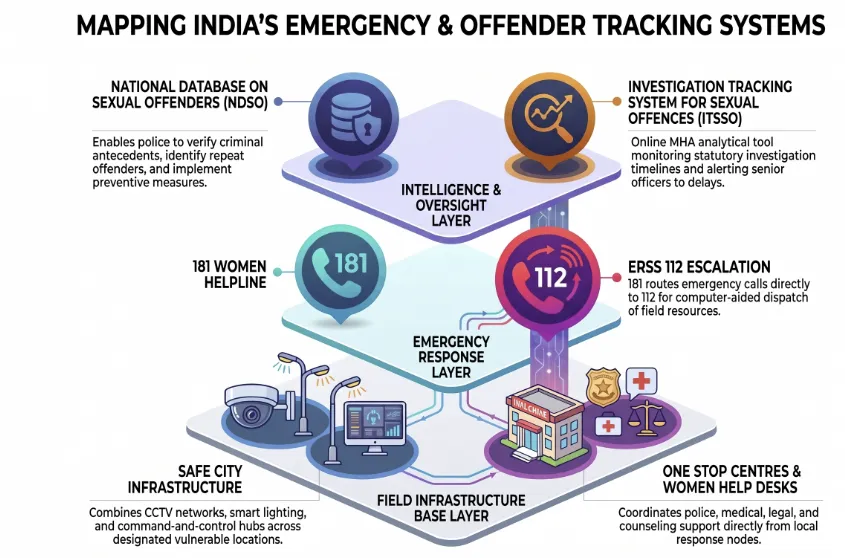
- National Database on Sexual Offenders (NDSO): Usage of the database for antecedent verification and lawful preventive measures against repeat offenders.
- Investigation Tracking System for Sexual Offences (ITSSO): MHA analytical tool usage to monitor statutory investigation timelines and notify senior officers of delays.
- Mission Shakti & Support Infrastructure: Ground availability of Women Help Desks, Emergency Response Support System (ERSS 112), Women Helpline (181), Safe City Projects, and One Stop Centres.
Time-Bound Interim Directives (4-Week Implementation)
Pending review of the status reports, the Court issued immediate binding directives to be executed within 4 weeks:
- Dedicated Police Survey Teams: The Commissioner of Police (CP), Delhi, must form district teams headed by an officer not below DSP rank to inspect vulnerable pockets using NCRB data, local intelligence, and past complaints.
- District Vulnerability Mapping: Creation and sharing of district-wise vulnerability maps across adjoining police stations to prevent crime patterns from staying isolated within single jurisdictions.
- Lighting & CCTV Infrastructure Audits: Immediate audits to eliminate dark spots and repair non-functional CCTVs and lighting in parks, metro stations, bus stops, terminals, and railway stations.
- Citizen Grievance Integration: Ingestion of citizen reports from portals like the CM Jan Sunwai Portal for geo-tagged reporting of lighting or surveillance deficiencies, with mandatory time-bound remediation.
- Enforcement on Tinted Vehicle Windows: Total enforcement of the prohibition against aftermarket dark/tinted or solar-control window films under Avishek Goenka v. Union of India, ordering the impounding of non-compliant vehicles.
Judicial Oversight & Responsible Media Coverage
The Delhi High Court Registrar General has been directed to file an affidavit within 4 weeks detailing the pendency, disposal rates, and functionality of Fast Track Special Courts (FTSCs) and Exclusive POCSO Courts, while assigning current cases to designated courts for trial completion within one year.
Statutory Mandates for Media Organizations
The Court reminded print, electronic, and digital media platforms of statutory prohibitions against disclosing victim identities under Section 72 of the Bharatiya Nyaya Sanhita (BNS), 2023 and Section 23 of the POCSO Act:
- Media coverage must prioritize dignity, factual accuracy, and institutional accountability over sensationalism.
- District authorities must coordinate with media houses to allocate dedicated probono print columns and electronic broadcast slots for emergency helplines.
Senior Advocate Ms. Liz Mathew has been appointed as Amicus Curiae to assist the Court, with notices issued to the Chief Secretary of NCT Delhi, CP Delhi, and the Registrar General of the Delhi High Court. The matter is scheduled for compliance review on October 5, 2026.