Preview
An in-depth analysis of the Delhi High Court's judgment in Habib Ur Rahman v. State Through SHO PS Special Cell Delhi, balancing fundamental rights under Article 21 against national security imperatives under the Official Secrets Act, 1923.
Executive Summary of the Ruling
In a significant judgment delivered in BAIL APPLN. 3081/2026, the High Court of Delhi, presided over by Hon’ble Mr. Justice Sanjeev Narula, rejected the regular bail application of Habib Ur Rahman. The applicant was arrested on 14th July, 2021 in connection with FIR No. 132/2021 registered at Police Station Crime Branch. He faces prosecution under Sections 3 and 9 of the Official Secrets Act, 1923 (OSA), along with Sections 409, 201, 380, 381, 457, 120B, and 34 of the Indian Penal Code, 1860 (IPC).
The case highlights the delicate judicial balance between an accused's right to personal liberty under Article 21 of the Constitution during a delayed trial and the State's overriding interest in safeguarding classified military information.
"An allegation bearing upon national security calls for close scrutiny; it does not place the matter beyond the Court’s bail jurisdiction... The gravity of the present case lies not in the statutory label alone, but in the nature of the documents allegedly procured, their asserted source, and their intended destination."
— Justice Sanjeev Narula, Delhi High Court
Key Factual Background & Prosecution Case
The prosecution alleges that the applicant was apprehended possessing sensitive and confidential military documents. The core elements of the case established by the investigation include:
- Recovery of Classified Documents: The applicant was caught with copies of documents concerning military training, the operationalisation of the Armed Forces Special Operations Division (AFSOD), an Intelligence Summary, and other restricted military material.
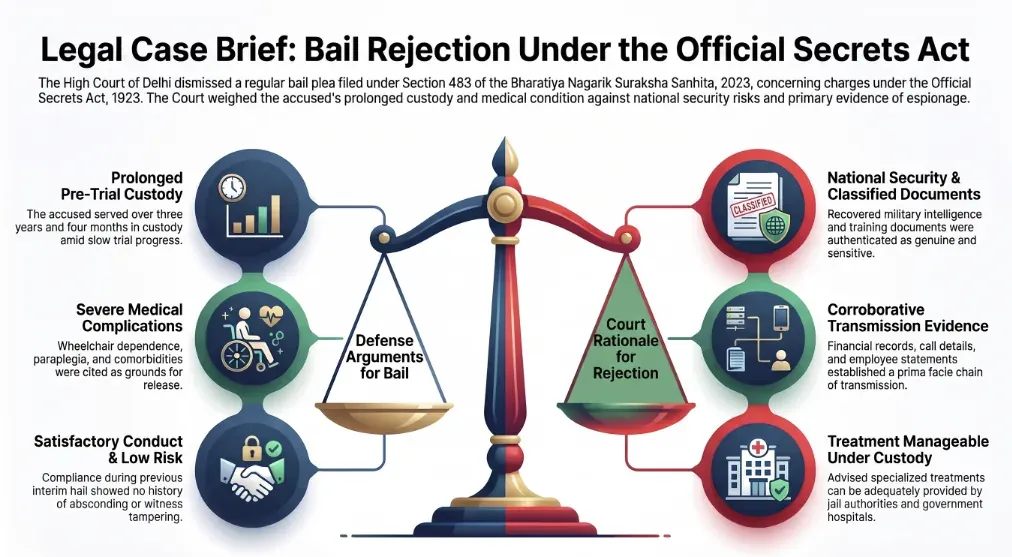
- Military Authentication: The Army authorities subsequently verified the seized documents as genuine, classified, and sensitive.
- Role as Intermediary: According to the prosecution, the applicant acted as a key intermediary between co-accused Naik Clerk Paramjeet Kumar and Rana Muhammad Qasim Zia, an official stationed at the Pakistan High Commission.
- Corroborative Physical & Digital Evidence: The State's case relies on financial transactions, CDR (Call Detail Records), subscriber details of a SIM card acquired in the name of the applicant's employee, and the statement of employee Mohd. Arif, who allegedly delivered documents to the Pakistan High Commission under the applicant's instructions.
Defense Arguments Submitted for Bail
Counsel for the applicant, led by Mr. V. Madhukar, advanced several key arguments seeking regular bail under Section 483 of the Bharatiya Nagarik Suraksha Sanhita, 2023 (BNSS):
- Substantial Period of Incarceration: The applicant has undergone more than 3 years and 4 months of actual custody (recorded as 3 years, 4 months, and 13 days as of September 18, 2026).
- No Misuse of Liberty During Interim Bail: The applicant remained on interim bail from April 2024 until surrendering on 6th February, 2026. During this period, there were no allegations of fleeing, approaching witnesses, or tampering with evidence.
- Slow Pace of Trial: Although charges have been framed, only four witnesses have been examined so far, making early conclusion of the trial unlikely and turning pre-trial detention into a punitive measure.
- Severe Medical Condition: The applicant suffers from post-traumatic paraplegia, left upper limb paresis, and neurogenic bladder, rendering him wheelchair-dependent and reliant on constant daily assistance.
Judicial Analysis & Supreme Court Precedents Evaluated
The High Court undertook a systematic evaluation of statutory provisions, gravity of allegations, and binding constitutional precedents:
1. Bail Jurisdiction in Official Secrets Act Matters
The Court noted that the statutory invocation of Section 3 of the OSA or the potential maximum punishment of 14 years imprisonment is not an absolute bar to granting bail. Relying on the landmark rulings in:
- ***State v. Captain Jagjit Singh* (AIR 1962 SC 253):** Establishing classic bail principles including nature of accusation, character of evidence, and public interest.
- ***State v. Jaspal Singh Gill* ((1984) 3 SCC 555):** Reaffirming that accusations under Section 3 of the OSA concerning military affairs demand a higher standard of judicial care.
2. Evaluation of Evidentiary Material
Justice Narula observed that the prosecution’s case does not rely solely on uncorroborated disclosure statements. The presence of direct documentary recovery, financial links, call detail logs, and witness statements provided a prima facie basis that could not be disregarded at the bail stage.
3. Constitutional Rights under Article 21 vs. Trial Progress
The Court addressed constitutional protections regarding prolonged pre-trial detention:
- Cited ***Union of India v. K.A. Najeeb* ((2021) 3 SCC 713) and Javed Gulam Nabi Shaikh v. State of Maharashtra ((2024) 9 SCC 813)** regarding Article 21 violations in cases of indefinite delay.
- Distinguished these precedents by noting that in the present case, charges have already been framed and prosecution evidence is actively underway.
4. Medical Ailments in Custody
Addressing the applicant's medical reports, the Court observed that he is housed in the Medical Intervention Room of the jail dispensary and is receiving specialized care from leading hospitals (Safdarjung, Dr. BSA, and G.B. Pant Hospitals). Since the medical records did not state that necessary treatment was impossible within custody, medical grounds alone could not justify release on regular bail.
Final Directions Issued by the High Court
While dismissing the regular bail application, the High Court issued critical procedural safeguards to protect the rights of the accused:
- Expeditious Trial Mandate: The Trial Court was directed to accord due priority to the case and record prosecution evidence expeditiously without granting unnecessary adjournments to either side.
- Uninterrupted Medical Treatment: The Jail Superintendent was instructed to ensure that all required investigations, specialist consultations, physiotherapy, and hospital treatments are provided without avoidable delay.
Case Summary at a Glance
| Parameter | Details | | :--- | :--- | | Court | High Court of Delhi at New Delhi | | Case Title | Habib Ur Rahman v. State Through SHO PS Special Cell Delhi | | Case Number | BAIL APPLN. 3081/2026 (CNR No. DLHC010348812026) | | Presiding Judge | Hon'ble Mr. Justice Sanjeev Narula | | Date of Order | September 25, 2026 | | Statutory Provisions | Section 483 BNSS, 2023; Sections 3 & 9 Official Secrets Act, 1923; Sections 409, 201, 380, 381, 457, 120B, 34 IPC | | Key Precedents | Capt. Jagjit Singh (1962), Jaspal Singh Gill (1984), K.A. Najeeb (2021), Javed Gulam Nabi Shaikh (2024) | | Final Disposition | Regular Bail Application Dismissed with directions for expedited trial & medical care |
For further reading on bail jurisprudence under national security laws, check our related article on Default Bail under BNSS.