
All insights

Can courts direct police to conclude a two-decade-long stalled investigation?

Supreme Court Orders Conclusion of Two-Decade-Old Forgery Investigation in Six Weeks

A criminal complaint filed in 2007 alleging forgery of property documents remained uninvestigated for nearly two decades due to lost case records and police inaction. The Supreme Court held that the H

Litigation India Editorial 22 October 2026 1 min read 2026 INSC 626

Story

Case at a glance1 / 5

Supreme Court of India

Two Decades, No Chargesheet: Supreme Court Acts on Stalled Forgery Probe

Sahil Abdulsattar Mansuri & Ors. v. Safimahamad Fafirbhai Mansuri & Ors. | 2026 INSC 626

Court: Supreme Court of India; Date: June 4, 2026Bench: Justice Sanjay Karol and Justice Augustine George MasihArea of Law: Criminal Law — right to speedy investigation under Article 21Complaint filed in 2007 alleging forgery of property documents; no chargesheet for nearly 20 years
Supreme Court Orders Conclusion of Two-Decade-Old Forgery Investigation in Six Weeks · 2026 INSC 6262026-10-22T12:32:13.432121+00:00
The legal question2 / 5

Must High Courts intervene when police delay investigation for decades?

Core legal issue decided by the Supreme Court

  • Appellant: Despite FSL Report confirming forgery in 2017, no chargesheet was filed; High Court wrongly declined to intervene.
  • Appellant: The complainant had repeatedly approached courts over two decades with no relief.
  • Respondent/State: Original case records were lost in transit; witnesses could not be traced; JMFC was the appropriate forum.
  • High Court (below): No case made out for Article 226 directions; JMFC already had powers to act.
Right to speedy trial under Article 21 includes the right to timely investigation.
Supreme Court Orders Conclusion of Two-Decade-Old Forgery Investigation in Six Weeks · 2026 INSC 6262026-10-22T12:32:13.432121+00:00
The Court's reasoning3 / 5

Court's Reasoning: From Complaint to Direction

Step-by-step legal reasoning of the Supreme Court

  1. 1Step 1: Complaint filed in 2007; FSL confirmed forgery in 2017; still no chargesheet — inordinate delay established.
  2. 2Step 2: Article 21 of the Constitution includes right to speedy trial, which encompasses timely investigation.
  3. 3Step 3: Relied on Robert Lalchungnunga Chongthu v. State of Bihar (2025) — investigations cannot continue endlessly.
  4. 4Step 4: State's explanation of lost records insufficient; a closure report should have been filed even without witnesses.
  5. 5Step 5: Constitutional courts must not be mute spectators — High Court ought to have exercised Article 226 jurisdiction.
Supreme Court Orders Conclusion of Two-Decade-Old Forgery Investigation in Six Weeks · 2026 INSC 6262026-10-22T12:32:13.432121+00:00
The verdict4 / 5

The Supreme Court's Final Order

What the Court decided and directed

  • The Fact: Forgery complaint filed in 2007; case records lost in transit; no chargesheet for nearly 20 years despite JMFC and High Court orders.
  • The Law: Article 21 right to speedy trial includes timely investigation; constitutional courts must intervene in prolonged investigative delays under Article 226.
  • The Result: High Court order dismissed the writ petition set aside; Gujarat Police directed to conclude investigation in six weeks and file report with JMFC.
State of Gujarat directed to conclude investigation within six weeks and file affidavit explaining the loss of records and action against errant officer.
Supreme Court Orders Conclusion of Two-Decade-Old Forgery Investigation in Six Weeks · 2026 INSC 6262026-10-22T12:32:13.432121+00:00
Why it matters5 / 5

What This Means for Ordinary People

Practical significance of this judgment

  • Crime victims cannot be made to wait indefinitely for police to file a chargesheet — courts must intervene.
  • If your police complaint has been pending investigation for an unreasonably long time, you can approach the High Court under Section 528 BNSS or Section 482 CrPC.
  • Police losing case records during investigation is a serious failure; the State must account for it through affidavit and disciplinary action.
  • High Courts cannot simply redirect complainants to the JMFC when decades of investigative inaction are established.
Constitutional courts must not be mute spectators when prolonged investigative inaction renders bonafide complaints inactionable.
Supreme Court Orders Conclusion of Two-Decade-Old Forgery Investigation in Six Weeks · 2026 INSC 6262026-10-22T12:32:13.432121+00:00
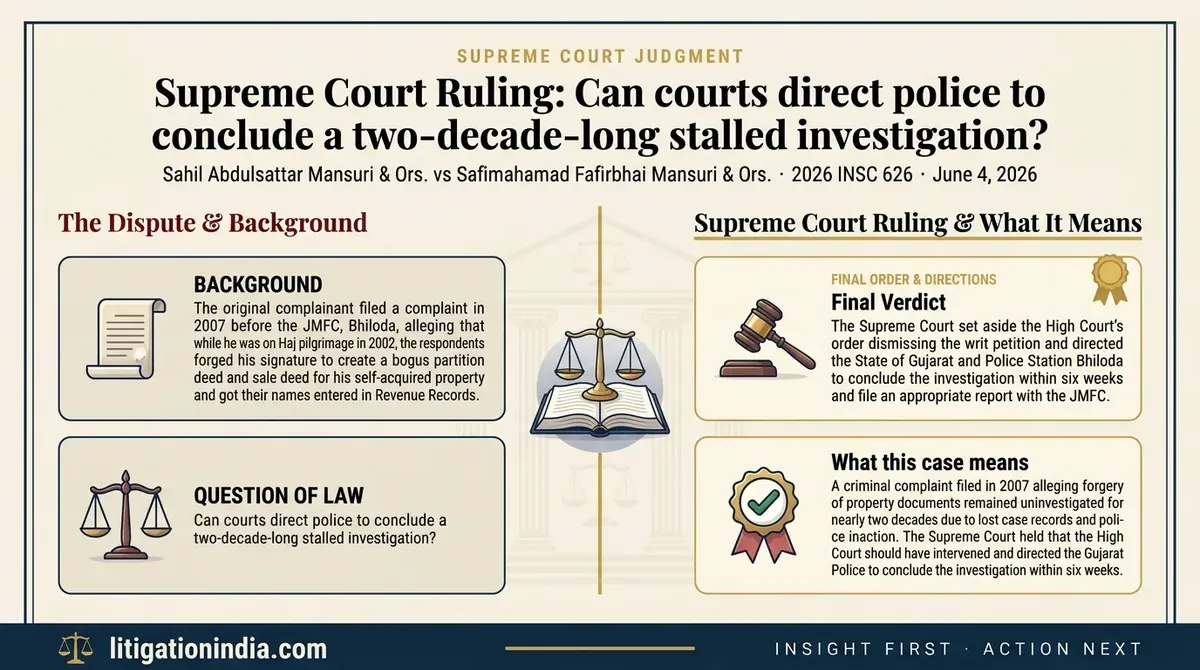
Supreme Court Orders Conclusion of Two-Decade-Old Forgery Investigation in Six Weeks — infographic summary

What this case means

A criminal complaint filed in 2007 alleging forgery of property documents remained uninvestigated for nearly two decades due to lost case records and police inaction. The Supreme Court held that the High Court should have intervened and directed the Gujarat Police to conclude the investigation within six weeks. The case reaffirms that the right to speedy trial under Article 21 includes timely investigation.

What the Supreme Court held

The Supreme Court set aside the High Court's order dismissing the writ petition and directed the State of Gujarat and Police Station Bhiloda to conclude the investigation within six weeks and file an appropriate report with the JMFC. The State was further directed to file an affidavit detailing action taken against the errant officer, reasons for not informing the JMFC about inability to reconstruct records, and compliance with the investigation direction. The matter was listed for hearing on 14.07.2026.

Case: Sahil Abdulsattar Mansuri & Ors. vs Safimahamad Fafirbhai Mansuri & Ors. (2026) Citation: 2026 INSC 626

Want the full legal reasoning, citations and case documents?

Read the full judgment analysis
Sahil Abdulsattar Mansuri
speedy trial
Article 21
chargesheet delay
forgery
IPC Section 420
Gujarat High Court
BNSS Section 528
CrPC Section 482
criminal investigation delay
lost case records
right to speedy trial
Article 21, Article 226, The Constitution of India
Sections 120B, 406, 420, 463, 468, 471, 114, Indian Penal Code, 1860