
Updates

Can courts direct police to conclude a two-decade-long stalled investigation?

Supreme Court Orders Conclusion of Two-Decade-Old Forgery Investigation in Six Weeks

Case: Sahil Abdulsattar Mansuri & Ors. vs Safimahamad Fafirbhai Mansuri & Ors.Citation: 2026 INSC 626Decided on: June 4, 2026

What this case means

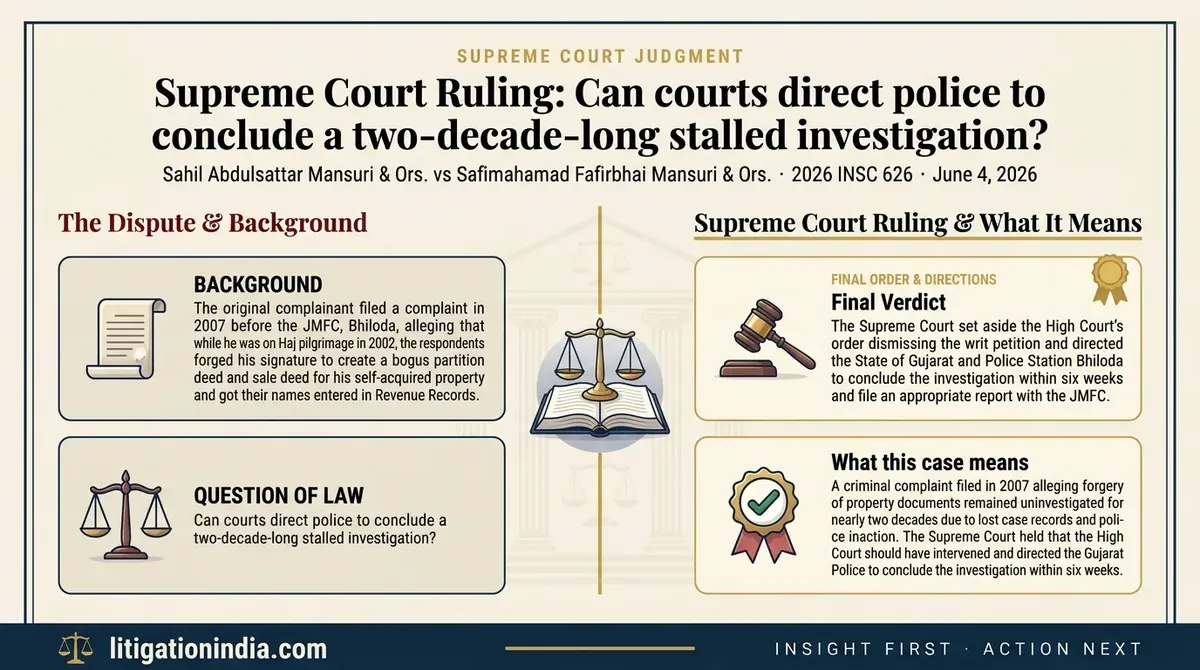
A criminal complaint filed in 2007 alleging forgery of property documents remained uninvestigated for nearly two decades due to lost case records and police inaction. The Supreme Court held that the High Court should have intervened and directed the Gujarat Police to conclude the investigation within six weeks. The case reaffirms that the right to speedy trial under Article 21 includes timely investigation.

“The Supreme Court directed the Gujarat Police to conclude a nearly two-decade-old forgery investigation within six weeks, holding that constitutional courts must intervene in cases of prolonged investigative delay.”

Share:

Story Slides

Case at a glance1 / 5

Supreme Court of India

Two Decades, No Chargesheet: Supreme Court Acts on Stalled Forgery Probe

Sahil Abdulsattar Mansuri & Ors. v. Safimahamad Fafirbhai Mansuri & Ors. | 2026 INSC 626

Court: Supreme Court of India; Date: June 4, 2026Bench: Justice Sanjay Karol and Justice Augustine George MasihArea of Law: Criminal Law — right to speedy investigation under Article 21Complaint filed in 2007 alleging forgery of property documents; no chargesheet for nearly 20 years
Sahil Abdulsattar Mansuri & Ors. vs Safimahamad Fafirbhai Mansuri & Ors. · 2026 INSC 626June 4, 2026
The legal question2 / 5

Must High Courts intervene when police delay investigation for decades?

Core legal issue decided by the Supreme Court

  • Appellant: Despite FSL Report confirming forgery in 2017, no chargesheet was filed; High Court wrongly declined to intervene.
  • Appellant: The complainant had repeatedly approached courts over two decades with no relief.
  • Respondent/State: Original case records were lost in transit; witnesses could not be traced; JMFC was the appropriate forum.
  • High Court (below): No case made out for Article 226 directions; JMFC already had powers to act.
Right to speedy trial under Article 21 includes the right to timely investigation.
Sahil Abdulsattar Mansuri & Ors. vs Safimahamad Fafirbhai Mansuri & Ors. · 2026 INSC 626June 4, 2026
The Court's reasoning3 / 5

Court's Reasoning: From Complaint to Direction

Step-by-step legal reasoning of the Supreme Court

  1. 1Step 1: Complaint filed in 2007; FSL confirmed forgery in 2017; still no chargesheet — inordinate delay established.
  2. 2Step 2: Article 21 of the Constitution includes right to speedy trial, which encompasses timely investigation.
  3. 3Step 3: Relied on Robert Lalchungnunga Chongthu v. State of Bihar (2025) — investigations cannot continue endlessly.
  4. 4Step 4: State's explanation of lost records insufficient; a closure report should have been filed even without witnesses.
  5. 5Step 5: Constitutional courts must not be mute spectators — High Court ought to have exercised Article 226 jurisdiction.
Sahil Abdulsattar Mansuri & Ors. vs Safimahamad Fafirbhai Mansuri & Ors. · 2026 INSC 626June 4, 2026
The verdict4 / 5

The Supreme Court's Final Order

What the Court decided and directed

  • The Fact: Forgery complaint filed in 2007; case records lost in transit; no chargesheet for nearly 20 years despite JMFC and High Court orders.
  • The Law: Article 21 right to speedy trial includes timely investigation; constitutional courts must intervene in prolonged investigative delays under Article 226.
  • The Result: High Court order dismissed the writ petition set aside; Gujarat Police directed to conclude investigation in six weeks and file report with JMFC.
State of Gujarat directed to conclude investigation within six weeks and file affidavit explaining the loss of records and action against errant officer.
Sahil Abdulsattar Mansuri & Ors. vs Safimahamad Fafirbhai Mansuri & Ors. · 2026 INSC 626June 4, 2026
Why it matters5 / 5

What This Means for Ordinary People

Practical significance of this judgment

  • Crime victims cannot be made to wait indefinitely for police to file a chargesheet — courts must intervene.
  • If your police complaint has been pending investigation for an unreasonably long time, you can approach the High Court under Section 528 BNSS or Section 482 CrPC.
  • Police losing case records during investigation is a serious failure; the State must account for it through affidavit and disciplinary action.
  • High Courts cannot simply redirect complainants to the JMFC when decades of investigative inaction are established.
Constitutional courts must not be mute spectators when prolonged investigative inaction renders bonafide complaints inactionable.
Sahil Abdulsattar Mansuri & Ors. vs Safimahamad Fafirbhai Mansuri & Ors. · 2026 INSC 626June 4, 2026

At a glance (infographic)

Sahil Abdulsattar Mansuri & Ors. vs Safimahamad Fafirbhai Mansuri & Ors. — infographic summary
Download infographic

In short

The Supreme Court of India, in a criminal appeal arising from Gujarat, intervened in a case where a criminal complaint filed in 2007 by the original complainant (father of the appellants) remained without a chargesheet for nearly two decades. The complaint alleged that while the complainant was on Haj pilgrimage from February to March 2002, the respondents forged his signatures, created a bogus partition deed and sale deed for his self-acquired property (Survey No. 761, Bhiloda Village), and got their names entered in Revenue Records. The police filed a C-Summary in 2014 which was rejected and further investigation was ordered. Subsequently, the High Court of Gujarat directed preparation of an investigation report in 2017, and an FSL Report confirmed the forgery. Despite multiple orders by the JMFC and the High Court, no chargesheet was filed. The State of Gujarat explained that case records went missing in transit to the JMFC, re-investigation was ordered, but original records remained untraceable and relevant witnesses could not be found. The High Court dismissed the writ petition in 2025, holding that Article 226 directions were not warranted and the JMFC was the appropriate forum. The Supreme Court reversed this view, holding that the right to speedy trial under Article 21 of the Constitution includes timely investigation. Relying on Robert Lalchungnunga Chongthu v. State of Bihar (2025 SCC OnLine SC 2511), the Court held that constitutional courts must not remain mute spectators to prolonged investigations. The Court directed the State of Gujarat and Police Station Bhiloda to conclude investigation within six weeks and file an appropriate report with the JMFC. It also directed the State to file an affidavit detailing action taken against the errant officer, the reasons for not informing the JMFC about inability to reconstruct records, and compliance with the investigation direction. The matter was listed for 14.07.2026.

Need clarity on a similar legal issue?

Request free pro bono guidance from a Supreme Court Advocate.

Request Guidance

Background

The original complainant filed a complaint in 2007 before the JMFC, Bhiloda, alleging that while he was on Haj pilgrimage in 2002, the respondents forged his signature to create a bogus partition deed and sale deed for his self-acquired property and got their names entered in Revenue Records. Despite an FSL Report in 2017 confirming forgery and multiple orders by the JMFC directing further investigation, no chargesheet was filed for nearly two decades. The State attributed the delay to the loss of original case records in transit, making it impossible to conclusively trace witnesses.

The Decision

The Supreme Court set aside the High Court's order dismissing the writ petition and directed the State of Gujarat and Police Station Bhiloda to conclude the investigation within six weeks and file an appropriate report with the JMFC. The State was further directed to file an affidavit detailing action taken against the errant officer, reasons for not informing the JMFC about inability to reconstruct records, and compliance with the investigation direction. The matter was listed for hearing on 14.07.2026.

Why it matters for you

This judgment affirms that victims of crime cannot be made to wait indefinitely for police to file a chargesheet, and that High Courts must use their writ jurisdiction to correct prolonged investigative inaction. It establishes that loss of case records by police is a serious failure that strikes at the core of the justice system. Ordinary complainants can now approach the High Court under Section 528 BNSS or Section 482 CrPC if investigation drags on without adequate justification.

Relevant Legal Provisions

Key Acts and sections cited or relied upon in this judgment

“Article 21 guarantees the right to life and personal liberty including the right to speedy trial, which the Court held encompasses timely investigation; Article 226 confers extraordinary writ jurisdiction on High Courts, which the Court held ought to have been exercised to direct filing of the chargesheet.”
“These sections relating to criminal conspiracy, criminal breach of trust, cheating, forgery, and abetment formed the basis of the original criminal complaint filed by the complainant alleging forged property documents.”
“Section 528 BNSS (equivalent to Section 482 CrPC) was cited as the provision under which an accused or complainant may approach the High Court seeking an update on investigation or quashing in cases of undue delay.”
“Section 482 CrPC (now Section 528 BNSS) was cited as the provision under which complainants or accused may approach the High Court where investigation has remained pending for an unduly long period without adequate justification.”

Full text of the judgment

Text extracted from Sahil Abdulsattar Mansuri & Ors. vs Safimahamad Fafirbhai Mansuri & Ors.. For the authoritative version refer to the Supreme Court of India's official website.

2026 INSC 626 Crl. A. @ SLP (Crl.) No. 17479/2025

Page 1 of 10 REPORTABLE

IN THE SUPREME COURT OF INDIA CRIMINAL APPELLATE JURISDICTION

CRIMINAL APPEAL NO. ____ OF 2026 (@ Special Leave Petition (Crl.) NO. 17479 OF 2025)

SAHIL ABDULSATTAR MANSURI & ORS.

… APPELLANT(S)

SAFIMAHAMAD FAFIRBHAI MANSURI & ORS.

… RESPONDENT(S)

SANJAY KAROL, J.

Leave granted. 2. Justice delayed is justice denied. While this proverb has been reiterated by Courts for time immemorial, the case at hand Digitally signed by SOURAV PAL Date: 2026.06.04 16:08:47 IST Reason: Signature Not Verified

Crl. A. @ SLP (Crl.) No. 17479/2025

Page 2 of 10 is an unfortunate occasion where despite repeatedly knocking the doors of the Courts below, there has been an inordinate delay of nearly two decades in the investigation of the criminal complaint, which compels interference by this Court.

3. The present appeal arises from the impugned order dated 26.06.2025 in Special Criminal Application (Direction) No. 2029 of 2024 passed by the High Court of Gujarat at Ahmedabad, whereby the writ petition preferred by the predecessor of the appellants praying for a direction to respondent no. 6 to file charge-sheet in their criminal complaint dated 14.09.2007, came to be dismissed.

Brief Facts

4. The father of the appellant(s)1 instituted a complaint before the Judicial Magistrate First Class, Bhiloda2 against respondent no. 1 to 4, under Sections 120B, 406, 420, 463,468, 471, and 114 of the Indian Penal Code, 18603. It was alleged therein that the subject property, being Survey No. 761, Bhiloda Village, was self-acquired by him on 11.12.1975. Subsequently, when he was on Haj pilgrimage from 05.02.2002 to 21.03.2002, the aforesaid accused persons forged his signature and prepared a forged

1 Hererinafter ‘original complainant’. 2 Hereinafter ‘JMFC’. 3 Hereinafter ‘IPC’.

Crl. A. @ SLP (Crl.) No. 17479/2025

Page 3 of 10 partition deed alongwith a bogus sale deed qua the subject property. On the basis of such forgery, their names were entered into the Revenue Records.

5. On 10.10.2014, the police presented C-Summary before the JMFC which came to be rejected, and further investigation was directed, to be concluded within 60 days. Thereafter, upon consideration of an application filed by the original complainant4 before the High Court of Gujarat at Ahmedabad5, on 20.07.2017, the Court directed preparation of the investigation report within six weeks while recording that some of the material collected during the investigation had gone missing from the custody of the concerned Police Station.

6. Consequently, on 29.08.2017, the FSL Report was prepared and forwarded to JMFC on 27.11.2017. In this report, it was stated that the accused persons had prepared forged documents and forged signatures of the complainant. Pursuant thereto, on 27.11.2017, in Summary No.59 of 2017 the JMFC directed the police to take further action and carry out further investigation.

4 Special Criminal Application (Direction) No. 4455 of 2017. 5 Hereinafter ‘High Court’.

Crl. A. @ SLP (Crl.) No. 17479/2025

Page 4 of 10 7. Thereafter, on 21.01.2018, an application was filed by the original complainant before the JMFC praying for appropriate orders to the investigating officer as neither the investigation was concluded nor a final report was submitted in the complaint. In the said application, the JMFC directed the investigating officer to specify within a period of 10 days as to whether investigation remains pending or has been concluded.

8. On 14.09.2022, the Addl. Judicial Magistrate Bhiloda, again directed the investigating officer to carry out investigation and file charge sheet in accordance with law. The original complainant was constrained to file another application6 before the High Court, praying for directions to the investigating officer to file chargesheet.

9. Vide the impugned order, the High Court refused to issue any such direction and disposed of the application. It was observed that no case is made out for issuance of direction under Article 226 of the Constitution and since the JMFC had already passed an order to similar effect, an appropriate proceeding should have been initiated before the JMFC.

6 Special Criminal Application (Direction) No. 2029 of 2024.

Crl. A. @ SLP (Crl.) No. 17479/2025

Page 5 of 10 Our View

10. We have heard the learned counsel for the parties. At the outset, in the considered view of this Court, the High Court ought to have taken note of the inordinate delay in filing of the chargesheet and intervened in the matter at hand.

11. The right to speedy trial is intrinsically linked to Article 21 of the Constitution. On this aspect, we advert to the observations of this Court in Robert Lalchungnunga Chongthu v. State of Bihar7:

“14. Various judgments of this Court have emphasised the right to speedy trial as being an important facet of Article 21 of the Constitution. Timely completion of investigation is inherent thereto.

15. Moving further, it is to be noted that this aspect of prompt investigation has received statutory recognition as well in the CrPC, which of course, is the comprehensive code laying down detailed procedure is for stages of investigation, trial and appeal among other things. It must be stated that statutory recognition of prompt investigation is a preconstitutional stipulation.

17. The inescapable conclusion arrived at from the above discussion in the Indian context, is that there has been an evolution in legislative wisdom over the years and the criminal procedure have moved from a

7 2025 SCC OnLine SC 2511.

Crl. A. @ SLP (Crl.) No. 17479/2025

Page 6 of 10 period of no timelines and minimal judicial interventions/oversight to progressively more oversight and recognition of the need to conclude investigations in time. It may be true that no strict timelines are provided in the CrPC, but it is equally so that investigations are to be completed in reasonable time.

21. Before parting with this matter, we deem it fit to issue the following directions:

ii) Reasons are indispensable to the proper functioning of the machinery of criminal law. They form the bedrock of fairness, transparency, and accountability in the justice system. If the Court finds or the accused alleges (obviously with proof and reason to substantiate the allegation) that there is a large gap between the first information report and the culminating chargesheet, it is bound to seek an explanation from the investigating agency and satisfy itself to the propriety of the explanation so furnished.

The direction above does not come based on this case alone. This Court has noticed on many unfortunate occasions that there is massive delay in filing chargesheet/taking cognizance etc. This Court has time and again, in its pronouncements underscored the necessity of speedy investigation and trial as being important for the accused, victim and the society. However, for a variety of reasons there is still a lag in the translation of this recognition into a reality.

Crl. A. @ SLP (Crl.) No. 17479/2025

Page 7 of 10 (iii) While it is well acknowledged and recognised that the process of investigation has many moving parts and is therefore impractical to have strict timelines in place, at the same time, the discussion made in the earlier part of this judgement, clearly establishes that investigations cannot continue endlessly. The accused is not out of place to expect, after a certain point in time, certainty- about the charges against him, giving him ample time to preparing plead his defence. If investigation into a particular offence has continued for a period that appears to be unduly long, that too without adequate justification, such as in this case, the accused or the complainant both, shall be at liberty to approach the High Court under Section 528 BNSS/482 CrPC, seeking an update on the investigation or, if the doors of the High Court have been knocked by the accused, quashing. It is clarified that delay in completion of investigation will only function as one of the grounds, and the Court, if in its wisdom, decides to entertain this application, other grounds will also have to be considered.”

(emphasis supplied)

12. In the present factual matrix, nearly two decades have passed since the initiation of the complaint by the original complainant. However, it is a matter of serious concern that despite the lapse of such an inordinate period of time the investigation is yet to reach any meaningful conclusion. From a bare perusal of the record, it is evident that the original complainant had run from pillar to post, for filing of a chargesheet in connection with his complaint, but to no avail.

Crl. A. @ SLP (Crl.) No. 17479/2025

Page 8 of 10

13. This Court is of the view that it is incumbent upon constitutional courts to not remain mute spectators, when such prolonged investigations are brought to its notice. Therefore, in such peculiar circumstances, the High Court ought to have exercised its extraordinary jurisdiction to intervene in the present matter.

14. At this stage, it becomes appropriate to consider the stand put forth by the State of Gujarat. It has been submitted that the materials seized during the course of investigation were sent for FSL examination, wherein it was opined that the original complainant had not authored the signatures on the forged documents. A detailed report, along with original case papers, was sent to the JMFC Court through Police Station Bhiloda, via Outward No. 564/15. However, during transit, the said material is stated to have been misplaced and was never received by the JMFC. Thereafter, re-investigation was ordered by the High Court of Gujarat vide order dated 20.07.2017.

15. It has been submitted that during re-investigation, the original case papers remained untraceable. Disciplinary proceedings were initiated against the officer concerned and appropriate action was taken in accordance with law. The stand of the State is that in the absence of the original case records and

Crl. A. @ SLP (Crl.) No. 17479/2025

Page 9 of 10 inability to conclusively trace all relevant witnesses, the investigation could not be carried out to its logical conclusion.

16. Upon consideration of the stand of the State, we find that from the order of the High Court ordering re-investigation, nearly a decade has passed. Even in the case that during the investigation the police were not able to trace the relevant witnesses, ordinarily an appropriate report seeking closure should have been filed before the JMFC. We find no reason from the record, as to why the complaint and investigation have remained pending till date.

17. Moreover, we are of the view that incidents such as this, wherein case records are lost during an active investigation, have to be taken with utmost seriousness. Moreover, such incidents strike at the very core of the criminal justice system, rendering bonafide complaints inactionable.

18. Therefore, in the interest of justice, we direct the State of Gujarat and Police Station Bhiloda, to conclude investigation within a period of six weeks from today and file an appropriate report with the JMFC containing all investigative material and if so, the lack thereof. Furthermore, the State of Gujarat to file an affidavit indicating:

Crl. A. @ SLP (Crl.) No. 17479/2025

Page 10 of 10 a. Specific action taken against the officer involved, the stage of such action and whether taken to its logical conclusion; b. Despite directions of the JMFC to conclude further investigation after the loss of records, why was the JMFC not informed of the inability to reconstruct records and track witnesses etc.; and c. Compliance with direction to conclude investigation.

19. List on 14.07.2026 at 2.00 P.M. as part heard.

………..…………………………..J. (SANJAY KAROL)

………..……………………….…..J. (AUGUSTINE GEORGE MASIH)

New Delhi June 4, 2026

AI-assisted summary, reviewed and verified by our editorial team.

In the Court's words

“Justice delayed is justice denied. While this proverb has been reiterated by Courts for time immemorial, the case at hand is an unfortunate occasion where despite repeatedly knocking the doors of the Courts below, there has been an inordinate delay of nearly two decades in the investigation of the criminal complaint.”
“It is incumbent upon constitutional courts to not remain mute spectators, when such prolonged investigations are brought to its notice.”
“Investigations cannot continue endlessly. The accused is not out of place to expect, after a certain point in time, certainty about the charges against him, giving him ample time to preparing plead his defence.”
“Incidents such as this, wherein case records are lost during an active investigation, have to be taken with utmost seriousness. Moreover, such incidents strike at the very core of the criminal justice system, rendering bonafide complaints inactionable.”

Need help with your case?

Facing a similar legal challenge in the Supreme Court or High Court? Connect with our pro bono volunteer advocates today.

Request Free Callback

Advocates handling Criminal Law / Speedy Investigation / Writ Jurisdiction

Litigation India

Insight First, Action Next. A public-service initiative to make justice understandable for every Indian.

contact@litigationindia.com

+91 9956486585

New Delhi, India

Quick Links

Our Mission

To empower ordinary citizens, litigants, and junior advocates across India by translating complex Supreme Court of India judgments into editor-verified, plain-language summaries in both English and Hindi. We aim to bridge the gap between judicial proceedings and everyday citizens by delivering verified legal insights and offering free, pro bono guidance from experienced Supreme Court advocates—ensuring no individual suffers injustice merely for lack of correct guidance.

Legal Disclaimer: The information and case summaries on this website are provided for general public understanding only and do not constitute legal advice. Accessing this website or any guidance here does not create an attorney-client relationship, which is established only upon a formal engagement with a lawyer. Litigation India is an informational, public-service platform — always consult a qualified advocate before acting on any information relating to your specific matter.

© 2026 Litigation India. All rights reserved.