
All insights

Can accused in a serious corruption case be kept in pre-trial custody indefinitely?

Supreme Court Grants Bail to Accused in Rajasthan Jal Jeevan Mission Corruption Case

Two accused in a major corruption case involving the Jal Jeevan Mission in Rajasthan sought bail after the High Court rejected their applications. The Supreme Court granted bail, holding that prolonge

Litigation India Editorial 29 September 2026 1 min read 2026 INSC 1065

Story

Case at a glance1 / 5

Supreme Court of India

Bail Granted in Rajasthan Jal Jeevan Mission Corruption Case

Sanjay Badaya & Shubhanshu Dixit vs. State of Rajasthan | 2026 INSC 1065

Court: Supreme Court of India | Date: 29 September 2026Bench: Justice Dipankar Datta and Justice Sheel NaguArea of Law: Criminal Law — Bail / Anti-CorruptionFIR for offences under Prevention of Corruption Act 1988 and IPC 1860
Supreme Court Grants Bail to Accused in Rajasthan Jal Jeevan Mission Corruption Case · 2026 INSC 10652026-09-29T13:29:03.726727+00:00
The legal question2 / 5

Should Bail Be Denied Indefinitely in Serious Economic Offences?

Core legal issue framed by the Court

  • Appellant: Investigation complete, chargesheets filed, evidence seized — no risk of tampering.
  • Appellant: Trial not imminent; prolonged pre-trial custody violates Article 21 liberty rights.
  • Appellant: Co-accused including the former PHED Minister already granted bail.
  • Respondent: Economic offences with deep-rooted conspiracy must be viewed seriously; bail should be opposed.
Supreme Court Grants Bail to Accused in Rajasthan Jal Jeevan Mission Corruption Case · 2026 INSC 10652026-09-29T13:29:03.726727+00:00
The Court's reasoning3 / 5

How the Court Reached Its Decision to Grant Bail

Step-by-step reasoning

  1. 1Step 1: Acknowledged gravity of economic offences — conspiracy serious and State justified in opposing bail.
  2. 2Step 2: Evidence already seized and secured — risk of tampering substantially eliminated.
  3. 3Step 3: Trial at nascent stage — charges not framed, some accused still under investigation or absconding.
  4. 4Step 4: Invoked Article 21 — pre-trial incarceration cannot become punitive detention when trial is distant.
  5. 5Step 5: Applied parity — co-accused including former PHED Minister already on bail; no reason to treat appellants differently.
Supreme Court Grants Bail to Accused in Rajasthan Jal Jeevan Mission Corruption Case · 2026 INSC 10652026-09-29T13:29:03.726727+00:00
The verdict4 / 5

The Court's Final Decision

Fact, Law, Result

  • Fact: Rs. 979.45 crore tender fraud alleged; chargesheets filed; 124 witnesses; trial not yet commenced.
  • Law: Article 21 — pre-trial detention cannot be punitive; parity with co-accused who received bail.
  • Result: High Court orders set aside; both appellants directed to be released on bail with Trial Court conditions.
Appellants shall be released on bail unless required in any other case, subject to bail bonds and conditions of the Trial Court.
Supreme Court Grants Bail to Accused in Rajasthan Jal Jeevan Mission Corruption Case · 2026 INSC 10652026-09-29T13:29:03.726727+00:00
Why it matters5 / 5

What This Judgment Means for Ordinary People

Practical significance

  • Even in grave corruption cases, an accused has a right to bail if the trial is unlikely to start soon.
  • Once evidence is seized and secured, courts will not deny bail merely on fear of tampering.
  • If co-accused have been granted bail, courts must give equal treatment to others in similar positions.
  • Pre-trial detention is not punishment — the Constitution protects personal liberty until guilt is proved.
Pre-trial incarceration cannot masquerade as punitive detention when the trial is not imminent.
Supreme Court Grants Bail to Accused in Rajasthan Jal Jeevan Mission Corruption Case · 2026 INSC 10652026-09-29T13:29:03.726727+00:00
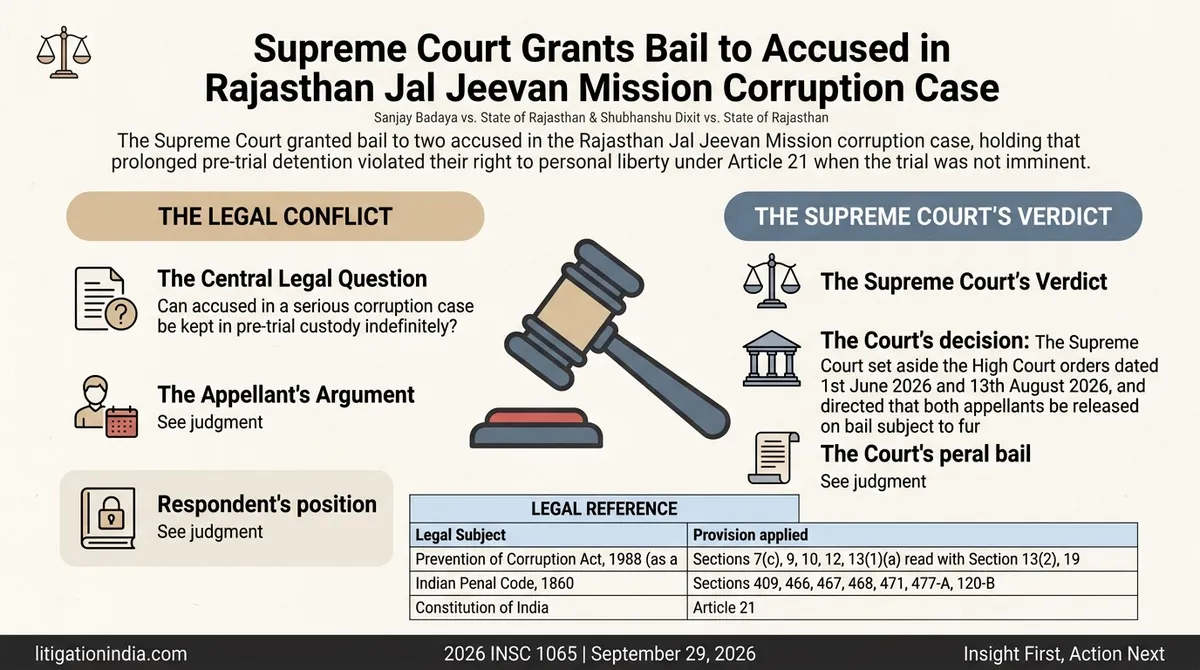
Supreme Court Grants Bail to Accused in Rajasthan Jal Jeevan Mission Corruption Case — infographic summary

What this case means

Two accused in a major corruption case involving the Jal Jeevan Mission in Rajasthan sought bail after the High Court rejected their applications. The Supreme Court granted bail, holding that prolonged pre-trial custody is unjustifiable when the trial is likely to be long and evidence is already secured. The decision reinforces that pre-trial detention cannot function as punishment.

What the Supreme Court held

The Supreme Court set aside the High Court orders dated 1st June 2026 and 13th August 2026, and directed that both appellants be released on bail subject to furnishing bail bonds to the satisfaction of the Trial Court and such other conditions as the Trial Court may impose. The appellants were also directed to cooperate with ongoing investigation if called upon by the investigating officer, and to attend all Trial Court hearings diligently.

Case: Sanjay Badaya vs. State of Rajasthan & Shubhanshu Dixit vs. State of Rajasthan (2026) Citation: 2026 INSC 1065

Want the full legal reasoning, citations and case documents?

Read the full judgment analysis
Sanjay Badaya
Shubhanshu Dixit
State of Rajasthan
bail
Prevention of Corruption Act 1988
Jal Jeevan Mission
Anti-Corruption Bureau
Indian Penal Code 1860
Article 21
pre-trial incarceration
economic offences
PHED
Sections 7(c), 9, 10, 12, 13(1)(a) read with Section 13(2), 19, Prevention of Corruption Act, 1988 (as amended in 2018)
Sections 409, 466, 467, 468, 471, 477-A, 120-B, Indian Penal Code, 1860