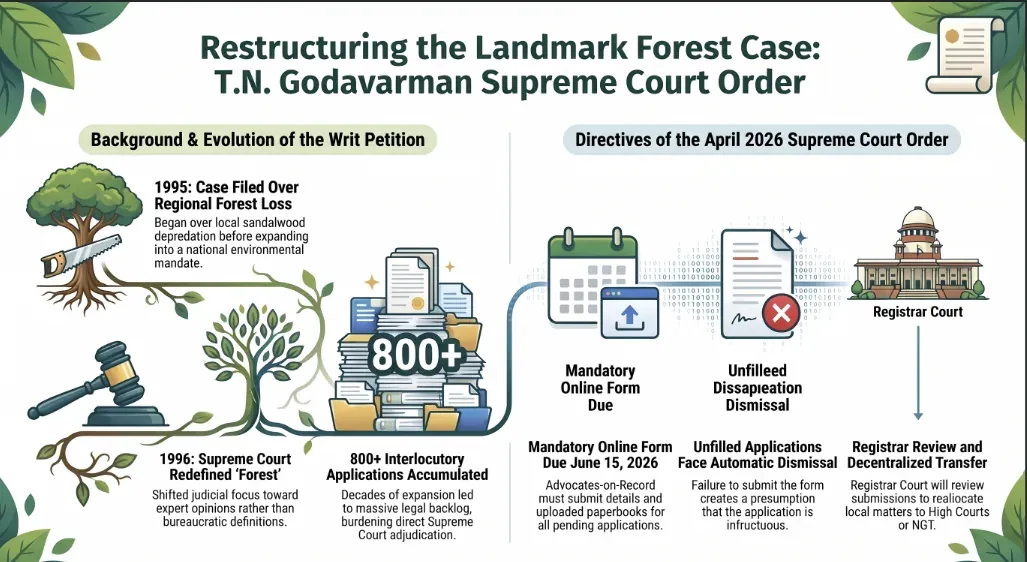
The Supreme Court of India (Bench comprising Chief Justice of India and Justice Joymalya Bagchi) has instituted a comprehensive framework to restructure and streamline proceedings in Writ Petition (Civil) No. 202 of 1995 (In Re: T.N. Godavarman Thirumulpad v. Union of India & Ors.). Recognizing that the accumulation of over 800 pending Interlocutory Applications (IAs)—many lingering for nearly 25 years—has rendered adjudication cumbersome and clogged the legal system, the Court has directed a mandatory online audit for all pending applications.
Background: Evolution of India's Continuing Mandamus on Forests
The T.N. Godavarman Thirumulpad petition was originally instituted in 1995 to address rampant sandalwood timber logging and deforestation in the Nilgiris region of Tamil Nadu. Recognizing widespread systemic and regulatory lapses across the country, the Supreme Court expanded the scope of the petition into a national proceeding.
Through its landmark order dated December 12, 1996, the Supreme Court expanded the legal definition of "forest" beyond statutory forest lands to include all areas conforming to the dictionary meaning of a forest, relying on expert opinions rather than bureaucratic classifications. Over the last three decades, this continuing mandamus led to major policy and statutory reforms, including:
- Protection of Ecologically Sensitive Zones: Judicial oversight over Protected Areas, National Parks, Wildlife Sanctuaries, Tiger Reserves, and the Morphological Ridge in Delhi.
- Institutional Mechanisms: The creation of the Central Empowered Committee (CEC) as an expert supervisory body (later granted statutory backing under Section 3(3) of the Environment Protection Act, 1986).
- Compensatory Afforestation: Establishing ad-hoc mechanisms for funds management, which eventually evolved into the statutory National and State Compensatory Afforestation Fund Management and Planning Authorities under the Compensatory Afforestation Fund Act, 2016.
The Challenge of Over 800 Pending Applications
While the expanding scope allowed the Court to address regulatory gaps, centrifuging all localized forest-related disputes before the Supreme Court created significant procedural bottlenecks. The Bench noted that handling hundreds of applications involving diverse local factual scenarios hindered swift access to justice through jurisdictional High Courts and the specialized Benches of the National Green Tribunal (NGT).
"Centrifuging all forest related issues of local and executory nature before this Court has also impacted quick and seamless access to justice through the decentralised judicial structure of the High Courts and the Specialised Benches of the National Green Tribunal." — Supreme Court of India
Moreover, pending applications frequently involved complex, interconnected legal questions. For instance, applications seeking permission for commercial activities like Night Safaris in Tiger Reserves across the Aravalli region depend on broader determinations regarding:
- The exact legal definition and permissible activities within the Aravalli Region;
- Delimitation of Tiger Reserve/Sanctuary boundaries and Eco-Sensitive Buffer Zones; and
- Impact assessment reports submitted by expert bodies.
Directions Issued by the Supreme Court
To resolve these bottlenecks, the Supreme Court adopted a model similar to its recent restructuring of long-standing M.C. Mehta environmental litigations. Accepting the recommendations of Senior Advocate Mr. K. Parameshwar (Amicus Curiae), the Court issued the following binding directions:
1. Mandatory Online Questionnaire
The Amicus Curiae and the Supreme Court Registry shall deploy an accessible online form for all pending IAs, tagged petitions, and appeals.
2. Required Data Disclosure
Advocates-on-Record (AORs) and Parties-in-Person must provide:
- Applicant and proposed respondent details.
- Specific category/subject matter of the IA.
- Whether the application was necessitated by a prior order mandating Supreme Court leave.
- Whether the IA has become infructuous due to passage of time or subsequent orders.
- Justification as to why the matter cannot be adjudicated by the local High Court or National Green Tribunal.
- A complete uploaded digital set of paperbooks.
3. Strict Filing Deadline: June 15, 2026
The link to the questionnaire will be made available on the Supreme Court website and circulated via the Supreme Court Advocates-on-Record Association (SCAORA). All AORs or Parties-in-Person must submit the completed form on or before June 15, 2026.
Key Takeaway for Practitioners: Failure to submit the completed online questionnaire by June 15, 2026, will create a legal presumption that the application has become infructuous, resulting in immediate dismissal.
Scrutiny by Registrar Court and Future Hearing
Upon submission of the forms, individual IAs will be listed before the Registrar Court to determine:
- Whether the IA is infructuous;
- The appropriate subject-matter category; and
- Prima facie whether the matter should be transferred to the jurisdictional High Court or NGT.
Additionally, the Court directed that fresh Interlocutory Applications filed in the writ petition shall not be numbered or taken on record until further directions. Following the completion of this audit and categorisation exercise, the main Writ Petition will be listed before a Three-Judge Bench in the week commencing July 20, 2026.