Supreme Court Rules Anti-Corruption Agencies Cannot Claim Blanket Exemption Under Section 24(4) RTI Act: SPE v. Kamta Prasad Mishra
Executive Summary
In a landmark ruling reinforcing government transparency and accountability, the Supreme Court of India held that anti-corruption bodies like the Madhya Pradesh Special Police Establishment (SPE) under the Lokayukta cannot be treated as "intelligence and security organisations" to claim blanket immunity from the Right to Information (RTI) Act, 2005.
Delivered by a Bench of Justice J.K. Maheshwari and Justice Atul S. Chandurkar, the Court struck down the State Government's Notification dated August 25, 2011, which sought to exclude the SPE from the purview of the RTI Act. The Court clarified that once an investigation is completed and a charge-sheet is filed, information concerning the decision-making process for prosecution sanction must be disclosed to citizens under the RTI Act.
Factual Matrix: From a Trap Case to a Transparency Battle
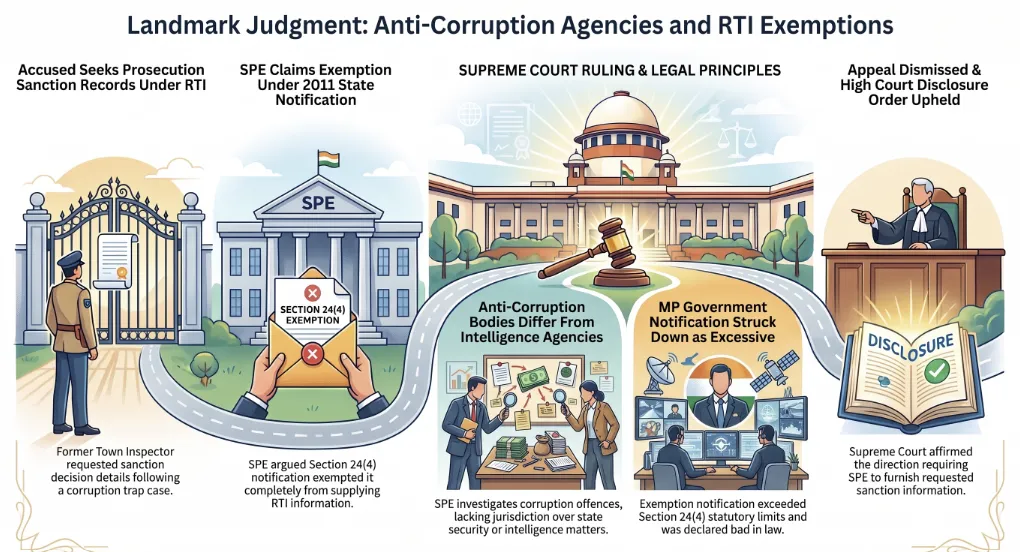
The dispute originated from a trap case registered under the Prevention of Corruption Act, 1988 against Kamta Prasad Mishra (Respondent No. 1), who was serving as Town Inspector at Police Station Madhav Nagar, Katni, Madhya Pradesh.
- FIR & Prosecution Sanction: A First Information Report (FIR) was registered by the SPE, Bhopal, on April 11, 2017. Subsequently, on May 20, 2020, the Home Department of the State Government granted sanction for his prosecution.
- RTI Application: On July 1, 2020, Mishra submitted an application under Section 6(1) of the RTI Act, 2005, seeking details regarding the decision-making process behind the grant of prosecution sanction and communications exchanged between the authorities.
- Denial & SIC Rejection: The Assistant Public Information Officer turned down the request. On appeal, the State Information Commission (SIC) on December 16, 2020, rejected Mishra's plea, relying on Section 8(1)(h) of the RTI Act, which exempts information that would impede the investigation or prosecution.
- High Court Order: Aggrieved, Mishra filed a writ petition before the High Court of Madhya Pradesh. A Division Bench allowed the petition on December 20, 2021, holding that because the investigation was complete, disclosing sanction details would not impede the trial under Section 8(1)(h).
- Appeal to the Supreme Court: The SPE appealed the High Court order to the Supreme Court, raising a new defense based on a State Notification dated August 25, 2011, which exempted the SPE entirely from the RTI Act under Section 24(4).
Key Legal Issues Before the Supreme Court
The Supreme Court framed two fundamental legal questions for determination:
- Section 24(4) Applicability: Can a statutory anti-corruption investigative body (like the SPE) assisting the Lokayukta be categorized as an "intelligence and security organisation" under Section 24(4) of the RTI Act?
- Suo Motu Invalidation of Subordinate Legislation: Can the Constitutional Courts examine and strike down a subordinate notification as ultra vires when its validity was not specifically challenged in the original writ petition?
Court's Analysis & Findings
1. Distinction Between Anti-Corruption Bodies and Security/Intelligence Agencies
The Supreme Court examined the statutory scheme of Section 24 of the RTI Act, 2005. While Section 24(1) exempts specified Central agencies listed in the Second Schedule, Section 24(4) enables State Governments to notify state-level "intelligence and security organisations" for similar exemption.
The Court analyzed the nature of bodies listed in the Second Schedule—such as the Directorate of Enforcement (ED), Central Reserve Police Force (CRPF), Border Security Force (BSF), Central Industrial Security Force (CISF), and National Investigation Agency (NIA). The Court noted that these agencies deal specifically with national security, border defense, counter-terrorism, or intelligence gathering.
By contrast, the SPE was constituted under Section 2(1) of the Madhya Pradesh Special Police Establishment Act, 1947 with a strictly limited jurisdiction:
"The SPE has been clothed with limited jurisdiction to investigate offences punishable under the Act of 1988, Sections 409, 420 and Chapter XVIII of the Penal Code... It is, thus, clear that insofar as issues of 'intelligence' and 'security' are concerned, neither the Lokayukt nor the Up-Lokayukt under the Act of 1981 has been conferred jurisdiction to make any enquiry."
The Court rejected the State's argument of "institutional parity," emphasizing that anti-corruption units enforcing ethical standards in public life cannot claim status as security or intelligence bodies.
2. Validity of the Notification dated August 25, 2011
The State Government's General Administration Department (GAD) issued the Notification on August 25, 2011, invoking Section 24(4) to exclude cases investigated by the SPE from the RTI Act.
The Supreme Court held that the notification was excessive in nature and travelled beyond the scope of enabling statutory powers under Section 24(4). Since the SPE does not possess intelligence or security mandates, any delegated rule attempting to exempt it from transparency mandates is ultra vires the parent Act.
3. Authority to Suo Motu Examine Subordinate Legislation
Addressing the State's preliminary objection that the 2011 Notification was not specifically challenged in the High Court writ petition, the Bench invoked established constitutional precedents:
- *Bihar Rajya Dafadar Chaukidar Panchayat v. State of Bihar (2025)*: Affirmed the inherent power of Constitutional Courts under Article 226/Article 136 to declare subordinate legislation invalid if it violates fundamental rights or parent statutes, provided full opportunity is given to the State to defend it.
- *Bharathidasan University v. AICTE (2001): Reaffirmed that when delegated regulations exceed the confines of the enabling statute, courts are bound to ignore or strike them down even in the absence of a specific prayer for ultra vires* declaration.
- *State of Tamil Nadu v. P. Krishnamurthy (2006)*: Reiterated the grounds for challenging subordinate legislation, including failure to conform to the parent statute and exceeding statutory limits.
The Supreme Court noted that the State Government, through the Advocate General of Madhya Pradesh and Senior Counsel, was given complete opportunity to justify the notification's validity before the judgment was rendered.
4. Scope of Section 8(1)(h) Exemption Post-Investigation
The Court affirmed the High Court's finding regarding Section 8(1)(h). Once the investigation concludes and a charge-sheet is submitted in court, information regarding the decision-making process for prosecution sanction cannot be withheld under the guise of "impeding investigation".
Comparative Judicial Precedent
The Supreme Court aligned its reasoning with a notable ruling of the Allahabad High Court:
- *Dr. Nutan Thakur v. State of U.P. (2017)*: The Allahabad High Court struck down a Uttar Pradesh Government Notification dated August 3, 2012, which had similarly attempted to bring the Lokayukta office out of the purview of the RTI Act under Section 24(4). The High Court held that anti-corruption authorities are concerned with public servant integrity, not state security or intelligence.
Final Directions & Operative Ruling
The Supreme Court passed the following conclusive directions:
- Notification Struck Down: The State GAD Notification dated August 25, 2011, to the extent it seeks to exclude the Special Police Establishment (SPE) from the RTI Act under Section 24(4), is struck down as illegal and excessive.
- High Court Order Upheld: The High Court judgment directing the supply of sanction details and Lokayukta communications to Respondent No. 1 is maintained.
- Limited Saving Clause: The Court clarified that it did not adjudicate upon the notification's applicability to the State Bureau of Investigation of Economic Offences, which remains operational to that extent.
- Appeal Dismissed: Criminal Appeal No. 3743 of 2024 filed by the SPE was dismissed.
Key Takeaways for Practitioners & Public Authorities
- Anti-Corruption Agencies Subject to RTI: State anti-corruption branches, Lokayukta police units, and vigilance establishments cannot enjoy blanket RTI immunity under Section 24(4).
- Limits of Delegated Legislation: Executive notifications cannot expand statutory definitions or grant exemptions beyond the strict scope of the parent Act.
- Post-Investigation Transparency: Information regarding prosecution sanctions under the Prevention of Corruption Act must be disclosed under RTI once charge-sheets are filed.