
All insights

Can a High Court record strictures against a judicial officer without hearing her?

Supreme Court Expunges Adverse Remarks Against Judicial Officer Recorded Without Hearing

A POCSO Special Court judge in Rajasthan was criticised by the High Court for inadvertent overlapping text in two related judgments, without being given a chance to explain. The Supreme Court held thi

Litigation India Editorial 4 November 2026 1 min read 2026 INSC 1188

Story

Case at a glance1 / 6

Supreme Court of India

High Court Cannot Censure a Judge Without Hearing Her

In Re: XXX, A Judicial Officer in the District Judge Cadre of Rajasthan Judicial Services — 2026 INSC 1188

Court: Supreme Court of India; Date: 02 November 2026Bench: Justice Sandeep Mehta and Justice Devendra Kumar UpadhyayaArea of Law: Criminal Law / Service Law — Expungement of Adverse RemarksHigh Court strictures against a POCSO judge challenged for violating natural justice
Supreme Court Expunges Adverse Remarks Against Judicial Officer Recorded Without Hearing · 2026 INSC 11882026-11-04T08:59:13.863104+00:00
The legal question2 / 6

Can a High Court Record Strictures Against a Judge Without Giving Her a Hearing?

Core legal issue decided by the Supreme Court

  • Appellant: Overlapping text was an inadvertent error due to identical witnesses and absence of Stenographer; she was never given a chance to explain.
  • Appellant: Errors were typographical and did not affect the outcome of either judgment; strictures were disproportionate and career-damaging.
  • Respondent: High Court exercised its supervisory jurisdiction under Article 227 to flag negligence in judgment writing by a Senior District Judge.
Supreme Court Expunges Adverse Remarks Against Judicial Officer Recorded Without Hearing · 2026 INSC 11882026-11-04T08:59:13.863104+00:00
The Court's reasoning3 / 6

How the Supreme Court Reasoned to Expunge the Strictures

Step-by-step reasoning

  1. 1Step 1: Article 227 power must be exercised as guardian of district judiciary — to guide, not condemn.
  2. 2Step 2: Overlapping text was explained by identical witnesses, absent Stenographer, and time-pressure under POCSO Act.
  3. 3Step 3: Strictures recorded without giving the judicial officer any opportunity to explain — violating audi alteram partem.
  4. 4Step 4: Precedents confirm adverse remarks must not be recorded on the judicial side; administrative side is the correct route.
  5. 5Step 5: Such remarks can destroy a career and chill the entire district judiciary — expungement ordered.
Supreme Court Expunges Adverse Remarks Against Judicial Officer Recorded Without Hearing · 2026 INSC 11882026-11-04T08:59:13.863104+00:00
Key points4 / 6

Criticism of Judgment vs. Condemnation of Judge's Conduct: The Key Distinction

Expressly drawn by the Supreme Court in this judgment

  • Permissible: Criticising the reasoning, findings, or legal conclusions in a judgment.
  • Not permissible (on judicial side): Adverse comments on a judicial officer's personal conduct, calibre, or work ethic without hearing.
  • Correct procedure: Record concerns in a remark slip; place it before the administrative Judge or Chief Justice for follow-up.
  • Consequence of breach: Strictures recorded without audi alteram partem are unsustainable in law and must be expunged.
High Courts must act with magnanimity as guardians of district judiciary, not as censors of individual judges' conduct.
Supreme Court Expunges Adverse Remarks Against Judicial Officer Recorded Without Hearing · 2026 INSC 11882026-11-04T08:59:13.863104+00:00
The verdict5 / 6

The Supreme Court's Final Decision

Appeal allowed; adverse remarks expunged

  • The Fact: A POCSO Special Court judge's two judgments had inadvertent overlapping text; the High Court recorded sweeping strictures without hearing her.
  • The Law: Article 227 superintendence must respect natural justice; adverse remarks on judicial conduct must not be recorded on the judicial side without audi alteram partem.
  • The Result: Strictures in paragraphs 9, 10, 11, 17 and 18 of the High Court's order dated 1 May 2025 are expunged and set aside.
Strictures in paras 9, 10, 11, 17 and 18 of the High Court order dated 1 May 2025 are hereby expunged and set aside.
Supreme Court Expunges Adverse Remarks Against Judicial Officer Recorded Without Hearing · 2026 INSC 11882026-11-04T08:59:13.863104+00:00
Why it matters6 / 6

What This Judgment Means for Judges and Citizens

Practical significance

  • Judges are entitled to natural justice: no adverse career remarks without an opportunity to explain.
  • High Courts must use administrative channels — not public judicial orders — to address concerns about a judge's conduct.
  • Inadvertent typographical errors that do not affect the outcome of a judgment cannot justify sweeping strictures against a judicial officer.
  • Disproportionate public censure of judges can chill the independence of the entire district judiciary.
To forgive an inadvertent error is the mark of a great institution; to condemn without hearing is the mark of injustice.
Supreme Court Expunges Adverse Remarks Against Judicial Officer Recorded Without Hearing · 2026 INSC 11882026-11-04T08:59:13.863104+00:00
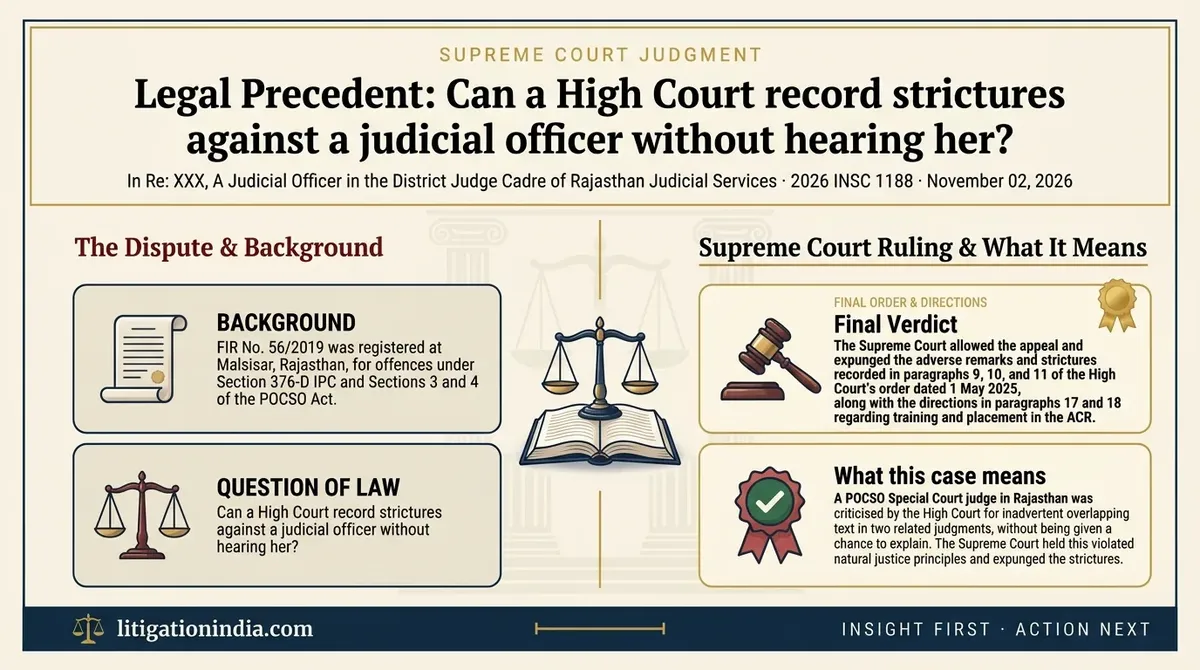
Supreme Court Expunges Adverse Remarks Against Judicial Officer Recorded Without Hearing — infographic summary

What this case means

A POCSO Special Court judge in Rajasthan was criticised by the High Court for inadvertent overlapping text in two related judgments, without being given a chance to explain. The Supreme Court held this violated natural justice principles and expunged the strictures. The case reaffirms that High Courts must follow audi alteram partem before recording adverse remarks against judicial officers.

What the Supreme Court held

The Supreme Court allowed the appeal and expunged the adverse remarks and strictures recorded in paragraphs 9, 10, and 11 of the High Court's order dated 1 May 2025, along with the directions in paragraphs 17 and 18 regarding training and placement in the ACR. The Court directed its Registry to transmit a copy of the order to the Registrar General, High Court of Rajasthan, for placement before the Chief Justice.

Case: In Re: XXX, A Judicial Officer in the District Judge Cadre of Rajasthan Judicial Services (2026) Citation: 2026 INSC 1188

Want the full legal reasoning, citations and case documents?

Read the full judgment analysis
adverse remarks judicial officer
expungement strictures
natural justice audi alteram partem
Article 227 Constitution of India
POCSO Act
Juvenile Justice Act 2015
High Court superintendence
district judiciary
cut copy paste judgment
Rajasthan Judicial Services
2026 INSC 1188
Article 227, Constitution of India
Sections 3 and 4, Protection of Children from Sexual Offences Act, 2012
Section 376-D, Indian Penal Code, 1860