
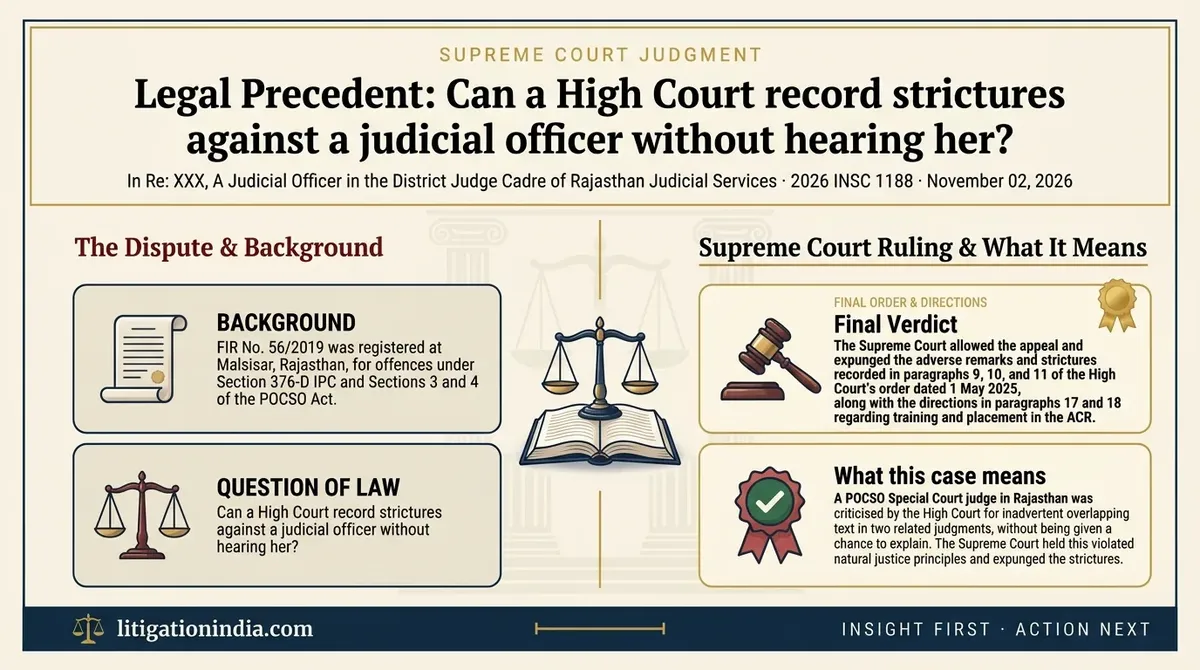
Full text of the judgment
Text extracted from In Re: XXX, A Judicial Officer in the District Judge Cadre of Rajasthan Judicial Services. For the authoritative version refer to the Supreme Court of India's official website.
2026 INSC 1188 1
REPORTABLE IN THE SUPREME COURT OF INDIA CRIMINAL APPELLATE JURISDICTION
CRIMINAL APPEAL NO(S). OF 2026 (Arising out of SLP(Crl.) No(s). 13501 of 2025)
IN RE: XXX, A JUDICIAL OFFICER IN THE DISTRICT JUDGE CADRE OF RAJASTHAN JUDICIAL SERVICES
J U D G M E N T Mehta, J.
1. Heard. 2. Leave granted. 3. The appellant1 before us is a Judicial Officer from the District Judge Cadre of the Rajasthan Judicial Services. For the sake of non-disclosure of the identity, the name of the appellant-Judicial Officer has been masked in the title of the judgment. 4. The famous English poet Alexander Pope, in his celebrated work ‘An Essay on Criticism’, penned the timeless lines: “To err is human, to forgive,
1 Hereinafter referred to as “appellant-Judicial Officer”. Digitally signed by SONIA BHASIN Date: 2026.11.02 17:43:10 IST Reason: Signature Not Verified
divine.” This global truth reverberates in Indian ethos and ancient jurisprudence. The foundational Jain virtue of “उत्तम क्षमा” (Uttama Kshama), outlined in the “तत्वार्थ सूत्र” (Tattvartha Sutra), establishes forgiveness as a supreme spiritual tenet, a concept beautifully mirrored in the renowned Sanskrit adage “क्षमा वीरस्य भूषणम्” (Kshama Virasya Bhushanam), which proclaims that forgiveness is the ornament of the brave. This philosophy is a solemn reminder that fallibility is an inherent facet of human nature and forgiveness is the noblest virtue of a person in authority and for that matter, every human being. The present case is a fit illustration calling for the exercise of this very virtue of forgiveness. 5. Under Article 227 of the Constitution of India, the High Courts are vested with supervisory jurisdiction over the Courts within their respective jurisdictions. The duty cast upon the High Courts under this constitutional provision is of the utmost importance and requires exercise of powers of superintendence in a manner that guides, strengthens and nurtures the district judiciary.
6. The present case portrays a situation where the said supervisory power appears to have been exercised in a manner that could have been avoided by exercising the virtue of forgiveness and magnanimity. 7. FIR No. 56/2019 was lodged at Police Station Malsisar, District Jhunjhunu, Rajasthan, against the following accused persons: (i) Abdul Aziz (father of the victim), (ii) S - the Child in Conflict with Law2 and (iii) Dev Kumar, for offences punishable under Section 376-D of the Indian Penal Code, 1860,3 and Sections 3 and 4 of the Protection of Children from Sexual Offences Act, 2012.4 8. S-CNCL was arrested on 6th October, 2021, and produced before the Juvenile Justice Board concerned. A preliminary assessment was conducted under Section 15(1) of the Juvenile Justice (Care and Protection of Children) Act, 2015,5 in which S, the CNCL was recorded as being 16 years 9 months and 28 days as on the date of the incident. The Board was of the opinion that the S-CNCL was fit to be tried as
2 Hereinafter referred to as “S-CNCL”. 3 For short “IPC”. 4 For short “POCSO”. 5 For short “JJ Act, 2015”.
an adult, and, accordingly, exercising powers under Section 18(3) of the JJ Act, 2015, the Board transferred the case of S-CNCL for trial to the Court of the Special Judge, POCSO Act Cases, Jhunjhunu, where the same was registered as Sessions Case No. 12/2022. 9. Parallel to the proceedings against S-CNCL, a separate trial arising out of the same FIR was conducted in Sessions Case No. 65/2019 against the co-accused Abdul Aziz. Owing to the statutory embargo contained in Section 23 of the JJ Act, 2015, which expressly bars joint proceedings of a child in conflict with law and the adult accused, there existed a statutory mandate to conduct separate trials and deliver distinct judgments in both matters. 10. After appreciating the evidence in both trials, the appellant-Judicial Officer pronounced separate judgments on 20th January, 2024, convicting both accused persons of the charges found proved against them and sentencing each to 20 years’ rigorous imprisonment. 11. It seems that, during the course of rendering judgments in the two cases referred to supra, some overlapping extracts of evidence/numerical details of
the record of evidence from one trial were inadvertently incorporated into the judgment of the other. 12. Aggrieved by his conviction, S-CNCL preferred S.B. Criminal Appeal No. 426/2024 before the High Court, along with S.B. Criminal Misc. Suspension of Sentence Application No. 1456/2024. 13. The learned Single Judge of the High Court rejected the suspension of sentence application after discussing merits of the case vide order dated 1st May, 2025. However, in passing the said order, the learned Single Judge was of the view that negligence had been committed by the Presiding Officer of the trial Court (the appellant herein) in rendering the judgment in the case of S-CNCL. The High Court was of the opinion that the appellant-Judicial Officer had used the methodology of ‘cut, copy and paste’ and in all probability, the judgment had been scripted by the concerned Stenographer/Clerk and was signed without being read and corrected by the Presiding Officer as she failed to strike out the irrelevant paragraphs which related to the trial of the adult accused. Observing so, the learned Single Judge, proceeded to record adverse remarks against the
appellant-Judicial Officer in paragraphs 8, 9, 10 and 11 of the impugned order and issued the directions contained in paragraphs 17 and 18 thereof. The relevant paragraphs read as below:- “8. A perusal of record of the case and also the judgment dated 20.01.2024 in Sessions Case No.65/2019 clearly indicate that learned trial Court has passed two judgments on very same day,one relating to Abdul Aziz and other to present one. Both the cases were arising out of same FIR No.56/2019 registered at Police Station Malsisar, District Jhunjhunu but the process of trial was different. In Sessions Case No.65/2019, 17 witness were examined and 30 documents were exhibited and DW- 1 was examined as defence witness.
9. A perusal of judgment in the instant case clearly indicate that the trial Judge has shirked her responsibility and neglected her duty by not dictating the judgment in toto, rather, learned Judge has used methodology of cut, copy and paste, which shows that the judgment is in fact written by concerned Stenographer/Clerk. After preparing the judgment, the learned Presiding Officer has not taken care to read and correct the judgment so that irrelevant paragraphs may be striked out. This again shows that learned trial Judge instead of devoting time for judgment writing, was busy in other irrelevant work and leaving the judgment writing upon Stenographer or P.A. It is duty of a Judge to consider the factual aspect of the case and after applying the proper law, write a judgment.
10. In U.S. Courts, role of a Judge has been defined as a person who presides over the trial from an elevated platform called dias. The Judge has five basic tasks and these are:-
(i) Preside over the proceedings and see that order is maintained; (ii) To determine whether any of the evidence that the parties want to use is illegal or improper; (iii)To ensure applicability of law on facts of the case and maintain standard to decide the case; (iv)To determine the real facts of the case and decide accordingly; (v)To sentence convicted criminals appropriately.
11.Since this is a bail (SOS) order, therefore, we are not burdening ourselves on this issue but certainly this is an alarming situation that a Senior District Judge posted in POCSO Court is not devoting time to write a judgment rather depending upon a Stenographer. It is the duty of a Judge to dictate judgment from top to bottom which means entire judgment from para No.1 to last para must be in steno diary. If it is not available, it means the Judge is shirking his or her responsibility and such a Judicial Officer is not entitled to remain in service of Judiciary. [...] 17. A copy of this order be sent to the Hon’ble Judge, In-charge of the Rajasthan Judicial Academy to impart training to learned Presiding Officer, about judgment writing.
18. The Registrar General is directed to make a copy of this order as a part of her ACR for year 2024 but after obtaining her comments.”
14. Being aggrieved by the aforesaid adverse observations/strictures, the appellant-Judicial Officer is before us by way of the instant appeal with special leave seeking expungement of the adverse
remarks (supra) recorded against her in the impugned order. 15. We have heard and considered the submissions advanced by learned counsel representing the appellant and learned counsel appearing for the respondent and have gone through the material available on record. 16. Ex facie, we feel that the adverse observations and the strictures recorded by the High Court against the appellant-Judicial Officer were uncalled for and avoidable. These disparaging remarks and the strictures were recorded on the judicial side, without affording an opportunity to the appellant-Judicial Officer to show cause or to place her explanation on record before such observations and strictures were made, and hence, suffer from the vice of nonadherence to the principles of natural justice. 17. In the instant appeal, the appellant-Judicial Officer has explained the circumstances under which the overlapping facts came to be recorded in the judgment of S-CNCL. It has been stated that the facts of both the cases were intricately intermingled and interwoven with each other, as the witnesses in both
the cases and the substantive evidence were almost the same. 18. The appellant-Judicial Officer has also explained that the Special Courts under the POCSO Act have limited resources available and that the provisions of the POCSO Act require a time-bound, expeditious disposal of cases registered under the said Act. 19. The sole Stenographer provided for the Special Court had proceeded on leave and, hence, the appellant-Judicial Officer was constrained to dictate part of the judgment directly to the Lower Division Clerk (LDC) on the computer, while the major remaining portion was dictated to the Stenographer, upon his return. The errors in the judgment, including the incorrect serial numbers of the prosecution witnesses, are explained by the appellant-Judicial Officer as bona fide typographical errors which, according to her, neither altered nor affected the outcome or substance of the judgment. 20. Having appreciated the submissions advanced at the Bar and after going through the impugned order, specifically the adverse observations/strictures recorded by the learned
Single Judge as above, we are of the opinion that it was a fit case wherein the High Court, while exercising the power of superintendence, should have acted with greater magnanimity and in the true spirit of its role under Article 227 of the Constitution of India as guardian of the officers in the district judiciary. 21. To castigate a Judicial Officer for inadvertent typographical errors in a judgment, which did not, in any manner, affect the outcome of the case was avoidable. 22. In this regard, reference may be made to the judgment of this Court in Kaushal Singh v. State of Rajasthan,6 wherein after considering the settled principles governing the recording of strictures against Judicial Officers, this Court reiterated that High Courts should ordinarily refrain from passing strictures against Judicial Officers while deciding matters on the judicial side. Relying upon the principles laid down in In Re: ‘K’, A Judicial Officer7 and Sonu Agnihotri v. Chandra Shekhar
6 2025 SCC OnLine SC 1473. 7 (2001) 3 SCC 54.
& Ors.,8 this Court emphasised the distinction between criticism of an erroneous judicial order and adverse comments on the personal conduct or calibre of the Judicial Officer. It was further observed that concerns regarding the conduct of a Judicial Officer may appropriately be brought to the notice of the Chief Justice on the administrative side, where the officer would have an opportunity to explain the circumstances in question. Applying these principles, this Court held that the strictures recorded against the Judicial Officer therein, without affording an opportunity to explain the position or showing cause, were uncalled for and accordingly expunged the same. 23. Such adverse remarks may have the deleterious effect of destroying the Judicial Officer’s career and may also have a chilling effect on the entire district judiciary. In this background, we are unable to subscribe to the view taken by the High Court that the appellant-Judicial Officer was acting in dereliction of her duties while rendering the judgment dated 20th January, 2024.
8 2024 SCC OnLine SC 3382.
24. In any event, even if the High Court was of the view that any error had occurred on part of the appellant-Judicial Officer in rendering the judgment, it ought not to have recorded adverse observations against her without first affording her an opportunity to explain the circumstances in which the error occurred. The course chosen by the High Court was contrary to the fundamental principle of ‘audi alteram partem’. 25. Furthermore, we may reiterate that this Court in the case of Shuvendu Saha v. State of West Bengal and Anr.,9 has observed that, where situation warrants such a course of action, the appropriate procedure would be to record observations concerning the merits or quality of the judgment or the proceedings of the Presiding Officer in a remark slip which, in turn, would be placed before the administrative Judge or the Hon’ble Chief Justice of the High Court, as the case may be, for necessary follow-up action on the administrative side. Condemnation of the conduct of the Judicial Officer by the High Cout on the judicial side would
9 2026 INSC 367.
undeniably lead to adverse consequences on the career of the Judicial Officer. Such action, taken without following the salutary principles of natural justice is unsustainable in the eyes of law. 26. As a consequence, the strictures and adverse remarks recorded against the appellant-Judicial Officer in paragraphs 9, 10, and 11 (supra) of the impugned order dated 1st May, 2025, as well as the directions in paragraphs 17 and 18 (supra) regarding training and placement in her ACR, cannot be sustained and are hereby expunged and set aside. 27. The appeal is allowed accordingly. 28. A copy of this order shall be transmitted by the Registry of this Court to the Registrar General, High Court of Judicature for Rajasthan, for being placed before the Hon’ble Chief Justice of the High Court. 29. Pending application(s), if any, shall stand disposed of. ………………….….……………………J. (SANDEEP MEHTA)
………………….....…………………….J. (DEVENDRA KUMAR UPADHYAYA)
NEW DELHI; NOVEMBER 02, 2026.