
All insights

Can an IPS officer's unconditional apology justify expunging adverse High Court remarks?

Supreme Court Expunges Adverse High Court Remarks Against IPS Officer After Unconditional Apology

An IPS officer challenged adverse remarks made by the Madras High Court while it set aside a preventive detention order he had passed. The Supreme Court expunged those remarks after the officer tender

Litigation India Editorial 2 November 2026 1 min read 2026 INSC 1186

Story

Case at a glance1 / 5

Supreme Court of India

IPS Officer's Apology Secures Expunction of Adverse Judicial Remarks

A. Arun vs Varsha Sharma & Ors. | 2026 INSC 1186

Court: Supreme Court of India; decided 02 November 2026Bench: Justice Vikram Nath, Justice R. Mahadevan, Justice Aparesh Kumar SinghArea of law: Criminal Law — Preventive Detention and Expunction of Adverse RemarksIPS officer sought removal of adverse remarks made by Madras High Court while quashing his detention order
Supreme Court Expunges Adverse High Court Remarks Against IPS Officer After Unconditional Apology · 2026 INSC 11862026-11-02T14:11:40.397978+00:00
The legal question2 / 5

Should adverse High Court remarks against an IPS officer be expunged?

Core issue before the Supreme Court

  • Appellant: Adverse remarks could seriously damage professional reputation and career of the officer.
  • Appellant: He now acknowledges the error, tenders unconditional apology and assures greater care in future.
  • Respondent No. 1: Challenged the original detention order, which the High Court had already set aside.
  • Respondents 2–5 (State): Represented by Additional Advocate General before the Supreme Court.
Supreme Court Expunges Adverse High Court Remarks Against IPS Officer After Unconditional Apology · 2026 INSC 11862026-11-02T14:11:40.397978+00:00
The Court's reasoning3 / 5

How the Court Reached Its Decision

Step-by-step reasoning

  1. 1Step 1: High Court set aside detention order and made adverse remarks against appellant in its judgment.
  2. 2Step 2: Appellant filed unconditional apology acknowledging error and assuring greater care in future.
  3. 3Step 3: Court noted that preventive detention power directly affects liberty and demands utmost circumspection.
  4. 4Step 4: Court accepted apology but cautioned apology cannot substitute due care in liberty-affecting powers.
  5. 5Step 5: Adverse remarks expunged; High Court's order setting aside detention left undisturbed.
Supreme Court Expunges Adverse High Court Remarks Against IPS Officer After Unconditional Apology · 2026 INSC 11862026-11-02T14:11:40.397978+00:00
The verdict4 / 5

The Supreme Court's Final Order

Fact, Law, Result

  • The Fact: IPS officer's preventive detention order was quashed by Madras High Court with adverse remarks against him.
  • The Law: Preventive detention power under Section 3(1) of Tamil Nadu Act 1982 must be exercised with utmost care; apology cannot substitute due diligence.
  • The Result: Adverse remarks in paragraphs 6, 8, 10 and 19–23 of High Court judgment expunged; detention order remains set aside.
Adverse remarks in paragraphs 6, 8, 10 and 19 to 23 of the High Court judgment are directed to be expunged; detention order remains set aside.
Supreme Court Expunges Adverse High Court Remarks Against IPS Officer After Unconditional Apology · 2026 INSC 11862026-11-02T14:11:40.397978+00:00
Why it matters5 / 5

Why This Judgment Matters

Practical significance for citizens and public officials

  • Preventive detention is a serious power; authorities must carefully follow law before detaining anyone.
  • Courts can remove adverse remarks against officials who show genuine remorse through unconditional apology.
  • An apology never excuses past misuse of power — the original wrong is not wiped out, only the remarks.
  • Citizens' liberty remains protected: setting aside of the unlawful detention order was not disturbed.
Apology cannot be a substitute for due care when exercising powers that affect a person's liberty.
Supreme Court Expunges Adverse High Court Remarks Against IPS Officer After Unconditional Apology · 2026 INSC 11862026-11-02T14:11:40.397978+00:00
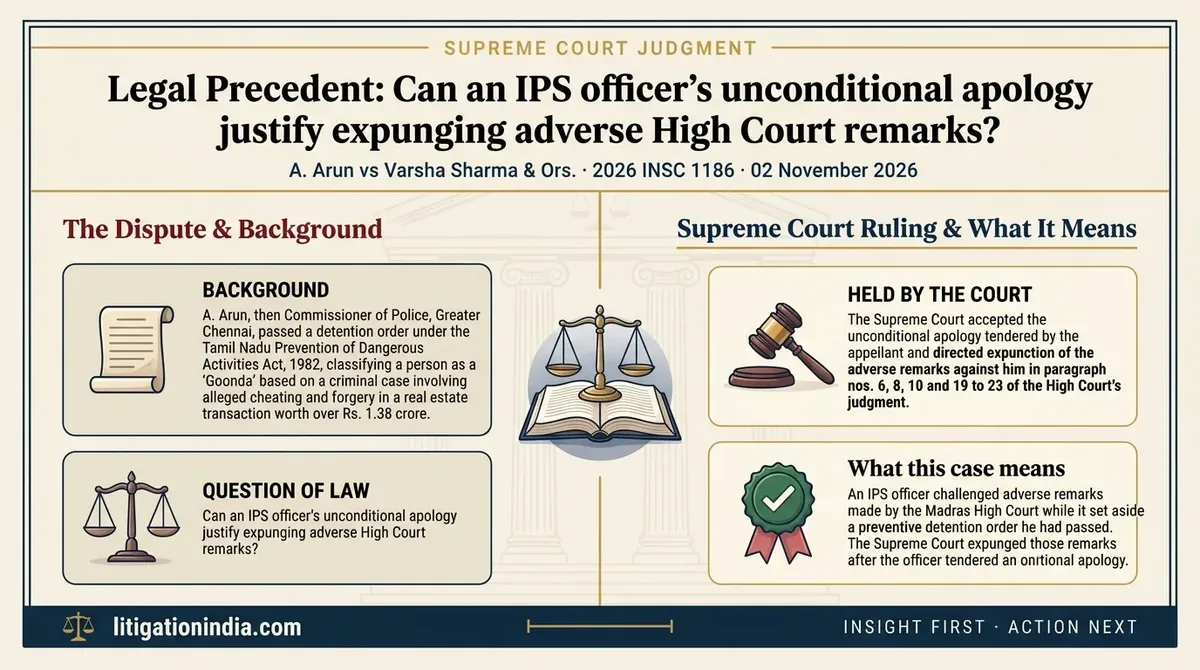
Supreme Court Expunges Adverse High Court Remarks Against IPS Officer After Unconditional Apology — infographic summary

What this case means

An IPS officer challenged adverse remarks made by the Madras High Court while it set aside a preventive detention order he had passed. The Supreme Court expunged those remarks after the officer tendered an unconditional apology. The Court clarified that the High Court's order setting aside the detention remained unaffected.

What the Supreme Court held

The Supreme Court accepted the unconditional apology tendered by the appellant and directed expunction of the adverse remarks against him in paragraph nos. 6, 8, 10 and 19 to 23 of the High Court's judgment. The Court clarified that this order does not affect the High Court's decision setting aside the detention order, and cautioned that apology cannot substitute for due care in exercising powers affecting liberty.

Case: A. Arun vs Varsha Sharma & Ors. (2026) Citation: 2026 INSC 1186

Want the full legal reasoning, citations and case documents?

Read the full judgment analysis
A. Arun
Varsha Sharma
expunction of adverse remarks
preventive detention
Tamil Nadu Act 14 of 1982
Goonda Act
IPS officer
unconditional apology
Commissioner of Police
liberty of individual
Section 3(1), Tamil Nadu Prevention of Dangerous Activities of Bootleggers, Cyber Law Offenders, Drug Offenders, Forest Offenders, Goondas, Immoral Traffic Offenders, Sand Offenders, Sexual Offenders, Slum-Grabbers and Video Pirates Act, 1982 (Tamil Nadu Act 14 of 1982)
Sections 409, 420, 465, 468, 471 and 120-B, Indian Penal Code, 1860
Criminal Law / Preventive Detention / Expunction of Adverse Remarks
Supreme Court legal news