
Updates
Criminal Law / Preventive Detention / Expunction of Adverse Remarks
Summarized by Adv. Om Narayan Pandey|Verified by Adv. Om Narayan Pandey, Supreme Court of India 0 views

Can an IPS officer's unconditional apology justify expunging adverse High Court remarks?

Supreme Court Expunges Adverse High Court Remarks Against IPS Officer After Unconditional Apology

Case: A. Arun vs Varsha Sharma & Ors.Citation: 2026 INSC 1186Decided on: 02 November 2026

What this case means

An IPS officer challenged adverse remarks made by the Madras High Court while it set aside a preventive detention order he had passed. The Supreme Court expunged those remarks after the officer tendered an unconditional apology. The Court clarified that the High Court's order setting aside the detention remained unaffected.

“The Supreme Court expunged adverse remarks made by the Madras High Court against an IPS officer after he tendered an unconditional apology, while keeping intact the order setting aside his detention order.”

Share:

Story Slides

Case at a glance1 / 5

Supreme Court of India

IPS Officer's Apology Secures Expunction of Adverse Judicial Remarks

A. Arun vs Varsha Sharma & Ors. | 2026 INSC 1186

Court: Supreme Court of India; decided 02 November 2026Bench: Justice Vikram Nath, Justice R. Mahadevan, Justice Aparesh Kumar SinghArea of law: Criminal Law — Preventive Detention and Expunction of Adverse RemarksIPS officer sought removal of adverse remarks made by Madras High Court while quashing his detention order
A. Arun vs Varsha Sharma & Ors. · 2026 INSC 118602 November 2026
The legal question2 / 5

Should adverse High Court remarks against an IPS officer be expunged?

Core issue before the Supreme Court

  • Appellant: Adverse remarks could seriously damage professional reputation and career of the officer.
  • Appellant: He now acknowledges the error, tenders unconditional apology and assures greater care in future.
  • Respondent No. 1: Challenged the original detention order, which the High Court had already set aside.
  • Respondents 2–5 (State): Represented by Additional Advocate General before the Supreme Court.
A. Arun vs Varsha Sharma & Ors. · 2026 INSC 118602 November 2026
The Court's reasoning3 / 5

How the Court Reached Its Decision

Step-by-step reasoning

  1. 1Step 1: High Court set aside detention order and made adverse remarks against appellant in its judgment.
  2. 2Step 2: Appellant filed unconditional apology acknowledging error and assuring greater care in future.
  3. 3Step 3: Court noted that preventive detention power directly affects liberty and demands utmost circumspection.
  4. 4Step 4: Court accepted apology but cautioned apology cannot substitute due care in liberty-affecting powers.
  5. 5Step 5: Adverse remarks expunged; High Court's order setting aside detention left undisturbed.
A. Arun vs Varsha Sharma & Ors. · 2026 INSC 118602 November 2026
The verdict4 / 5

The Supreme Court's Final Order

Fact, Law, Result

  • The Fact: IPS officer's preventive detention order was quashed by Madras High Court with adverse remarks against him.
  • The Law: Preventive detention power under Section 3(1) of Tamil Nadu Act 1982 must be exercised with utmost care; apology cannot substitute due diligence.
  • The Result: Adverse remarks in paragraphs 6, 8, 10 and 19–23 of High Court judgment expunged; detention order remains set aside.
Adverse remarks in paragraphs 6, 8, 10 and 19 to 23 of the High Court judgment are directed to be expunged; detention order remains set aside.
A. Arun vs Varsha Sharma & Ors. · 2026 INSC 118602 November 2026
Why it matters5 / 5

Why This Judgment Matters

Practical significance for citizens and public officials

  • Preventive detention is a serious power; authorities must carefully follow law before detaining anyone.
  • Courts can remove adverse remarks against officials who show genuine remorse through unconditional apology.
  • An apology never excuses past misuse of power — the original wrong is not wiped out, only the remarks.
  • Citizens' liberty remains protected: setting aside of the unlawful detention order was not disturbed.
Apology cannot be a substitute for due care when exercising powers that affect a person's liberty.
A. Arun vs Varsha Sharma & Ors. · 2026 INSC 118602 November 2026

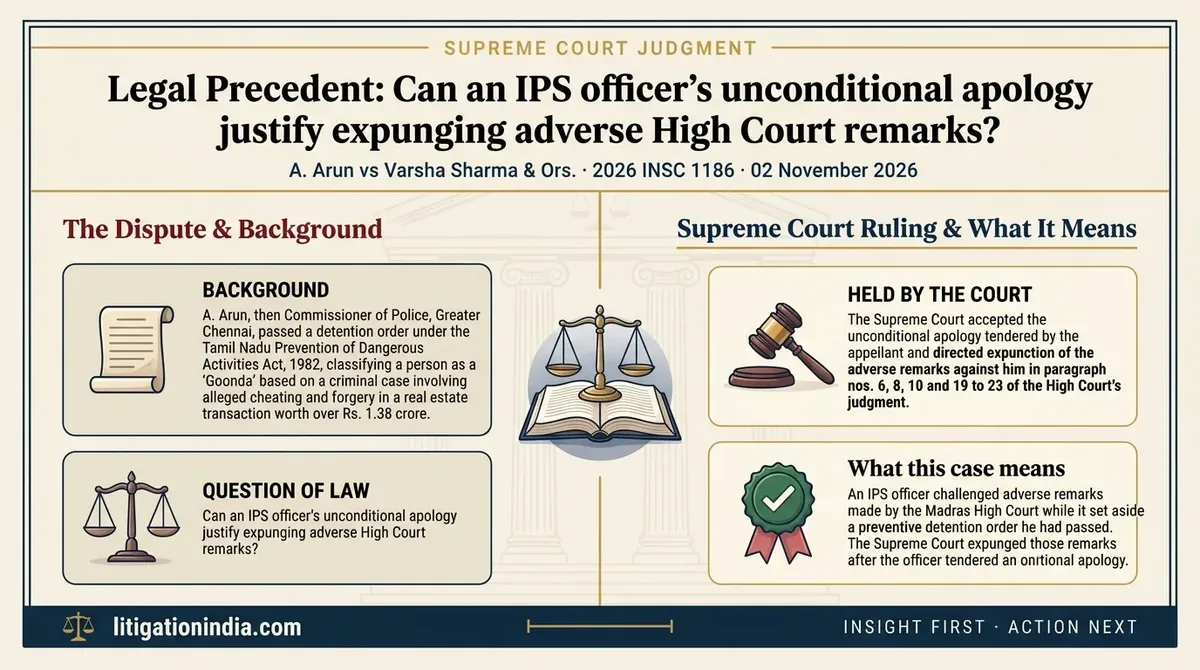
At a glance (infographic)

A. Arun vs Varsha Sharma & Ors. — infographic summary
Download infographic

In short

The appellant, A. Arun, an IPS officer serving as Director of Tamil Nadu Police Academy, had previously been the Commissioner of Police, Greater Chennai. In that capacity, he passed a preventive detention order dated 22nd September 2025 under Section 3(1) of the Tamil Nadu Prevention of Dangerous Activities Act, 1982, classifying one individual as a 'Goonda'. The underlying criminal case, Crime No. 178 of 2025, involved allegations of cheating, criminal breach of trust and forgery against the detenue and his wife, who were directors of a real estate company that allegedly failed to deliver an apartment worth over Rs. 1.38 crore to a complainant. The first respondent, the detenue's daughter, challenged the detention order before the Madras High Court. The High Court allowed the petition and set aside the detention order. In doing so, however, it also made adverse observations against the appellant in several paragraphs of its judgment. The appellant approached the Supreme Court seeking expunction of those adverse remarks. During the hearing, the appellant tendered an unconditional apology, acknowledging that he had erred in passing the detention order and had failed to accept that error when summoned before the High Court. The Supreme Court accepted the apology, noting the assurance of greater care in future, and directed expunction of the adverse remarks in the identified paragraphs. The Court, however, issued a clear caution that an apology is not a substitute for due care when exercising powers that affect individual liberty. The Court also expressly clarified that its order of expunction did not disturb the High Court's decision setting aside the detention order itself.

Need clarity on a similar legal issue?

Request free pro bono guidance from a Supreme Court Advocate.

Request Guidance

Background

A. Arun, then Commissioner of Police, Greater Chennai, passed a detention order under the Tamil Nadu Prevention of Dangerous Activities Act, 1982, classifying a person as a 'Goonda' based on a criminal case involving alleged cheating and forgery in a real estate transaction worth over Rs. 1.38 crore. The detenue's daughter challenged this before the Madras High Court, which set aside the detention order and made adverse observations against the appellant in paragraphs 6, 8, 10 and 19 to 23 of its judgment. The appellant then approached the Supreme Court solely to seek expunction of those adverse remarks.

The Decision

The Supreme Court accepted the unconditional apology tendered by the appellant and directed expunction of the adverse remarks against him in paragraph nos. 6, 8, 10 and 19 to 23 of the High Court's judgment. The Court clarified that this order does not affect the High Court's decision setting aside the detention order, and cautioned that apology cannot substitute for due care in exercising powers affecting liberty.

Why it matters for you

This judgment reinforces that statutory powers of preventive detention must be exercised with great care since they directly curtail individual liberty. It also shows that courts may expunge adverse judicial remarks against public officials when genuine remorse is shown, but warns that apology alone cannot excuse abuse of power. Ordinary citizens benefit from the Court's reminder that detaining authorities must rigorously follow the law before taking away someone's freedom.

Relevant Legal Provisions

Key Acts and sections cited or relied upon in this judgment

“Section 3(1) empowers the detaining authority to pass an order of detention; the appellant passed such an order classifying the detenue as a 'Goonda', which the High Court set aside as erroneous.”
“These sections relating to criminal breach of trust, cheating, forgery and criminal conspiracy formed the basis of the criminal case (Crime No. 178 of 2025) registered against the detenue, which in turn formed the foundation for the detention order.”

Full text of the judgment

Text extracted from A. Arun vs Varsha Sharma & Ors.. For the authoritative version refer to the Supreme Court of India's official website.

2026 INSC 1186 Crl.A.No.@SLP(Crl.)No.16725 of 2026 1

REPORTABLE IN THE SUPREME COURT OF INDIA CRIMINAL APPELLATE JURISDICTION

CRIMINAL APPEAL NO(S). OF 2026 (ARISING OUT OF SLP (CRL.) NO.16725 of 2026)

A. ARUN ...APPELLANT(S) VERSUS VARSHA SHARMA & ORS. ...RESPONDENT(S)

J U D G M E N T VIKRAM NATH, J.

1. Leave granted. 2. The appellant before us is an Officer of the Indian Police Service (IPS), presently serving as the Director of the Tamil Nadu Police Academy. The present appeal arises out of certain adverse remarks made against him in the judgment and final order dated 29th May 2026 passed by the High Court of Judicature at Madras at Chennai in H.C.P. No. 2066 of 2025. 3. At the relevant time, the appellant was serving as the Commissioner of Police, Greater Chennai. 3.1. The first respondent was the writ petitioner before the High Court. Her father, who was the detenue in the Digitally signed by SONIA BHASIN Date: 2026.11.02 17:43:09 IST Reason: Signature Not Verified

Crl.A.No.@SLP(Crl.)No.16725 of 2026 2

proceedings before the High Court, was detained under the Tamil Nadu Prevention of Dangerous Activities of Bootleggers, Cyber Law Offenders, Drug Offenders, Forest Offenders, Goondas, Immoral Traffic Offenders, Sand Offenders, Sexual Offenders, Slum-Grabbers and Video Pirates Act, 1982 (Tamil Nadu Act 14 of 1982) (hereinafter, “the Act of 1982”), having been classified as a “Goonda” by the appellant. 3.2. The case which formed the basis of the detention order arose out of Crime No. 178 of 2025, wherein one Ravi was the complainant. It was alleged that the complainant had entered into a sale and construction agreement with M/s. Lokaa Developers Pvt. Ltd. for the purchase of an apartment and had paid a sum of ₹1,38,08,095/- towards the consideration. 3.3. The detenue and his wife were directors of the aforesaid company. Despite the execution of the agreements and payment of the consideration, the apartment was allegedly not handed over to the complainant. It was further alleged that the property was dealt with in favour of third parties and subsequently mortgaged, on the basis of documents alleged to be forged. Accordingly, Crime No. 178 of 2025 was registered on 29th August 2025 for offences punishable under

Crl.A.No.@SLP(Crl.)No.16725 of 2026 3

Sections 409, 420, 465, 468, 471 and 120-B of the Indian Penal Code, 1860 (hereinafter, “IPC”). 3.4. The detenue and his wife were arrested on 1st September 2025 and remanded to judicial custody. Other criminal cases were also registered against them on similar allegations. 3.5. A proposal for detention under the Act of 1982 was thereafter forwarded to the appellant by the Inspector of Police, Central Crime Branch-II. Upon consideration of the materials placed before him, the appellant arrived at a subjective satisfaction and passed an order of detention dated 22nd September 2025 under Section 3(1) of the Act of 1982, classifying the detenue as a “Goonda”. 3.6. Aggrieved by the detention order, the first respondent instituted H.C.P. No. 2066 of 2025 before the High Court. The High Court allowed the petition and set aside the detention order. In the course of its judgment, however, the High Court made certain adverse observations against the appellant in paragraph nos. 6, 8, 10 and 19 to 23. 4. The appellant has approached this Court seeking expunction of the aforesaid adverse remarks. 5. We have heard Mr. Sidharth Luthra, learned senior counsel appearing for the appellant; Mr. Prashanto

Crl.A.No.@SLP(Crl.)No.16725 of 2026 4

Chandra Sen, learned Additional Advocate General appearing for respondent nos. 2 to 5; and Mr. Vairawan A.S., learned counsel appearing for respondent no. 1. 6. During the course of hearing, the appellant was present before this Court. Learned senior counsel appearing on his behalf submitted that the appellant had realised his error and was willing to tender an unconditional apology. It was further submitted that the adverse remarks, if allowed to remain on record, could have serious repercussions for the appellant's professional reputation and career. Accordingly, an affidavit tendering an unconditional apology was filed by the appellant and taken on record. 7. We have perused the unconditional apology tendered by the appellant. In the affidavit, the appellant expresses regret for not having tendered an apology before the High Court and for having failed to accept the error committed by him in passing the detention order dated 22nd September 2025. He further states that, when summoned by the High Court, he ought to have accepted the error at that stage. Having failed to do so, he now tenders his unconditional apology to this Court as well as to the High Court. He has also assured this Court that he would exercise greater care in the discharge of his official functions in the future.

Crl.A.No.@SLP(Crl.)No.16725 of 2026 5

8. We take note of the unconditional apology tendered by the appellant, as well as the assurance furnished by him. The exercise of power by a public authority must be guided by a careful appreciation of the facts and the applicable law. This assumes particular significance in matters of preventive detention, where the exercise of statutory power directly affects the liberty of an individual. Such power must, therefore, be exercised with utmost circumspection and in strict conformity with the requirements of law. 9. At the same time, we consider it appropriate to observe that an officer holding a senior position in the police administration is expected to appreciate the significance of the duties entrusted to him and the responsibility that accompanies the exercise of statutory powers. The appellant's expression of regret and his assurance to exercise greater care in the future are duly noted. We trust that the same shall be reflected in the discharge of his official functions hereafter. We also caution that the tendering of an apology cannot be regarded as a substitute for due care in the exercise of powers affecting the liberty of a person. 10. Having regard to the unconditional apology tendered by the appellant, the assurance furnished by him, and the circumstances of the present case, we accept the apology. In these circumstances, the adverse remarks made against

Crl.A.No.@SLP(Crl.)No.16725 of 2026 6

the appellant in paragraph nos. 6, 8, 10 and 19 to 23 of the impugned judgment are directed to be expunged. 11. It is clarified that the present order is confined to the adverse remarks made against the appellant and shall not affect the decision of the High Court setting aside the detention order. 12. The appeal stands disposed of in the above terms. 13. Pending application(s), if any, shall also stand disposed of.

……………………………..J. [VIKRAM NATH]

……………………………..J. [R. MAHADEVAN]

………………………………..J. [APARESH KUMAR SINGH]

NEW DELHI; NOVEMBER 02, 2026

AI-assisted summary, reviewed and verified by our editorial team.

In the Court's words

“The exercise of power by a public authority must be guided by a careful appreciation of the facts and the applicable law.”
“Such power must, therefore, be exercised with utmost circumspection and in strict conformity with the requirements of law.”
“We also caution that the tendering of an apology cannot be regarded as a substitute for due care in the exercise of powers affecting the liberty of a person.”
“The present order is confined to the adverse remarks made against the appellant and shall not affect the decision of the High Court setting aside the detention order.”

Need help with your case?

Facing a similar legal challenge in the Supreme Court or High Court? Connect with our pro bono volunteer advocates today.

Request Free Callback

Advocates handling Criminal Law / Preventive Detention / Expunction of Adverse Remarks

Litigation India

Insight First, Action Next. A public-service initiative to make justice understandable for every Indian.

contact@litigationindia.com

+91 9956486585

New Delhi, India

Quick Links

Our Mission

To empower ordinary citizens, litigants, and junior advocates across India by translating complex Supreme Court of India judgments into editor-verified, plain-language summaries in both English and Hindi. We aim to bridge the gap between judicial proceedings and everyday citizens by delivering verified legal insights and offering free, pro bono guidance from experienced Supreme Court advocates—ensuring no individual suffers injustice merely for lack of correct guidance.

Legal Disclaimer: The information and case summaries on this website are provided for general public understanding only and do not constitute legal advice. Accessing this website or any guidance here does not create an attorney-client relationship, which is established only upon a formal engagement with a lawyer. Litigation India is an informational, public-service platform — always consult a qualified advocate before acting on any information relating to your specific matter.

© 2026 Litigation India. All rights reserved.