
All insights

Can functional disability exceed medically certified disability for accident compensation?

Supreme Court Enhances Motor Accident Compensation Distinguishing Medical and Functional Disability

Two scooter accident victims challenged inadequate compensation awarded by the Kerala High Court. The Supreme Court held that functional disability — the real-life impact on earning capacity — can exc

Litigation India Editorial 18 October 2026 1 min read 2026 INSC 1145

Story

Case at a glance1 / 6

Supreme Court of India

Functional Disability vs Medical Disability in Accident Claims

Sunil Kumar v. IFFCO Tokio General Insurance Company Ltd. — 2026 INSC 1145

Court: Supreme Court of India; Date: October 15, 2026Bench: Justice S.V.N. Bhatti and Justice N.V. AnjariaArea: Motor Accident Compensation LawTwo disabled scooter accident victims sought enhanced compensation beyond High Court award
Supreme Court Enhances Motor Accident Compensation Distinguishing Medical and Functional Disability · 2026 INSC 11452026-10-18T10:47:35.940143+00:00
The legal question2 / 6

Can functional disability exceed Medical Board's certified percentage?

Core legal issue in both appeals

  • Appellant: Medical Board certified 75.5% and 62% disability, but real-life earning capacity is totally destroyed and functional disability should be 100%.
  • Appellant: Attendant charges and future medical expenses awarded by High Court are grossly inadequate.
  • Respondent: Medical Board certificate is the proper basis; High Court's enhancement was already just and sufficient.
Supreme Court Enhances Motor Accident Compensation Distinguishing Medical and Functional Disability · 2026 INSC 11452026-10-18T10:47:35.940143+00:00
Statutory comparison3 / 6

Medical Disability vs Functional Disability: Key Differences

As explained by the Court in this judgment

AspectMedical DisabilityFunctional Disability
DefinitionPhysical impairment certified by Medical Board on clinical standardsLong-term impact on daily life, occupation, and earning capacity
BasisDoctor's clinical assessment of bodily injuryAge, occupation, nature of work, earning activity, real-life consequences
Can exceed the other?May understate actual incapacityOften greater than medically certified percentage
Applied in this case75.5% (Sunil Kumar); 62% (Sreejith K.S.)100% (Sunil Kumar); 80% (Sreejith K.S.)
Courts must look beyond the Medical Board certificate to assess the true loss of earning capacity in the open competitive market.
Supreme Court Enhances Motor Accident Compensation Distinguishing Medical and Functional Disability · 2026 INSC 11452026-10-18T10:47:35.940143+00:00
The Court's reasoning4 / 6

How the Court Calculated Enhanced Compensation

Step-by-step reasoning for Sunil Kumar (First Case)

  1. 1Step 1: Monthly income fixed at Rs.15,000 based on Exhibit-A13 and Ramachandrappa (supra); multiplier 14 per Sarla Verma.
  2. 2Step 2: Medical disability of 75.5% rejected as too low; functional disability fixed at 100% given permanent dependence on attendant.
  3. 3Step 3: Loss of earning capacity = Rs.15,000 x 12 x 25% future prospects x 14 multiplier = Rs.31,50,000.
  4. 4Step 4: Attendant charges calculated by multiplier method per Kajal: Rs.15,000 x 12 x 14 = Rs.25,20,000.
  5. 5Step 5: Future medical expenses Rs.10,00,000 added; total compensation fixed at Rs.77,84,394 with 6.5% interest on additional amount.
Supreme Court Enhances Motor Accident Compensation Distinguishing Medical and Functional Disability · 2026 INSC 11452026-10-18T10:47:35.940143+00:00
The verdict5 / 6

The Final Verdict

Both appeals allowed with substantially enhanced compensation

  • The Fact: Both claimants suffered serious permanent disabilities in a 2016 scooter accident; Medical Board certificates understated their functional incapacity.
  • The Law: Functional disability — not Medical Board percentage — governs compensation; attendant charges must be calculated by the multiplier method.
  • The Result: Sunil Kumar awarded Rs.77,84,394 (from Rs.36,22,644); Sreejith K.S. awarded Rs.69,60,880 (from Rs.27,70,664); 6.5% interest on additional sums.
Insurance company directed to deposit additional compensation within 6 weeks; Tribunal to transfer directly to claimants' bank accounts.
Supreme Court Enhances Motor Accident Compensation Distinguishing Medical and Functional Disability · 2026 INSC 11452026-10-18T10:47:35.940143+00:00
Why it matters6 / 6

What This Means for Accident Victims

Practical significance of this judgment

  • A Medical Board's disability percentage is not the ceiling — courts must assess real loss of earning capacity in daily life.
  • Seriously injured persons needing a lifelong attendant are entitled to attendant charges calculated by the multiplier method, not a flat monthly rate.
  • Young accident victims can claim compensation for loss of marriage prospects as a separate recognised head.
  • Victims dissatisfied with High Court compensation can approach the Supreme Court for realistic recompense.
Functional disability — the true impact on your life and livelihood — is what courts must compensate, not just a doctor's percentage.
Supreme Court Enhances Motor Accident Compensation Distinguishing Medical and Functional Disability · 2026 INSC 11452026-10-18T10:47:35.940143+00:00
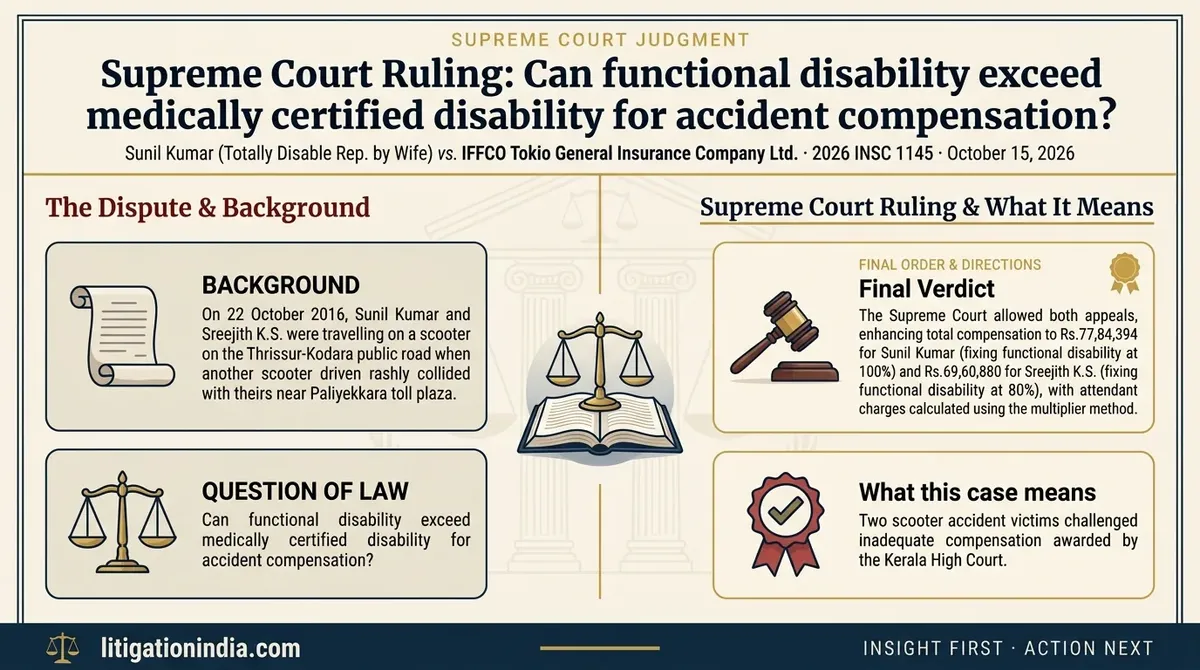
Supreme Court Enhances Motor Accident Compensation Distinguishing Medical and Functional Disability — infographic summary

What this case means

Two scooter accident victims challenged inadequate compensation awarded by the Kerala High Court. The Supreme Court held that functional disability — the real-life impact on earning capacity — can exceed the medically certified percentage, and awarded substantially higher compensation to both claimants, including for attendant charges calculated using the multiplier method.

What the Supreme Court held

The Supreme Court allowed both appeals, enhancing total compensation to Rs.77,84,394 for Sunil Kumar (fixing functional disability at 100%) and Rs.69,60,880 for Sreejith K.S. (fixing functional disability at 80%), with attendant charges calculated using the multiplier method. The respondent insurance company was directed to deposit the additional amounts within six weeks at 6.5% interest per annum on the incremental sums.

Case: Sunil Kumar (Totally Disable Rep. by Wife) vs. IFFCO Tokio General Insurance Company Ltd. (2026) Citation: 2026 INSC 1145

Want the full legal reasoning, citations and case documents?

Read the full judgment analysis
Sunil Kumar
IFFCO Tokio General Insurance
motor accident compensation
functional disability
medical disability
Motor Vehicles Act
multiplier method
attendant charges
loss of earning capacity
permanent disability
bystander charges
future prospects
Compensation provisions (Motor Accident Claims), Motor Vehicles Act
Motor Accident Claims / Compensation Law