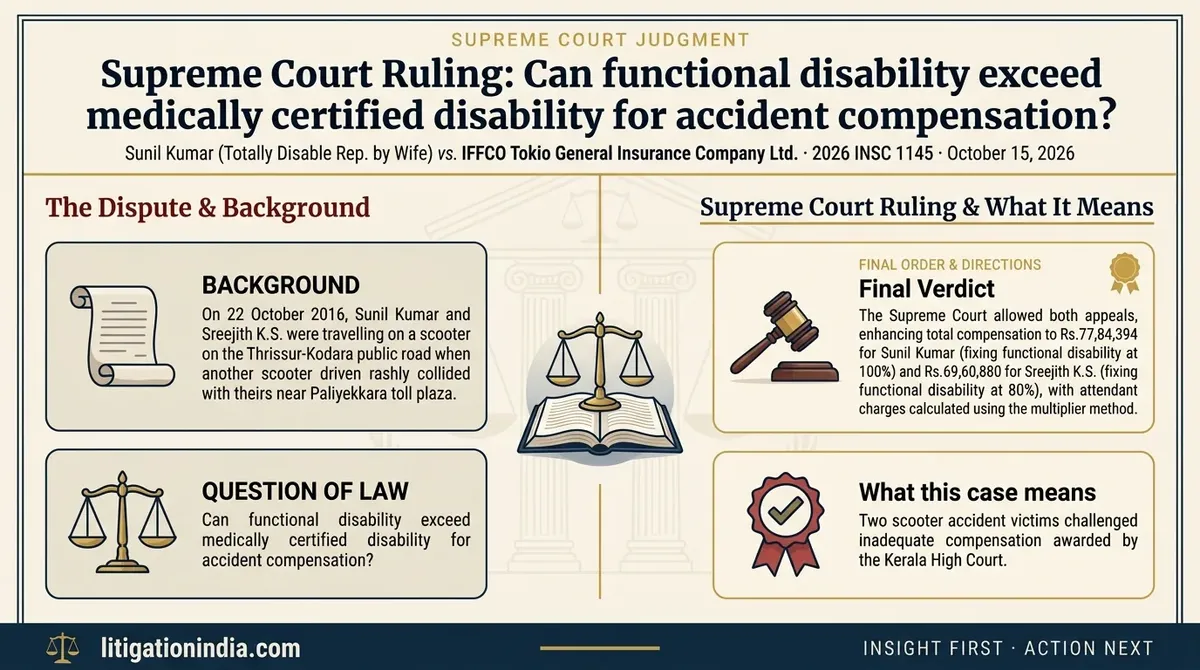
Full text of the judgment
Text extracted from Sunil Kumar (Totally Disable Rep. by Wife) vs. IFFCO Tokio General Insurance Company Ltd.. For the authoritative version refer to the Supreme Court of India's official website.
2026 INSC 1145
Civil Appeal @ SLP (C) No. 21292 of 2026 Civil Appeal @ SLP (C) No. 21441 of 2026
Page 1 of 27
IN THE SUPREME COURT OF INDIA CIVIL APPELLATE JURISDICTION
CIVIL APPEAL NO. 13542 OF 2026 (Arising out of SLP (C) No. 21292 of 2026)
SUNIL KUMAR (TOTALLY DISABLE REP. BY WIFE)
IFFCO TOKIO GENERAL INSURANCE COMPANY LTD.
…RESPONDENT
CIVIL APPEAL NO. 13543 OF 2026 (Arising out of SLP (C) No. 21441 of 2026)
J U D G M E N T
N.V. ANJARIA, J.
Leave already granted on 17.09.2026. 2. What is impugned in the present two appeals is common judgment and order dated 06.01.2026 passed by the High Court of Kerala at Ernakulam1, by which the High Court dealt with MACA No. 130 of 2022 and MACA No. 249
1 Hereinafter “High Court” Digitally signed by SNEHA DAS Date: 2026.10.16 17:58:12 IST Reason: Signature Not Verified
Civil Appeal @ SLP (C) No. 21292 of 2026 Civil Appeal @ SLP (C) No. 21441 of 2026
Page 2 of 27
of 2022. The appeals before the High Court arose from O.P. (M.V.) No. 642 of 2017 and O.P. (M.V.) No. 1555 of 2017 respectively, decided by common judgment and award dated 15.02.2021 of the Motor Accident Claims Tribunal at Irinjalakuda2. 2.1 The Tribunal awarded to the appellant-claimant Sunil Kumar3, by way of compensation, Rs.19,91,954/- with 8% per annum interest from the date of filing of the claim petition till realization who has been represented by his wife in the present appeal, having become totally disabled on account of the injuries suffered in the accident. In the second case, the appellant-claimant Sreejith K.S.4 came to be awarded Rs.16,03,400/- by the Tribunal with interest as above. 2.2 The High Court has enhanced the compensation to the appellant in the first case from Rs.19,91,954/- to Rs.36,22,644/-, whereas, in the second case, the amount is
2 Hereinafter “Tribunal” 3 Hereinafter “Appellant in the first case” 4 Hereinafter “Appellant in the second case”
Civil Appeal @ SLP (C) No. 21292 of 2026 Civil Appeal @ SLP (C) No. 21441 of 2026
Page 3 of 27
enhanced from Rs.16,03,400/- to Rs.27,70,664/- with interest as above. 2.3 Since both the appellants are dissatisfied with the extent of enhancement granted by the High Court, they have approached this Court by way of the present appeals. 3. The claim petitions arose out of one single accident, which took place on 22.10.2016 at about 7:40 in the morning. The appellant in the first case-Sunil Kumar was a pillion rider, whereas the appellant in the second case named Sreejith K.S. was driving the scooter bearing Registration No. KL-64/C-6493, both going through Thrissur-Kodara public road. When they reached near Paliyekkara toll plaza, all of a sudden, another scooter bearing Registration No. KL-45/M-9130 which was driven by original respondent no.1 stated to have come in a rash and negligent manner and collided with the scooter of the appellants. The appellants were thrown on the ground and sustained serious injuries. The appellant – claimant in the first case, who was a pillion rider claimed Rs.50,00,000/-, whereas the driver of the scooter – the appellant in the
Civil Appeal @ SLP (C) No. 21292 of 2026 Civil Appeal @ SLP (C) No. 21441 of 2026
Page 4 of 27
second case claimed Rs. 15,00,000/- towards compensation for the injuries sustained by them. 3.1 Before proceeding to consider the merits of the case for enhancement, relevant facts pertaining to both may be noticed. The appellant in the first case was 43 years of age on the date of the accident. His case was that he was engaged in the trading of bakery items and had been earning Rs.30,000/- per month. He relied on Exhibit-A13 certificate to contend that he had income from agriculture also. The Tribunal fixed his income to be Rs. 9,000/- per month taking the view that the Exhibit-A13 certificate showed that he was a farmer by occupation. 3.1.1 Before the High Court reliance was placed on the decision in Ramachandrappa vs. Manager, Royal Sundaram Alliance Insurance Company Limited5 to contend that since the accident had taken place in the year 2016, the notional income of the claimant ought to be taken at least Rs.10,500/- per month. The High Court took into
5 (2011) 13 SCC 236
Civil Appeal @ SLP (C) No. 21292 of 2026 Civil Appeal @ SLP (C) No. 21441 of 2026
Page 5 of 27
account the Exhibit-A13 certificate, in which claimant was certified to have completed the training in the Field Operation and Maintenance of Agricultural Machinery and Implements, to take a view that on the basis of Exhibit-A13, it could not be concluded that the claimant’s occupation was farming only. The income was re-fixed by the High Court at Rs.15,000/- per month. This appellant was held entitled to be given 25% increase towards future prospects. The Multiplier was taken at 14 considering that the age of the appellant was 43 years, on the date of accident. 3.1.2 As per the disability certificate Exhibit-X1 issued by the Medical Board, looking at the injuries suffered, the permanent disability was fixed at 75.5%. The contention on the part of the appellant that functional disability was required to be taken at 100% was not accepted by the Tribunal. The High Court did not touch the said aspect and maintained the disability at 75.5% as stated by the Medical Board. 3.1.3 It was further held by the High Court that amounts of Rs.12,000/- and Rs.2,000/- respectively
Civil Appeal @ SLP (C) No. 21292 of 2026 Civil Appeal @ SLP (C) No. 21441 of 2026
Page 6 of 27
awarded by the Tribunal under the head of ‘bystander’s expenses’ and ‘extra nourishment’, deserved to be increased to Rs.30,000/- and Rs.20,000/- respectively. Towards ‘pain and suffering’ and ‘loss of amenities’, the High Court viewed that in light of the disability certificate and other consideration, Rs. 2,50,000/- was required to be granted under each of the aforesaid heads. 3.1.4 The comparative chart showing the compensation under the different heads as awarded by the Tribunal and enhanced by the High Court to the appellant in the first case-Sunil Kumar is as below, Head for Compensation Amount awarded by Tribunal (in Rs.) Amount awarded by High Court (in Rs.) Loss of earnings 72,000/- 1,80,000/- (15,000 x 12) Transportation expenses 10,000/- 10,000/- Damage to clothing and articles 2,000/- 2,000/- Extra nourishment 2,000/- 20,000/- Bystander's expenses 12,000/- 30,000/-
Civil Appeal @ SLP (C) No. 21292 of 2026 Civil Appeal @ SLP (C) No. 21441 of 2026
Page 7 of 27
Medical expenses, including future medical expenses 4,02,394/- 4,02,394/- Pain and suffering 1,50,000/- 2,50,000/- Permanent disability and loss of earning power 11,41,560/- 23,78,250/- (15,000 + 25% x 12 x 14 x 75.5%) Loss of amenities 1,00,000/- 2,50,000/- Future bystander's expenses 1,00,000/- 1,00,000/- Total 19,91,954/- 36,22,644/-
3.2 Turning to the relevant facts in respect of the appellant in second case, the claimant named Sreejith K.S. was a driver of the ill-fated scooter. He was 22 years of age at the time of the accident. He claimed similar to the appellant in the first case, that he was engaged in the business of bakery items. The Tribunal fixed his notional income at Rs.8,000/-, against of his assertion of income to be of Rs.30,000/-. The High Court was of the view that no evidence was produced to fortify the plea for taking enhanced figure of income, however, considering the decision in Ramachandrappa (supra), the High Court re-
Civil Appeal @ SLP (C) No. 21292 of 2026 Civil Appeal @ SLP (C) No. 21441 of 2026
Page 8 of 27
fixed the amount to Rs.10,500/- per month. The appellant was held to be entitled for future prospects at 40%, having regard to his age. 3.2.1 The High Court increased the amount to Rs.2,50,000/- towards each of the head of ‘pain and suffering’ and ‘loss of amenities’ from Rs. 1,50,000/- and Rs. 1,00,000/- respectively which were granted by the Tribunal. The total compensation was calculated accordingly. In this case, Multiplier applied was 18 as the claimant was aged 22 years. 3.2.2 The extent of permanent disability in respect of the appellant in the second case was certified by the Medical Board. The Medical Board was of the view that having regard to the nature of injuries suffered by this appellant-claimant, disability was required to be assessed at 62%. The High Court took the view that the percentage of disability for the appellant in the second case was acceptable as certified by the Medical Board. It was found that this claimant suffered injuries in the nature of right volar bartons fracture, right scaphoid fracture, fractures of left 1st and 2nd metacarpal
Civil Appeal @ SLP (C) No. 21292 of 2026 Civil Appeal @ SLP (C) No. 21441 of 2026
Page 9 of 27
fracture, left brachial plexuses injury (lower trunk). The said injuries have potential to affect nerve supplying the arm. 3.2.3 The comparative chart showing compensation amount under the different heads as awarded by the Tribunal and enhanced by the High Court to the appellant in the second case-Sreejith K.S. is as below, Head of Claim for Compensation Amount awarded by Tribunal (in Rs.) Amount awarded by High Court (in Rs.) Loss of earnings 64,000/- 84,000/- (10,500 x 8) Transportation expenses 10,000/- 10,000/- Damage to clothing and motorcycle 2,000/- 2,000/- Extra nourishment 2,000/- 2,000/- Bystander's expenses 9,300/- 9,300/- Medical expenses 1,94,720/- 1,94,720/- Pain and suffering 1,50,000/- 2,50,000/- Permanent disability and loss of earning power 10,71,360/- 19,68,624/- (10,500 + 40% x 12 x 18 x 62%)
Civil Appeal @ SLP (C) No. 21292 of 2026 Civil Appeal @ SLP (C) No. 21441 of 2026
Page 10 of 27
Loss of amenities 1,00,000/- 2,50,000/- Total 16,03,380/- (rounded off to 16,03,400) 27,70,664/-
4. Heard learned counsel Ms. Aarthi Rajan for the appellants and learned counsel Mr. Shubham Janghu for the respondent in both the appeals, at length. 5. Proceeding to analyse the merits of the case for enhancement in the compensation put forward in both the appeals, firstly taking the case of the appellant-Sunil Kumar, who suffered serious head injuries and other injuries in the accident. While considering the monthly income of the appellant in the first case, the High Court, while referring to Exhibit-A13 certificate, observed that he had completed training in Field Operation and Maintenance of Agricultural Machinery and Implements, however from the certificate, it would not be suggested that the appellant was engaged in farming activity alone. 5.1. The High Court’s view was correct. The appellant could reasonably be presumed to be engaged in other
Civil Appeal @ SLP (C) No. 21292 of 2026 Civil Appeal @ SLP (C) No. 21441 of 2026
Page 11 of 27
earning activities also. Therefore, the High Court was justified in taking Rs.15,000/- per month to be his monthly income. Furthermore, the High Court took the loss of earning, increasing the same from 8 to 12 months. For this appellant, 40% ‘future prospects’ came to be awarded. 5.1.1 In the case of the appellant, since he was 43 years of age, the multiplier of 14 applied, which was in accordance with Smt. Sarla Verma & Ors. vs. Delhi Transport Corporation & Another6. The reasoning, the finding, and the amount awarded by the High Court on this score need no interference. 5.1.2 The Medical Board certified the medical disability of this appellant to the extent of 75.5%. However, the extent of permanent disability cannot be realistically assessed without considering the nature of the injuries and the effect thereof on the life and state of living of the appellant. The injuries which he suffered, included severe head injuries, open diffuse axonal injury, midbrain contusion with Weber’s
6 (2009) 6 SCC 121
Civil Appeal @ SLP (C) No. 21292 of 2026 Civil Appeal @ SLP (C) No. 21441 of 2026
Page 12 of 27
syndrome and left knee penetrating injury. The functional effect of those injuries has to be estimated. They have grave consequences on the earning capacity of the appellant. The appellant would require an attendant and a bystander to look after him throughout his life. The appellant would be suffering from psychiatric disability of higher grade. 5.1.3 Therefore, even though the Medical Board certified the medical disability to be 75.5%, the functional effect can be said to be debilitating for the appellant to the extent of 100%. One who remains dependent on another and requires an attendant throughout his life can be said to be suffering from 100% functional disability. The appellant would not be able to do his own work, much less engage in earning activity for himself and his family, leading to total loss of working capacity. 5.1.4 In Shankar Dutt vs. United India Insurance Co. Ltd. and Others7, this Court elaborated the concept of permanent disability, highlighting the components thereof,
7 2026 SCC OnLine SC 1193
Civil Appeal @ SLP (C) No. 21292 of 2026 Civil Appeal @ SLP (C) No. 21441 of 2026
Page 13 of 27
the prime of which is loss of earning capacity. The claimant, who becomes partially or completely disabled and lose forever the capacity to earn, is a permanently disabled person, and the amount of compensation on the said count has to be determined in such context. 5.1.5 The Court drew the distinction between medical disability and functional disability, ‘A conceptual distinction has to be drawn between the medically certified disability resulting out of physical injury or impairment on one hand, and the long-term repercussions on the injured, on his or her life and activities on the other hand. The functional disability is one which is suffered and felt by the injured in his day-to-day life or in his avocation, occupation, business or profession.’ (Para 5.6.1) 5.1.5 (a) It was further observed, ‘The medical opinion may have suggested that physical impairment on account of the injury is to a particular extent, however its functional effect may be greater. In fact, it could be reasonable to state that the functional incapacity resulting out of a particular bodily injury, which may be impairment or amputation, would be higher and greater than what may be medically perceived.’ (Para 5.6.2)
Civil Appeal @ SLP (C) No. 21292 of 2026 Civil Appeal @ SLP (C) No. 21441 of 2026
Page 14 of 27
5.1.5 (b) The Court next explained, ‘When it comes to assessing the compensation in the context of the injury suffered, what matters is the extent by which the functions of an injured person suffers, and not what the doctor may have judged in terms of medical standards. The functional aspect of the disability arising out of injury has correlation with the age of the injured, his occupation, engagement in work or avocation, the adversarial effect on the earning capacity of the injured, which would again depend upon the nature of work or earning activity with which and in which the injured is engaged and such other relevant considerations.’ (Para 5.6.3)
5.1.6 In Jithendran vs. New India Assurance Co. Ltd. and Another8, this Court emphasised for taking realistic approach while assessing the permanent disability, ‘The courts should strive to provide a realistic recompense having regard to the realities of life, both in terms of assessment of the extent of disabilities and its impact including the income generating capacity of the claimant. In cases of similar nature, wherein the claimant is suffering severe cognitive dysfunction and restricted mobility, the courts should be mindful of the fact that even though the physical disability is assessed at 69%, the functional disability is 100% insofar as the claimant's loss of earning capacity is concerned.’ (Para 14)
8 (2022) 15 SCC 620
Civil Appeal @ SLP (C) No. 21292 of 2026 Civil Appeal @ SLP (C) No. 21441 of 2026
Page 15 of 27
5.1.7 In Reliance General Insurance Co. Ltd. vs. Priyanka Das and Others9, the Court again highlighted the concept of functional disability as under, ‘The calculation of functional disability depends on assessing the victim's earning capacity in the open, competitive market, rather than on retention in a specific, highly accommodated role. Evidence before the High Court, specifically the Career Growth Letter dated 06.02.2018 from her employer, confirmed that the Claimant lost out on her normal career growth and promotional progression, including advancement to the positions…’ (Para 19)
5.1.8 Therefore, because of the injuries, the appellant became permanently disabled and effectively stood deprived of his earning capacity in open competitive market. The distinction between medical disability and functional disability, as highlighted from the decision in Shankar Dutt (supra), applies for arriving at the functional disability in the present case also. In Jithendran (supra), this Court underlined the need to adopt a realistic approach for arriving at the figure of permanent disability, which principle would also equally apply.
9 2026 SCC OnLine SC 1760
Civil Appeal @ SLP (C) No. 21292 of 2026 Civil Appeal @ SLP (C) No. 21441 of 2026
Page 16 of 27
5.1.9 Having regard to the nature of injuries suffered by the appellant in the first case and the resultant effect on his body and activity, it would be reasonable to take the permanent functional disability to the extent of 100%, and the amount towards loss of earning capacity would be calculated thus- Rs. 15,000/- monthly income multiplied by 12 which brings total annual income of Rs. 1,80,000/-. Since the permanent disability is to the extent of 100%, which will come to Rs. 1,80,000/-, further multiplied by 25% towards ‘future prospects, which comes to Rs. 45,000/- , therefore, Rs. 1,80,000/- + 45,000/-, total of which Rs. 2,25,000/-, multiplied by multiplier figure of 14, brings total amount of Rs. 31,50,000/- to be awarded towards ‘loss of earning capacity’ on the basis of 25% future prospects and 100% disability. 5.2 There is another head under which the amount of compensation awarded by the High Court is inadequate, and not conforming to the principles laid down by this Court in that regard, which is under the head of ‘attendant charges’ or ‘bystander charges’ to the extent of Rs.1,00,000/-. The
Civil Appeal @ SLP (C) No. 21292 of 2026 Civil Appeal @ SLP (C) No. 21441 of 2026
Page 17 of 27
principles were stated in Kajal vs. Jagdish Chand and Others10, to arrive at a just and reasonable amount towards attendant charges in case of serious injuries where the person has become disabled almost for lifetime. 5.2.1 In Kajal (supra), the appellant-Kajal was a young school going girl who suffered serious accidental injuries resulting in damage to the brain. As far as ‘attendant charges’ are concerned, the High Court awarded Rs.2,500/per month for 44 years, which method was not approved by this Court. It was observed that the multiplier system was used to balance out the various factors and the same should be followed not only for determining the compensation on account of loss of income or dependency but also for determining the attendant charges. 5.2.2 The method or system based on multiplier application was recognized by this Court in Gobald Motor Service Ltd. vs. R.M.K. Veluswami11. It was stated that the multiplier system factors in the inflation rate, the rate of
10 (2020) 4 SCC 413 11 AIR 1962 SC 1
Civil Appeal @ SLP (C) No. 21292 of 2026 Civil Appeal @ SLP (C) No. 21441 of 2026
Page 18 of 27
interest payable on the lumpsum amount awarded, the longevity of the claimant and also the aspects such as uncertainties of life.
5.2.3 By applying the multiplier method to adequately compensate the appellant under the head of attendant charges, the following amount would be awardable: monthly income Rs.15,000/- multiplied by 12, to arrive at annual income to Rs.1,80,000/-, further multiplied by multiplier figure 14, which comes to Rs.25,20,000/-. The aforesaid amount as arrived at above would be just compensation towards the ‘attendant charges’ to the appellant, who would need such assistance almost throughout his life. 5.3 In respect of ‘future medical expenses’, the High Court has granted Rs.10,00,000/- by placing reliance on the decision in Reliance General Insurance Co. Ltd. (supra). Therefore, the said amount of Rs.10,00,000/- is properly awarded to be just and proper. It is maintained. The High Court has awarded Rs.10,000/- towards ‘transportation expenses’, Rs.2,000/- towards ‘clothes and articles’,
Civil Appeal @ SLP (C) No. 21292 of 2026 Civil Appeal @ SLP (C) No. 21441 of 2026
Page 19 of 27
Rs.20,000/- towards ‘extra nourishment’, which are just and proper. 5.4 The amount awarded under the head of ‘medical expenses including future medical expenses’ to the tune of Rs.4,02,394/-, is also proper. Under the ‘loss of amenities’, Rs.2,50,000/- and the equivalent amount for ‘pain and suffering’ are also just and proper. They do not require any interference or increase. 5.5 As a result of the foregoing discussion, the total compensation that would be payable to the appellant in the first case, named Sunil Kumar, would be as under, Heads Amounts Loss of earnings 15,000 × 12 = 1,80,000/- Transportation expenses 10,000/- Damage to clothing and motorcycle 2,000/- Extra nourishment 20,000/- Bystander's expenses 15,000 × 12 × 14 = 25,20,000/- Medical expenses 4,02,394/-
Civil Appeal @ SLP (C) No. 21292 of 2026 Civil Appeal @ SLP (C) No. 21441 of 2026
Page 20 of 27
Future medical expenses 10,00,000/- Pain and suffering 2,50,000/- Permanent disability and loss of earning power [15,000 x 12 = 1,80,000/- 1,80,000 x 100% = 1,80,000/- 1,80,000 x 25% = 45,000/- 45,000+1,80,000= 2,25,000/- 2,25,000 x 14 = 31,50,000/-] 31,50,000/- Loss of amenities 2,50,000/- Total 77,84,394/-
As far as the appellant in the second case is concerned, he was the driver of the ill-fated scooter, aged 22 years on the date of the accident. As regards income, the claim of this appellant was on the same lines as of the appellant in the first case, claiming that he had been engaged in bakery items and earned Rs.30,000/- per month. Since there was no evidence produced in fortification, the High Court was justified in rejecting the claim about the income by this appellant to such extent.
Civil Appeal @ SLP (C) No. 21292 of 2026 Civil Appeal @ SLP (C) No. 21441 of 2026
Page 21 of 27
6.1 The High Court, however on the basis of the decision in Ramachandrappa (supra), took his notional monthly income to be Rs.10,500/- to commit no error. This appellant was granted ‘loss of future prospects’ to the extent of 40%, having regard to his age. The multiplier applied in his case was 18, which was in accordance with the decision in Sarla Verma (supra).
6.2 In respect of this appellant, the Medical Board certified the medical disability to the extent of 62%. The injuries suffered by the appellant were serious. They included right volar bartons fracture, right scaphoid fracture, fractures of left 1st and 2nd metacarpal fracture and left brachial plexuses injury (lower trunk). The said injuries have potential to affect nerve supplying arm. Therefore, because of the injuries, the appellant became permanently disabled and effectively lost his earning capacity in the open competitive market. 6.2.1 The distinction between medical disability and functional disability, as highlighted from the decision in Shankar Dutt (supra), in Jithendran (supra) and in
Civil Appeal @ SLP (C) No. 21292 of 2026 Civil Appeal @ SLP (C) No. 21441 of 2026
Page 22 of 27
Reliance General Insurance Ltd. (supra), applies for arriving at the functional disability in the present case also. Considering the nature of injuries suffered by the appellant in the second case and the resultant effect on his body and life activity, it would be reasonable to take the permanent functional disability to the extent of 80%. The amount would be calculated as under - Rs. 10,500/- notional income multiplied by 12, which comes to Rs. 1,26,000/- as annual income. Since the permanent disability is assessed at 80%, Rs.1,26,000/multiplied by 80% which comes to Rs.1,00,800/- and that figure multiplied by 40%, which is ‘loss of future prospects’ Rs. 40,320/- + 1,00,800/- and total amount is to be multiplied by the figure of 18, which comes to total Rs.25,40,160/- to be awarded towards ‘permanent disability and loss of earning power’. 6.3 This appellant was granted Rs.9,300/- towards ‘bystander charges’. The principles discussed in Kajal (supra) and also in Hansraj vs. Mukesh Nath and Others12, would also suggest that the attendant charges or bystander
12 2026 INSC 454
Civil Appeal @ SLP (C) No. 21292 of 2026 Civil Appeal @ SLP (C) No. 21441 of 2026
Page 23 of 27
charges have to be calculated on the basis of the multiplier method. The amount would be calculated as notional income per month Rs. 10,500/- multiplied by 12 and further multiplied by the figure of multiplier 18, which come to Rs.22,68,000/-.
6.4 Considering the nature of injuries in this case, the future medical expenses, taking suggestions from Reliance General Insurance Company Limited (supra), could be reasonably granted to the extent of Rs.8,00,000/-. The appellant in the second case also would be entitled to get enhancement under the heads of ‘pain and suffering’ and ‘loss of amenities’ to the extent of Rs.2,50,000/- under each head, as awarded in the case of the first appellant.
6.5 Further, the appellant in the second case was an energetic, able-bodied youngster at the time of the incident. Therefore, the loss towards marriage prospects would have to be recognized while determining the amount of compensation for this appellant - claimant. Under the head of loss of marriage prospects, the principles laid down by
Civil Appeal @ SLP (C) No. 21292 of 2026 Civil Appeal @ SLP (C) No. 21441 of 2026
Page 24 of 27
this Court in Raj Kumar vs. Ajay Kumar13, would be relied upon, and the amount of Rs.5,00,000/- would be a proper amount to be awarded for ‘loss of future prospects of marriage’.
6.6 The amounts awarded under other heads by the High Court do not warrant any interference.
6.7 As a result of the foregoing discussion, the total compensation that would be payable to the appellant in the second case, named Sreejith K.S., would be as under,
Heads Amounts Loss of earnings 10,500 x 12 =1,26,000/- Transportation expenses 10,000/- Damage to clothing and motorcycle 2,000/- Extra nourishment 20,000/- Bystander's expenses 10,500 x 12 x 18 = 22,68,000/- Medical expenses 1,94,720/-
13 (2011) 1 SCC 343
Civil Appeal @ SLP (C) No. 21292 of 2026 Civil Appeal @ SLP (C) No. 21441 of 2026
Page 25 of 27
Future medical expenses 8,00,000/- Pain and suffering 2,50,000/- Permanent disability and loss of earning power [10,500 x 12 = 1,26,000 1,26,000 x 80%= 1,00,800 1,00,800 x 40% = 40,320 40,320+1,00,800=1,41,120/- 1,41,120 x 18 = 25,40,160/-] 25,40,160/- Loss of amenities 2,50,000/- Loss of marriage prospects 5,00,000/- Total 69,60,880/-
7. Accordingly, the appellant in the first case is held entitled to a total amount of Rs.77,84,394/- with interest, the additional compensation payable to him would be Rs.41,61,750/-. However, this Court deems it fit to grant interest at 6.5% per annum from the date of filing claim petition till realisation on the additional amount instead of 8% as awarded by the Tribunal and the High Court on the originally granted amount.
Civil Appeal @ SLP (C) No. 21292 of 2026 Civil Appeal @ SLP (C) No. 21441 of 2026
Page 26 of 27
7.1. The appellant in the second case would be entitled to total compensation of Rs. 69,60,880/- with interest, and the differential additional amount payable would come to Rs.41,90,216/- to be paid with interest at 6.5% from the date of application till actual payment. 7.2 Both the appellants will get the additional amount with 6.5% interest per annum to run from the date of filing of the claim petition till realization. 8. The respondent- insurance company shall deposit, in both the cases, the additional amount of compensation awarded with interest calculated as above, within 6 weeks from the date of this judgment, before the Tribunal concerned. 9. The Tribunal shall disburse the amount in favour of the respective appellants, after seeking proof of identification and undertaking necessary procedure in that regard, by directly transferring the amount into the Bank Accounts of the appellants-claimants concerned.
Civil Appeal @ SLP (C) No. 21292 of 2026 Civil Appeal @ SLP (C) No. 21441 of 2026
Page 27 of 27
10. Both the appeals accordingly succeed and are allowed in the above terms and to the aforesaid extent.
Any interlocutory applications, if pending, shall cease to survive in view of the disposal of the main appeals.
.………………………...J. [S.V.N. BHATTI]
………………………….J. [N.V. ANJARIA] NEW DELHI; October 15, 2026