Introduction: Institutionalizing Legal Technology in the Indian Judiciary
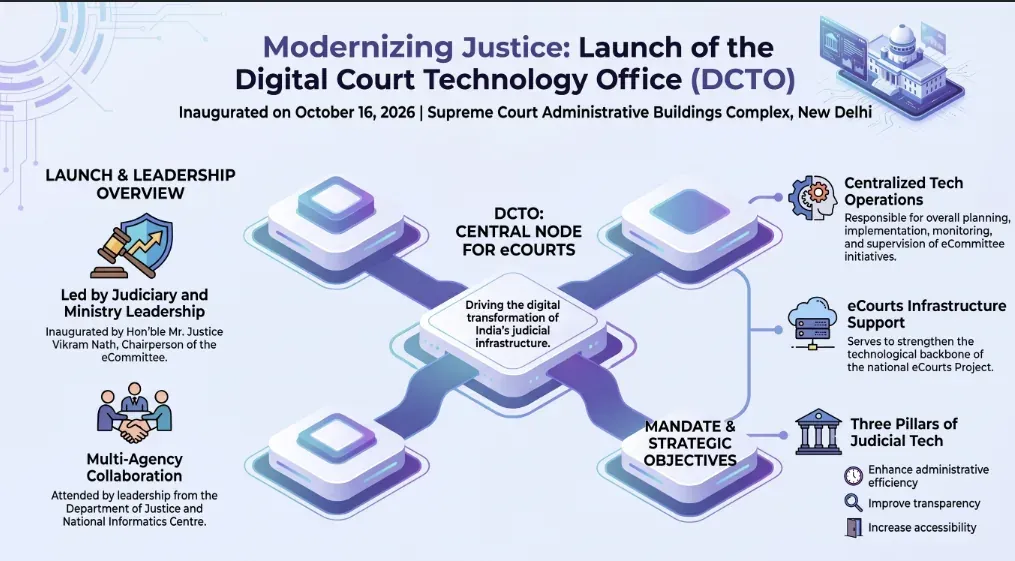
In a major development towards modernizing judicial infrastructure, the eCommittee of the Supreme Court of India formally inaugurated the Digital Court Technology Office (DCTO) on Friday, October 16, 2026. Located at Room No. 802, 8th Floor, Administrative Buildings Complex, Supreme Court of India, New Delhi, the new establishment is designed to serve as the technological engine driving digital reforms across the court network.
The creation of the DCTO marks a structured transition toward dedicated technical governance within the judicial branch, reinforcing the judiciary's capacity to manage large-scale digital transformations under the ongoing eCourts Project.
Inauguration Ceremony and Key Dignitaries
The inauguration was solemnized by Hon’ble Mr. Justice Vikram Nath, Judge, Supreme Court of India and Chairperson of the eCommittee, Supreme Court of India.
The ceremony was attended by prominent judicial and executive dignitaries, including:
- Hon’ble Mr. Justice Anjani Kumar Mishra, Vice-Chairperson, eCommittee, Supreme Court of India.
- Shri Niraj Verma, Secretary (Justice), Department of Justice, Government of India.
- Shri Priyank Bharti, Director General, National Informatics Centre (NIC).
- Distinguished Members of the eCommittee, Supreme Court of India.
The presence of senior representation from the judiciary, the Department of Justice, and the National Informatics Centre underscores the collaborative framework required to build robust digital court systems.
Core Functions and Mandate of the Digital Court Technology Office (DCTO)
The Digital Court Technology Office has been established to function as a centralized administrative and technical body. Rather than operating through ad-hoc technical arrangements, the DCTO will provide unified oversight and institutional continuity for digital initiatives.
Key Responsibilities of the DCTO:
- Strategic Planning: Formulating long-term roadmaps for technical architecture, software deployments, and digital workflows across court complexes.
- Project Implementation: Directing the execution of specialized digital court tools, electronic filing systems, and virtual hearing platforms.
- System Monitoring & Supervision: Continuously tracking system performance, data security protocols, and operational compliance under the eCourts Project umbrella.
- Inter-Agency Coordination: Facilitating seamless technical integration between the eCommittee, the Department of Justice, and the National Informatics Centre (NIC).
Strengthening the eCourts Project Backbone
The establishment of the DCTO represents a milestone in the evolution of the eCourts Project. By centralizing technical and administrative oversight, the initiative directly supports the eCommittee’s broader commitment to:
- Enhancing Efficiency: Streamlining judicial workflows and reducing administrative friction in case management.
- Increasing Transparency: Facilitating seamless public access to case statuses, orders, judgments, and court cause lists.
- Improving Accessibility: Ensuring litigants, legal practitioners, and citizens can engage with court processes remotely and securely.
- Adapting to Societal Needs: Aligning judicial service delivery with the evolving technological expectations of modern society.
Cover image (16:9 recommended)

Tags (comma separated) Supreme Court of India, eCommittee, Digital Court Technology Office, DCTO, eCourts Project, Legal Technology, Justice Vikram Nath, Judicial Reforms, Department of Justice, National Informatics Centre Author Litigation India Editorial
SEO
Meta title (28/60) SC eCommittee Launches DCTO | Litigation India Insights
Meta description (0/158) The eCommittee, Supreme Court of India inaugurates the Digital Court Technology Office (DCTO) to supervise all technology initiatives under the eCourts Project.
I have also dispatched the request to generate the accompanying Infographic highlighting the establishment and key mandates of the Digital Court Technology Office (DCTO). It will appear in your Studio panel shortly.
Would you like to prepare a detailed briefing note or slide presentation on the technical roadmap and eCourts Project integration for the DCTO?