
All insights

Can a consensual long-term relationship be retrospectively treated as rape after it ends?

Supreme Court Discharges Accused in Consensual Relationship Converted to Rape Case

The case involved a man accused of rape and related offences after a long-term live-in relationship ended. The Supreme Court found that all relevant ingredients of the alleged offences under IPC were

Litigation India Editorial 30 October 2026 1 min read 2026 INSC 1179

Story

Case at a glance1 / 6

Supreme Court of India

Consensual Relationship Cannot Be Retrospectively Criminalised as Rape

Santhosh Kumar N.P. v. State & Anr. | 2026 INSC 1179

Court: Supreme Court of IndiaDate: October 30, 2026Bench: Justice B.V. Nagarathna and Justice R. MahadevanArea of Law: Criminal Law — Discharge, Rape, Consent, IPC Offences
Supreme Court Discharges Accused in Consensual Relationship Converted to Rape Case · 2026 INSC 11792026-10-30T19:23:23.753490+00:00
The legal question2 / 6

Did FIR No.503/2011 Disclose Sufficient Grounds to Proceed Against the Appellant?

Core legal question under Section 227, CrPC

  • Appellant: Relationship was fully consensual; complainant knew of prior marriage within months yet continued for 7 years.
  • Appellant: Ingredients of Sections 376, 420, 493, 494, 495 IPC are entirely absent; prosecution is an abuse of process.
  • Respondent: Second complaint valid as first was dismissed for non-prosecution, not on merits.
  • Respondent: Appellant's continued reassurances and documentary evidence such as IVF signatures and joint accounts show complainant's genuine belief in marriage.
Supreme Court Discharges Accused in Consensual Relationship Converted to Rape Case · 2026 INSC 11792026-10-30T19:23:23.753490+00:00
The Court's reasoning3 / 6

Court's Reasoning: From Allegations to Discharge

Step-by-step analysis under Section 227 CrPC

  1. 1Step 1: Apply Prafulla Kumar Samal and Sajjan Kumar — only a prima facie probability of offence is needed to proceed; discharge if probability is non-existent.
  2. 2Step 2: Section 376(2)(n) — repeated acts were part of an ongoing consensual relationship; complainant continued cohabitation after learning of prior marriage.
  3. 3Step 3: Section 420 — no delivery of property or creation of valuable security by complainant; essential ingredient entirely absent.
  4. 4Step 4: Sections 493, 494, 495 — valid marriage not established prima facie; complainant's continued stay after knowing of prior marriage negates claim of deceit.
  5. 5Step 5: Probability of commission of any alleged offence is entirely non-existent — discharge ordered.
Supreme Court Discharges Accused in Consensual Relationship Converted to Rape Case · 2026 INSC 11792026-10-30T19:23:23.753490+00:00
Key points4 / 6

Genuine Sexual Assault vs. Retroactive Criminalisation of Consent

Key distinction drawn by the Court

  • Genuine case: Woman kept entirely in the dark about prior marriage; consent built wholly on deceit from the outset.
  • Not a genuine case: Woman informed of prior marriage early on, yet voluntarily continued the relationship for years.
  • Genuine case: Sexual acts committed under threat, fear, captivity or continued coercion.
  • Not a genuine case: Repeated acts forming part of a mutually affectionate ongoing relationship that later soured.
Regret over a past consensual relationship does not, by itself, amount to rape.
Supreme Court Discharges Accused in Consensual Relationship Converted to Rape Case · 2026 INSC 11792026-10-30T19:23:23.753490+00:00
The verdict5 / 6

The Verdict: Appellant Discharged

Supreme Court allows appeals; sets aside High Court and Trial Court orders

  • The Fact: Appellant and complainant cohabited for seven years; complainant knew of prior marriage within months but continued voluntarily.
  • The Law: Section 227 CrPC requires discharge where probability of commission of offence is entirely non-existent; ingredients of all five IPC sections were absent.
  • The Result: Appeals allowed; High Court and Trial Court orders set aside; appellant discharged from all alleged offences.
The appellant is discharged from the offences alleged against him. The appeals are allowed.
Supreme Court Discharges Accused in Consensual Relationship Converted to Rape Case · 2026 INSC 11792026-10-30T19:23:23.753490+00:00
Why it matters6 / 6

What This Means for Ordinary People

Practical significance of the judgment

  • A consensual adult relationship that ends badly cannot automatically become a rape case; courts will look at the full picture.
  • If a woman knowingly continues a relationship after learning facts that negate her claimed belief, she cannot later claim her consent was obtained by deception.
  • Genuine rape and sexual assault cases must still be pursued vigorously; this ruling does not protect those who truly deceive and coerce.
  • Courts must distinguish personal disputes from genuine crimes; criminal law must not be used as a weapon of revenge after relationships fail.
Regret over a failed consensual relationship is not a crime; criminal law cannot settle personal scores.
Supreme Court Discharges Accused in Consensual Relationship Converted to Rape Case · 2026 INSC 11792026-10-30T19:23:23.753490+00:00
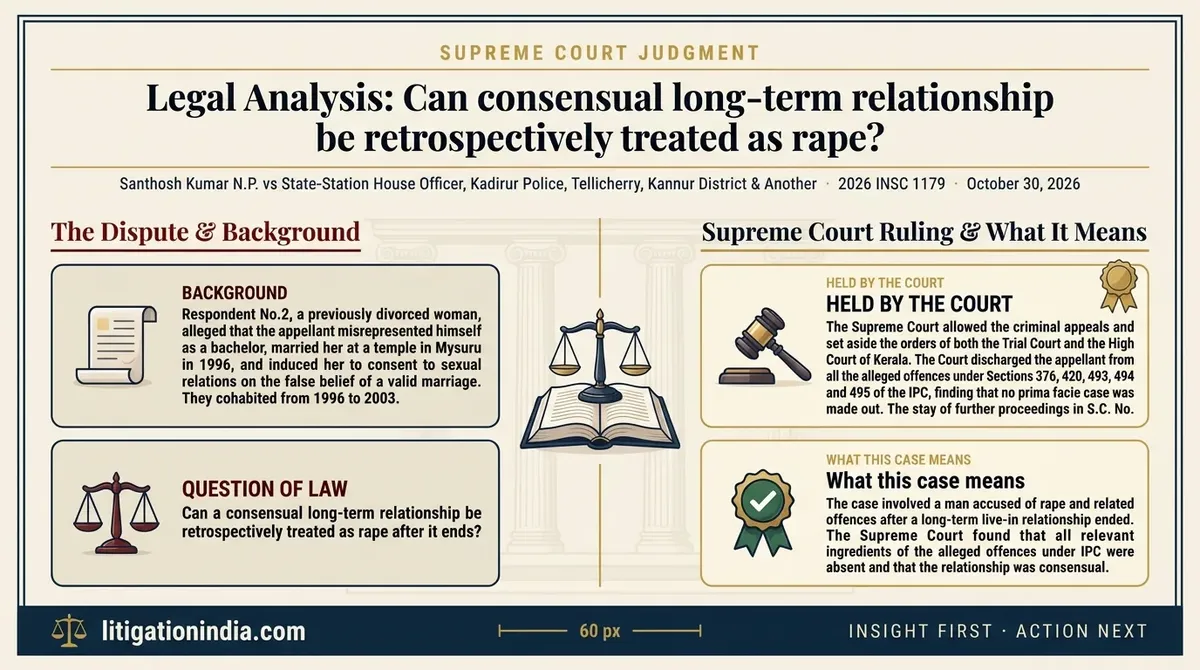
Supreme Court Discharges Accused in Consensual Relationship Converted to Rape Case — infographic summary

What this case means

The case involved a man accused of rape and related offences after a long-term live-in relationship ended. The Supreme Court found that all relevant ingredients of the alleged offences under IPC were absent and that the relationship was consensual. The Court discharged the accused, warning against the misuse of criminal law to settle personal disputes after relationships fail.

What the Supreme Court held

The Supreme Court allowed the criminal appeals and set aside the orders of both the Trial Court and the High Court of Kerala. The Court discharged the appellant from all the alleged offences under Sections 376, 420, 493, 494 and 495 of the IPC, finding that no prima facie case was made out. The stay of further proceedings in S.C. No.371/2013 was thereby rendered effective.

Case: Santhosh Kumar N.P. vs State-Station House Officer, Kadirur Police, Tellicherry, Kannur District & Another (2026) Citation: 2026 INSC 1179

Want the full legal reasoning, citations and case documents?

Read the full judgment analysis
Santhosh Kumar NP
discharge under Section 227 CrPC
consensual relationship
rape IPC Section 376
Section 493 IPC
Section 494 IPC
Section 495 IPC
prima facie case
failed relationship criminalisation
FIR quashing
Section 227, Section 156(3), Section 482, Code of Criminal Procedure, 1973
Section 376(2)(n), Section 420, Section 493, Section 494, Section 495, Indian Penal Code, 1860
Section 12(1), Protection of Women from Domestic Violence Act, 2005
Criminal Law / Discharge / Sexual Offences