
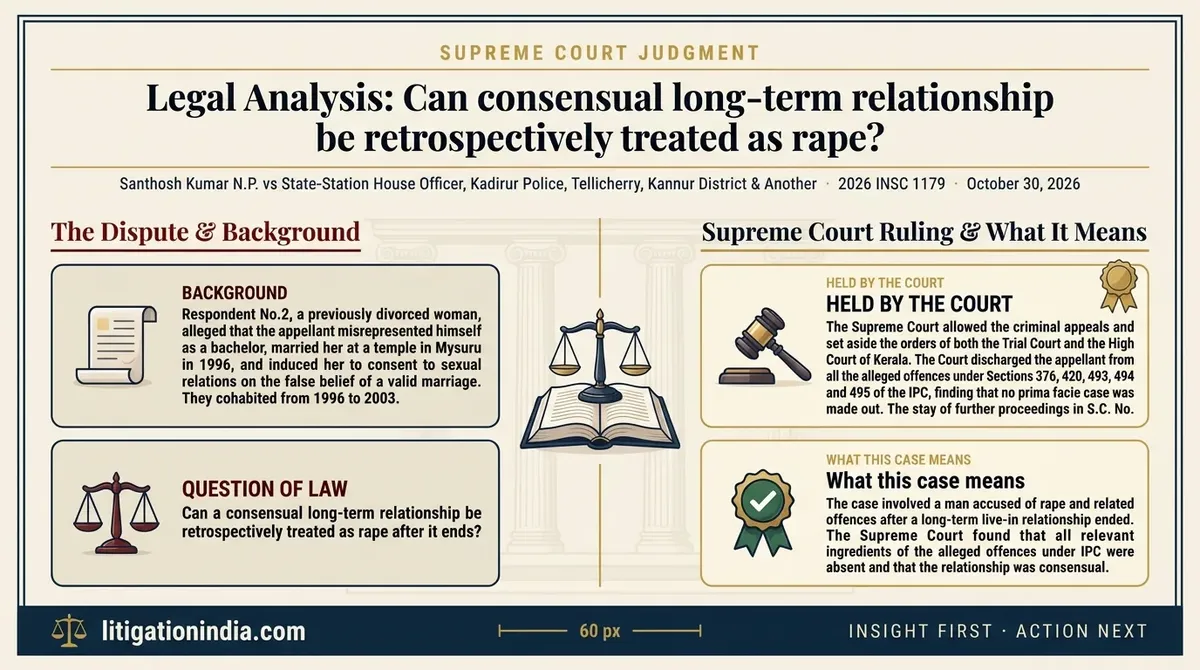
Full text of the judgment
Text extracted from Santhosh Kumar N.P. vs State-Station House Officer, Kadirur Police, Tellicherry, Kannur District & Another. For the authoritative version refer to the Supreme Court of India's official website.
2026 INSC 1179 1
REPORTABLE IN THE SUPREME COURT OF INDIA CRIMINAL APPELLATE JURISDICTION CRIMINAL APPEAL NOS.
OF 2026 (Arising Out of SLP (Crl.) Nos.10173-10174 of 2025)
SANTHOSH KUMAR N.P.
… APPELLANT
VERSUS STATE-STATION HOUSE OFFICER, KADIRUR POLICE, TELLICHERRY, KANNUR DISTRICT & ANOTHER
… RESPONDENTS
J U D G M E N T
NAGARATHNA, J.
Leave granted. 2. These criminal appeals have been preferred by the appellant assailing the impugned common order dated 21.05.2025 passed by the High Court of Kerala dismissing Cr. R.P. No.295/2015 and Crl. M.C. No.1221/2015. Digitally signed by RADHA SHARMA Date: 2026.10.30 15:56:48 IST Reason: Signature Not Verified
3. Briefly stated, the facts of the case are that respondent No.2 herein was earlier married to one Divakaran. After they were divorced, respondent No.2 became acquainted with the appellant herein and the acquaintance gradually matured into a personal relationship. It is the case of respondent No.2 that appellant herein represented himself to be a bachelor and offered to marry her. In the year 1996, appellant and respondent No.2 travelled to Mysuru, where they were married at a temple. They also resided together as a married couple until the year 2003 and on the basis of the presumption of a validly subsisting marriage, respondent No.2 consented to sexual acts with the appellant on a multitude of occasions. 4. Thereafter, alleging neglect, respondent No.2 filed M.C. No.3/2008 (re-registered as M.C. No.31/2009) before the Judicial First Class Magistrate Court-IV, Kozhikode under Section 12(1) of the Protection of Women from Domestic Violence Act, 2005 (hereinafter, “DV Act”) seeking arrangement of an alternate accommodation for her along with certain sums of money towards various expenses. In the proceedings before the Magistrate,
appellant herein disclosed that he was earlier married with two children and that on 31.08.2009, the aforesaid complaint came to be dismissed. The criminal appeal filed against the said order of dismissal also came to be dismissed. 5. Pursuant to this, respondent No.2 filed a private complaint before the Additional Chief Magistrate, Thalassery under Sections 376, 420, 493, 494 and 495 of the Indian Penal Code, 1860 (hereinafter, “IPC”) against the appellant, alleging that she had been deceived by the appellant who had claimed to be a bachelor and had married her and that she had consented to physical relationship on the basis of the said presumption (when he was in fact already married to someone else). On 04.04.2011, the said complaint came to be dismissed for non-prosecution. A revision petition filed against the said order of dismissal is pending. 6. Respondent No.2 proceeded to file a second private complaint before the Additional Chief Judicial Magistrate, Thalassery under Sections 376, 420, 493, 494 and 495 of the IPC, containing similar allegations as raised in the earlier complaint. The said second
complaint was referred to the Kadirur Police under Section 156(3) of the Criminal Procedure Code, 1973 (hereinafter, “CrPC”). 7. On receipt of the said complaint, FIR bearing No.503/2011 came to be registered at Kadirur Police Station, Thalassery against the appellant for the offences punishable under Sections 376, 420, 493, 494 and 495 of the IPC. 8. Feeling aggrieved, appellant filed Crl. M.C. No.5051/2013 before the Kerala High Court under Section 482 of the CrPC seeking quashing of the FIR No.503/2011 and all subsequent proceedings arising therefrom. On 19.11.2013, the said petition came to be disposed of by a Single Judge of the High Court, with a direction to the Trial Court to dispose of the discharge application filed by the appellant expeditiously. 9. On 09.01.2015, by way of a common order, a discharge petition preferred before the Court of Addl. District and Sessions Judge, Thalassery along with an application challenging the territorial jurisdiction of the Trial Court by the appellant came to be dismissed on the basis of the existence of a prima facie case and
sufficient materials to substantiate the allegations made against the appellant. An application filed by the appellant seeking further investigation into the complaint filed by respondent No.2 also came to be dismissed. 10. Appellant preferred Crl. R.P. No.295/2015 against the aforesaid common order dated 09.01.2015 and Crl. M.C No.1221/2015 against the order of dismissal of the application seeking further investigation before the Kerala High Court. Both of these were heard and disposed of by way of a common order. By order dated 21.05.2025, the High Court dismissed both Crl. R.P. No.295/2015 and Crl. M.C. No.1221/2015. The High Court upheld the finding of the Trial Court as regards the existence of a prima facie case. That the appellant herein had misrepresented himself to be a bachelor and had induced respondent No.2 to believe that she was in a legally subsisting marriage and to consent to sexual acts on the basis of the said belief. That under Section 376, consent given under a misconception of fact would amount to rape. That the mere factum of continuous cohabitation for six years would not nullify the initial fraudulent inducement. It was observed that the
Trial Court’s appreciation of materials such as the statements of respondent No.2 as well as appellant’s legally wedded wife, bank statements, income tax records among other materials supported the case of the prosecution sufficiently. That the request of the appellant for further investigation was merely a delay tactic and was without merit. Finally, that prior proceedings did not act as a bar against the institution of a subsequent complaint and that the High Court had earlier declined to intervene in an application seeking quashing of the FIR. 11. Hence, the instant criminal appeals. 12. This Court, vide order dated 18.07.2025 issued notice in the instant appeals and granted stay of further proceedings in S.C. No.371/2013. 13. We have heard learned senior counsel, Sri R. Basant for the appellant and learned AOR, Sri K. Rajeev for respondent No.2 herein.
14. Learned senior counsel appearing for the appellant submitted that respondent No.2 herein is a lady presently aged 64 years of age and has been involved in politics. That she fully possessed sufficient maturity to understand the nature of the relationship between herself and the appellant herein. 15. That the appellant and respondent No.2 were in a consensual relationship and cohabited for nearly seven years between 1996 to 2003. That criminal proceedings came to be initiated under the DV Act a whole five years after the end of their relationship, which came to be dismissed on the basis of insufficient proof of the existence of a marriage between the appellant and respondent No.2. 16. It was submitted that an earlier complaint of a similar nature had been dismissed for non-prosecution. That it was only on the basis of suppression of the earlier complaint that a second complaint of an identical nature was filed. 17. It was further contended that respondent No.2 herself had, in the earlier proceedings under the DV Act, recorded that the brother
of the appellant had informed her within nine months of the alleged marriage between herself and the appellant that the latter was already married. That despite knowing that she would never attain the status of the legally wedded wife of the appellant, respondent No.2 continued to cohabit with him and their relationship continued. Thus, the notion that any consent for sexual acts was thus obtained on the basis of deception and misrepresentation of the matrimonial status of the appellant herein is entirely baseless. 18. It was submitted that in the earlier proceedings under the DV Act, respondent No.2 herein was unable to even identify the temple in which the marriage had taken place in 1996 and not a single witness could be examined to prove the existence of the said marriage. 19. That as a result, the continuation of the criminal proceedings was a mere abuse of the process of law and the same was initiated to exact revenge against the appellant and to pressurise him financially. That none of the ingredients of Sections 376, 420, 493, 494 and 495 of the IPC can remotely be said to have been made
out. That at best, the given factual matrix reveals a consensual relationship between the appellant and respondent No 2. Therefore, the High Court ought to have allowed the petitions filed by the appellant herein by setting aside the order of the trial court. 20. Per contra, learned counsel for respondent No.2 contended that there was no bar against a second complaint being filed by respondent No.2 herein, as the first complaint had not been dismissed on merits but for non-prosecution. That the second complaint was not received as a private complaint, as it was referred for police investigation under Section 156(3) of the CrPC. As a result, it is on the basis of the subsequent investigation and filing of chargesheet that criminal proceedings were ongoing as against the appellant herein, as opposed to merely the existence of respondent No.2’s complaint. 21. It was further contended that the relationship was not one of a consensual nature despite respondent No.2 being aware of the appellant’s earlier marriage. That appellant and respondent No.2 had cohabited for several years on the strength of appellant’s
reassurances that he was not married and that his brother was also not telling the truth regarding appellant already being married. That the belief of respondent No.2 in the validity of the marriage is further exemplified in her undergoing IVF treatment, wherein appellant himself had signed as the “husband”. That there is a rental/lease agreement for the property in Mysuru where respondent No.2 resided that bears the signature of the appellant. That appellant and respondent No.2 further held a joint Post Office savings account. That these materials further corroborate the absolute nature of the belief in the appellant held by respondent No.2. 22. It was also submitted that delay in filing the complaint could be explained by the fact that respondent No.2 was deliberately isolated in Mysuru and was not allowed to travel anywhere or contact anyone. That the ingredients of all of the offences mentioned in the FIR, namely Sections 376, 420, 493, 494 and 495 of the IPC were all clearly made out in the instant case. Hence, there is no merit in these appeals.
23. We have given our thorough consideration to the arguments advanced at the Bar and in light of the material on record. 24. Having heard learned counsel for the respective parties and upon perusal of the material placed on record, the only question that arises for our consideration is whether the allegations contained in FIR No.503 of 2011 disclose sufficient material to warrant the continuance of criminal proceedings as against the appellant herein or whether he is liable to be discharged. 25. At this stage, it would be apposite to refer to the relevant provision under the CrPC: “227: Discharge If, upon consideration of the record of the case and the documents submitted therewith, and after hearing the submissions of the accused and the prosecution in this behalf, the Judge considers that there is not sufficient ground for proceeding against the accused, he shall discharge the accused and record his reasons for so doing.”
26. In Union of India vs. Prafulla Kumar Samal, (1979) 3 SCC 4 (“Prafulla Kumar Samal”), a two-Judge Bench of this Court observed as follows:
“10. Thus, on a consideration of the authorities mentioned above, the following principles emerge: (1) That the Judge while considering the question of framing the charges under section 227 of the Code has the undoubted power to sift and weigh the evidence for the limited purpose of finding out whether or not a prima facie case against the accused has been made out: (2) Where the materials placed before the Court disclose grave suspicion against the accused which has not been properly explained the Court will be fully justified in framing a charge and proceeding with the trial. (3) The test to determine a prima facie case would naturally depend upon the facts of each case and it is difficult to lay down a rule of universal application. By and large however if two views are equally possible and the Judge is satisfied that the evidence produced before him while giving rise to some suspicion but not grave suspicion against the accused, he will be fully within his right to discharge the accused. (4) That in exercising his jurisdiction under section 227 of the Code the Judge which under the present Code is a senior and experienced Judge cannot act merely as a Post office or a mouth-piece of the prosecution, but has to consider the broad probabilities of the case, the total effect of the evidence and the documents produced before the Court, any basic infirmities appearing in the case and so on. This however does not mean that the Judge should make a roving enquiry into the pros and cons of the matter and weigh the evidence as if he was conducting a trial.”
27. In Sajjan Kumar vs. Central Bureau of Investigation, (2010) 9 SCC 368 (“Sajjan Kumar”), placing reliance on Prafulla
Kumar Samal this Court reiterated and elaborated upon the parameters in terms of which the powers under Section 227 of CrPC could be exercised. “21. On consideration of the authorities about the scope of Section 227 and 228 of the Code, the following principles emerge:-
(i) The Judge while considering the question of framing the charges under Section 227 of the Cr.P.C. has the undoubted power to sift and weigh the evidence for the limited purpose of finding out whether or not a prima facie case against the accused has been made out. The test to determine prima facie case would depend upon the facts of each case.
(ii) Where the materials placed before the Court disclose grave suspicion against the accused which has not been properly explained, the Court will be fully justified in framing a charge and proceeding with the trial.
(iii) The Court cannot act merely as a Post Office or a mouthpiece of the prosecution but has to consider the broad probabilities of the case, the total effect of the evidence and the documents produced before the Court, any basic infirmities etc. However, at this stage, there cannot be a roving enquiry into the pros and cons of the matter and weigh the evidence as if he was conducting a trial.
(iv) If on the basis of the material on record, the Court could form an opinion that the accused might have committed offence, it can frame the charge, though for conviction the conclusion is required to be proved beyond reasonable doubt that the accused has committed the offence.
(v) At the time of framing of the charges, the probative value of the material on record cannot be gone into but before framing a charge the Court must apply its judicial mind on the material placed on record and must be satisfied that the commission of offence by the accused was possible.
(vi) At the stage of Sections 227 and 228, the Court is required to evaluate the material and documents on record with a view to find out if the facts emerging therefrom taken at their face value discloses the existence of all the ingredients constituting the alleged offence. For this limited purpose, sift the evidence as it cannot be expected even at that initial stage to accept all that the prosecution states as gospel truth even if it is opposed to common sense or the broad probabilities of the case.
(vii) If two views are possible and one of them gives rise to suspicion only, as distinguished from grave suspicion, the trial Judge will be empowered to discharge the accused and at this stage, he is not to see whether the trial will end in conviction or acquittal.”
28. A perusal of the aforesaid judgements of this Court reveal that what is required of the concerned court at the stage of discharge under Section 227 of the CrPC is a limited examination of the material on record to ascertain if a prima facie case is made out against the accused or not. While this can involve a consideration of the evidence, such consideration cannot translate to a sweeping probe of such evidence akin to the conduct of a pre-trial. It cannot also mean deference to the prosecution’s version of events and
must involve the due consideration of other possibilities put forth by the accused. What is truly being evaluated at the stage of discharge is the probability or likelihood that the offence has been committed by the accused. It is not the higher standard of the offence having been committed beyond reasonable doubt that is required for conviction. 29. The aforementioned principles elucidate that if the material on record discloses that such commission of an offence was probable or likely, the case would likely not be a fit one for discharge. Such a determination is necessarily fact-specific and it is for the Judge to apply their mind to determine, as to, whether, such a probability warrants the continuance of criminal proceedings against the accused or if such probability is weak or non-existent enough that discharge would be justified. 30. While such a determination is straightforward in cases where the probability of the commission of an offence by the accused therein is either very strong or very weak/non-existent, what is a more nebulous inquiry is in cases where neither is the case and it
would be possible to both identify scenarios that would make the commission of the offence both probable or improbable by the accused therein. No threshold as such can be laid down as to how improbable the version of events should be to operate as grounds for discharge. It is an individuated act of reasoning that may be guided, but not made subject to precise constraints. 31. Upon an examination of the material on record, we are of the opinion that the instant case is a fit one for discharge of the appellant herein for the reasons set out hereunder. 32. On perusal of the FIR of the instant case, it is noted that respondent No.2-complainant has filed the FIR invoking Sections 376, 420, 493, 494 and 495 of the IPC. 33. An offence of rape if established in terms of Section 375 is punishable under Section 376 of the IPC. In the present case, subsection (2)(n) of Section 376 is relevant which is set out below : “376: Punishment for rape.— (1) Whoever, except in the cases provided for in subsection (2), commits rape, shall be punished with rigorous imprisonment of either description for a term which shall
not be less than ten years, but which may extend to imprisonment for life, and shall also be liable to fine (2) Whoever,— xxx
(n) commits rape repeatedly on the same woman, shall be punished with rigorous imprisonment for a term which shall not be less than ten years, but which may extend to imprisonment for life, which shall mean imprisonment for the remainder of that person's natural life, and shall also be liable to fine.”
34. The other Sections are extracted hereunder:
“420. Cheating and dishonestly inducing delivery of property.—
Whoever cheats and thereby dishonestly induces the person deceived to deliver any property to any person, or to make, alter or destroy the whole or any part of a valuable security, or anything which is signed or sealed, and which is capable of being converted into a valuable security, shall be punished with imprisonment of either description for a term which may extend to seven years, and shall also be liable to fine. xxx 493. Cohabitation caused by a man deceitfully inducing a belief of lawful marriage.—
Every man who by deceit causes any woman who is not lawfully married to him to believe that she is lawfully married to him and to cohabit or have sexual intercourse with him in that belief, shall be punished with imprisonment of either description for a term which may extend to ten years, and shall also be liable to fine.
494. Marrying again during lifetime of husband or wife.— Whoever, having a husband or wife living, marries in any case in which such marriage is void by reason of its taking place during the life of such husband or wife, shall be punished with imprisonment of either description for a term which may extend to seven years, and shall also be liable to fine.
Exception - This section does not extend to any person whose marriage with such husband or wife has been declared void by a Court of competent jurisdiction,
nor to any person who contracts a marriage during the life of a former husband or wife, if such husband or wife, at the time of the subsequent marriage, shall have been continually absent from such person for the space of seven years, and shall not have been heard of by such person as being alive within that time provided the person contracting such subsequent marriage shall, before such marriage takes place, inform the person with whom such marriage is contracted of the real state of facts so far as the same are within his or her knowledge.
495. Same offence with concealment of former marriage from person with whom subsequent marriage is contracted.—
Whoever commits the offence defined in the last preceding section having concealed from the person with whom the subsequent marriage is contracted, the fact of the former marriage, shall be punished with imprisonment of either description for a term which may extend to ten years, and shall also be liable to fine.”
35. In the present case, the issue that had to be addressed by the High Court was, whether, assuming all the allegations in the FIR and chargesheet are correct as they stand, the appellant is likely to have committed the offences or not. 36. We do not understand as to how the allegations against the appellant herein could be brought within the scope and ambit of the aforesaid provisions. Taking the allegations in the FIR and the charge-sheet as they stand, the crucial ingredients of the offences under Sections 376, 420, 493, 494 and 495 of the IPC are entirely absent. The instant case is one wherein the probability of the commission of the said offences by the appellant is entirely nonexistent. 37. Section 376(2)(n) of the IPC, which is the relevant part of the provision to the case at hand, provides for enhanced punishment in cases where rape is committed repeatedly on the same woman. It mandates rigorous imprisonment for a term not less than ten years, which may extend to life imprisonment for the remainder of the person’s natural life. The object of this provision is to address
aggravated instances of sexual assault where the act is not a onetime incident but has occurred repeatedly on the same victim. The expression “repeatedly” employed in the aforesaid provision is not without weight. It denotes a scenario wherein sexual assault is committed at different points of time. Courts have consistently interpreted this phrase to mean a series of acts that are separate in nature and not the continuation of a single transaction. 38. In genuine cases under Section 376(2)(n), the pattern is usually unmistakable; it is an initial act of sexual assault, followed by multiple acts under threat of fear, pressure, captivity, or continued deceit, often when the woman is rendered vulnerable and unable to escape the situation. 39. In the instant case, a bare perusal of the First Information Report and the statements on record reveal that appellant herein and respondent No.2 had cohabited together between the years 1996 to 2003, after what is described as a marriage ceremony in Mysuru. Despite respondent No.2 being made aware of the prior marriage of the appellant early on, she voluntarily continued to
reside with him. On a multitude of occasions during this period, she claims to have consented to sexual acts. 40. The real question, therefore, for determination is, whether, the appellant established physical relationship with the respondent No.2 that was procured by deception or a false promise. 41. The allegation of rape hinges entirely on respondent No.2’s claim that she consented to the sexual relationship only because she was under a misconception that she had been validly married to and was the legally wedded wife of the appellant. The appellant does not deny existence of such a physical relationship but contends that the same was entirely consensual. 42. Respondent No.2 does not also deny the fact that she was made aware of the pre-existing marriage of the appellant within a few months of cohabiting with him from his brother. Considering this, it is untenable and incredulous that she continued to believe herself to be appellant’s legal wife solely on the basis of his alleged oral reassurances to the contrary. The case at hand is evidently one of consensual relationship that perhaps was camouflaged in a
marriage for the sake of avoiding scrutiny or stigma, which eventually came to an end. The mere factum of the relationship having turned sour and acrimonious cannot on its own convert earlier incidences of consent to sexual acts into offences of rape. Such a conclusion would be putting the cart before the horse, predicating the prior act of consent on the outcome of the relationship itself into an offence. 43. We wish to note a worrying trend in recent years wherein consensual relationships that have come to an end are retrospectively combed with a fine tooth so as to identify what can post-facto be construed as violence and sexual assault. There is thus a need to distinguish between an absence of consent in its entirety because of it having been built entirely on a mirage of deceit and falsehood at the outset on the one hand from the experiencing of regret over having consented to past sexual acts, owing to the later demise of the relationship. While the latter scenario is unfortunate, such hindsight on its own cannot constitute a consensual relationship as a crime and set the gears of the criminal justice system into motion in a manner that
deprives the accused of his liberty and reputation. In fact, such an approach denudes the man of any agency entirely, as the mere factum of being in a consensual relationship at one point would bind him to it entirely for fear of being accused of rape at a subsequent point of time. 44. In such a scenario, can it be said that the man had no right to withdraw from the relationship? Can such a decision be termed as deceit or fraud? Clearly not. In such cases, physical intimacy that occurred during the currency of a functioning relationship cannot be retrospectively branded as acts of rape merely because the relationship soured and no longer subsists. 45. This Court has time and again witnessed the disturbing trend where failed relationships are being converted into criminal cases. Rape, being a heinous offence, must be reserved for situations where there is real sexual violence, coercion, or manipulation of consent. When every consensual relationship which sours is converted into an accusation of rape, it not only dilutes the gravity of the offence alleged or rather negates the very allegation of crime.
It also subjects the accused to irreparable stigma, harassment and injustice. This is not merely a matter of personal dispute. The abuse of the criminal justice process in such cases is a matter of serious concern and must be condemned. Hence, courts would have to view the entire relationship holistically rather than from the perspective of its end. 46. At this juncture, this Court must also sound a note of caution. Rape is an offence that strikes at the core of a woman’s bodily autonomy and dignity. It continues to be heavily underreported and victims are encouraged to choose silence so as to protect their and their family’s honour and reputation over seeking justice. For every case where the provisions related to rape are misused, there are several cases that never see the light of day. We must emphasise that genuine cases must be pursued with vigour where the facts clearly show sexual assault and violence. But equally, the justice system must not be turned into a tool of vengeance when relationships fail. The legislature has never intended that consensual sexual acts between adults occurring during a mutually affectionate relationship, to be retrospectively
criminalised merely because the relationship came to an end. It is unfortunate that despite judicial deprecation, this trend is increasing, and it is a matter of concern for the courts as often settlement of disputes comes with huge monetary considerations to be borne by the male accused. 47. In the facts of the present case, in our view, the materials do not support an inference of rape. The relationship was consensual between two adults. The acts were not forced. The appellant merely decided, for reasons best known to him, to withdraw from the relationship which was claimed to be in the nature of a marital relationship. The repeated sexual acts were part of the ongoing relationship and cannot be severed from it artificially to bring them under Section 376(2)(n). 48. Hence, we find that the ingredients of Section 376(2)(n) are not made out in the instant case. To allow such a prosecution to continue would amount to a misuse and abuse of criminal law and would set a dangerous precedent where a failure in a relationship is criminalised and individuals are driven into litigation for matters
that are essentially personal in nature. Society and courts must discourage the weaponisation of criminal law in the aftermath of an emotional discord between two consenting adults. 49. Coming to the offence under Section 420 of the IPC, the said offence penalises cheating that dishonestly induces another person to either (i) deliver any property to any person, (ii) make, alter or destroy the whole or any part of any valuable security, or anything which is signed or sealed and which is capable of being converted into a valuable security. The said offence is punishable with up to seven years of imprisonment and payment of fine. The key ingredient of the said offence is thus not merely cheating in the form of some manner of deceit but the said deceit inducing some person to take further steps regarding property or valuable securities. 50. There is nothing on record whatsoever to substantiate the aforesaid allegation. Nowhere is there a whisper of the appellant having, by way of deceit, caused respondent No.2 to deliver any property to any person. Neither are there any allegations that, due
to the alleged deceit of the appellant, respondent No.2 has made, altered or destroyed the whole or any part of any valuable security, or anything which is signed or sealed and capable of being converted into a valuable security. The phrase “valuable security”, as defined under Section 30 of the IPC, clearly refers to a legal document that creates, extends, transfers, restricts, extinguishes or releases some right in favour of a person or where a person acknowledges a legal liability or the absence of a right. 51. Even if the allegation that respondent No.2 was deceived into believing that she was the legally wedded wife of the appellant is taken at its face value, there is nothing to suggest that this belief led her to part with any property or create or modify some valuable security. No property was delivered by respondent No.2 to anyone and no valuable security was either made, destroyed or modified by respondent No.2. 52. Sections 493, 494 and 495 of the IPC will be addressed in conjunction. Under Section 493 of the IPC, a man who, by deceit, causes a woman who is not lawfully married to him to believe that
she is, in fact, his legal wife and to cohabit and/or engage in sexual intercourse with him would be liable to be punished with imprisonment up to seven years and payment of fine. A plain reading of the provision reveals the following constituent elements that must be satisfied, namely that (i) the man must make use of deceitful means to (ii) convince a woman who is not lawfully married to him otherwise that (iii) she is lawfully married to him and (iv) to cohabit with her and/or engage in sexual intercourse with her on this pretext. 53. In the facts of the instant case, it is evident that there was continued cohabitation on the part of respondent No.2 even after coming to know of the existence of the appellant’s earlier marriage and having two children. Thus, there is no possibility that respondent No.2 could have been cohabiting on the premise that she was the legally wedded wife of the appellant. The mere alleged performance of some rituals at a temple per se, in light of having received information regarding the appellant’s earlier marriage, could not have given rise to any assumption of lawful marriage on the part of respondent No.2. She has admitted that having come to
know of this information within six months of her cohabitation with the appellant, i.e, in the year 1996 and despite this knowledge, she made no attempt to withdraw from the company of the appellant. This conduct is highly suggestive of the consensual nature of the relationship between the appellant and respondent No.2, that it was not in the nature of any legally recognised marriage. The said relationship subsisted, despite awareness of the appellant’s earlier marriage. 54. There is further no material on record to indicate that the appellant deceitfully induced respondent No.2 to marry him on the basis of her being his legally wedded wife. While some rituals are alleged to have taken place at a temple, respondent No.2 has been unable to sufficiently make out a prima facie case that these were in the nature of a bona fide marriage. Most of the materials placed on record, such as signatures on documents relating to IVF treatments, joint bank accounts etc. do not on their own imply the existence of any sort of a marriage, instead they only suggest the existence of a long-standing personal relationship.
55. Similarly, under Section 494, the provision penalises the entering into of a subsequent marriage during the lifetime of the first spouse, which is void, with imprisonment of up to seven years and payment of fine. Exceptions are when the earlier marriage itself was declared void or if the first spouse has been absent for seven years. Section 495 penalises the entering into of such a second marriage during the lifetime of the first spouse when the existence of the earlier marriage is deliberately concealed from the subsequent spouse, with imprisonment of up to ten years and payment of fine. 56. The ingredients of both the aforesaid offences have not been made out in the instant case. The relationship between the appellant and the respondent No.2 was more akin to a domestic relationship, possibly in the nature of a marriage, as opposed to a real marriage in the eyes of law. Respondent No.2, when queried in the proceedings under the DV Act, was entirely unable to recollect the name of the temple in which the marriage had taken place, despite having lived in Mysuru for an extended period of time. While respondent No.2 claims that she was taken to the temple by
the appellant and a thali/mangalsutra was tied, there is no further information provided if any other rituals required to make a Hindu marriage valid, had been carried out. The statement of the priest of the temple also merely states that a marriage was performed by him between the appellant and respondent No.2 with no further details being provided. While the aforesaid ceremony may have been carried out with some manner of intention to effectuate a marriage, in the absence of further conclusive evidence, it cannot be said that, prima facie, any valid marriage was in subsistence between the parties. Further, as discussed earlier, respondent No.2 was fully aware of the existence of the appellant’s earlier marriage and having two children. Having been informed by the appellant’s own brother of the same merely six months after the purported “marriage”, she sought not to make any further enquiries and continued to cohabit with the appellant for seven more years. 57. After the cessation of the relationship between respondent No.2 and the appellant in 2003, after a lapse of five years in the year 2008, proceedings came to be instituted under the DV Act. Following the dismissal of the said proceedings, respondent No.2
attempted to file two almost identical complaints against the appellant herein, the second of which culminated in the filing of FIR No.301/2011 and all subsequent proceedings arising therefrom. 58. While it is indubitably true that in a country like ours, where social and cultural values place a significant premium on the institution of marriage, a woman may repose complete faith in her partner and consent to physical intimacy on the assurance that such a relationship is either a precursor to a legally and socially sanctioned union or formed on the explicit basis of such a union. Marriage itself then forms the very substratum of her decision to engage in a sexual relationship, making her consent conditional on the belief in its validity. 59. It is conceivable that such consent may stand vitiated if it is subsequently revealed that the woman was genuinely kept in the dark entirely about the true nature of her marriage, and that the husband had been married earlier, entirely unknown to her. There are certainly such genuine cases where trust is betrayed and
dignity is compromised, lest the protective mantle of Section 376 along with Sections 493, 494 and 495 of the IPC would be rendered illusory for women who are truly wronged. However, the application of this principle must be guided by facts and evidence in each case, and not by mere allegations or moral presumptions. 60. It is trite to reiterate at this stage that this Court has not been entrusted to pass moral judgement on the varying exercises of free choice, autonomy and agency by individuals in the country. Adult, men and women may freely make decisions that are wise or unwise, prudent or reckless and considerate or callous. These decisions would necessarily be accompanied by consequences, perhaps in the form of undesirable outcomes or unexpected possibilities, some even deeply hurtful. None of this would, however, transform these decisions and their resulting circumstances automatically into criminal offences requiring the intervention of the State apparatus. Criminal law cannot be used as munitions to settle personal scores, exact revenge or coerce an individual to act in any particular way.
61. As demonstrated in the above analysis, the facts as they stand, which are not in dispute, indicate that the ingredients of the offences under Sections 376, 420, 493, 494 and 495 of the IPC are not established. Prima facie, we hold that no case is made out against the appellant of having committed the said offences. In our view, the High Court erred in concluding that there was sufficient material to make out a prima facie case against the appellant and therefore, proceeded to dismiss the petitions filed against the order of the Trial Court on a completely misconceived basis. 62. On a careful consideration of the aforementioned facts and judicial dicta, we find that none of the offences alleged against the appellant herein is made out and that it is not at all probable that the appellant herein has committed the said offences. Therefore, the principles elucidated in the judgments of this Court in the cases of Prafulla Kumar Samal and Sajjan Kumar extracted above, squarely apply to the facts of this case. It is neither expedient nor in the interest of justice to permit the present prosecution to continue.
63. In the circumstances, we find that the Trial Court as well as the High Court ought to have discharged the appellant herein rather than holding that the appellant has to face the trial. 64. Consequently, the application filed by the appellant herein seeking discharge is allowed by setting aside the impugned order of the High Court as well as the orders of the Trial Court. The appellant is discharged from the offences alleged against him. 65. The appeals are allowed in the aforesaid terms.
………………………………J. (B.V. NAGARATHNA)
……………..……………….J. (R. MAHADEVAN)
NEW DELHI; OCTOBER 30, 2026.