
All insights

Are workers of defunct State corporations entitled to interest on delayed wages and EPF dues?

Supreme Court directs Bihar and Jharkhand to pay interest and compensation to workers of defunct State corporations

This case concerned employees of five defunct State-owned corporations arising from the bifurcation of Bihar and creation of Jharkhand. The Supreme Court directed payment of 12% per annum interest on

Litigation India Editorial 28 September 2026 1 min read 2026 INSC 1061

Story

Case at a glance1 / 6

Supreme Court of India

Workers of Defunct State Corporations: Interest, Wages and EPF Rights

Bihar State Ardh Sarkari Arajpati Karamchari Maha Sangh v. State of Bihar & Ors. — 2026 INSC 1061

Court: Supreme Court of India; Date: 28 September 2026Bench: Justice Vikram Nath and Justice Sandeep MehtaArea of law: Labour Law, Constitutional Law, Public Law RemediesFive defunct State-owned corporations; employees of both Bihar and Jharkhand
Supreme Court directs Bihar and Jharkhand to pay interest and compensation to workers of defunct State corporations · 2026 INSC 10612026-09-28T12:51:13.861896+00:00
The legal question2 / 6

Three Core Legal Questions the Court Had to Decide

Issues left open by the order dated 29th May, 2026

  • Appellant: Untraceable employees' entitlements should be preserved; amounts earmarked in escrow.
  • Appellant: Daily-wage computation at Rs.42.50/day since 1992 is arbitrary; wages should reflect statutory rates over time.
  • Appellant: Interest on EPF dues must be computed under Section 7-Q from the date dues arose.
  • Respondent: Residual cases should be closed; States are not legally liable for defunct corporations' debts; interest is unjustified.
Supreme Court directs Bihar and Jharkhand to pay interest and compensation to workers of defunct State corporations · 2026 INSC 10612026-09-28T12:51:13.861896+00:00
Statutory comparison3 / 6

Interest on EPF Dues vs Interest on Salary Arrears

How the Court treated the two categories differently

Legal SubjectEPF DuesSalary/Wage Arrears
Source of interest liabilityStatutory — Section 7-Q, EPF Act 1952Equitable/constitutional jurisdiction of Court
Rate of interest12% per annum (simple)6% per annum (simple)
Discretion of CourtNo — arises by operation of lawYes — rate moderated to avoid punitive effect
Period of interestFrom date dues became due to date of actual paymentFrom date dues became payable to date of actual payment
Key precedentArcot Textile Mills Ltd. v. Regl. PF Commissioner (2013) 16 SCC 1Central Bank of India v. Ravindra & Ors. (2002) 1 SCC 367
Section 7-Q interest is mandatory by law; salary arrears interest is awarded in equity — both run from the date dues arose.
Supreme Court directs Bihar and Jharkhand to pay interest and compensation to workers of defunct State corporations · 2026 INSC 10612026-09-28T12:51:13.861896+00:00
The Court's reasoning4 / 6

Court's Reasoning: From Corporate Veil to Workers' Relief

  1. 1Step 1: States argued defunct corporations are separate legal entities; their debts cannot bind the State.
  2. 2Step 2: Court acknowledged corporate separateness but held welfare States cannot use it to deny workers' lawful dues.
  3. 3Step 3: Rs.42.50/day wage frozen since 1992 is unreasonable over decades; fresh individual computation would cause more delay.
  4. 4Step 4: Court balanced finality and fairness: Rs.1,00,000 one-time payment per daily-wage worker as equitable remedy.
  5. 5Step 5: Statutory interest under Section 7-Q is non-discretionary; salary interest at 6% is compensatory, not punitive.
Supreme Court directs Bihar and Jharkhand to pay interest and compensation to workers of defunct State corporations · 2026 INSC 10612026-09-28T12:51:13.861896+00:00
The verdict5 / 6

The Court's Final Directions

Writ Petition disposed of with specific directions

  • The Fact: Around 200 of 2,274 employees of five defunct State corporations remain untraced or unverified after decades of litigation.
  • The Law: Section 7-Q mandates 12% interest on delayed EPF dues; equitable principles warrant 6% on delayed wages; daily-wage computation at Rs.42.50/day since 1992 is inadequate.
  • The Result: States directed to pay 12% EPF interest, 6% salary interest, and Rs.1,00,000 to each daily-wage worker; untraced claimants given 12 months to appear.
Pay 12% interest on EPF dues, 6% on salary arrears, and Rs.1,00,000 to each daily-wage worker within three months.
Supreme Court directs Bihar and Jharkhand to pay interest and compensation to workers of defunct State corporations · 2026 INSC 10612026-09-28T12:51:13.861896+00:00
Why it matters6 / 6

What This Means for Ordinary Workers

  • Government cannot use corporate dissolution to permanently deny workers wages and provident fund owed for decades.
  • EPF interest at 12% per annum is a legal right, not a favour — it applies automatically on delayed payment.
  • Even daily-wage workers, not covered by service rules, have dignity-based entitlements the Court can enforce.
  • If you are an untraced employee of these corporations, you have 12 months from this order to claim your dues.
A welfare State cannot let corporate closure erase its workers' lawful wages — interest is the price of that delay.
Supreme Court directs Bihar and Jharkhand to pay interest and compensation to workers of defunct State corporations · 2026 INSC 10612026-09-28T12:51:13.861896+00:00
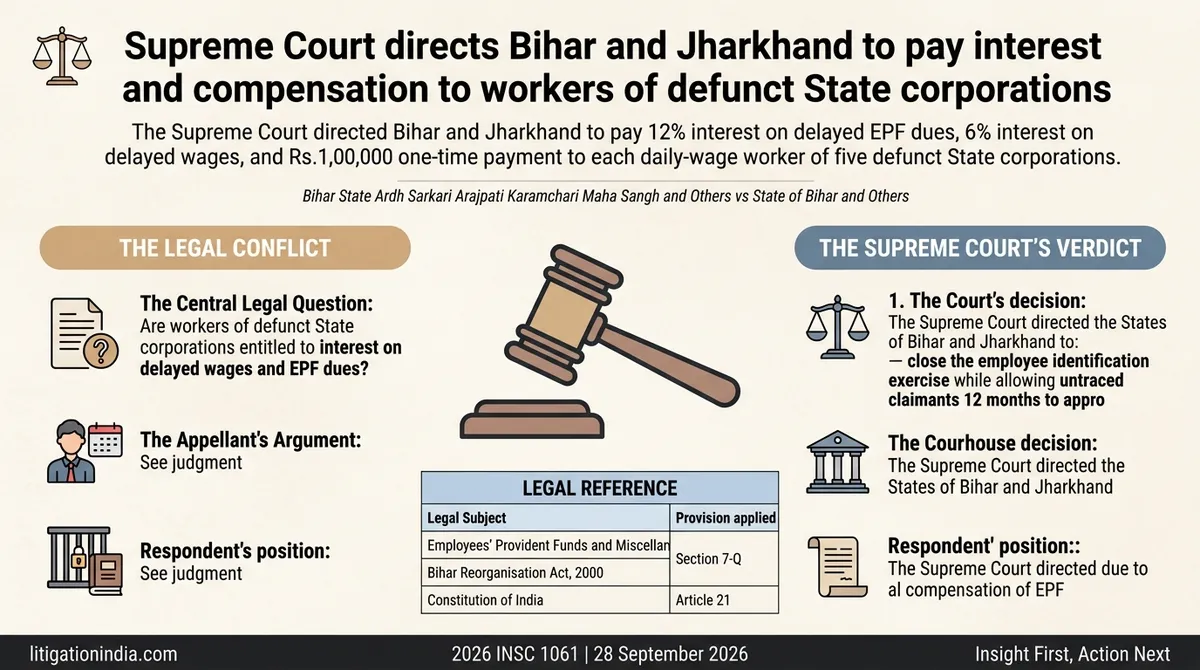
Supreme Court directs Bihar and Jharkhand to pay interest and compensation to workers of defunct State corporations — infographic summary

What this case means

This case concerned employees of five defunct State-owned corporations arising from the bifurcation of Bihar and creation of Jharkhand. The Supreme Court directed payment of 12% per annum interest on delayed EPF dues under Section 7-Q, 6% per annum on delayed salary arrears, and a one-time Rs.1,00,000 payment to each daily-wage worker. It matters because it ensures decades-old wage and provident fund entitlements of workers are not extinguished by corporate dissolution.

What the Supreme Court held

The Supreme Court directed the States of Bihar and Jharkhand to: close the employee identification exercise while allowing untraced claimants 12 months to approach the Nodal Officer; pay Rs.1,00,000 one-time additional sum to each daily-wage worker; pay 12% per annum simple interest on delayed EPF dues under Section 7-Q; and pay 6% per annum simple interest on delayed salary and other non-EPF dues. The States were also directed to publish updated particulars of all employees on official websites within four weeks, and to disburse interest along with principal dues within three months.

Case: Bihar State Ardh Sarkari Arajpati Karamchari Maha Sangh and Others vs State of Bihar and Others (2026) Citation: 2026 INSC 1061

Want the full legal reasoning, citations and case documents?

Read the full judgment analysis
Bihar Reorganisation Act 2000
EPF interest Section 7-Q
daily wage workmen compensation
State corporations employees dues
Bihar Jharkhand inter-State liability
provident fund delayed payment
Article 21 dignified wages
Kapila Hingorani
Bihar State Construction Corporation
welfare state obligations
Section 7-Q, Employees' Provident Funds and Miscellaneous Provisions Act, 1952
Bihar Reorganisation Act, 2000
Article 21, Constitution of India
Labour Law / Constitutional Law / Public Law Remedies