Full text of the judgment
Text extracted from Bihar State Ardh Sarkari Arajpati Karamchari Maha Sangh and Others vs State of Bihar and Others. For the authoritative version refer to the Supreme Court of India's official website.
2026 INSC 1061 1
REPORTABLE IN THE SUPREME COURT OF INDIA CIVIL ORIGINAL JURISDICTION
WRIT PETITION (CIVIL) NO(S). 932 OF 2022
BIHAR STATE ARDH SARKARI ARAJPATI KARAMCHARI MAHA SANGH AND OTHERS ….PETITIONER(S)
STATE OF BIHAR AND OTHERS ….RESPONDENT(S)
J U D G M E N T Mehta, J. For ease of reference, this judgment is divided into the following sections: INDEX A. BACKGROUND ............................................................................. 2 6.1. THE APPORTIONMENT AND FIXATION OF THE INTER-SE LIABILITY OF THE RESPECTIVE STATES ............................................................................. 5 6.2. PAY REVISION COMMISSION ............................................................ 7 6.3. THE DETERMINATION, COMPUTATION AND DISBURSAL OF DUES PAYABLE TOWARDS EMPLOYEES’ PROVIDENT FUND CONTRIBUTIONS ......................... 8 B. SUBMISSIONS ON BEHALF OF THE PETITIONERS ..................... 12 Digitally signed by NEETU KHAJURIA Date: 2026.09.28 17:42:03 IST Reason: Signature Not Verified
2 WRIT PETITION (CIVIL) NO(S). 932/2022
I. THE IDENTIFICATION AND VERIFICATION OF THE REMAINING EMPLOYEES/WORKMEN ....................................................................... 12 II. DAILY-WAGERS’ ENTITLEMENT AND WELFARE/DEATH COMPENSATION .. 14 III. ENTITLEMENT TO AND RATE OF INTEREST ON DELAYED PAYMENTS ........ 16 C. SUBMISSIONS ON BEHALF OF THE RESPONDENT-STATES ....... 17 I. THE IDENTIFICATION AND VERIFICATION OF THE REMAINING EMPLOYEES/WORKMEN ....................................................................... 17 II. DAILY-WAGERS’ ENTITLEMENT AND WELFARE/DEATH COMPENSATION .. 19 III. ENTITLEMENT TO AND RATE OF INTEREST ON DELAYED PAYMENTS ........ 22 D. ANALYSIS AND DISCUSSION ...................................................... 24 I. THE IDENTIFICATION AND VERIFICATION OF THE REMAINING EMPLOYEES/WORKMEN ....................................................................... 24 II. DAILY-WAGERS’ ENTITLEMENT AND WELFARE/DEATH COMPENSATION .. 26 III. ENTITLEMENT TO AND RATE OF INTEREST ON DELAYED PAYMENTS ........ 30 a. Interest on delayed payment of EPF dues ............................... 30 b. Interest on delayed payment of salary/wages ........................ 34 E. CONCLUSION AND DIRECTIONS ................................................ 41
1. Heard. A. BACKGROUND 2. The present proceedings have their genesis in the reorganisation of the erstwhile State of Bihar pursuant to the Bihar Reorganisation Act, 2000. The reorganisation of the erstwhile State of Bihar, pursuant to which the State of Jharkhand came to be constituted, gave rise, inter alia, to questions concerning the apportionment and discharge of liabilities, dues and service-related claims of the employees/workmen of five State-owned inter-State
3 WRIT PETITION (CIVIL) NO(S). 932/2022
corporations, namely, Bihar State Construction Corporation Ltd.1; Bihar State Industrial Development Corporation Ltd.2; Bihar State Electronic Development Corporation Ltd.3; Bihar State Forest Development Corporation Ltd.4; and Bihar State Panchayati Raj Financial Corporation Ltd.5. The controversy, which has its roots in the statutory reorganisation, has since traversed a long and chequered course, necessitating successive rounds of judicial intervention and administrative consideration. 3. The history of the litigation, including the proceedings in Kapila Hingorani v. State of Bihar6, the subsequent adjudication in relation to the inter-State liabilities, and the constitution and functioning of the Committee under the Chairmanship of Hon’ble Mr. Justice Dinesh Maheshwari, Judge (Retd.), Supreme Court of India,7 has been noticed and dealt with in extenso by this Court in its order dated 29th May, 2026. In view of the
1 For Short, “BSCCL”. 2 For Short, “BSIDC”. 3 For Short, “BSEDC”. 4 For Short, “BSFDC”. 5 For Short, “BPRFC”. 6 (2003) 6 SCC 1. 7 Hereinafter, referred to as “the Committee”.
4 WRIT PETITION (CIVIL) NO(S). 932/2022
detailed consideration already undertaken therein, we do not deem it necessary to once again recapitulate the entire course of the litigation. The said order constitutes the backdrop against which the issues presently arising for consideration are required to be examined. 4. By the order dated 29th May, 2026, this Court considered the Final Report dated 30th April, 2026 submitted by the Committee, and accepted its recommendations to the extent indicated in paragraph 37 of the said order. The effect of the said order was to bring finality to the matters in respect of which the recommendations of the Committee were accepted, leaving no room for those issues to be reopened in future. 5. Pursuant to the order dated 29th May, 2026, the States of Bihar and Jharkhand have filed their respective compliance affidavits in August, 2026, reporting compliance with the directions issued by this Court and the disbursement of the principal dues to the identified and verified employees/workmen of the five Corporations. The affidavits set out the corporation-wise position of payments made by the respective States, while also
5 WRIT PETITION (CIVIL) NO(S). 932/2022
identifying the cases which remain pending on account of the claimants being untraceable, absence of requisite documentation or other verification formalities. 6. The respective compliance affidavits filed by the States of Bihar and Jharkhand disclose the following position with regard to the implementation of the directions issued by this Court in paragraph 37 of the order dated 29th May, 2026:- 6.1. The apportionment and fixation of the interse liability of the respective States 6.1.1. Bihar State Construction Corporation Ltd.: Against the assessed liability of Rs.97.50 crore in respect of all 1,256 employees/workmen, the State of Bihar has disbursed Rs.84.10 crore to 1,054 employees/workmen, comprising 587 regular and 467 daily-wage employees/workmen. The State of Jharkhand has transferred Rs.36.01 crore out of its allotted liability of Rs.38.41 crore to the State of Bihar for disbursement to the verified employees/workmen. 6.1.2. Bihar State Industrial Development Corporation Ltd.: The State of Bihar has paid Rs.25.67 crore towards the principal dues of 403
6 WRIT PETITION (CIVIL) NO(S). 932/2022
employees/workmen of Bihar Spun Silk Mill, Bhagalpur and Bihar Scooters Ltd., Fatuha. The State of Jharkhand has disbursed Rs.5.30 crore in respect of 163 allotted employees/workmen of its units, of whom 136 have been paid, while 25 were found to have no outstanding dues. 6.1.3. Bihar State Electronic Development Corporation Ltd.: The State of Bihar has disbursed the salary arrears payable to 67 employees/workmen out of the total 70 employees/workmen of Beltron Video Systems Ltd.8, Hajipur. The State of Jharkhand has transferred Rs.7.22 crore to BSEDC towards its liability in respect of 61 out of 63 employees/workmen allotted to it from BVSL, Ranchi and Beltron Mining Systems Ltd., Dhanbad. 6.1.4. Bihar State Forest Development Corporation Ltd.: The State of Bihar has paid the outstanding dues of 201 out of 203 employees/workmen. The State of Jharkhand has discharged its liability towards 36 allotted employees/workmen of the subsidiary units of Bihar
8 For Short, “BVSL”.
7 WRIT PETITION (CIVIL) NO(S). 932/2022
Solvents Chemicals Ltd. and Bihar State Tanin Extract Ltd. 6.1.5. Bihar State Panchayati Raj Financial Corporation Ltd.: The State of Bihar has paid the principal dues of 90 out of 103 employees/workmen. The State of Jharkhand has disbursed Rs.3.65 crore in respect of 21 out of 26 allotted employees/workmen, while three employees/workmen have been absorbed into regular pensionable service. 6.2. Pay Revision Commission 6.2.1. The respective compliance affidavits further disclose that the outstanding dues of the employees/workmen were computed and disbursed with reference to the pay scales in force and adopted by the respective Corporations prior to their closure. While the dues pertaining to BSCCL, BSIDC, BSEDC and BPRFC were computed on the basis of the 4th Pay Revision Commission, those pertaining to BSFDC were computed in accordance with the 5th Pay Revision Commission. However, insofar as the defunct subsidiary units of BSFDC, namely, Bihar
8 WRIT PETITION (CIVIL) NO(S). 932/2022
Solvent and Chemicals Limited9 and Bihar State Tannin Extract Limited10, are concerned, the dues were computed on the basis of the 4th Pay Revision Commission, as these units had not adopted the 5th Pay Revision Commission prior to becoming nonfunctional. 6.3. The determination, computation and disbursal of dues payable towards Employees’ Provident Fund contributions 6.3.1. Bihar State Construction Corporation Ltd.: Out of 1,054 identified employees, comprising 587 regular employees and 467 daily-wage workmen, the Employees’ Provident Fund11 contributions representing both the employer’s and employees’ shares have been directly disbursed to 1,035 employees/legal heirs. Disbursement in respect of the remaining 19 employees/legal heirs remains pending on account of deficiencies such as nonproduction of death/succession certificates or discrepancies in bank account particulars.
9 For Short, “BSCL”. 10 For Short, “BSTEL”. 11 For Short, “EPF”.
9 WRIT PETITION (CIVIL) NO(S). 932/2022
6.3.2. Bihar State Industrial Development Corporation Ltd.: In respect of Bihar Spun Silk Mill, Bhagalpur, an exempted establishment, the EPF amounts deducted from the employees’ dues have been directly disbursed along with the salary arrears to 341 out of 351 employees, while the accumulated pension corpus of Rs.1,14,77,756/- was deposited with the EPF Office, Bhagalpur, in 2025. In respect of Bihar Scooters Ltd., Fatuha, the EPF and pension corpus of Rs.89,46,858/-, pertaining to 62 employees, had been deposited with the EPF Office, Patna. Pursuant to the order dated 29th May, 2026, BSIDC has sought refund of the said amount, vide letter dated 20th August, 2026, to enable its direct disbursement to the concerned employees/legal heirs. 6.3.3. Bihar State Electronics Development Corporation Ltd.: In respect of Beltron Video Systems Ltd., Hajipur, the EPF contributions, comprising both the employer’s and employees’ shares, have been directly disbursed to the employees whose salary dues have been cleared. In respect of Beltron Video Systems Ltd., Ranchi and Beltron Mining Systems Ltd., Dhanbad, falling to the
10 WRIT PETITION (CIVIL) NO(S). 932/2022
share of Jharkhand, the requisite employer’s and employees’ contributions have been directly disbursed, with compliance completed in respect of 61 out of 63 employees. The amounts pertaining to the two untraced employees, Late Bindu Urraon and Late Sheila Rani Ghatak, have been retained in earmarked treasury accounts. 6.3.4. Bihar State Forest Development Corporation Ltd.: In respect of the parent corporation, EPF contributions, including both shares, have been directly disbursed to all 201 employees. As regards its defunct subsidiary units, Bihar Solvent and Chemicals Ltd. and Bihar State Tannin Extract Ltd., the employees’ contributions were directly paid to the employees, while the employer’s contribution is stated to be in the process of being directly disbursed to the concerned employees. 6.3.5. Bihar State Panchayati Raj Financial Corporation Ltd.: BPRFC, being exempt from the Employees’ Provident Funds and Miscellaneous Provisions Act, 195212, historically maintained its
12 Hereinafter, referred to as “the Act”.
11 WRIT PETITION (CIVIL) NO(S). 932/2022
own Private Provident Fund Trust. Since no employee contributions were deducted or deposited during the period of its non-functioning, the State has computed the employer’s contribution at 12% of basic salary for the 103 Bihar-allocated employees, amounting to Rs.15,43,320/-. Of this amount, Rs.13,61,248/- has been directly disbursed to 90 traced employees and their successors. 7. We have taken note of the position emerging from the compliance affidavits filed by the respective States. It is apparent therefrom that, while substantial compliance with the directions issued by this Court has been reported, certain aspects of the implementation continue to remain pending and are being attended to by the respective States. We expect the respective States to take all necessary steps to complete the implementation of the directions issued by this Court at the earliest and bring the pending aspects to their logical conclusion. 8. At the same time, it is necessary to bear in mind that, by paragraph 38 of its order dated 29th May, 2026, this Court had identified following three issues which had not been conclusively resolved and
12 WRIT PETITION (CIVIL) NO(S). 932/2022
accordingly left open for determination by this Court:- “i. The identification and verification of the remaining employees/workmen and/or the legal heirs of deceased employees/workmen in cases where claims are yet to attain finality; ii. The entitlement of the daily-wage workmen, as also the legal heirs of deceased employees/workmen, to lump-sum compensation and/or any other form of monetary, rehabilitative or welfare support including payment of due wages and other consequential admissible benefits; and iii. The entitlement to, and determination of, appropriate interest on delayed payment of salaries/wages, retiral dues, provident fund amounts and other consequential emoluments.”
9. It is against the aforesaid backdrop that the matter has now fallen for consideration before this Court in respect of the three issues so left open for determination. B. SUBMISSIONS ON BEHALF OF THE PETITIONERS i. The identification and verification of the remaining employees/workmen 10. Ms. Priya Hingorani, learned senior counsel appearing for the petitioners submitted that the mere fact that certain employees/workmen are presently
13 WRIT PETITION (CIVIL) NO(S). 932/2022
untraceable, or that their claims remain pending for want of requisite documents or completion of formalities, cannot operate to extinguish the underlying entitlements otherwise found due to them. It was contended that the Committee itself has recorded that, in these residual cases, there is no substantive dispute as to the existence of the employees’ entitlements, the impediment being essentially one of identification, verification or completion of the requisite formalities. 11. Learned senior counsel urged that the amounts found payable in respect of such untraced employees/workmen or their legal heirs ought to be finally ascertained and earmarked separately, preferably by placing the same in an appropriate escrow or designated corpus. Such earmarking would preserve the amounts against the eventual establishment of the claimant’s entitlement and enable disbursement to the concerned employee/workman or his legal heir(s) upon completion of the requisite formalities, without compelling the claimants to re-establish an entitlement which has already been crystalized.
14 WRIT PETITION (CIVIL) NO(S). 932/2022
ii. Daily-Wagers’ Entitlement and Welfare/Death Compensation 12. Learned senior counsel contested the applicability of the doctrine of “no work, no pay” to the daily-wagers in question. It was submitted that the Bihar State Construction Corporation Ltd. continued to treat the concerned daily wagers as its workmen and that their services were not formally discontinued during the relevant period. It was only in October, 2015 that formal orders of termination came to be issued, in circumstances where BSCCL had ceased to function and was itself facing severe financial distress. It was contended that the absence of work during the intervening period was, therefore, not occasioned by any refusal, abandonment or omission on the part of the workmen, but was the direct consequence of the BSCCL’s non-functioning and the larger administrative failure surrounding the affairs of the erstwhile Corporation. 13. It was further submitted that the monetary entitlement of the daily-wagers cannot be determined by mechanically applying the historical flat rate of Rs.42.50 per day, irrespective of the period for which the entitlement accrued. The computation must
15 WRIT PETITION (CIVIL) NO(S). 932/2022
necessarily take into account the actual period of service rendered by each workman, the date of his superannuation or cessation of service, and the statutory wage rates applicable during the corresponding periods. The mere cessation of operations of BSCCL, for reasons wholly unconnected with the conduct of the workmen cannot be permitted to operate to their prejudice or to freeze their entitlements at an arbitrary wage rate fixed by the authorities. 14. Learned senior counsel further submitted that the absence of specific statutory service rules governing the claims in question cannot, by itself, denude this Court of its jurisdiction to mould an appropriate public-law remedy where the circumstances disclose a prolonged and unconstitutional deprivation of a fundamental right, i.e., appropriate dignified wages. It was contended that the extraordinary delay in recognising and discharging the legitimate monetary entitlements of the workmen, extending over several decades, must be viewed in the context of their fundamental right to life and dignity guaranteed under Article 21 of the Constitution of India. It was thus urged that this
16 WRIT PETITION (CIVIL) NO(S). 932/2022
Court, in exercise of its constitutional jurisdiction, may award quantified monetary compensation as a public-law remedy for the deprivation occasioned by the State and its instrumentalities. iii. Entitlement to and rate of interest on delayed payments 15. Learned senior counsel submitted that the recommendation of the Committee providing for interest at the rate of 7.5% per annum on delayed salaries and 12% per annum on delayed Employees Provident Fund13 dues does not, by itself, conclude the question of the period for which interest is liable to be paid. It was contended that the accrual of interest must bear a direct nexus to the period during which the employees/workmen were deprived of the monies lawfully due to them and, consequently, must commence from the date on which the respective salary, wage, retiral benefit or provident fund dues became payable, rather than from any subsequent date adopted for the purposes of computation. 16. Insofar as EPF dues are concerned, it was further submitted that the statutory interest
13 For short, “EPF”.
17 WRIT PETITION (CIVIL) NO(S). 932/2022
mandated under Section 7-Q of the Act, is required to be duly computed for the relevant period and incorporated in the final amount payable to the concerned employee/workman or his legal heir(s). C. SUBMISSIONS ON BEHALF OF THE RESPONDENT-STATES 17. Per Contra, Shri Ranjit Kumar, learned senior counsel appearing for the State of Bihar, and Shri Arunabh Chowdhury, learned senior counsel representing the State of Jharkhand, vehemently and fervently opposed the submissions advanced by the learned counsel appearing for the petitioners. i. The identification and verification of the remaining employees/workmen 18. Learned senior counsel for the States of Bihar and Jharkhand submitted that, out of the total 2,274 verified employees/workmen pertaining to the five defunct State-owned corporations, approximately 2,074 have been successfully traced, verified and paid their lawful principal and statutory dues.
18 WRIT PETITION (CIVIL) NO(S). 932/2022
19. It was, however, submitted that around 200 residual cases continue to remain unresolved, either on account of the concerned employees/workmen being untraceable or for want of the requisite documentation necessary for verification and disbursement of their dues. In order to trace such employees/workmen and their legal heirs, the State administrations, in coordination with the respective managements of the concerned Corporations, have undertaken extensive and repeated efforts, including deputing special messengers to the last-known permanent addresses of the employees/workmen, issuing registered post/speed post communications, coordinating with the concerned district authorities and representatives of labour unions, and publishing repeated public notices in prominent regional and national newspapers. 20. Learned senior counsel contended that these residual cases involve no substantive dispute as to the underlying entitlement, but remain pending for want of tracing the employees/workmen concerned or completion of requisite formalities. It was accordingly submitted that such claims may be treated as closed for administrative purposes, while
19 WRIT PETITION (CIVIL) NO(S). 932/2022
leaving it open to the concerned claimants to avail such appropriate remedy as may be available to them in accordance with law. ii. Daily-Wagers’ Entitlement and Welfare/Death Compensation 21. Shri Ranjit Kumar submitted that the concerned daily-wage employees/workmen were engaged exclusively by the Bihar State Construction Corporation Ltd. and that their engagement was governed by the terms and conditions applicable to such daily-wage employment. Adverting to, and endorsing, the findings of the Committee, it was contended that mere continuation of such engagement does not confer upon a daily-wage employee/workman any vested right to claim the benefit of subsequent revisions in the minimum wage. The dues of the concerned daily-wage employees/workmen have rightly been computed with reference to the daily-wage rate of Rs.42.50 per day. 22. As regards the quantum of liability, it was submitted that, upon finalisation of the computations, an aggregate liability of Rs.17.92 crore
20 WRIT PETITION (CIVIL) NO(S). 932/2022
has been determined in respect of 598 daily-wage employees/workmen of the Bihar State Construction Corporation Ltd. The said employees/workmen were allocated between the two successor States on location basis, with 270 employees falling to the share of the State of Bihar and 328 to the State of Jharkhand. It was further submitted that, pursuant to the compliance exercise undertaken thereafter, the principal dues payable to 467 daily-wage employees/workmen have already been disbursed. As regards the remaining daily-wage employees/workmen, the requisite steps for disbursement are being undertaken upon the respective claimants, or their legal heirs, furnishing the requisite documents and completing the necessary verification formalities. 23. Shri Arunabh Chowdhury submitted that no issue arises for consideration in respect of daily-wage employees/workmen insofar as the units allotted to the State of Jharkhand are concerned, except as mentioned above. 24. Learned senior counsel appearing for the State of Bihar as well as the State of Jharkhand opposed the claim for payment of lump-sum compensation in
21 WRIT PETITION (CIVIL) NO(S). 932/2022
the event of death of an employee/workman while in service. 25. It was submitted that the service rules governing the concerned Corporations contain no provision for payment of any such compensation, either to the family of a regular employee or of a dailywage employee/workman. In absence of any statutory or service-rule provision conferring such an entitlement, a direction for lump-sum compensation thereof would lack any legal foundation and would, in any event, impose an unjustified additional financial burden upon the public exchequer. 26. Shri Ranjit Kumar submitted that any claim for compensation on the ground that an employee/workman died of starvation owing to nonpayment of his dues would necessarily require determination of the cause of death. The question, therefore, arises as to who would undertake such determination and ascertain whether the death was, in fact, attributable to starvation occasioned by nonpayment of the dues, or whether it resulted from natural causes or any other intervening circumstances.
22 WRIT PETITION (CIVIL) NO(S). 932/2022
iii. Entitlement to and rate of interest on delayed payments 27. Learned senior counsel appearing for the respondent-States strongly assailed the recommendation of the Committee insofar as it provides for payment of interest at the rate of 7.5% per annum on the salary arrears and 12% per annum on the delayed EPF dues. It was submitted that fastening liability towards interest at the aforesaid rates, particularly over the period in question, would impose a substantial financial burden upon the respective State exchequers, without due regard to the circumstances in which the underlying liabilities arose, the absence of any deliberate withholding of the amounts by the States, and the complexities involved in the determination and apportionment of the inter-State liabilities. 28. Shri Ranjit Kumar submitted that the Corporations in question are distinct and independent juristic entities, having a legal personality separate from that of the State, and that the liabilities incurred by such Corporations cannot, in the absence of a specific legal framework, be
23 WRIT PETITION (CIVIL) NO(S). 932/2022
fastened upon the State merely by reason of its ownership, control or association with the entities. 29. Learned senior counsel further submitted that the payments made by the State of Bihar were undertaken voluntarily and on humanitarian considerations, and not towards the discharge of any legally enforceable liability on the State. It was, therefore, contended that, in absence of any delay or default attributable to the State of Bihar in relation to the amounts in question, there can be no justification for imposing upon the State any additional liability towards interest. 30. Shri Arunabh Chowdhury submitted that the claim for interest is wholly untenable in law, having regard to the fact that the Corporations in question had ceased to function and remained defunct for several decades, most of them having become nonfunctional even prior to the creation of the State of Jharkhand in November, 2000. It was contended that, during the period of such non-functionality, the concerned employees/workmen neither rendered any services nor performed any work for the Corporations and, consequently, no liability towards payment of salary/wages could have accrued for the said period
24 WRIT PETITION (CIVIL) NO(S). 932/2022
so as to give rise to any corresponding liability towards interest. It was further contended that the workmen would be under the obligation to prove that they were not gainfully employed during this period. D. ANALYSIS AND DISCUSSION 31. We have carefully examined the facts and circumstances borne out from the material on record and given our thoughtful consideration to the submissions advanced at the bar. 32. At the cost of repetition, we reiterate that, by order dated 29th May, 2026, this Court had left open for determination only three issues specifically identified in paragraph 38 thereof. The scope of the present order is, therefore, confined to adjudication of the said three issues, and nothing beyond that. i. The identification and verification of the remaining employees/workmen 33. As disclosed in the respective compliance affidavits filed by the States of Bihar and Jharkhand in August, 2026, out of the total verified baseline workforce of 2,274 employees/workmen, dues have been fully disbursed to 2,074 employees/workmen.
25 WRIT PETITION (CIVIL) NO(S). 932/2022
Around 200 remaining cases comprise employees/workmen who either remain untraceable despite the publication of notices in newspapers or whose claims remain pending for want of the requisite documentation. 34. We may take note of the fact that the States of Bihar and Jharkhand have undertaken extensive and repeated measures to trace the untraceable employees/workmen and their legal heirs, including publication of notices in newspapers and other modes of communication. All these efforts have been noted and acknowledged by the Committee. Having regard to the efforts so undertaken, we are satisfied that the States have taken all reasonable steps that could be expected of them for tracing the concerned claimants. Once such efforts have yielded no result despite repeated attempts and public notices, the States cannot be required to continue such exercise indefinitely. 35. In view of the aforesaid circumstances, we deem it appropriate, at this stage, to put a quietus to the matter insofar as the claims of the untraceable employees/workmen are concerned. However, such closure shall not operate to extinguish or otherwise
26 WRIT PETITION (CIVIL) NO(S). 932/2022
prejudice their underlying entitlement. The concerned employees/workmen, or their legal heirs, shall, within a reasonable period of time which is fixed at 12 months from the date of this order, be at liberty to approach the concerned Nodal Officer appointed for the respective Corporation, along with the requisite documents for verification, and upon such verification, their claims shall be processed and the amounts found due shall be disbursed in accordance with law. ii. Daily-Wagers’ Entitlement and Welfare/Death Compensation 36. Daily-wage workers constitute a significant segment of the workforce and, notwithstanding the nature of their engagement, perform services which contribute to the functioning of the establishment in which they are engaged. The mere description of a person as a daily-wage worker cannot, by itself, detract from the dignity of the work performed or the services actually rendered. At the same time, dailywage employment is distinct in its legal character from regular employment, and the rights and entitlements arising therefrom must necessarily be
27 WRIT PETITION (CIVIL) NO(S). 932/2022
determined with reference to the terms of engagement and the applicable statutory or service framework. The nature of such engagement, however, cannot furnish a basis for arbitrary or inequitable treatment, and the claims of such workers must be considered in accordance with the requirements of fairness and reasonableness. 37. In the present case, the daily-wage employees/workmen were engaged by the concerned Corporation and rendered services in the discharge of the functions entrusted to them. While their status as daily-wage workmen cannot, by itself, confer upon them the same rights and entitlements as regular employees, but at the same time, such status cannot be treated as a reason for disregarding the services rendered by them or denying the entitlements lawfully accruing from such engagement. 38. As disclosed in the respective compliance affidavits, out of the 598 daily-wage employees/workmen, the dues of 467 employees/workmen have been fully disbursed. The amount payable has been computed at the rate of Rs.42.50 per day for the period commencing from 1992 and extending up to the respective date of
28 WRIT PETITION (CIVIL) NO(S). 932/2022
retirement, death or formal cessation of service. It is stated that, on the aforesaid basis, a sum of Rs.14.21 crore has been disbursed to the said 467 daily-wage employees/workmen. 39. It is in this backdrop that the aforesaid basis of computation falls for examination. A fixed daily wage of Rs.42.50, adopted as a uniform basis for computing the dues of workmen over a prolonged period extending from 1992 onwards, cannot, in our view, constitute a fair and reasonable measure of their monetary entitlement. Such an approach proceeds on the premise that the value of labour and the wages payable therefor remained static over a period spanning several decades, notwithstanding the corresponding changes in the cost of living and the statutorily prescribed wage structure applicable from time to time. 40. The fact that the concerned workmen were engaged on a daily-wage basis cannot, by itself, justify a computation which effectively disregards the passage of time and the wages applicable during the respective periods of their engagement. Their status as daily-wage workmen may undoubtedly distinguish the nature of their engagement from that of regular
29 WRIT PETITION (CIVIL) NO(S). 932/2022
employees, however, it cannot furnish a basis for treating the services rendered by them as having a fixed and unvarying monetary value irrespective of the period during which such services were rendered. 41. Nonetheless, having regard to the peculiar facts and circumstances of the present case, the protracted period over which the claims of the dailywage workmen have remained unresolved, and the fact that the rate of Rs.42.50 per day cannot reasonably serve as a uniform basis for computation over the entire period in question, we do not consider it appropriate, at this stage, to remit the matter for a fresh determination or refixation of the daily wage applicable to each individual workman. Such an exercise would inevitably entail a further round of determination and verification, thereby prolonging a dispute which has already remained pending for several decades. 42. In order to balance the equities and bring finality to this aspect of the matter, we deem it appropriate to direct the States of Bihar and Jharkhand to pay, in addition to the amounts already determined and disbursed, a one-time sum of Rs.1,00,000/- to each of the concerned daily-wage
30 WRIT PETITION (CIVIL) NO(S). 932/2022
employees/workmen employed by the concerned Corporation during the relevant period. iii. Entitlement to and rate of interest on delayed payments a. Interest on delayed payment of EPF dues 43. The entitlement to interest on delayed provident fund dues must be considered having regard to the statutory character of provident fund as a measure of social security. The amount standing to the credit of an employee by way of provident fund constitutes a statutory benefit accrued during the course of employment and is intended to provide financial security to the employee upon cessation of service. Such amount, therefore, cannot be treated as an ordinary monetary claim capable of being withheld without the consequences prescribed by law. 44. Where the provident fund contribution or any amount otherwise payable under the statutory scheme is not deposited within the time prescribed, the liability towards statutory interest arises in accordance with the applicable provisions. In cases governed by the Employees Provident Funds and Miscellaneous Provisions Act, 1952, Section 7-Q
31 WRIT PETITION (CIVIL) NO(S). 932/2022
mandates payment of simple interest at the rate of 12% per annum, or at such higher rate as may be specified in the Scheme, on the amount due from the date on which such amount became due until the date of its actual payment. The liability towards such interest is thus a statutory consequence of the delay in discharge of the provident fund obligation and does not depend upon any contractual stipulation between the employer and the employee. Section 7-Q of the Act is reproduced below for ready reference:- “7-Q. Interest payable by the employer.—The employer shall be liable to pay simple interest at the rate of twelve per cent per annum or at such higher rate as may be specified in the Scheme on any amount due from him under this Act from the date on which the amount has become so due till the date of its actual payment: Provided that higher rate of interest specified in the Scheme shall not exceed the lending rate of interest charged by any scheduled bank.”
45. This Court, in Arcot Textile Mills Ltd. v. Regl. Provident Fund Commissioner & Ors.14, while dealing with the nature and object of the liability contemplated under Section 7-Q of the Act, recognised the beneficial and social-welfare purpose
14 (2013) 16 SCC 1.
32 WRIT PETITION (CIVIL) NO(S). 932/2022
of the provision and, in that context, observed as follows:- “27. Presently we shall address to the nature of the lis that can arise under this provision. There cannot be any dispute that the Act in question is a beneficial social legislation to ensure health and other benefits of the employees and the employer under the Act is under statutory obligation to make the deposit that is due from him. In the event of default committed by the employer Section 14-B steps in and calls upon the employer to pay the damages. (See Regl. Provident Fund Commr. v. S.D. College [(1997) 1 SCC 241 : 1997 SCC (L&S) 449] .) Section 7-Q which provides for interest for belated payment is basically a compensation for payment of interest to the affected employees. This provision has been made to secure just and humane conditions of work as has been opined in Regl. Provident Fund Commr. v. Hooghly Mills Co. Ltd. [(2012) 2 SCC 489 : (2012) 1 SCC (L&S) 449] The language employed in Section 7- Q provides for levy of interest on delayed payment and the rates have been stipulated. When a composite order is passed or order imposing interest becomes a part of the order or levy in any of the provisions of the Act the authority grants a reasonable opportunity of hearing to the employer/affected party.” (Emphasis supplied) 46. The statutory interest contemplated under Section 7-Q of the Act is, therefore, distinct from any claim for additional interest or compensation on account of prolonged withholding of the employee’s dues. Interest under Section 7-Q of the Act is not founded upon any discretionary determination of
33 WRIT PETITION (CIVIL) NO(S). 932/2022
compensation; it is a liability which arises by operation of the statute upon delayed payment of an amount due under the Act. Accordingly, such interest is liable to be computed from the date on which the amount became due and continues to accrue until the date of its actual payment. 47. In view of the statutory mandate contained in Section 7-Q of the Act, and having regard to the prolonged delay in the deposit and disbursement of the provident fund dues of the concerned employees, we are of the considered view that, in the present case, the employees/workmen of the Corporations cannot be deprived of the statutory interest accruing on such dues. The liability to pay such interest is a consequence which follows by operation of law upon the delayed payment of the amounts due under the provident fund scheme and cannot be defeated merely on the ground that the underlying liability was subsequently discharged. 48. We, accordingly, direct the States of Bihar and Jharkhand to ensure payment, in respect of the EPF dues of the employees to which Section 7-Q is applicable, of simple interest at the rate prescribed thereunder, i.e., 12% per annum, for the period
34 WRIT PETITION (CIVIL) NO(S). 932/2022
commencing from the date on which the respective amounts became due and calculated until the date of their actual payment. Such interest shall be paid to the concerned employees or, where applicable, their legal heirs, and shall form part of the amounts finally payable towards the provident fund dues. b. Interest on delayed payment of salary/wages 49. Insofar as the salary arrears and other monetary dues, excluding provident fund dues, are concerned, the position stands on a somewhat different footing. Unlike the interest contemplated under Section 7-Q of the Act, there is no uniform statutory provision prescribing a particular rate of interest in respect of the salary and other dues involved in the present proceedings. The entitlement to interest in such cases is, therefore, required to be examined having regard to the nature of the dues, the period for which they remained unpaid, the circumstances occasioning the delay and the extent of prejudice caused to the employees/workmen by such withholding. 50. There can, however, be little doubt that salary, retiral benefits and other emoluments lawfully due to an employee/workman constitute his rightful
35 WRIT PETITION (CIVIL) NO(S). 932/2022
monetary entitlement. Prolonged withholding of such amounts deprives the employee/workman of the use of salary/wages which had become payable to him and, particularly where the delay extends over several years, results in a corresponding financial prejudice. The fact that the underlying liability arose from the affairs of defunct Corporations cannot by itself efface the consequence of the prolonged deprivation of lawful entitlements suffered by the employees/workmen. The question of interest must, therefore, be considered not merely from the standpoint of the identity/status of the entity in default, but also having regard to the extraordinary duration of the deprivation and the circumstances in which the employees/workmen have ultimately been required to seek enforcement of their lawful dues. 51. Interest, in its ordinary legal sense, represents compensation for the deprivation of the use of money to which a person is otherwise lawfully entitled. The concept of interest is not confined to a return upon money borrowed or advanced, but extends to compensation for the unjust deprivation occasioned by the withholding of money beyond the time when it becomes due and payable. It is, in substance,
36 WRIT PETITION (CIVIL) NO(S). 932/2022
recompense for the loss occasioned by being kept out of the use of money which ought to have been available to the person entitled thereto. A Constitution Bench of this Court, in Central Bank of India v. Ravindra & Ors.15, while examining the concept and nature of interest, referred to the meaning attributed to the expression “interest” in various legal authorities and precedents, and observed as follows:- “37.Black’s Law Dictionary (7th Edn.) defines “interest” inter alia as the compensation fixed by agreement or allowed by law for the use or detention of money, or for the loss of money by one who is entitled to its use; especially, the amount owed to a lender in return for the use of the borrowed money. According to Stroud’s Judicial Dictionary of Words And Phrases (5th Edn.) interest means, inter alia, compensation paid by the borrower to the lender for deprivation of the use of his money. In Secy., Irrigation Deptt., Govt. of Orissa v. G.C. Roy [(1992) 1 SCC 508] the Constitution Bench opined that a person deprived of the use of money to which he is legitimately entitled has a right to be compensated for the deprivation, call it by any name. It may be called interest, compensation or damages … this is the principle of Section 34 of the Civil Procedure Code. In Sham Lal Narula (Dr) v. CIT [AIR 1964 SC 1878 : (1964) 7 SCR 668] this Court held that interest is paid for the deprivation of the use of the money. The essence of interest in the opinion of Lord Wright, in Riches v. Westminster Bank Ltd. [(1947) 1 All ER 469 :
15 (2002) 1 SCC 367.
37 WRIT PETITION (CIVIL) NO(S). 932/2022
1947 AC 390 (HL)] All ER at p. 472 is that it is a payment which becomes due because the creditor has not had his money at the due date. It may be regarded either as representing the profit he might have made if he had had the use of the money, or, conversely, the loss he suffered because he had not that use. The general idea is that he is entitled to compensation for the deprivation; the money due to the creditor was not paid, or, in other words, was withheld from him by the debtor after the time when payment should have been made, in breach of his legal rights, and interest was a compensation whether the compensation was liquidated under an agreement or statute. A Division Bench of the High Court of Punjab speaking through Tek Chand, J. in CIT v. Dr Sham Lal Narula [AIR 1963 Punj 411 : (1963) 50 ITR 513] thus articulated the concept of interest: (AIR p. 414, para 8)…” (Emphasis supplied) 52. The aforesaid exposition underscores that the rationale underlying the award of interest lies in compensating for the deprivation of the use of money lawfully due to a person. Where a monetary entitlement has crystallized and payment thereof is delayed beyond the time when it became due and payable, the person entitled thereto is, for the intervening period, deprived of the use and benefit of the amount to which he is lawfully entitled. Interest, in such circumstances, serves as recompense for such deprivation and seeks to compensate, to the extent capable of monetary assessment, for the loss occasioned by the delay.
38 WRIT PETITION (CIVIL) NO(S). 932/2022
53. It is in this context that the submission advanced on behalf of the States, founded upon the separate juristic personality of the erstwhile Corporations, falls for consideration. We are conscious of the fact that the erstwhile Corporations were distinct juristic entities, separate from the respective States, and that their liabilities cannot, as a matter of course, be fastened upon the States merely by reason of Government ownership or control. However, the matter cannot be viewed solely from the standpoint of liability of defunct corporate bodies. The States of Bihar and Jharkhand, as welfare States, under whose exclusive domain the Corporations existed and functioned, are equally required to ensure that the legitimate rights and entitlements of their employees/workmen are not rendered illusory by the subsequent failure or cessation of functioning of State-owned instrumentalities. In the peculiar facts and circumstances of the present case, the separate corporate personality of the erstwhile Corporations cannot be permitted to deprive the employees/workmen of their lawful dues which have remained unpaid for decades.
39 WRIT PETITION (CIVIL) NO(S). 932/2022
54. Having said that, the award of interest in exercise of the Court’s equitable or constitutional jurisdiction cannot be permitted to assume the character of a punitive levy upon the public exchequer. Interest in such circumstances is intended to compensate, in a reasonable measure, for the prolonged deprivation of the use of money lawfully due and not to penalise the State. The rate of interest must, therefore, bear a reasonable relationship to the nature of the deprivation, the period for which the dues remained unpaid and the prevailing economic conditions. 55. Applying the aforesaid principles to the facts of the present case, we find that the employees/workmen have been deprived of their salary arrears and other lawful monetary entitlements for an exceptionally prolonged period, extending, in several cases, over decades. Such delay cannot be attributed by any figment of imagination to any act or omission on the part of the individual employees/workmen. They have, for no fault of their own, been kept out of amounts which were lawfully due to them and which, in the ordinary course, would have been available for their use and benefit. The
40 WRIT PETITION (CIVIL) NO(S). 932/2022
prolonged withholding of such dues, therefore, constitutes precisely the kind of monetary deprivation for which reasonable interest serves as recompense. 56. In light of the aforesaid discussion, and having regard to the peculiar facts and circumstances borne out from the record, the nature of the dues involved, the extraordinary length of the delay and the resultant financial prejudice suffered by the employees/workmen and their families, we are of the view that the award of reasonable interest on the delayed payment of salary arrears and other non-EPF dues is warranted. The employees/workmen having been deprived, for an inordinately long period, of the use and benefit of amounts lawfully due to them, payment of interest would constitute a fair and proportionate recompense for such deprivation. At the same time, having regard to the concerns noticed hereinabove and so also the recommendation made by the Committee for award of interest at the rate of 7.5% per annum on delayed payment, the rate of such interest must remain reasonable and compensatory, without assuming a punitive character.
41 WRIT PETITION (CIVIL) NO(S). 932/2022
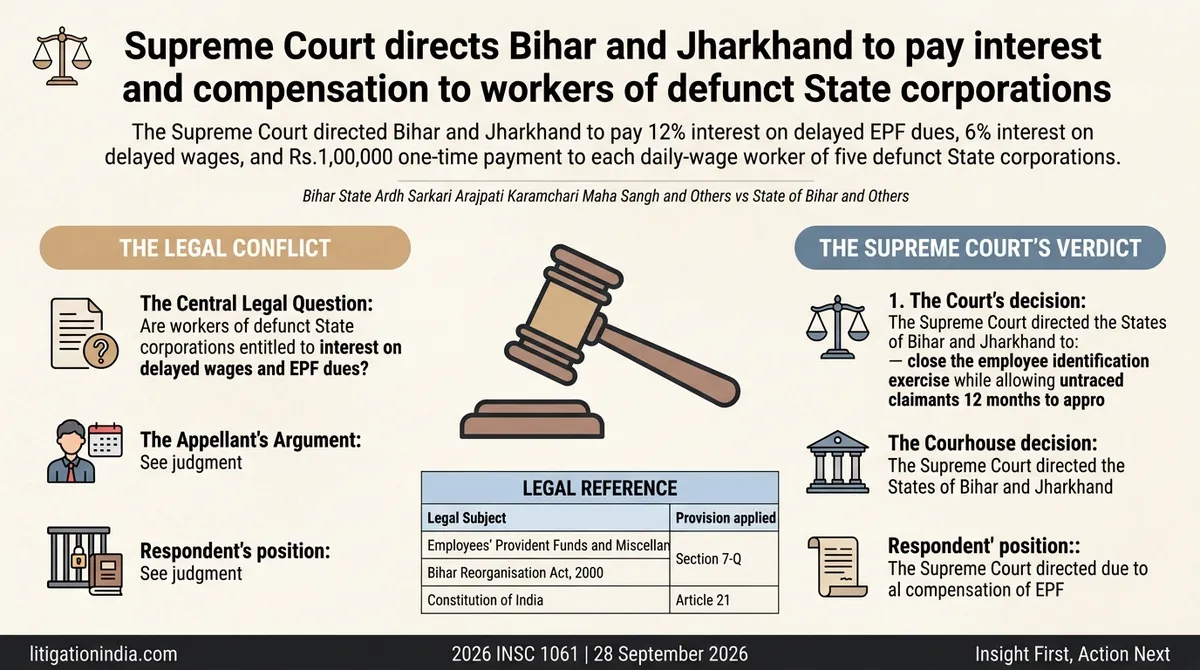
57. We accordingly direct the States of Bihar and Jharkhand to ensure payment of simple interest at the rate of 6% per annum on the salary/wages arrears and other monetary dues, excluding the EPF dues governed by Section 7-Q of the Act, for the period commencing from the date on which the respective amounts became due and payable until the date of actual payment. 58. The aforesaid rate shall apply to the extent of the liability of the respective State as determined in terms of the mechanism already approved by this Court vide order dated 29th May, 2026. The amount of interest shall be computed along with the principal dues and disbursed to the concerned employees/workmen or, where applicable, their legal heirs, within a period of three months from today. E. CONCLUSION AND DIRECTIONS 59. In light of the aforesaid discussion, we deem it appropriate to summarise the directions issued hereinabove as follows:a. Though the States of Bihar and Jharkhand have substantially complied with the directions
42 WRIT PETITION (CIVIL) NO(S). 932/2022
issued by this Court in paragraph 37 of the order dated 29th May, 2026, as per their compliance affidavits, certain aspects of such implementation continue to remain pending. The respective States shall, therefore, take all necessary steps to complete the implementation of the aforesaid directions in respect of the cases which remain pending and bring the same to its logical conclusion, in accordance with law. b. The exercise for identification and verification of the remaining employees/workmen shall stand closed. The untraced/unverified employees/workmen or their legal heirs, as the case may be, upon being traced or upon otherwise gaining knowledge of these proceedings would be at liberty to approach the concerned Nodal Officer appointed for the respective Corporation, within a period of 12 months from the date of this order, with the requisite documents for verification, whereupon their claims shall be duly processed and the amounts found payable shall be disbursed in accordance with law.
43 WRIT PETITION (CIVIL) NO(S). 932/2022
c. With a view to ensuring transparency and facilitating verification of the claims of the employees/workmen of the erstwhile defunct Corporations, the States of Bihar and Jharkhand shall: (i) compile and publish, in the public domain, updated particulars of all employees/workmen, including those whose dues have been paid or whose liability has otherwise been discharged and those whose claims remain pending; (ii) in respect of employees/workmen whose dues have been paid or liability discharged, publish their name, designation, period of service, amount payable, amount disbursed, date of disbursement and such other particulars as may be relevant for identification and verification of the claim; (iii) in respect of employees/workmen whose claims remain pending on account of their being untraced, unverified or for want of requisite documents, indicate the
44 WRIT PETITION (CIVIL) NO(S). 932/2022
present status of the claim, the reason for pendency and the documents or steps required for its processing, together with the contact particulars of the concerned Nodal Officer; (iv) post the aforesaid information on the official websites of the Information and Public Relations Department of the States, as also on the website of the concerned parent Administrative Department of the erstwhile Corporations; and (v) complete the aforesaid publication within four weeks from the date of this order and thereafter update the information periodically to reflect any subsequent verification, payment or discharge of liability. d. The States of Bihar and Jharkhand are directed to pay a one-time sum of Rs.1,00,000/- to each of the concerned daily-wage employees/workmen who were engaged during the relevant period. e. The States of Bihar and Jharkhand shall ensure payment of simple interest at the rate of 12%
45 WRIT PETITION (CIVIL) NO(S). 932/2022
per annum on the delayed EPF dues, and at the rate of 6% per annum on the delayed salary, wages and other monetary entitlements, for the period commencing from the date on which the respective amounts became due and payable until the date of their actual payment. f. The liability of the respective State shall be determined in accordance with the mechanism already approved by this Court vide its order dated 29th May, 2026. 60. It is clarified that the directions and reliefs granted herein are based upon the peculiar facts and circumstances of the present case, including the extraordinary period for which the claims have remained unresolved and the circumstances in which the liabilities of the erstwhile Corporations have come to be addressed pursuant to the orders passed by this Court. The reliefs so granted are intended to bring finality to the claims arising in the present proceedings and shall not be construed as laying down any general or binding principle with regard to the entitlement to, or computation of, similar reliefs in cases arising in a different factual or legal setting.
46 WRIT PETITION (CIVIL) NO(S). 932/2022
61. Before we part with the matter, we deem it appropriate to place on record our appreciation for the painstaking efforts undertaken by the Committee headed by Hon’ble Mr. Justice Dinesh Maheshwari, Judge (Retd.), Supreme Court of India, in carrying out the exercise entrusted to it and in assisting the Court in bringing the longstanding claims of the employees/workmen of the erstwhile Corporations towards resolution. We also place on record our appreciation for the assistance rendered by the learned counsel appearing for the respective parties and for the efforts made by them in facilitating the resolution of the issues arising in these proceedings. 62. The writ petition is accordingly disposed of in the above terms. 63. Pending applications, if any, are hereby disposed of.
….……………………J. (VIKRAM NATH)
...…………………….J. (SANDEEP MEHTA) NEW DELHI; SEPTEMBER 28, 2026.