Overview of the Supreme Court Court Master Recruitment 2026
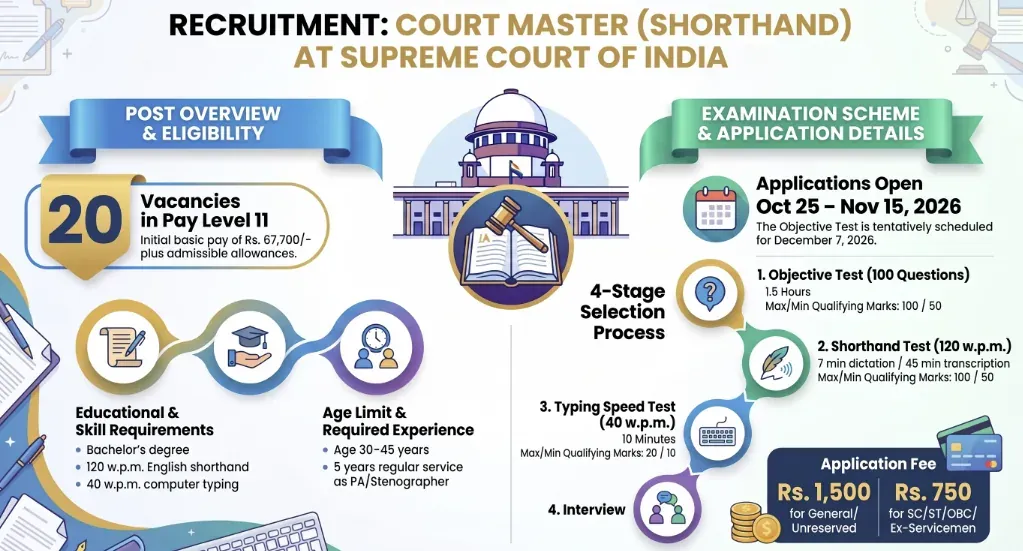
The Supreme Court of India has released official advertisement No.F.6/11/CM(S)/2026-SC (RC) dated October 15, 2026. Online applications are invited from eligible Indian citizens for filling up 20 tentative vacancies for the post of Court Master (Shorthand), a Level 11 gazetted post in the Supreme Court Registry with an initial Basic Pay of Rs. 67,700/- plus admissible allowances. The Registry reserves the right to modify the vacancy count or alter the selection procedure based on administrative requirements.
Key Highlights & Important Dates
"Selected candidates appointed to the post of Court Master (Shorthand) will be required to work even at odd hours and on holidays, subject to an undertaking submitted during application."
| Particulars | Details | | :--- | :--- | | Recruiting Authority | Supreme Court of India Registry | | Post Title | Court Master (Shorthand) (Gazetted Post) | | Pay Scale | Level 11 Pay Matrix (Rs. 67,700 – Rs. 2,08,700/-) | | Tentative Vacancies | 20 Posts | | Application Start Date | October 25, 2026 | | Application Closing Date | November 15, 2026 (11:55 PM) | | Tentative Written Exam Date | December 7, 2026 |
Eligibility Criteria & Qualifications
To be eligible as of October 1, 2026, candidates must fulfill the following mandatory qualifications, experience, and age requirements:
1. Educational & Skill Qualifications
- Degree: A Bachelor’s degree from a recognized University in India.
- Shorthand Speed: Proficiency in English Shorthand with a speed of 120 words per minute (w.p.m.).
- Typing Speed: Knowledge of computer operation with an English typing speed of 40 w.p.m. on computer.
2. Service Experience
- Minimum 5 years’ regular service in the cadre of Private Secretary, Senior PA, PA, or Senior Stenographer in Government departments, Public Sector Undertakings (PSUs), or Statutory bodies.
3. Age Limit & Relaxations
- Age Range: Candidates must be between 30 years and 45 years of age as of October 1, 2026.
- Category Relaxations: Age relaxation applies to SC, ST, OBC (Non-Creamy Layer), and ex-Servicemen as per Government of India rules. A maximum relaxation of 5 years is available for dependents of freedom fighters.
- Departmental Candidates: No upper age limit applies to departmental candidates of the Supreme Court Registry. No age relaxation is granted to employees of other government departments or PSUs.
Scheme of Examination & Gradation Method
Selection involves a four-stage process comprising written, shorthand, computer typing, and interview assessments:
Stage 1: Objective Type Test
- Structure: 100 questions (100 marks) duration of 1.5 hours with a minimum qualifying score of 50 marks.
- Syllabus Breakup:
1. General English: 25 questions 2. General Knowledge: 25 questions 3. Judiciary in Constitution of India: 25 questions 4. Supreme Court Rules, 2013: 15 questions 5. Computer Operation: 10 questions
- Negative Marking: There is no negative marking in the Objective Type Test.
Stage 2: Shorthand (English) Test
- Dictation Speed: Dictation at 120 w.p.m. for 7 minutes with 45 minutes allocated for transcription on computer. Total marks: 100 (Minimum qualifying: 50 marks).
- Permissible Mistakes: Maximum permissible errors equal 5% of total dictation words.
- Gradation Scale:
- 0% mistakes = 100% marks - Up to 1% mistakes = 90% marks - Up to 2% mistakes = 80% marks - Up to 3% mistakes = 70% marks - Up to 4% mistakes = 60% marks - Up to 5% mistakes = 50% marks
- Note: Full stop omissions or case-swaps (capital/small letters) are counted as half mistakes.
Stage 3: Computer Typing Speed Test
- Speed & Duration: Minimum speed of 40 w.p.m. over a 10-minute test in English. Maximum marks: 20 (Minimum qualifying: 10 marks).
- Permissible Mistakes: Up to 2% total mistakes allowed.
Stage 4: Personal Interview
- Total Marks: 30 marks with a minimum qualifying score of 15 marks.
Shortlisting Ratios
- Candidates qualifying the Objective Test are shortlisted for the Shorthand and Typing tests in a 1:10 ratio against vacant posts.
- Qualifying candidates are invited for the personal interview in a 1:3 ratio.
How to Apply Online
- Visit the official website of the Supreme Court of India at www.sci.gov.in.
- Complete the online registration form available between October 25, 2026, and November 15, 2026 (11:55 PM).
- Upload scanned copies of required documents including Class X, XII, Graduation degree, experience certificates, photo, signature, and caste certificates if applicable.
- Pay the non-refundable application fee online via the UCO Bank payment gateway:
- General / Unreserved: Rs. 1,500/- plus bank charges. - SC / ST / OBC (NCL) / Ex-Servicemen: Rs. 750/- plus bank charges.
- Submit the application, preview the details, and download the confirmation printout for future reference.