
All insights

Can electricity supply be restored on deposit of 50% of assessed amount in theft cases?

Supreme Court clarifies electricity theft assessment and supply restoration procedure under Electricity Act 2003

Two electricity distribution companies in Gujarat challenged High Court orders that allowed consumers accused of electricity theft to get their supply restored by depositing only 50% of the assessed a

Litigation India Editorial 26 October 2026 1 min read 2026 INSC 1157

Story

Case at a glance1 / 6

Supreme Court of India

Electricity Theft: Who Assesses the Bill and Who Gets Power Back?

Dakshin/Paschim Gujarat Vij Company Ltd. vs Vaibhav Metal Crusher & Ors. | 2026 INSC 1157

Court: Supreme Court of India | Date: 26 October 2026Bench: Justice Manoj Misra and Justice K.V. ViswanathanArea of law: Electricity Law — theft assessment and supply restorationTwo appeals from Gujarat involving disconnection of electricity supply on theft allegations
Does Section 126 assessment procedure apply to electricity theft cases under Section 135?
Supreme Court clarifies electricity theft assessment and supply restoration procedure under Electricity Act 2003 · 2026 INSC 11572026-10-26T17:38:46.560088+00:00
The legal question2 / 6

Can a Consumer Accused of Electricity Theft Contest the Bill and Get Power Back?

Core legal issue decided in both appeals

  • Appellant: Section 126 procedure and Section 127 appeal are inapplicable to theft cases; only Special Court determines liability under Section 154(5).
  • Appellant: Directing restoration on 50% deposit is too lenient and ignores theft's criminal nature.
  • Respondent: Third proviso to Section 135(1A) uses the word 'assessed amount'; there is no separate assessment mechanism for theft, so Section 126 procedure must apply.
  • Respondent: An appeal is a continuation of original proceedings, so Section 127 appeal is available; High Court was justified in directing restoration on 50% deposit.
Supreme Court clarifies electricity theft assessment and supply restoration procedure under Electricity Act 2003 · 2026 INSC 11572026-10-26T17:38:46.560088+00:00
Statutory comparison3 / 6

Unauthorized Use vs. Electricity Theft: Key Differences Under the Act

How Section 126 and Section 135 interact

Legal SubjectUnauthorized Use (Section 126)Electricity Theft (Section 135)
Nature of wrongCivil; no criminal intent requiredCriminal offence; dishonest intent (mens rea) required
Disconnection powerNot immediate under Section 126Immediate upon detection under Section 135(1A)
Assessment procedureProvisional assessment, objection, hearing, final order under Section 126Same Section 126 procedure applies (no separate procedure exists)
Restoration of supplyOn deposit of assessed amountOn deposit of assessed amount per third proviso to Section 135(1A)
AppealUnder Section 127; 50% deposit requiredAvailable under Section 127; finality limited to restoration purpose
Final civil liabilityDetermined by Appellate Authority; order final under Section 127(4)Determined by Special Court under Section 154(5); overrides Section 126/127 determination
Theft includes unauthorized use, but every unauthorized use is not theft — both proceedings can run in parallel.
Supreme Court clarifies electricity theft assessment and supply restoration procedure under Electricity Act 2003 · 2026 INSC 11572026-10-26T17:38:46.560088+00:00
The Court's reasoning4 / 6

Court's Reasoning: From Disconnection to Restoration

Step-by-step legal reasoning in this judgment

  1. 1Step 1: Theft falls within 'unauthorized use'; Section 126 is the only assessment mechanism in the Act for computing the 'assessed amount'.
  2. 2Step 2: Therefore, the Section 126 procedure — provisional assessment, objection, hearing, final order — applies to theft cases for restoration of supply.
  3. 3Step 3: Appeal under Section 127 is available; appellate order is final for the limited purpose of determining restoration amount.
  4. 4Step 4: In theft cases with a criminal complaint, the Special Court under Section 154(5) makes the final binding determination of civil liability — overriding Section 126/127 amounts.
  5. 5Step 5: High Court may, for reasons recorded, direct restoration on not less than 50% deposit where provisional assessment is prima facie arbitrary.
Supreme Court clarifies electricity theft assessment and supply restoration procedure under Electricity Act 2003 · 2026 INSC 11572026-10-26T17:38:46.560088+00:00
The verdict5 / 6

Supreme Court's Final Decision

Disposal of both appeals

  • The Fact: Consumers accused of electricity theft had supply disconnected; High Court ordered restoration on 50% deposit and allowed objections to the supplementary bill.
  • The Law: Section 126 procedure governs assessment for restoration in theft cases; Section 127 appeal is available; Special Court retains final authority on civil liability under Section 154(5).
  • The Result: Both appeals dismissed; High Court directions upheld with clarification that assessments remain subject to Special Court's civil liability determination.
Both appeals dismissed; High Court orders upheld with clarification on Special Court's overriding civil liability determination under Section 154(5).
Supreme Court clarifies electricity theft assessment and supply restoration procedure under Electricity Act 2003 · 2026 INSC 11572026-10-26T17:38:46.560088+00:00
Why it matters6 / 6

What This Means for Electricity Consumers and Licensees

Practical significance of this judgment

  • A consumer accused of electricity theft cannot be kept without power indefinitely; they have the right to contest the bill through objections and appeal before paying in full.
  • Electricity companies cannot skip the assessment procedure when raising a demand for theft; they must follow Section 126, serve a provisional assessment, and give the consumer a hearing.
  • High Courts can grant interim relief by ordering restoration on deposit of not less than 50% of provisionally assessed amount, but must be cautious in theft cases.
  • Payment made for restoration is not final; if the Special Court eventually determines a lower civil liability, the excess amount must be refunded to the consumer.
In electricity theft cases, follow Section 126 assessment procedure, allow objections and appeal, and know that the Special Court has the final say on civil liability.
Supreme Court clarifies electricity theft assessment and supply restoration procedure under Electricity Act 2003 · 2026 INSC 11572026-10-26T17:38:46.560088+00:00
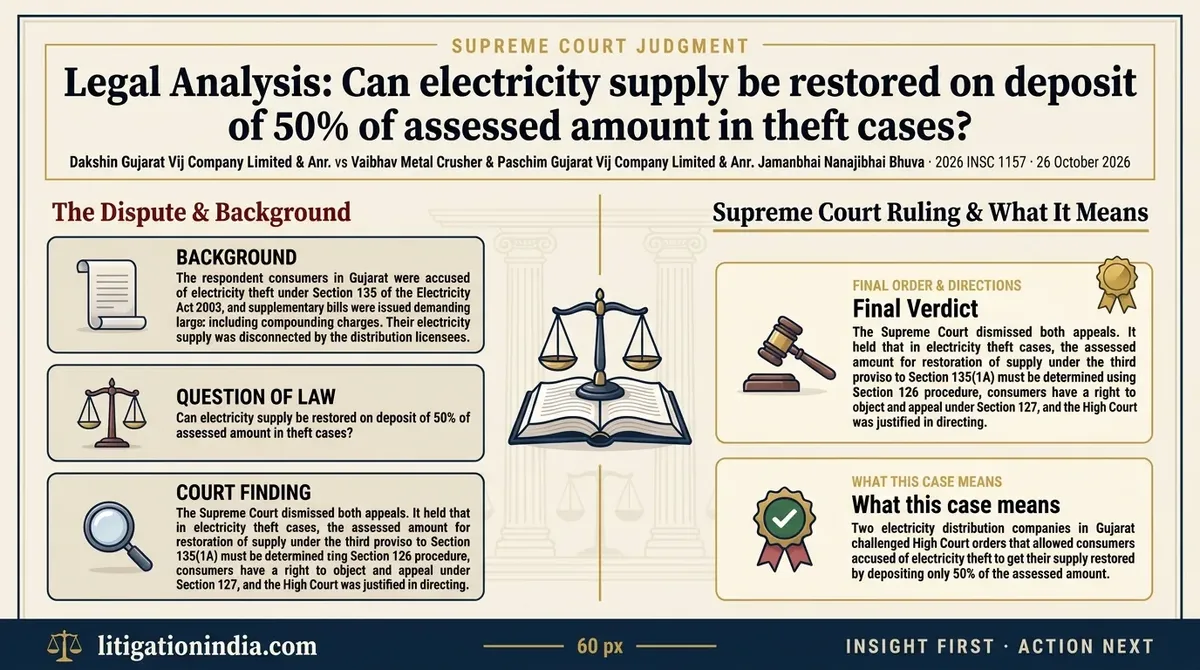
Supreme Court clarifies electricity theft assessment and supply restoration procedure under Electricity Act 2003 — infographic summary

What this case means

Two electricity distribution companies in Gujarat challenged High Court orders that allowed consumers accused of electricity theft to get their supply restored by depositing only 50% of the assessed amount. The Supreme Court held that the assessment procedure under Section 126 of the Electricity Act 2003 applies equally to electricity theft cases, consumers can file objections and appeal, and a High Court may direct restoration on deposit of not less than 50% of the provisionally assessed amount. This matters because it balances deterrence of theft with protection of consumers' essential electricity access.

What the Supreme Court held

The Supreme Court dismissed both appeals. It held that in electricity theft cases, the assessed amount for restoration of supply under the third proviso to Section 135(1A) must be determined using the Section 126 procedure, consumers have a right to object and appeal under Section 127, and the High Court was justified in directing restoration on 50% deposit. The Court added a clarification that such determination remains subject to the Special Court's civil liability determination under Section 154(5), and the High Courts must take a circumspect approach in theft cases.

Case: Dakshin Gujarat Vij Company Limited & Anr. vs Vaibhav Metal Crusher & Paschim Gujarat Vij Company Limited & Anr. vs Jamanbhai Nanajibhai Bhuva (2026) Citation: 2026 INSC 1157

Want the full legal reasoning, citations and case documents?

Read the full judgment analysis
electricity theft
Electricity Act 2003
Section 135
Section 126
restoration of supply
assessed amount
Special Court
civil liability
Section 154
distribution licensee
unauthorized use of electricity
Gujarat Electricity Regulatory Commission
Section 135, Sub-section (1A) and third proviso thereof, Electricity Act, 2003
Section 126, Electricity Act, 2003