
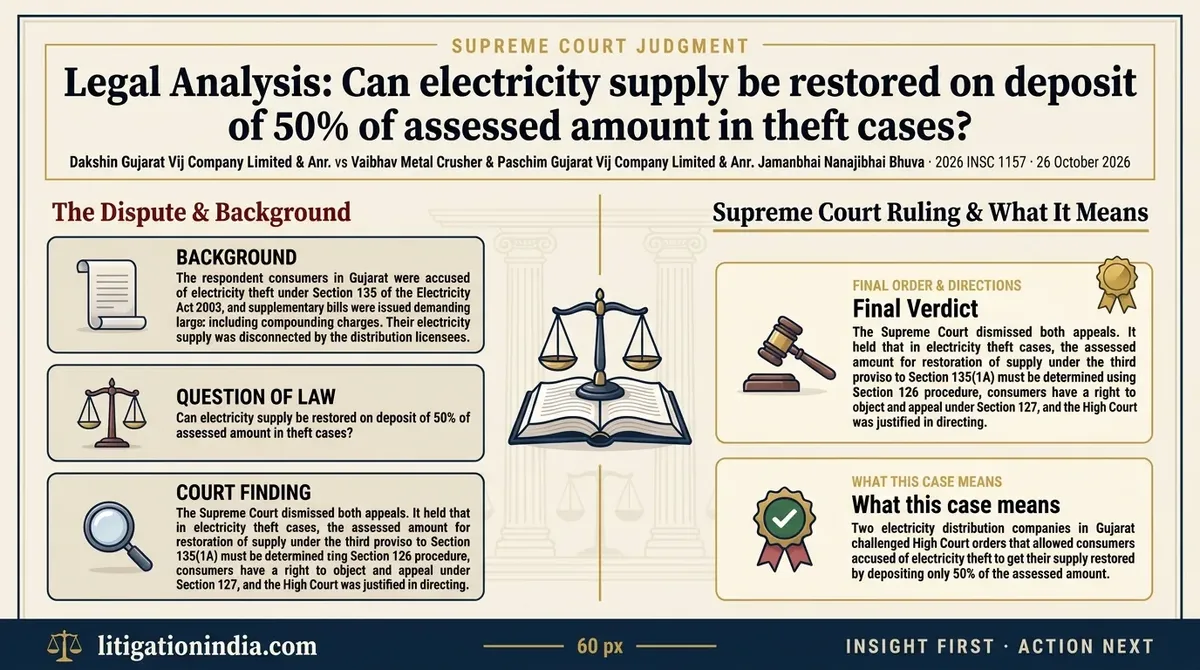
Full text of the judgment
Text extracted from Dakshin Gujarat Vij Company Limited & Anr. vs Vaibhav Metal Crusher & Paschim Gujarat Vij Company Limited & Anr. vs Jamanbhai Nanajibhai Bhuva. For the authoritative version refer to the Supreme Court of India's official website.
2026 INSC 1157 REPORTABLE IN THE SUPREME COURT OF INDIA CIVIL APPELLATE JURISDICTION CIVIL APPEAL No. of 2026 (Arising out of
Special Leave to Appeal (C) No. 17868/2024) DAKSHIN GUJARAT VIJ COMPANY LIMITED & ANR.
…APPELLANT(S) VERSUS VAIBHAV METAL CRUSHER …RESPONDENT
WITH CIVIL APPEAL No. of 2026 (Arising out of
Special Leave to Appeal (C) No. 8778/2025) PASCHIM GUJARAT VIJ COMPANY LIMITED & ANR. …APPELLANT(S) VERSUS JAMANBHAI NANAJIBHAI BHUVA …RESPONDENT J U D G M E N T MANOJ MISRA, J. 1. Leave granted. 2. These two appeals raise common questions of law, therefore, with the consent of the learned counsel for the parties, they Special Leave to Appeal Civil No(s). 17868/2024 & 8778/2025 Page 1 of 46 Digitally signed by CHETAN ARORA Date: 2026.10.26 17:11:27 IST Reason: Signature Not Verified
have been heard together and are being decided by this common judgment. 3. For a clear understanding of the factual controversy involving these two appeals, we propose to notice the facts of each appeal separately. Civil Appeal arising out of Special Leave Petition (Civil) No. 17868 of 2024 4. The relevant facts of the appeal arising from SLP (C) No.17868 of 2024 are: (i) The first respondent, namely, M/s Vaibhav Metal Crusher, was accused of an offence punishable under Section 135 of the Electricity Act, 2003. After being made accused, on 03.01.2024, a notice, titled as a supplementary bill, was issued to it by the distribution licensee (i.e., the appellant herein), raising a demand of Rs. 92,99,077.55 towards theft of electricity, and Rs. 23,45,845 towards compounding charges. The notice stated that if the said amount along with compounding charges is not paid, prosecution under Section 135 of the 2003 Act would be launched. 2003 Act Special Leave to Appeal Civil No(s). 17868/2024 & 8778/2025 Page 2 of 46
(ii) Aggrieved by the aforesaid notice-cum-bill, the first respondent filed an application2 under Article 226 of the Constitution of India before a Single Judge Bench of the High Court3. On 12.02.2024, the learned single Judge, following an earlier decision of the High Court in Letters Patent Appeal (LPA) No. 1445 of 2023 passed an interim order thereby permitting the first respondent (writ applicant therein) to deposit 50 percent of the bill amount including reconnection charges, and directed the distribution licensee, upon such deposit, to reconnect the electricity connection. (iii) Against the aforesaid interim order, the distribution licensee (‘the appellant’ herein) filed LPA No. 592 of 2024, inter alia, on the following grounds: (a) Direction to reconnect on deposit of 50 percent of the supplementary bill amount is wholly unwarranted as the demand is in respect of theft of electricity. (b) Prior opportunity of hearing is not required in raising a demand for theft of electricity. 22 Special Civil Application No.1183 of 2024 33 The High Court of Gujarat at Ahmedabad Special Leave to Appeal Civil No(s). 17868/2024 & 8778/2025 Page 3 of 46
(c) The learned single Judge failed to appreciate that Special Court alone has the power to determine civil liability under Section 154(5) and 154(6) of the 2003 Act, therefore, writ petition is not the appropriate remedy. (iv) The Division Bench of the High Court entertained the appeal, called for the record of the writ application and disposed of the appeal as well as the writ application vide impugned order dated 25.06.2024. The operative portion of the said order is extracted below: “21. We, therefore, dispose of the writ petition with the observation that the petitioner shall file a reply to the notice dated 03.01.2024 wherein computation towards energy consumption on the allegation of theft of electricity has been made and demand has been raised in the shape of Supplementary Bill. As the petitioner has made allegations with regard to the checking report and the laboratory tests of the meter, it is open for him to raise this issue before the competent authority. 22. It is, thus, provided that the petitioner would be free to raise all objections to the notice stated 03.01.2024 wherein the assessment towards energy consumption has been made on the allegations of theft of electricity. In case, the petitioner submits a reply within the period of two weeks along with the copy of this order, before the Executive Engineer concerned, he shall be under obligation to deal with all points of objections raised by the petitioner before proceeding further. The Supplementary Bill dated 03.01.2024 raised by the Special Leave to Appeal Civil No(s). 17868/2024 & 8778/2025 Page 4 of 46
respondent shall be subject to the decision to be taken by the Executive Engineer under the above directions. 23. Insofar as the deposits made by the petitioner under the directions issued by this court in the judgment and order dated 12.02.2024, we provide that the said deposits would also be subject to the decision of the Executive Engineer to be taken in compliance of the above directions, which shall be taken as early as possible preferably within the period of three weeks from the date of the receipt of reply. As regards the direction issued by the learned single judge in the order impugned for reconnection of electricity, the same is being kept subject to the fresh decision of the Executive Engineer. 24. However, in case, the decision goes against the petitioner, the petitioner would have a remedy to file appeal under Section 127 of the Electricity Act, 2003, in view of the observation made by us in the judgment and order dated 25.04.2024 noted hereinbefore. In that eventuality, the deposits made by the petitioner under the judgment and order dated 25.04.2024 passed by the learned Single Judge shall have to be adjusted towards the deposits to be made by the petitioner to maintain the appeal under Section 127 of the Electricity Act, 2003” Civil Appeal arising out of Special Leave Petition (Civil) No. 8778 of 2025 5. The facts of the appeal arising from SLP (C) No.8778 of 2025 are: (i) Jamanbhai Nanajibhai Bhuva (the sole respondent herein) filed writ application4 before Single Judge Bench of the High Court questioning the supplementary bill dated 01.06.2023 raised by the 44 Special Civil Application No.13655 of 2023 Special Leave to Appeal Civil No(s). 17868/2024 & 8778/2025 Page 5 of 46
distribution licensee (‘the appellant’ herein) in respect of theft of electricity. The learned single Judge entertained the writ application and, vide order dated 23.01.2024, directed the writ applicant to deposit 50 percent of the demanded amount within four weeks, whereupon recovery of the balance amount would remain stayed, and gave liberty to the writ applicant to apply for a fresh connection, upon which, the distribution licensee was directed to process the application within two weeks and provide estimate for the connection and, on deposit of the estimated amount, to provide connection within next two weeks. The learned single Judge also directed that fresh connection shall not be delayed, or the application shall not be rejected, only on the ground that there are arrears standing against the premises in question. (ii) Aggrieved by the order of the learned single Judge, LPA No. 474 of 2024 was filed by the distribution licensee (i.e., appellant herein) before the Division Special Leave to Appeal Civil No(s). 17868/2024 & 8778/2025 Page 6 of 46
Bench of the High Court, inter alia, on the following grounds: (a) Direction to reconnect on deposit of 50 percent of the demand raised was wholly unjustified as the demand was raised on account of theft of electricity. (b) Before raising the demand, opportunity of hearing need not be provided to a consumer accused of electricity theft. (c) The learned single Judge had failed to appreciate that Special Court has the power to determine civil liability under Section 154(5) and 154(6) of the 2003 Act, therefore, the writ petition under Article 226 is not the appropriate remedy. (iii) The Division Bench after noticing two decisions of this Court, namely, West Bengal State Electricity Distribution Company Ltd. and Ors. v. M/s. Orion Metal Pvt. Ltd. & Anr.5 and Southern Electricity Supply Company of Orissa Limited (SOUTHCO) & 55 (2020) 18 SCC 588 Special Leave to Appeal Civil No(s). 17868/2024 & 8778/2025 Page 7 of 46
Anr. v. Sri Seetaram Rice Mill6 remitted the matter back to the learned single Judge, vide impugned order dated 25.04.2024, with a direction that the learned single Judge shall pass a fresh order. 6. We have heard Shri Ranjit Kumar, learned senior counsel for the appellant (the distribution licensee); and Shri Raghenth Basant, for the respondent (the consumer), in both the appeals. Submissions on behalf of the appellant: 7. On behalf of the appellant it has been submitted: (i) Part XIV of the 2003 Act deals with offences and penalties. Sub-section (1) of Section 1357 delineates the circumstances in which theft of electricity takes place. 66 (2012) 2 SCC 108 77 Section 135. Theft of electricity- (1) Whoever, dishonestly,- (a) taps, makes or causes to be made any connection with overhead, underground or under water lines or cables, or service wires, or service facilities of a licensee or supplier, as the case may be; or (b) tampers a meter, installs or uses a tampered meter, current reversing transformer, loop connection or any other device or method which interferes with accurate or proper registration, calibration or metering of electric current or otherwise results in a manner whereby electricity is stolen or wasted; or (c) damages or destroys an electric meter, apparatus, equipment, or wire or causes or allows any of them to be so damaged or destroyed as to interfere with the power or accurate metering of electricity; or (d) uses electricity through a tampered meter; or (e) uses electricity for the purpose other than for which the usage of electricity was authorized, so as to abstract or consume or use electricity shall be punishable with imprisonment for a term which may extend to three years or with fine or with both: Special Leave to Appeal Civil No(s). 17868/2024 & 8778/2025 Page 8 of 46
Sub-section (1A) of Section 1358 provides that the licensee or supplier, as the case may be, may, upon detection of such theft of electricity, immediately disconnect the supply of electricity. The third proviso to sub-section (1A) of Section 135 provides for a right to apply for restoration of supply of electricity on deposit or payment of the assessed amount or electricity charges in accordance with the provisions of the Act. (ii) The assessment as envisaged under sub-section (1A) of Section 135 is different from one under Section 88 Sub-section (1A) of Section 135 – Without prejudice to the provisions of this Act, the licensee or supplier, as the case may be, may, upon detection of such theft of electricity, immediately disconnect the supply of electricity: Provided that only such officer of the licensee or supplier, as authorised for the purpose by the Appropriate Commission or any other officer of the licensee or supplier, as the case may be, of the rank higher than the rank so authorised shall disconnect the supply line of electricity: Provided further that such officer of the licensee or supplier, as the case may be, shall lodge a complaint in writing relating to the commission of such offence in police station having jurisdiction within twenty four hour from the time of such disconnect: Provided also that the licensee or supplier, as the case may be, on deposit or payment of the assessed amount or electricity charges in accordance with the provisions of this Act, shall, without prejudice to the obligation to lodge the complaint as referred to in the second proviso to this clause., restore the supply line of electricity within forty-eight hours of such deposit or payment. Special Leave to Appeal Civil No(s). 17868/2024 & 8778/2025 Page 9 of 46
1269 and is, therefore, not one which is subject to an appeal under Section 12710 of the 2003 Act. (iii) Besides, the assessment as contemplated under the third proviso to sub-section (1A) of Section 135 is for the limited purpose of reconnection in cases of 99 Section 126. Assessment.- (1) If on an inspection of any place or premises or after inspection of the equipments, gadgets, machines, devices found connected or used, or after inspection of records maintained by any person, the assessing officer comes to the conclusion that such person is indulging in unauthorized use of electricity, he shall provisionally assess to the best of his judgment the electricity charges payable by such person or by any other person benefited by such use. (2) The order of provisional assessment shall be served upon the person in occupation or possession or in charge of the place or premises in such manner as may be prescribed. (3) The person on whom an order had been served under sub-section (2), shall be entitled to file objections, if any, against the provisional assessment before the assessing officer, who shall, after affording a reasonable opportunity of hearing to such person, pass a final order of assessment, within 30 days from the date of service of such order of provisional assessment, of the electricity charges payable by such person. (4) Any person served with the order of provisional assessment may, accept such assessment and deposit the assessed amount with the licensee within seven days of service of such provisional assessment order upon him. (5) If the assessing officer reaches to the conclusion that unauthorized use of electricity has taken place, the assessment shall be made for the entire period during which such unauthorized use of electricity has taken place and if, however, the period during which such unauthorized use of electricity has taken place cannot be ascertained, such period shall be limited to a period of 12 months immediately preceding the date of inspection. (6) The assessment under this section shall be made at a rate equal to twice the tariff applicable for the relevant category of services specified in sub-section (5). Explanation.- For the purposes of this section,- (a) “Assessing officer” means an officer of a State Government or Board or licensee, as the case may be, designated as such by the State Government; (b) “Unauthorized use of electricity” means the usage of electricity-- (i) by any artificial means; or (ii) by a means not authorised by the concerned person or authority or licensee; or (iii) through a tampered meter; or (iv) for the purpose other than for which the usage of electricity was authorized; or (v) for the premises or areas other than those for which the supply of electricity was authorized. 1010 Section 127. Appeal to appellate authority.- (1) Any person aggrieved by the final order made under section 126 may, within 30 days of the said order, prefer an appeal in such form, verified in such manner and be accompanied by such fee as may be specified by the State Commission, to an appellate authority as may be prescribed. (2) No appeal against an order of assessment under sub-section (1) shall be entertained unless an amount equal to half of the assessed amount is deposited in cash or by way of bank draft with the licensee and documentary evidence of such deposit has been enclosed along with the appeal. (3) The appellate authority referred to in sub-section (1) shall dispose of the appeal after hearing the parties and pass appropriate order and send copy of the order to the assessing authority officer and the appellant. (4) The order of the appellate authority referred to in sub-section (1) passed under sub-section (3) shall be final. Special Leave to Appeal Civil No(s). 17868/2024 & 8778/2025 Page 10 of 46
disconnection consequent to electricity theft; therefore, the benefit of sub-section (3) of Section 126, that is the right to file an objection before the Assessing Authority against such provisional assessment, is not available. Thus, the High Court fell in error by giving liberty to the writ applicant to file objection to the supplementary bill which, in effect, was a provisional demand raised for the purposes of reconnection. Likewise, the High Court erred in giving right of appeal to the consumer against such assessment. (iv) Sub-section (4) of Section 127 of the 2003 Act provides that the order of the Appellate Authority referred to in sub-section (1) passed under sub-section (3) of Section 127 shall be final. As a corollary thereof, if the benefit of appeal is provided to the consumer charged with theft, then the order passed in appeal would attain finality and the provisions of sub-section (5) of Section 154 of the 2003 Act, which empowers the (5) No appeal shall lie to the appellate authority referred to in sub-section (1) against the final order made with the consent of the parties. (6) When a person defaults in making payment of assessed amount, he, in addition to the assessed amount, shall be liable to pay, on the expiry of 30 days from the date of order of assessment, an amount of interest at the rate of 16% per annum compounded every six months. Special Leave to Appeal Civil No(s). 17868/2024 & 8778/2025 Page 11 of 46
Special Court to determine the civil liability of a consumer or person, in terms of money, guilty of committing theft of energy, would be rendered nugatory. 8. In a nutshell, the submission on behalf of the appellant is that provisional assessment under Section 126(1) for unauthorized usage of electricity and provisional assessment for theft are made in different circumstances and, therefore, cannot be equated with each other. In case of assessment for unauthorized usage of electricity, the consumer has a right to file an objection, and thereafter an appeal; whereas in the case of theft, the consumer has to suffer disconnection, though on deposit/ payment of the entire assessed amount the supply would have to be restored, and such assessment is subject to the determination of civil liability by the Special Court under sub-section (5) of Section 154. In consequence, the argument is, in a case of theft of electricity, the High Court should not in a routine manner direct for restoration of electricity supply on mere deposit of 50 percent of the Special Leave to Appeal Civil No(s). 17868/2024 & 8778/2025 Page 12 of 46
demanded amount, and, further, it should not allow filing of objection, or appeal, against such demand. Submissions on behalf of respondent(s) 9. Per contra, on behalf of the respondents it is submitted that the third proviso to sub-section (1A) of Section 135 confers on the consumer a right to seek restoration of the electricity supply on deposit or payment of the assessed amount, or electricity charges, in accordance with the provisions of the 2003 Act. Such restoration is without prejudice to the right of the licensee or supplier to lodge the complaint. In the absence of any provision, other than Section 126, for assessment, the expression “the assessed amount” used in the third proviso to sub-section (1A) of Section 135 must be construed as the amount assessed in accordance with the provisions of Section 126 of the 2003 Act. 10. It is submitted on behalf of the respondents that an appeal is continuation of the original proceedings; hence, the expression “the assessed amount” would include the amount determined on an appeal, if any, filed against the Special Leave to Appeal Civil No(s). 17868/2024 & 8778/2025 Page 13 of 46
assessment. Therefore, the High Court was justified in giving a direction to the competent authority to make an assessment after considering the objection to the supplementary bill, subject to final determination in an appeal. The order of the High Court being just and proper does not warrant interference. 11. It is further submitted on behalf of the respondents that sub-section (4) of Section 127 of the 2003 Act, though attaches finality to the assessment, does not in any way render the provisions of Section 154(5) of the 2003 Act nugatory. Because in a case where complaint is filed for criminal prosecution, the finality attached to the amount assessed is qua restoration of electricity supply and it remains subject to determination of civil liability under subsection (5) of Section 154. In those circumstances, it is urged that these appeals are misconceived and are liable to be dismissed. Discussion Special Leave to Appeal Civil No(s). 17868/2024 & 8778/2025 Page 14 of 46
12. Before we address the rival submissions it would be useful to survey the relevant provisions of the 2003 Act and the Gujarat Electricity Regulatory Commission (Electricity Supply Code and Related Matters) Regulations, 2015,11 which has been notified by the Gujarat Electricity Regulatory Commission in exercise of powers conferred upon it under Section 181(2)(x) read with Section 50 of the 2003 Act and Section 42(1)(b) of the Gujarat Electricity Industry (Reorganization and Regulation) Act, 2003. Relevant Provisions of the 2003 Act, the Removal of Difficulty Order & the Supply Code 13. Section 126(1) of the 2003 Act provides that if on inspection of any place or premises or after inspection of the equipment, gadgets, machines, devices found connected or used, or after inspection of records maintained by any person, the assessing officer comes to the conclusion that such person is indulging in unauthorized use of electricity, he shall provisionally assess to the best of his judgment the electricity charges payable by such person or by any other person benefited by such use. Sub-section (2) thereof 1111 Supply Code, 2015 Special Leave to Appeal Civil No(s). 17868/2024 & 8778/2025 Page 15 of 46
provides that the order of provisional assessment shall be served upon the person in occupation or possession or in charge of the place or premises in such manner as may be prescribed. Sub-section (3) provides that the person on whom an order has been served under sub-section (2) shall be entitled to file objections, if any, against the provisional assessment before the assessing officer, who shall, after affording a reasonable opportunity of hearing to such person pass a final order of assessment. The explanation defines ‘assessing officer’ and ‘unauthorized use of electricity’. According to the explanation, “assessing officer” means an officer of a State Government or Board or licensee, as the case may be, designated as such by the State Government; and “unauthorized use of electricity” means the usage of electricity- (i) by any artificial means; or (ii) by a means not authorized by the concerned person or authority or licensee; or (iii) through a tampered meter; or (iv) for the purpose other than for which the usage of electricity was authorized; or (v) for the premises or areas Special Leave to Appeal Civil No(s). 17868/2024 & 8778/2025 Page 16 of 46
other than those for which the supply of electricity was authorized. 14. Section 127 provides for appeal to the appellate authority. Sub-section (1) of Section 127, inter alia, provides that any person aggrieved by the final order made under Section 126 may, within 30 days of the said order, prefer an appeal in such form and manner as may be specified by the State Commission to an appellate authority as may be prescribed. Sub-section (2) of Section 127, inter alia, provides that no appeal against an order of assessment under sub-section (1) shall be entertained unless an amount equal to half of the assessed amount is deposited in cash or by way of bank draft with the licensee. Sub-section (3), inter alia, provides that the appeal shall be disposed of by the Appellate Authority after hearing the parties. Sub-section (4), inter alia, provides that the order of the Appellate Authority passed under sub-section (3) shall be final. Sub-section (5) provides that no appeal shall lie to the Appellate Authority against the final order made with the consent of the parties. Special Leave to Appeal Civil No(s). 17868/2024 & 8778/2025 Page 17 of 46
Sub-section (6), inter alia, provides for the liability to pay interest on failure to make payment of the assessed amount. 15. Section 135 specifies certain acts that would constitute theft of electricity if committed dishonestly. Sub-section (1A) of Section 135 empowers the licensee or supplier, as the case may be, to disconnect the supply immediately upon detection of such theft of electricity. The third proviso to sub-section (1A) provides that the licensee or supplier, as the case may be, on deposit or payment of the assessed amount or electricity charges in accordance with the provisions of the Act, shall, without prejudice to the obligation to lodge the complaint as referred to in the second proviso, restore the supply line of electricity within 48 hours of such deposit or payment. Importantly, the second proviso to sub-section (1A) of Section 135 obligates the licensee or supplier to lodge complaint in writing relating to the commission of such offence in the police station concerned within 24 hours from the time of such disconnection. Special Leave to Appeal Civil No(s). 17868/2024 & 8778/2025 Page 18 of 46
16. Section 152 of the 2003 Act provides for compounding of offences. According to it, notwithstanding anything contained in the Code of Criminal Procedure, 1973 (CrPC), the Appropriate Government or any officer authorized by it in this behalf shall accept from any consumer or person who committed or who is reasonably suspected of having committed an offence of theft of electricity, punishable under the Act, a sum of money by way of compounding of the offence as specified in the Table below: TABLE Nature of service Rate at which the sum of money for compounding to be collected per Kilowatt (KW)/Horse Power (HP) or part thereof for Low Tension (LT) supply and per Kilo Volt Ampere (KVA) of contracted demand for High Tension (HT) 1 2 1. Industrial Service Twenty thousand rupees; 2. Commercial Service Ten thousand rupees; 3. Agricultural Service Two thousand rupees; 4. Other Services Four thousand rupees: Provided that the Appropriate Government may, by notification in the Official Gazette, amend the rates specified in the Table above. Sub-section (3) of Section 152 provides that acceptance of the sum of money for compounding an offence in Special Leave to Appeal Civil No(s). 17868/2024 & 8778/2025 Page 19 of 46
accordance with sub-section (1) shall be deemed to amount to an acquittal within the meaning of Section 300 of CrPC. 17. Section 151 of the 2003 Act states that no court shall take cognizance of an offence punishable under the Act except upon a complaint in writing made by the Appropriate Government or Appropriate Commission or any of their officer authorized by them or a Chief Electrical Inspector or an Electrical Inspector or licensee or the generating company, as the case may be. The proviso to Section 151 states that the Court may also take cognizance of an offence punishable under the Act upon a report of a police officer filed under Section 173 of CrPC. 18. Section 153 of the 2003 Act provides for constitution of Special Courts. Section 154 provides for the procedure and power of Special Courts. Sub-section (1) of Section 154 provides that notwithstanding anything contained in CrPC, every offence punishable under Sections 135 to 140 and Section 150 shall be triable only by the Special Court within Special Leave to Appeal Civil No(s). 17868/2024 & 8778/2025 Page 20 of 46
whose jurisdiction such offence has been committed. Subsection (5) of Section 154 provides: “The Special Court shall determine the civil liability against a consumer or a person in terms of money for theft of energy which shall not be less than an amount equivalent to two times of the tariff rate applicable for a period of twelve months preceding the date of detection of theft of energy or the exact period of theft if determined whichever is less and the amount of civil liability so determined shall be recovered as if it were a decree of civil court”. Sub-section (6) of Section 154 provides: “In case the civil liability so determined finally by the Special Court is less than the amount deposited by the consumer or the person, the excess amount so deposited by the consumer or the person to the Board or licensee or the concerned person, as the case may be, shall be refunded by the Board or licensee or the concerned person, as the case may be, within a fortnight from the date of communication of the order of the Special Court together with interest at the prevailing Reserve Bank of India prime lending rate for the period from the date of such deposit till the date of payment”.
Explanation to Section 154 reads: “For the purposes of this Section, “civil liability” means loss or damage incurred by the Board or licensee or the concerned person, as the case may be, due to the commission of an offence referred to in sections 135 to 140 and 150”. 19. Section 183 confers power on the Central Government to remove difficulties. Sub-section (1) of Section 183 provides: Special Leave to Appeal Civil No(s). 17868/2024 & 8778/2025 Page 21 of 46
“If any difficulty arises in giving effect to the provisions of this Act, the Central Government may, by order published, make such provisions not inconsistent with the provisions of this Act, as may appear to be necessary for removing the difficulty: Provided that no order shall be made under this Section after the expiry of two years from the date of commencement of this Act.” 20. In exercise of the power conferred upon the Central Government by Section 183 of the 2003 Act, The Electricity (Removal of Difficulties) Order, 2005 was notified and published in the Official Gazette on 08.06.2005. Paragraph 2 of the said Order reads as under: “Inclusion of measures to control theft in Electricity Supply Code: (1) The Electricity Supply Code as specified by the State Commission under Section 50 of the Act shall also include the following, namely: (i) method of assessment of the electricity charges payable in case of theft of electricity pending adjudication by the appropriate court; (ii) disconnection of supply of electricity and removing the meter, electric line, electric plant and other apparatus in case of theft or unauthorized use of electricity; and (iii) measures to prevent diversion of electricity, theft or unauthorized use of electricity or tampering, distress or damage to electrical plant, electronic lines or meter. (2) The above provisions in the Electricity Supply Code shall be without prejudice to other rights of the licensee under the Act or any other applicable laws to recover the Special Leave to Appeal Civil No(s). 17868/2024 & 8778/2025 Page 22 of 46
sum due or to protect the assets and interests of the licensee.” 21. Likewise, in exercise of the powers conferred by Section 181(2)(x) read with Section 50 of the 2003 Act and Section 42(1)(b) of the Gujarat Electricity Industry (Reorganization and Regulation) Act, 2003, and all powers enabling it in that behalf, the Gujarat Electricity Regulatory Commission (for short, the State Commission) made the “Supply Code, 2015”. Para 2.3 of the Supply Code carries the definition clause. Few definitions relevant to our purpose are reproduced below: “In this Code, unless it is repugnant to the context: 2.3(7) ‘Assessing Officer’ refers to an officer designated as Assessing Officer by the State Government of Gujarat under provisions of Section 126 of the Act; 2.3(8) ‘Authorised Officer’ refers to an officer designated as Authorised Officer by the Commission or the State Government, as the case may be, under provisions of Section 135 of the Act.” Para 7 of the Supply Code deals with theft of electricity. Para 7.1 of the Supply Code provides: “Whenever a case of theft of energy is detected on inspection by the Authorized Officer, the Assessing Officer shall carry out the assessment, in accordance with the procedure as laid down in the sections below: Special Leave to Appeal Civil No(s). 17868/2024 & 8778/2025 Page 23 of 46
Paras 7.2 to 7.5 deals with the procedural aspects which may not be relevant here. Para 7.7 of the Supply Code provides: “The Assessing Officer shall assess the energy consumption as per the assessment formula given in Annexure IV to this Code, for the entire period during which such theft of electricity has taken place. If, however, the period during which such theft of electricity has taken place cannot be ascertained, such period shall be limited to 12 months immediately preceding the date of inspection. The period of assessment may be arrived at after taking into consideration the following guidelines or in combination thereof: (1) Actual period from the date of commencement of supply to the date of detection of theft; (2) Actual period from the date of replacement of component of metering system in which the evidence is detected to the date of detection of theft; (3) Actual period from the date of previous checking of installation to date of detection of theft; (4) Meter Reading Instrument data should be considered wherever available. (5) Based on the valid document produced by the accused person.” 22. Para 7.12 deals with assessment. It provides: “Where it is established that there is a case of theft of energy, the Assessing Officer shall assess the energy consumption as per the assessment formula given in Annexure IV to this Code. The period of assessment may be arrived at as provided in Clause 7.7 of this Code. The assessment shall be twice the applicable tariff. The Special Leave to Appeal Civil No(s). 17868/2024 & 8778/2025 Page 24 of 46
assessment order shall be served to the person under proper receipt.” 23. In respect of unauthorized use of electricity, there are separate provisions in the Supply Code. Paras 7.24 to 7.30 govern the procedure for booking a case for unauthorized use of electricity. Clause 7.31 provides for notice to the consumer. It reads thus: “If the Assessing Officer suspects that the unauthorized use of electricity has taken place, he shall serve a provisional assessment order assessed as per clauses 7.40 and 7.41 of this Code along with a mention of time, date and place at which the objection on the assessment order has to be submitted and the designation and the person to whom it should be addressed.” 24. Para 7.34 of the Supply Code provides that the consumer shall submit his objection within seven days of receipt of provisional assessment order to the concerned officer mentioned in Clause 7.31 of the Code. 25. Para 7.36 provides for hearing on consumer’s objection. Clause 7.36 reads thus: “Within 7 days from the date of submission of the consumer’s objections, the licensee shall arrange a hearing with the consumer.” 26. Para 7.38 provides that if a consumer submits adequate evidence proving that unauthorized use of electricity is not Special Leave to Appeal Civil No(s). 17868/2024 & 8778/2025 Page 25 of 46
committed, further proceedings shall be discontinued and case of unauthorized use of electricity shall be dropped immediately. 27. Para 7.39 provides that if after considering consumer’s reply and submissions, the Assessing Officer concludes that there is a case of unauthorized use of electricity, the energy consumption shall be assessed taking into consideration the following: “7.40 The Assessing Officer shall assess the energy consumption considering the following: (1) Period of assessment: If the Assessing Officer reaches to the conclusion that unauthorized use of electricity has taken place, he shall take into account the following and arrive at the least period (duration) of unauthorized use of electricity: (a) for the period of twelve months; (b) for the period from the date of previous inspection if any by the licensee’s officer to the date of detection from the service connection to the date of detection; (c) wherever electronic meters are installed and the load curves are studied periodically, the period of unauthorized use of electricity could be limited to the exact period as could be determined scientifically; (d) based on the valid documents produced by the accused person. Special Leave to Appeal Civil No(s). 17868/2024 & 8778/2025 Page 26 of 46
(2) Assessment charge: The assessment for units assessed as per Clause 7.41 of the Code shall be done on the basis of applicable tariff and in accordance with the Electricity (Amendment) Act, 2007 and any subsequent amendments, excluding the consumption recorded by the meter or already billed during the assessment period at applicable tariffs. (3) If a consumer is found indulging in more than one act of unauthorized use of electricity, the charges payable by the consumer in respect of each such unauthorized use shall be separately assessed and billed accordingly.” 28. Para 7.43 of the Supply Code provides that the order of final assessment shall be served upon the person in occupation or possession or in-charge of the place or premises in such manner as may be prescribed in Gujarat Electricity (Manner of Service of Provisional Assessment Order) Rules, 2004. Clause 7.44 provides that any person served with the order of final assessment may accept such assessment and deposit the assessed amount with the licensee within thirty days of service of assessment order upon him. It further provides that the final order should contain the address of the appellate authority to whom the person can file appeal against the final order served upon him. Clause 7.45 provides that any person aggrieved by the final order served by the Assessing Officer may, within thirty Special Leave to Appeal Civil No(s). 17868/2024 & 8778/2025 Page 27 of 46
days of the said order, prefer an appeal in such form, verified in such manner and be accompanied by such fee as specified by the GERC (Procedure for filing Appeal before the Appellate Authority) Regulations, 2005, to an Appellate Authority. Clause 7.52 provides that in case the amount payable as determined by the appellate authority is less than the amount already deposited by the person, the excess amount shall be refunded by adjustment in the bills of the immediately succeeding months along with interest at the rate of 16 percent per annum compounded every six months from the date of such excess deposit till the date of actual adjustment. 29. A survey of the relevant provisions of the Supply Code, 2015 would indicate that in a case of theft of electricity, the Assessing Officer is required to use the same formula to make assessment as is to be used to make assessment for unauthorized use of electricity. The said formula is provided in Annexure IV of the Code. The same is extracted below: “Assessment of Energy in cases of Theft/Unauthorized use of electricity Special Leave to Appeal Civil No(s). 17868/2024 & 8778/2025 Page 28 of 46
1. The assessment formula for calculation of the consumption due to theft of electricity shall be as under: Units assessed = L x H x F Where, L = Load (Connected load found in the consumer’s premises during the course of inspection) in kW; In case of demand-based consumers: L in kW is the 75% of total connected load of the consumers at the time of inspection or the contracted demand whichever is higher. H = Number of hours of the [days] of the period considered as per Clause 7.7 of the [GERC (Electricity Supply Code and Related Matters) Regulations, 2015.] F = Load factor, which shall be taken for different categories of use as given below: Sr. No. Particulars Usage Load factor 1. High
Tension Industries, Railway traction and High Tension Agriculture Continuous process 100% I Shift - (8 Hrs.) 30% II Shift – (16 Hrs.) 60% III Shift – (24 Hrs.) 90% 2. High Tension – Nonresidential 50% 3. High
Tension- Residential 13% 4. Low
Tension Industrial Continuous process 100% I Shift – (8 Hrs.) 25% II Shift – (16 Hrs.) 38% III Shift – (24 Hrs.) 75% 5. Low Tension – Nonresidential 45% : Addition: Added word “days” vide GERC (Electricity Supply Code and Related Matters) (First Amendment) Regulations, 2016, Notification No. 6 of 2016 came into effect from 23.11.2016. : Addition: Added vide GERC (Electricity Supply Code and Related Matters) (First Amendment) Regulations, 2016, Notification No.6 of 2016 came into effect from 23.11.2016. Special Leave to Appeal Civil No(s). 17868/2024 & 8778/2025 Page 29 of 46
– Residential Appliances other than
airconditioning equipments 13% Air-conditioning equipments
– Feb- Oct. 50% Air-conditioning equipments
– Nov-Jan. 0% [7. Agriculture-Metered (a) Consumer getting power supply from agriculture dominant feeder 25% (b) Consumers getting power supply from other
than agriculture dominant feeder. 50% 8. Water supply and sewage pumping 50% 9. Streetlight/Public lighting 50% 10. Temporary
Power Supply 50% [11. Direct theft – For all categories
of consumers 1.25 times the load factor for relevant consumer categories as per Sr. Nos. 1 to 10 above, subject to maximum100%] : substituted vide GERC (Electricity Supply Code and Related Matters) (First Amendment) Regulations, 2016, Notification No. 6 of 2016 came into effect from 23.11.2016. Prior to substitution it read as “Agriculture – Metered consumers – 40%” : substituted vide GERC (Electricity Supply Code and Related Matters) (First Amendment) Regulations, 2016, Notification No. 6 of 2016 came into effect from 23.11.2016. Prior to substitution it read as “Direct theft- All categories – 100%” Special Leave to Appeal Civil No(s). 17868/2024 & 8778/2025 Page 30 of 46
30. As to what would constitute unauthorized use of electricity is described in clause (b) of the Explanation to Section 126; and as to what would constitute theft of electricity is described in sub-section (1) of Section 135 of the 2003 Act. When we compare the various sub-clauses of clause (b) of the Explanation to Section 126 with those of sub-section (1) of Section 135 of the 2003 Act, it becomes clear that theft undoubtedly would include unauthorized use of electricity, though every unauthorized use of electricity may not constitute theft. 31. From a survey of the relevant statutory provisions what also is clear is that there is no other provision in the 2003 Act for making assessment than the one provided in Section 126, which, however, is for making assessment qua unauthorized use of electricity. Similarly, the 2003 Act and the Supply Code do not specify any Assessing Officer for making assessment in cases of theft of energy. Thus, there is no Assessing Officer other than what is specified for making assessment in cases of unauthorized use of electricity. As a Special Leave to Appeal Civil No(s). 17868/2024 & 8778/2025 Page 31 of 46
logical corollary thereof, in our view, the expression “the assessed amount” as used in the third proviso to subsection 1(A) of Section 135 of the 2003 Act would have to be understood as the amount assessed in accordance with the procedure delineated in Section 126 of the 2003 Act. In consequence, the amount required to be deposited under the third proviso to sub-section (1A) of Section 135 for restoration of supply would have to be assessed by the same procedure as is to be used for making assessment under Section 126 of the 2003 Act. Therefore, if sub-section (2) of Section 126 requires the consumer to be served with an order of provisional assessment, and sub-section (3) thereof enables the consumer to file an objection to the provisional assessment to ensure that the final order of assessment is passed after affording a reasonable opportunity of hearing to such person, the same procedure, which conforms to the principles of natural justice, would have to be adopted for assessing the amount required to be deposited under the third proviso to sub-section (1A) of Section 135 for Special Leave to Appeal Civil No(s). 17868/2024 & 8778/2025 Page 32 of 46
restoration of supply until a separate procedure is prescribed therefor by the Supply Code. 32. In West Bengal State Electricity Distribution Company Ltd. (supra), a specific argument was raised that once a complaint is filed alleging theft of energy under Section 135(1)(a) of the Act, no assessment is permissible under Section 126(1) of the Act. After considering the relevant provisions of the 2003 Act including sub-sections (5) and (6) of Section 154, this Court, in paragraph 13, held: “… All instances of unauthorized use of energy may not amount to theft of electricity within the meaning of Section 135 of the Act, but at the same time, the theft of electricity which is covered by Section 135 of the Act, will fall within the definition of unauthorized use of electricity.” Thereafter this Court proceeded to consider the provisions of sub-section (1A) of Section 135 of the 2003 Act and the third proviso thereof to observe: “…Thus, it is clear that the authorities under the Act are empowered to make a provisional and final assessment by invoking power under Section 126(1) of the Act, even in cases where electricity is unauthorizedly used by way of theft.” And went on to hold: Special Leave to Appeal Civil No(s). 17868/2024 & 8778/2025 Page 33 of 46
“…When a consumer deposits the assessed amount, the licensee or the supplier has to restore the power supply. The assessed amount referred to in the aforesaid proviso, relates to assessment which is contemplated under Section 126(1) of the Act only.” After holding as above, this Court considered the distinction between Section 126 and Section 135 of the 2003 Act and, in that context, observed as under: “There is apparent distinction between Section 126 and Section 135 of the Act. Section 126 forms part of the scheme which authorizes electricity supplier to ascertain loss in terms of revenue caused to it by the consumer by his act of unauthorized use of electricity whereas Section 135 deals with offence of theft, if he is found to have indulged himself in the acts mentioned in clause (a) to (e) of sub-section (1) of Section 135 of the Electricity Act.” The Court thereafter considered the provisions of subsections (5) and (6) of Section 154 of the 2003 Act, conferring power on the Special Court to determine civil liability, and, in that context, observed/held: “The Special Court, in cases, where a criminal complaint is lodged, is also empowered to determine civil liability under Section 154 (5) of the Act. As per Section 154 (6) of the Act, in case civil liability so determined by the Special Court is less than the amount deposited by the consumer or the person, the excess amount so deposited by the consumer or the person, shall be refunded by the licensee or the person concerned, as the case may be. Merely because the Special Court is empowered to determine civil liability under Section 154 (5) of the Act, in cases where a complaint is lodged, it cannot be said that there is no power conferred on authorities to make Special Leave to Appeal Civil No(s). 17868/2024 & 8778/2025 Page 34 of 46
provisional assessment / final assessment under Section 126 of the Act.” After holding as above, the Court went on to summarize the interplay between Section 126, Section 135 and Section 154(5) of the 2003 Act in the following terms: “15. …The term “unauthorized use of energy” is of wide connotation. There may be cases of unauthorized use of energy, not amounting to theft, which are cases viz. exceeding the sanctioned load or using the electricity in the premises where its use is not authorized, etc. But at the same time, when there is an allegation of unauthorized use of energy by tampering the meter, such cases of unauthorized use of energy include “theft” as defined under Section 135 of the Act. The power conferred on authorities for making assessment under Section 126(1) of the Act and power to determine civil liability under Section 154(5) of the Act, cannot be said to be parallel to each other. In this regard, we are of the view that the High Court has committed an error in recording a finding, that both proceedings cannot operate parallelly. In a given case where there is no theft of energy, amounting to unauthorized use of energy, in such cases no complaint of theft can be lodged as contemplated under Section 135 of the Act. In such cases for loss of energy, on account of unauthorized use of energy not amounting to theft, it is always open for the authorities to assess the loss of energy by resorting to power under Section 126(1) of the Act. In cases where allegation is of unauthorized use of energy amounting to theft, in such cases, apart from assessment proceedings under Section 126(1) of the Act, a complaint also can be lodged alleging theft of energy as defined under Section 135(1) of the Act. In such cases, the Special Court is empowered to determine civil liability under Section 154(5) of the Act. On such determination of civil liability by the Special Court, the excess amount, if any, deposited by the petitioner, is to be refunded to the consumer. It is a settled principle that to prove the guilt of the accused in a criminal proceeding, authorities have to prove the case beyond reasonable doubt and the element of mens rea is also to be established. On the Special Leave to Appeal Civil No(s). 17868/2024 & 8778/2025 Page 35 of 46
other hand, such a strict proof is not necessary for assessing the liability under Section 126(1) of the Act.” 33. It is therefore clear that in cases of unauthorized use of electricity amounting to theft, besides assessment proceeding under Section 126 (1) of the 2003 Act, a complaint can also be filed under Section 135 (1) of the 2003 Act and in such cases the Special Court is empowered to determine the civil liability of the person concerned under Section 154(5) of the 2003 Act. On such determination of the civil liability by the Special Court, the excess amount, if any, deposited by the person concerned, is to be refunded to him. This implies that in cases of theft i.e. where a criminal complaint is filed, the assessment made under Section 126 read with the provisions of the Supply Code is subject to the final determination of the civil liability under Section 154(5) of the 2003 Act. 34. The contention on behalf of the distribution licensee that in matters concerning electricity theft there could be no assessment in terms envisaged under Section 126 does not appear correct when we consider the provisions of subsection (1A) of Section 135 of the 2003 Act in conjunction Special Leave to Appeal Civil No(s). 17868/2024 & 8778/2025 Page 36 of 46
with other provisions of the 2003 Act and the Supply Code. Importantly, the third proviso to sub-section (1A) of Section 135 enables the consumer to seek restoration of the supply of electricity on deposit/ payment of the assessed amount. It is an emergency provision which enables a consumer who has suffered disconnection, being accused of electricity theft, to seek restoration of the supply of electricity, a commodity essential for all aspects of life including business. Therefore, for restoration of the supply of electricity, if the person facing accusations of theft is required to await final determination of civil liability under sub-section (5) of Section 154, the very purpose of the third proviso to sub-section (1A) of Section 135 would stand frustrated. In our view, therefore, in the absence of any provision other than the one under Section 126 of the 2003 Act to determine the ‘assessed amount’ (i.e. the expression used in the third proviso to sub-section (1A) of Section 135), and there being a singular formula (see Annexure IV extracted above) in the Supply Code to make assessment, adoption of the same procedure to determine the ‘assessed Special Leave to Appeal Civil No(s). 17868/2024 & 8778/2025 Page 37 of 46
amount’ for seeking restoration of the supply of electricity, disconnected under sub-section (1-A) of Section 135 of the 2003 Act on accusations of theft, cannot be faulted. 35. Now what needs to be borne in mind is that sub-section (1) of Section 126 provides for provisional assessment against which an objection can be filed by the person aggrieved under sub-section (3). Upon such objection, a reasonable opportunity of hearing is to be afforded to the objector. Whereafter, final assessment is made under sub-section (5) of Section 126. Aforesaid assessment is subject to an appeal under Section 127 and the order of the appellate authority, by virtue of sub-section (4) of Section 127, is final. Taking a clue from the aforesaid statutory scheme, particularly the finality clause, it is submitted on behalf of the distribution licensee that since final determination of the civil liability is by the Special Court which addresses the accusations of electricity theft, an appeal under Section 127 should not be allowed in cases of theft because if the appellate order attains finality, the provision enabling determination of civil liability would be rendered otiose. In our view, the aforesaid Special Leave to Appeal Civil No(s). 17868/2024 & 8778/2025 Page 38 of 46
contention is not acceptable because in cases where there is a complaint of theft, the finality attached to the order of the appellate authority is limited to determining the amount required for restoration of the supply of electricity disconnected under sub-section (1A) of Section 135. It does not absolve the offender of his civil liability which is determined by the Special Court in exercise of its power under sub-section (5) of Section 154. This is clear from a bare reading of sub-section (6) of Section 154 of the 2003 Act which provides that in case the civil liability determined by the Special Court under sub-section (5) is less than the amount deposited by the consumer or the person, the excess amount so deposited by the consumer or the person concerned shall be refunded by the Board or licensee, etc. to such consumer or person. 36. Thus, the legal position emerging from the aforesaid discussion is that the benefit of the third proviso to subsection (1A) of Section 135 qua restoration of the supply of electricity disconnected under sub-section (1A) of Section 135, in the absence of any specific provision in the Supply Special Leave to Appeal Civil No(s). 17868/2024 & 8778/2025 Page 39 of 46
Code notified under Section 181(2)(x) read with Section 50 of the 2003 Act, is available on deposit or payment of the amount assessed in accordance with the provisions of Section 126 of the 2003 Act read with the provisions of the Supply Code, as are applicable to cases of unauthorized use of electricity. However, since an appeal is considered as a continuation of the original proceeding, the amount so assessed under Section 126 is subject to the order in an appeal under Section 127. In consequence, the assessed amount determined in the appeal, if any, is final for the limited purpose of seeking restoration of the supply of electricity as contemplated under the third proviso to subsection (1A) of Section 135. However, in cases of theft where a criminal complaint is filed, the determination under Sections 126 and 127, though final for the purpose of seeking restoration of the supply of electricity under the third proviso to sub-section (1A) of Section 135, is subject to the determination of the civil liability by the Special Court under sub-section (5) of Section 154 of the 2003 Act. Special Leave to Appeal Civil No(s). 17868/2024 & 8778/2025 Page 40 of 46
37. In view of the discussion above, we summarize our conclusions as under: (i) In cases of electricity theft, for seeking restoration of the supply of electricity disconnected under subsection (1A) of Section 135 of the 2003 Act, the ‘assessed amount’ required to be deposited or paid under the third proviso to sub-section (1A) of Section 135 by the person concerned, in the absence of any specific procedure prescribed under the Supply Code notified under Section 181(2)(x) read with Section 50 of the 2003 Act, is to be determined by adopting the same procedure as is for assessing the electricity charges payable by a person benefiting by the unauthorized use of electricity. (ii) The amount so assessed is subject to the determination in an appeal, if any, filed under Section 127 of the 2003 Act. However, in cases of theft, the determination by the appellate authority is final for the limited purpose of seeking restoration of the supply of Special Leave to Appeal Civil No(s). 17868/2024 & 8778/2025 Page 41 of 46
electricity in terms of the third proviso to sub-section (1A) of Section 135 of the 2003 Act. Importantly, where a criminal complaint is filed, such determination is not binding on the Special Court which is empowered to determine the civil liability of the person concerned under sub-section (5) of Section 154 of the 2003 Act. (iii) If the amount assessed and deposited under the third proviso to sub-section (1A) of Section 135 exceeds the civil liability determined by the Special Court under sub-section (5) of Section 154, the excess amount is to be refunded in terms envisaged under sub-section (6) of Section 154. 38. At this stage, we shall deal with another contention made on behalf of the licensee, which is, that the direction given by the High Court for restoration of the electricity supply on payment of half of the provisionally assessed amount is too lenient a view that fails to accord due consideration to the mandate of the third proviso to sub-section (1A) of Section Special Leave to Appeal Civil No(s). 17868/2024 & 8778/2025 Page 42 of 46
135. Moreover, such lenient view, if adopted, would fail to deter those indulging in theft of electricity. 39. In that regard, we may observe that the powers of a Constitutional Court, including the High Court, cannot be totally circumscribed by statutory provisions, though selfimposed restraints in dealing with matters which fall within the four corners of a self-contained statutory code are necessary. However, we must not be oblivious to the fact that electricity is an essential commodity necessary for both life and livelihood. Its deprivation may have serious consequences. Therefore, in an appropriate case, the High Court may be justified in exercising its constitutional powers to protect a person from an arbitrary action of the State and its instrumentalities including a distribution licensee. However, in cases of theft, which necessarily involves a criminal intent (i.e. mens rea), adoption of a liberal approach may not be appropriate. Rather, each case should be addressed on its own facts and if the facts so warrant, the High Court might be justified in even declining the prayer for restoration of electricity supply till entire Special Leave to Appeal Civil No(s). 17868/2024 & 8778/2025 Page 43 of 46
amount, provisionally assessed, is deposited. In short, a circumspect approach is required while dealing with petitions seeking restoration of supply of electricity disconnected on ground of theft. 40. At the same time, we cannot be oblivious to the timeconsuming procedure of making an assessment. An order of provisional assessment under sub-section (1) of Section 126 is to be served upon the person concerned, under subsection (2) of Section 126 of the 2003 Act, to enable him to file an objection. Final assessment takes shape only after affording a reasonable opportunity of hearing to the person concerned. Against the final assessment, the person concerned has a right to file an appeal. This entire process of assessment may, therefore, take considerable time. In such circumstances, where the provisional assessment is prima facie arbitrary, in our view, the High Court may, for reasons to be recorded, order restoration of the supply by directing the writ petitioner to pay such amount, out of the demanded amount, which should not be less than 50%. We have said 50% because under sub-section (2) of Section 127 Special Leave to Appeal Civil No(s). 17868/2024 & 8778/2025 Page 44 of 46
of the 2003 Act an appeal is be entertained only upon deposit of half of the assessed amount. 41. In the present case, the High Court was well within its jurisdiction in directing for restoration of the supply of electricity to the writ petitioner on deposit of 50 percent of the amount provisionally assessed as due and payable. Besides, the High Court justifiably permitted the writ petitioner (i.e., the respondent herein) to contest the provisional assessment by filing its objection and thereafter deposit the balance amount finally assessed. These stipulations sufficiently protect the interest of the appellant. However, in our view, the High Court ought to have clarified that such determination would be, in the first place, subject to the appeal, if any, under Section 127 and, finally, subject to the civil liability determined by the Special Court under sub-section (5) of Section 154 of the 2003 Act, in case of prosecution of the writ petitioner i.e. the respondent herein. Except for the aforesaid clarification, we do not find any reason to interfere with the impugned order of the High Court in LPA No. 592 of 2024. Thus, subject to the aforesaid Special Leave to Appeal Civil No(s). 17868/2024 & 8778/2025 Page 45 of 46
clarification, the appeal arising from the impugned order passed in LPA No. 592 of 2024 is dismissed. 41. In so far as the appeal arising from the impugned order passed in LPA No.474 of 2004 is concerned, we do not find a good reason to interfere with the impugned order as it merely remands the matter to the learned Single Judge who shall decide the matter in accordance with the law. Thus, this appeal too is dismissed. 42. All pending applications stand disposed of. .....................................J.
(Manoj Misra) .....................................J. (K.V. Viswanathan) New Delhi; October 26, 2026 Special Leave to Appeal Civil No(s). 17868/2024 & 8778/2025 Page 46 of 46