
All insights

Can a college raise fees for already admitted students midway through a course?

Supreme Court Bars Midstream Fee Hike for Already Admitted Engineering Students

This case concerned whether a self-financing engineering college in West Bengal could raise fees midway through a course for students already admitted. The Supreme Court held that fees determined befo

Litigation India Editorial 14 October 2026 1 min read 2026 INSC 1120

Story

Case at a glance1 / 6

Supreme Court of India

No Midstream Fee Hike for Enrolled Students

Dr. B.C. Roy Engineering College & Anr. v. State of West Bengal & Ors. | 2026 INSC 1120

Court: Supreme Court of India; Date: 14 October 2026Bench: Justice Pamidighantam Sri Narasimha and Justice Alok AradheArea of Law: Education Law, Fee Regulation, Administrative LawIssue: Can fees be revised midstream for students already admitted to a professional course?
Fee hike of 37.5% imposed mid-semester on 2023-27 B.Tech students struck down for those admitted before 16.10.2023.
Supreme Court Bars Midstream Fee Hike for Already Admitted Engineering Students · 2026 INSC 11202026-10-14T18:39:03.324497+00:00
The legal question2 / 6

Can Colleges Revise Fees Midway for Already Admitted Students?

Core legal question decided by the Supreme Court

  • Appellant: The State Notification revised fees from 2023-24 AY; college prospectus allowed fee changes per government decision.
  • Appellant: Single Judge held no legal infirmity; writ jurisdiction cannot override contractual obligation.
  • Respondent: Regulation 7(7), AICTE Regulations 1994 requires en bloc fee fixation for the entire course before admission.
  • Respondent: Students relied on disclosed fee structure; applying revised fees midstream violates certainty and predictability.
Supreme Court Bars Midstream Fee Hike for Already Admitted Engineering Students · 2026 INSC 11202026-10-14T18:39:03.324497+00:00
Statutory comparison3 / 6

Fee Regulation: AICTE Regulations vs NEP-2020

Two frameworks the Court relied upon

ProvisionWhat it saysHow the Court applied it
AICTE Regulations 1994, Reg. 7(7)College must intimate fee for the entire course in advance; fees divided semester/year-wise.Court held this mandates en bloc fee fixation before admissions; bars midstream revision for enrolled students.
AICTE Regulations 1994, Reg. 7(4)Fee fixed once in every three years or longer intervals by the committee.Court found seven-year delay by West Bengal committee violated this duty of periodic timely revision.
NEP-2020, Paras 18.13-18.14No arbitrary increases in fees during period of enrolment; transparent upper-limit mechanism.Court used this to reinforce that midstream fee hikes for enrolled students are impermissible as a matter of policy.
Both frameworks independently support: fee for the full course must be fixed before admissions begin.
Supreme Court Bars Midstream Fee Hike for Already Admitted Engineering Students · 2026 INSC 11202026-10-14T18:39:03.324497+00:00
The Court's reasoning4 / 6

How the Court Reached Its Decision

Step-by-step reasoning

  1. 1Step 1: Identified three interests to balance — students' certainty, institutions' resources, and societal fair regulation.
  2. 2Step 2: Read AICTE Regulations 1994, Reg. 7 conjointly — fees must be fixed in advance for the full course duration.
  3. 3Step 3: NEP-2020 independently prohibits arbitrary fee increases during enrolment period.
  4. 4Step 4: Found West Bengal committee's seven-year delay caused the controversy; regulatory inefficiency cannot burden admitted students.
  5. 5Step 5: Upheld Division Bench's final directions; rejected retrospectivity and estoppel reasoning; affirmed certainty principle.
Regulatory delay by the State cannot be remedied by imposing revised fees on students already admitted under the old structure.
Supreme Court Bars Midstream Fee Hike for Already Admitted Engineering Students · 2026 INSC 11202026-10-14T18:39:03.324497+00:00
The verdict5 / 6

The Supreme Court's Final Decision

Fact, Law, and Result

  • Fact: College raised fees by 37.5% mid-semester for 2023-27 B.Tech students, relying on a government notification issued after admissions closed.
  • Law: AICTE Regulations 1994, Reg. 7 and NEP-2020 require fees for the full course to be fixed before admissions; midstream revision impermissible except in exceptional circumstances.
  • Result: Revised fees under the 16.10.2023 Notification apply only to students admitted on or after that date; excess fees collected from earlier-admitted students must be refunded.
Fee fixation committees must notify fees for the entire course before admissions begin; High Courts must ensure institutional efficiency of these bodies.
Supreme Court Bars Midstream Fee Hike for Already Admitted Engineering Students · 2026 INSC 11202026-10-14T18:39:03.324497+00:00
Why it matters6 / 6

What This Means for Students and Families

Practical significance

  • Students enrolling in professional courses have a legal right to know the full fee for the entire course before they commit to admission.
  • Colleges cannot use government notifications issued after admissions close to hike fees for already-enrolled students.
  • Fee fixation committees must work ahead of time; seven-year gaps in fee revision are unacceptable and harm students and institutions alike.
  • High Courts are empowered and directed to monitor fee fixation bodies and ensure they function efficiently and honestly.
Once you are admitted, the fee structure cannot be changed against you — regulatory delays are not your burden to bear.
Supreme Court Bars Midstream Fee Hike for Already Admitted Engineering Students · 2026 INSC 11202026-10-14T18:39:03.324497+00:00
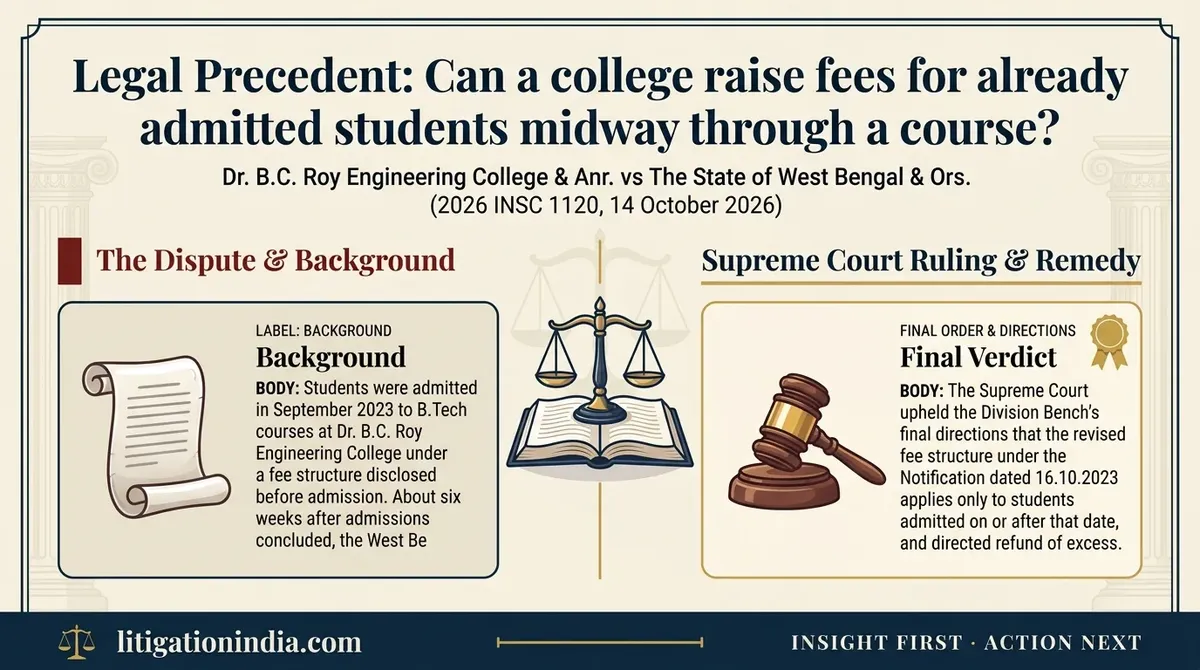
Supreme Court Bars Midstream Fee Hike for Already Admitted Engineering Students — infographic summary

What this case means

This case concerned whether a self-financing engineering college in West Bengal could raise fees midway through a course for students already admitted. The Supreme Court held that fees determined before admission cannot be changed during the course, except in exceptional circumstances. The judgment directs fee fixation committees to decide fees for the entire course duration before admissions begin.

What the Supreme Court held

The Supreme Court upheld the Division Bench's final directions that the revised fee structure under the Notification dated 16.10.2023 applies only to students admitted on or after that date, and directed refund of excess fees collected from earlier-admitted students. The Court directed that fee fixation committees must notify fees for the entire course before admissions begin, and that variation midstream is permissible only in exceptional circumstances. High Courts are directed to exercise judicial review to ensure these committees function efficiently.

Case: Dr. B.C. Roy Engineering College & Anr. vs The State of West Bengal & Ors. (2026) Citation: 2026 INSC 1120

Want the full legal reasoning, citations and case documents?

Read the full judgment analysis
fee revision midstream
self-financing colleges
AICTE Regulations 1994
professional education fees
West Bengal engineering colleges
fee fixation committee
TMA Pai Foundation
P.A. Inamdar
National Education Policy 2020
WBJEE 2023
Dr. B.C. Roy Engineering College
certainty in fee structure
Regulation 7(1), 7(4), 7(5), 7(6), 7(7), All India Council for Technical Education (Norms and Guidelines for Fees and Guidelines for Admission in Professional Colleges) Regulations, 1994
Paragraphs 18.13 and 18.14, National Education Policy 2020