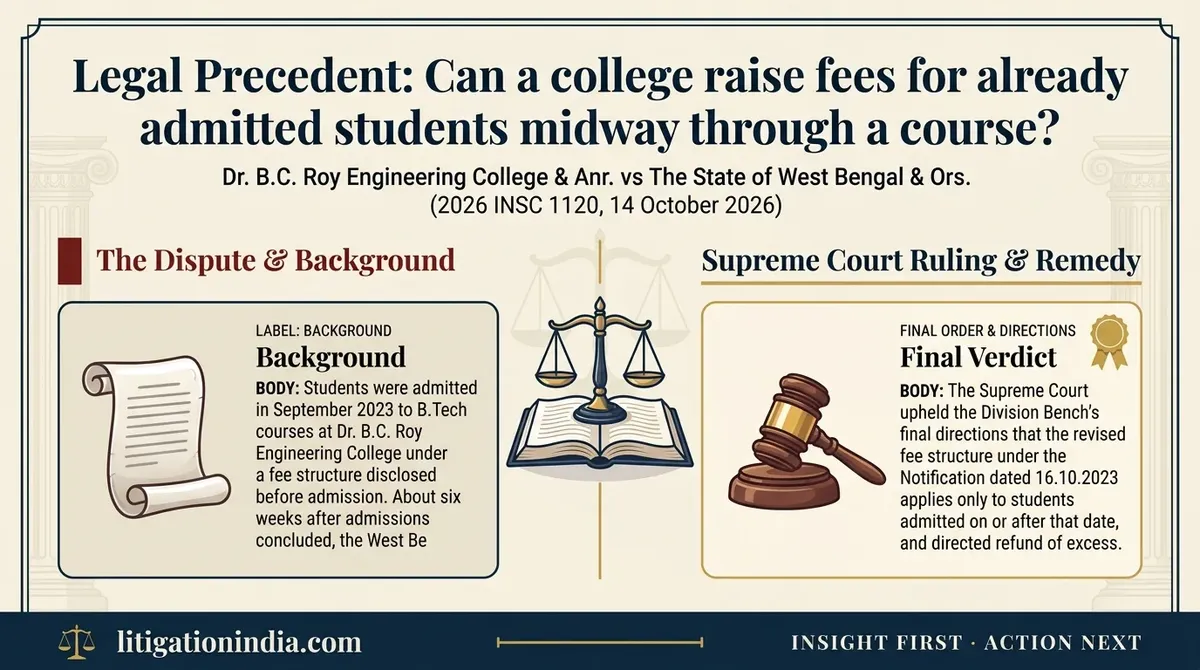
Full text of the judgment
Text extracted from Dr. B.C. Roy Engineering College & Anr. vs The State of West Bengal & Ors.. For the authoritative version refer to the Supreme Court of India's official website.
2026 INSC 1120 1
REPORTABLE IN THE SUPREME COURT OF INDIA CIVIL APPELLATE JURISDICTION CIVIL APPEAL NO. OF 2026 @ SPECIAL LEAVE PETITION (C) NO. 13237 OF 2026
DR. B.C. ROY ENGINEERING COLLEGE & ANR. ...APPELLANT (S)
THE STATE OF WEST BENGAL & ORS. …RESPONDENT(S)
WITH CIVIL APPEAL NOS. OF 2026 @ SPECIAL LEAVE PETITION (C) NOS. 13690-13691 OF 2026 WITH CIVIL APPEAL NO. OF 2026 @ SPECIAL LEAVE PETITION (C) NO. 16753 OF 2026 WITH CIVIL APPEAL NOS. OF 2026 @ SPECIAL LEAVE PETITION (C) NOS. 14913-14914 OF 2026 WITH CIVIL APPEAL NOS. OF 2026 @ SPECIAL LEAVE PETITION (C) NOS. 15617-15618 OF 2026 WITH CIVIL APPEAL NO. OF 2026 @ SPECIAL LEAVE PETITION (C) NO. 16677 OF 2026
Digitally signed by KAPIL TANDON Date: 2026.10.14 16:37:23 IST Reason: Signature Not Verified
J U D G M E N T 1. Leave granted. 2. The question for our consideration is whether fee payable for professional education through self-financing Higher Education Institutions (HEIs) can be changed midstream. While we uphold the decision of the division bench of the High Court,1 that the fees determined at the commencement of the course cannot be varied midstream, for the independent and separate reasons to follow, we have held that determination of the fee payable for professional education such as medicine, engineering, pharmacy etc. conducted by professional HEIs involves balancing of two legitimate interests. Firstly, the interest of students and their parents in fixation of a reasonable fee, as also the certainty about the quantum and the time. Secondly, the interest of selffinancing HEIs in securing adequate resources for developing necessary infrastructure and provide quality education. Pursuant to the judgments of this Court in TMA Pai Foundation and Others v. State of Karnataka and Others,2 and P.A. Inamdar and Others v. State of Maharashtra and Others,3 fee fixation committees constituted for determining the appropriate fee payable must be given institutional status. They are
1 Common judgment and order dated 23.03.2026 passed by the Calcutta High Court in MAT No. 268 of 2026, FMA No. 284 of 2026, and FMA No. 288 of 2026, reported as Tanushri Mondal and Others v State of West Bengal and Others, 2026 SCC OnLine Cal 2382. 2 (2002) 8 SCC 481. 3 (2005) 6 SCC 537.
virtually the regulatory bodies for determining the appropriate fee and must therefore perform their duties with efficiency, expertise and integrity. As they perform an important public function, their actions are subject to review. Facts 3. The West Bengal Joint Entrance Examinations (‘WBJEE’) 2023 was conducted on 30.04.2023 for admissions to engineering colleges in West Bengal with respect to courses commencing from the 2023-24 Academic Year (‘AY’). WBJEE results were declared on 26.05.2023. Parallelly, results of the Joint Entrance Examination (Main) (‘JEE (Main)’) were also declared, and candidates were ranked in order of merit with respect to both examinations, with both sets of scores and ranks for admission to engineering colleges under the counselling process. 4. The West Bengal Joint Entrance Examinations Board, a statutory body, conducted the WBJEE Centralised Counselling between July- August 2023. After conclusion of the counselling process, candidates reported to their allocated colleges, had their documents verified, and, upon deposit of fees, their admission processes were concluded. In September 2023, the Respondents-Students were admitted as students of Bachelor of Technology (‘B.Tech.’) courses, for the 2023-27 cohort, at the Dr. B.C. Roy Engineering College (‘the Appellant-College’), a self-
financing college affiliated to the Maulana Abul Kalam Azad University of Technology. 5. It is important to note that the prospectus of the Appellant-College had a specific clause stating that, “fee structure is subject to change from time to time as per Government decision.” The following is a simplified version of the per-semester fee structure that was applicable to students who had joined the 2023-27 cohort: For B. Tech. (CSE/IT/ECE) Academic Year Tuition Fee Total (Without Hostel) Total (With Hostel) 2023-24 ₹44,000/- ₹71,050 + ₹46,450 ₹1,06,050 + ₹79,450 2024-25 ₹45,100/- ₹47,550/- ₹85,350 + ₹80,550 2025-26 ₹46,200/- ₹50,650 + ₹48,650 ₹88,450 + ₹81,650 2026-27 ₹47,300/- ₹49,750/- ₹87,550 + ₹82,750 For B. Tech. (EE/ME/CE/CSD/CSE(AIML)/CSE(DS)) Academic Year Tuition Fee Total (Without Hostel) Total (With Hostel) 2023-24 ₹40,000/- ₹67,050 + ₹42,450 ₹1,02,050 + ₹75,450 2024-25 ₹41,000/- ₹43,450/- ₹81,250 + ₹76,450 2025-26 ₹42,000/- ₹46,450 + ₹44,450 ₹84,250 + ₹77,450 2026-27 ₹43,000/- ₹45,450/- ₹83,250 + ₹78,450
6. About one-and-a-half months after admissions closed, the Department of Higher Education, Government of West Bengal issued a Notification dated 16.10.2023 revising the upper ceiling of fees chargeable by self-financing professional colleges, such as the Appellant-College, allowing them to enhance their fees to a maximum of ₹1,10,000/- per annum per student. The Notification made this new arrangement applicable from the 2023-24 AY itself. The text of the Notification is reproduced hereinbelow for ready reference:
“No. 466-Edn-(T)/10M-04/2004 (Part IV) Date: 16.10.2023
NOTIFICATION
Regarding the fees of Under Graduate Engineering & Technology, Pharmacy and Architecture Programmes conducted by the Private Self-financing Engineering & Technology, Pharmacy and Architecture Colleges of this State, the Governor is pleased to order that the Fees Structure for the Programmes conducted by the Private Self-financing Engineering & Technology, Pharmacy and Architecture Colleges of this State will be continued for at least four (04) years for B. Tech and B. Pharm courses and five (05) years for B. Arch courses w.e.f. 2023-2024 academic session.
Now, the details of Fees Structure stipulated in 2023-24 academic year are enumerated in this order.
Accordingly, the Tuition fees and other fees for the students to be admitted in the 1st year of under Graduate Engineering & Technology, Pharmacy and Architecture Courses and Students admitted through lateral entry in the Self-financing Engineering & Technology, Pharmacy and Architecture Colleges in the State with effect from the academic year 2023-2024 are given here under:- I) Maximum Annual Tuition Fee will be Rs. 1,10,000/- per annum per Student.
II) In addition to the prescribed tuition fees, Institutes may charge development fees not exceeding 15% of the prescribed tuition fees for future expansion and development of the Institute. III) Besides Tuition Fees as prescribed above, the Selffinancing Colleges may charge the following fees from the students admitted with effect from the academic year 2023- 2024. a) Maximum onetime Admission Fee of Rs. 10,000/- for entire Course period. b) Library-cum-Book-Bank Fee not exceeding Rs. 6,000/for the entire course period. c) Students Welfare, Sports & Games Fee not exceeding Rs. 1,000/- annually. d) A reasonable amount as Refundable Caution Money. e) Fees charged by the University for Welfare of students and Development. f) Other usual University Fees like Registration Fee, Examination Fee, etc. IV) Professional Colleges which have obtained Autonomous Status, have earned NBA accreditation (Program wise)/NAAC/NIRF ranking from the National level Regulatory Authority/Authorities at the time of their admission process can charge a maximum 10% additional tuition fees above the prescribed maximum fees for the said Programme(s). Such additional fees can be charged from the students for entire duration of the Program. V) Colleges have to implement the West Bengal Freeship Scheme (WBFS) as per the Govt. Order issued from time to time in this regard. VI) No capitation fee in any form or kind can be demanded or realized from the students for admission or continuation of the study in the colleges or for any other reason, either directly or indirectly. VII) No college shall demand or charge any other fee of compulsory nature except fees prescribed in the Para-I to IV of this Order. VIII) In case of any violation or deviation from any condition of this order, the State Government shall take appropriate action. IX) The Private Self Financing Engineering & Technology/Pharmacy/Architecture colleges shall submit the college specific audited annual accounts and annual administrative reports to the Registrar of the affiliating University and the Director of Technical Education at the earliest.
X) The Affiliating University MAKAUT will conduct and evaluate Academic Audit and Performance to ensure that the desired quality of education is available in and provided by the said self financing colleges and will submit report to the State Government at a regular interval for the purpose of suitable Ranking System for self financing Engineering & Technology/Pharmacy/Architecture colleges in the State.
This Notification is issued with the approval of the Competent Authority in the Higher Education Department and in supersession of all previous orders and/or Notifications issued by this Department on this subject and will take effect from the date of notification.”
7. The genesis of this 2023 Notification lay in a belated fee revision exercise, with the delay being the reason for the entire controversy. 8. On 15.11.2019, the State Government had constituted an Expert Committee to assess and make recommendations on fees payable by students for undergraduate professional courses in West Bengal. The Expert Committee had consulted a range of stakeholders, including selffinancing professional colleges, and recommended that the upper ceiling of fees chargeable be enhanced. The Expert Committee’s recommendation was considered and adopted by the Fee Structure Committee on 09.06.2023 and forwarded to the State Government for necessary action. Thus, after a hiatus of seven years since the last fee revision exercise, the Notification was issued in 2023 and a new fee arrangement for self-financing professional colleges put in place. 9. Pursuant to the Notification, the Appellant-College, on 15.12.2023, i.e., after classes for the semester were well underway, revised the fee structure for the 2023-27 cohort, raising the per semester tuition fee. In
addition to this upward revision of the tuition fee, the Appellant-College also imposed a new “development fee”, payable by each student on a per semester basis. The revised fee structure was made applicable from January 2024, i.e., second semester onwards. The resultant impact of the revised structure was a 37.5% increase in the fees payable by each student. A simplified version of the revised fee structure is presented in the following table: For B. Tech. (CSE/IT/ECE) Academic Year Tuition Fee Total (Without Hostel) Total (With Hostel) 2023-24 ₹60,500/- ₹1,01,625 + ₹72,025 ₹1,36,625 + ₹1,05,025 2024-25 ₹60,500/- ₹72,025/- ₹1,12,025 + ₹1,07,025 2025-26 ₹60,500/- ₹74,025 + ₹72,025 ₹1,14,025 + ₹1,07,025 2026-27 ₹60,500/- ₹72,025/- ₹1,12,025 + ₹1,07,025 For B. Tech. (EE/ME/CE/CSD/CSE(AIML)/CSE(DS)) Academic Year Tuition Fee Total (Without Hostel) Total (With Hostel) 2023-24 ₹55,000/- ₹95,300 + ₹65,700 ₹1,30,300 + ₹98,700 2024-25 ₹55,000/- ₹65,700/- ₹1,05,700 + ₹1,00,700 2025-26 ₹55,000/- ₹67,700 + ₹65,700 ₹1,07,700 + ₹1,00,700 2026-27 ₹55,000/- ₹65,700/- ₹1,05,700 + ₹1,00,700
10. Aggrieved by this fee hike during the 2023-24 AY, students made representations to the Appellant-College seeking a rollback of the revised fee structure. When the Appellant-College did not accede to this demand, the students filed writ petitions before the Calcutta High Court challenging the Notification and the Appellant-College’s revised fee structure.4 During the course of the writ proceedings, the students abandoned their challenge to the Notification and confined their contest to the legality and validity of applying the revised fee structure to students admitted in the 2023-24 AY for the 2023-27 courses. 11. Before the High Court, the students’ principal contention was that the Appellant-College’s upward fee revision was in violation of Regulation 7 of the All India Council for Technical Education (Norms and Guidelines for Fees and Guidelines for Admission in Professional Colleges) Regulations, 1994 (‘AICTE Regulations 1994’). Regulation 7 reads as follows: “Regulation 7. Fee. — (1) Tuition and other fees for professional college shall be determined by a State Level committee. (2) The Council shall constitute a standing committee for each State to fix ceiling on the fees chargeable for individual courses by a professional college or class of professional colleges, as the case may be. The Standing committee shall consist of the following members namely:— (i) Vice-Chancellor of a University in a State, to be nominated by the State Government. (ii) Secretaries, Department of Technical Education and Department of Finance of the respective State, ex-officio.
4 WPA Nos. 13054, 26400, and 3028 of 2024.
(iii) Two economists or experts in cost accountancy with background of institutional financing, to be nominated by the Council. (iv) Member-Secretary not below the rank of Joint Secretary or Director of the respective State Government, to be nominated by the State Government. (3) The members referred to in clauses (i), (iii), (iv) shall hold office for a period of three years from the date of their nomination. (4) The Committee shall give an opportunity to the professional colleges to place such material, as they think relevant in determining the tuition fee and other fees. The fee shall be fixed once in every three years or at such longer intervals, as the Committee may think appropriate. (5) The fees chargeable in professional colleges shall be determined on the basis of estimation of expenditure of the professional college for its efficient function. The committee shall take the items specified in the Annexure to these regulations, into account while determining the tuition fee and other fees to be charged by a professional college. The committee may in its directions take into consideration a reasonable return on capital investment with reference to the investment made and determine the fees accordingly. While calculating the fees, the estimates of recurring expenditure shall be based on at least the last two years audited figures of recurring expenditure of the college and projected requirement for next three years. (6) No professional college shall be entitled to receive from the student any other payment or amount, or whatever name it may be called in addition to the fee fixed by the committee for a free seat or payment seat. (7) A professional college shall send intimation to the competent authority in advance the fees chargeable for the entire course commencing from the academic year for which admissions shall be made. The total fees shall be divided into the number of years, or as the case may be, the number of semesters of study for a course. In the first instance, fees only for the first year or semester shall be collected. The fee chargeable by a Professional College shall be subject to the ceiling fixed by the Standing committee.” (emphasis supplied)
12. Proceedings before the High Court: The Learned Single Judge, by his judgment dated 15.01.2026,5 dismissed the writ petitions, holding that neither the Notification approving upward revision of the fees for the 4-year B.Tech and B.Pharm courses commencing from 2023-24 AY nor Regulation 7(7) of the AICTE Regulations 1994 treated the fee structure as indivisible. Referring to the explicit clause of the Appellant-College’s prospectus prescribing that “fee structure is subject to change from time to time as per Government decision”, the Learned Single Judge held that there was no legal infirmity in the revision of the Appellant-College’s fee structure. While dismissing the writ petitions, the Learned Single Judge also held that writ jurisdiction cannot be invoked to avoid a contractual obligation. 13. Aggrieved, the students filed writ appeals before a Division Bench of the Calcutta High Court. 14. The Division Bench formulated three issues: (i) whether Regulation 7(7) of the AICTE Regulations 1994 was violated by the Notification, (ii) the purport of the Appellant-College’s original fee structure, and (iii) whether the Notification was applicable to already admitted students. 15. Differing with the conclusions drawn by the Learned Single Judge, the Division Bench accepted the students’ submission that Regulation
5 Reported as Gourab Kumar Sadhu and Others v State of West Bengal and Others, 2026 SCC OnLine Cal 390.
7(7) contemplated an en bloc fixation of fees for the entire course. Further, interpreting the language of the Appellant-College’s original fee structure, it concluded that the fee arrangement was intended to continue for the full duration of the 2023-27 courses. With respect to the applicability of the revised fee structure under the Notification, the Division Bench held that it would be applicable to students admitted on or after 16.10.2023 and those of subsequent batches, e.g., the 2024-28 cohort. The Division Bench was of the view that applying the revised fee structure to alreadyadmitted students would give the Notification retrospective effect contrary to its explicit text. It further invoked the doctrines of equity and estoppel as the students had relied on the fee information made available by the Appellant-College at the time of admission. Finally, while applying the revised fee schedule vis-à-vis students admitted after 16.10.2023, the Division Bench further directed a refund of the enhanced fee collected from students admitted prior to that date. The relevant portion of the Impugned Judgment is as follows: “75. Accordingly, MAT No. 268 of 2026, FMA No. 284 of 2026 and FMA No. 288 of 2026 are partially allowed on contest, thereby setting aside the impugned judgments dated January 15, 2026, passed in WPA No. 26400 of 2024, WPA No. 13054 of 2024 and WPA No. 3028 of 2024 respectively, with the following findings/directions: (I) The impugned Notification, bearing no. 466-Edn- (T)/10M-04/2004 (Part IV) dated October 16, 2023, is read down to be applicable for the academic year 2023-24 onwards, at least for four years in respect of B.Tech and B. Pharm courses and five years for B.Arch. courses, only in respect of students who were admitted or shall be admitted
on and from October 16, 2023 onwards. However, the impugned Notification shall not apply to students whose admission process for the academic session 2023-2027, starting from the academic year 2023-2024, stood completed before October 16, 2023. (II) The revised fee structures published in terms of the impugned Notification dated October 16, 2023 by the respondent no. 10-College and all other colleges coming under the umbrella of the said Notification are hereby quashed and set aside to the limited extent insofar as those apply to the students of such colleges whose admission process stood concluded before October 16, 2023 and shall be applicable only to those students who were or shall be admitted on and from October 16, 2023. (III) Any action taken in terms of the impugned Notification shall stand reversed, insofar as the candidates whose admission process stood concluded before October 16, 2023 are concerned. (IV) Additional amounts, if any, collected from any such student (whose admission process stood concluded before October 16, 2023) in terms of revised fee structures framed pursuant to the impugned Notification dated October 16, 2023, shall be refunded by the respondent no. 10-college and all other colleges standing on similar footing to the respective students who have paid such additional amounts, before commencement of the next semester. (V) Alternatively, such additional amount shall be adjusted with the fees payable by the aforementioned students (whose admission process stood concluded before October 16, 2023) for the next semester in terms of the fee structure prevailing prior to the impugned Notification; in the event, even after such adjustment with the next semester fees, a part of the additional amounts paid by such students still remains unrefunded, such balance amounts shall be refunded by the concerned colleges to the concerned students within one month from the commencement of such next semester.”
16. Aggrieved by the judgment of the Division Bench, the Appellant- College and other self-financing professional colleges, represented by the Association of Professional Academic Institutes, West Bengal, are in appeal before us.
17. We have heard Mr. Jaideep Gupta, Mr. Harin Raval, and Mr. Rauf Rahim, learned Senior Advocates for the Appellants, and Mr. Sanjay R. Hegde, learned Senior Advocate for the Respondents. Analysis 18. The determination of fees payable for professional education imparted through self-financing higher educational institutions involves three legitimate interests which must coordinate and operate together. The first is the interest of students and parents in certainty and predictability about the reasonable fee payable for the course. The second is the interest of self-financing educational institutions in securing adequate resources for providing quality education and also for the future development of the institution. The third is the societal interest, represented by the fee fixation committees and the concerned government, to ensure fixation of reasonable and appropriate fee, and also the appropriate timeframe for effective and efficient implementation.
Interests of Students and Teachers 19. An empirical study based on data collected by the National Statistical Office (‘NSO’) examining the socio-economic and institutional
factors determining household expenditure on professional higher education in India6 suggested that: “The annual average household expenditure on higher education in India is Rs.26,400, which accounts for 17.3% of the total annual household consumption expenditure in 2017-2018. Fees accounted for 61.2%, and non-fee spending constituted 38.8% of the overall spending. Although this is the picture for overall higher education, we notice a significant difference in household spending between general and professional courses. Students pursing professional courses spent remarkably higher on their education (483% more) than those attending general courses. Households spend around 46.7% and 9.7% of their annual consumption expenditure if one of their children is pursuing a professional course and general course, respectively, marking a huge difference. This is largely due to higher fees charged (particularly in private institutions) in professional courses such as engineering, management, medicine and law. Estimates reveal that the fee charged in professional courses is reported to be 711% more than in general courses.”7
Thus, the aforesaid study reveals that students pursuing professional courses spend remarkably higher amount on their education and the estimates reveal that fee charged in professional courses is reported to be 711% more than the general courses. 20. For the overwhelming majority of households, the fee payable for a professional course constitutes a substantial part of the family’s income and savings; it is not a matter of incidental expenditure. The parents make
6 Pradeep Kumar Choudhury and Amit Kumar, ‘How Much do Households Spend on Professional Higher Education in India? Results from a National Survey’ (2022) 16(1) Indian Journal of Human Development 77. 7 ibid 83.
the provision for payment of fee payable for the professional courses with the aspiration that their children will acquire better qualifications, secure better opportunities, and build a future that may be better than their own. Many students and families also depend on educational loans to finance professional higher education. 21. It is a matter of good governance for the state and its regulatory bodies to create an ecosystem in which there is certainty about the financial obligation that students and their families need to undertake for acquiring professional qualifications. Adverse variations in financial commitment, and the insecurities that it may create, will impact the student and the family, and, in the long run, have an adverse effect on the quality and character of the professionals that are in the making. We are of the opinion that it is not difficult to formulate a scheme through which such uncertainties can be avoided. Participation of Private Enterprise in Nation Building and the Need to Secure Their Interests
22. Our nation’s demand for high-quality professional education cannot realistically be sustained exclusively through public resources. In this backdrop, private enterprise contributes meaningfully in building our nation’s higher educational system. The role of such private enterprise in
higher educational institutions is recognised in TMA Pai Foundation and Others v. State of Karnataka and Others,8 wherein this Court held “48. Private education is one of the most dynamic and fastest-growing segments of post-secondary education at the turn of the twenty-first century. A combination of unprecedented demand for access to higher education and the inability or unwillingness of the Government to provide the necessary support has brought private higher education to the forefront. Private institutions, with a long history in many countries, are expanding in scope and number, and are becoming increasingly important in parts of the world that relied almost entirely on the public sector. 49. Not only has demand overwhelmed the ability of the Governments to provide education, there has also been a significant change in the way that higher education is perceived. The idea of an academic degree as a “private good” that benefits the individual rather than a “public good” for society is now widely accepted. The logic of today's economics and an ideology of privatization have contributed to the resurgence of private higher education, and the establishing of private institutions where none or very few existed before.”
23. This Court also recognised the role of private unaided professional colleges and held as follows: “70. It is well established all over the world that those who seek professional education must pay for it. The number of seats available in government and government-aided colleges is very small, compared to the number of persons seeking admission to the medical and engineering colleges. All those eligible and deserving candidates who could not be accommodated in government colleges would stand deprived of professional education. This void in the field of medical and technical education has been filled by institutions that are established in different places with the aid of donations and the active part taken by public-minded individuals. The object of establishing an institution has thus been to provide technical or professional education to the
8 (2002) 8 SCC 481.
deserving candidates, and is not necessarily a commercial venture. In order that this intention is meaningful, the institution must be recognized….. A college or a professional educational institution has to get recognition from the university concerned, which normally requires certain conditions to be fulfilled before recognition…”
24. Self-financing institutions necessarily require substantial investment in land, buildings, facilities, student services, libraries, equipment, technology, and the like. They must be capable of drawing and retaining competent teaching faculty and other professional staff by providing them suitable, if not attractive, remuneration. After meeting legitimate operational and developmental expenditure, the institutions must also be permitted a reasonable return for sustenance and further development. The Institutional Mechanism for Balancing the Interests of Students and Educational Institutions
25. In pursuance of the judgment of this Court in TMA Pai Foundation (supra) and subsequent decisions,9 a regulatory mechanism has been evolved, as the State Legislatures have enacted laws and the State Governments have constituted regulatory committees to establish an objective mechanism for fixation of fees payable by the students. A regulatory framework relevant for the purposes of the controversy
9 Islamic Academy of Education and Another v. State of Karnataka and Others, (2003) 6 SCC 697; P.A. Inamdar and Others v. State of Maharashtra and Others, (2005) 6 SCC 537.
involved in these appeals is contained in the provisions of AICTE Regulations, 1994 and National Education Policy (‘NEP-2020’). The said regulatory framework operates to pre-empt arbitrary increases in the fee by self-financing higher educational institutions while preserving legitimate fiscal space for self-financing institutions. NEP-2020 also envisions empowering private/self-financing higher educational institutions to set the fees for their programmes through a fair regulatory mechanism. The relevant extract of the NEP-2020 reads as under: “18.13. All HEIs - public and private - shall be treated on par within this regulatory regime. The regulatory regime shall encourage private philanthropic efforts in education. There will be common national guidelines for all legislative Acts that will form private HEIs. These common minimal guidelines will enable all such Acts to establish private HEIs, thus enabling common standards for private and public HEIs. These common guidelines will cover Good Governance, Financial Stability & Security, Educational Outcomes, and Transparency of Disclosures. 18.14. Private HEIs having a philanthropic and publicspirited intent will be encouraged through a progressive regime of fees determination. Transparent mechanisms for fixing of fees with an upper limit, for different types of institutions depending on their accreditation, will be developed so that individual institutions are not adversely affected. This will empower private HEIs to set fees for their programmes independently, though within the laid-out norms and the broad applicable regulatory mechanism. Private HEIs will be encouraged to offer freeships and scholarships in significant numbers to their students. All fees and charges set by private HEIs will be transparently and fully disclosed, and there shall be no arbitrary increases in these fees/charges during the period of enrolment of any student. This fee determining mechanism will ensure
reasonable recovery of cost while ensuring that HEIs discharge their social obligations.”10 (emphasis supplied)
26. It is noteworthy that NEP-2020 articulates a commitment to ensure that there is no arbitrariness in the increase of fees in respect of professional courses. It also contains a clear articulation of a policy position against unjustified increases in the fee during a period of students’ enrolment. 27. The real question is whether the institutions and regulatory committees entrusted with this responsibility are discharging their functions efficiently and within a timeframe that gives meaningful certainty to students, parents, and educational institutions alike. 28. The fee fixation committees established pursuant to this Court’s direction in Islamic Academy and PA Inamdar are discharging an important function. It is necessary for the High Courts to ensure that these bodies are in a position to effectively and efficiently perform their obligations, as their recommendations have a direct bearing on the aspiring students’ access to higher educational opportunities and the participating private enterprises’ interest in establishing world-class institutions. In the context of the compelling need to institutionalize the
10 ‘National Education Policy 2020’ (Ministry of Human Resource Development, Government of India) paras 18.13 and 18.14.
functioning of such bodies and the important role which High Courts exercise in ensuring that these bodies function effectively, this Court in Lifecare Innovations Pvt. Ltd. and Another v. Union of India and Others11 held: “22. While exercising judicial review of administrative action in the context of Statutes, laws, rules or policies establishing statutory or administrative bodies to implement the provisions of the Act or its policy, the first duty of constitutional courts is to ensure that these bodies are in a position to effectively and efficiently perform their obligations. This approach towards judicial review has multiple advantages. In the first place, while continually operating in the field with domain experts, these bodies acquire domain expertise, the consequence of which would also be informed decision-making and consistency. Further, the critical mass of institutional memory acquired by these bodies will have a direct bearing on the systematic development of the sector and this will also help handling polycentric issues. Thirdly, while continuously being on the field, and having acquired the capability of making real-time assessments about the working of the policies, these bodies will be in a position to visualize course correction for future policymaking.
23. Shifting the focus of judicial review to functional capability of these bodies is not to be understood as an argument for alternative remedy, much less as a suggestion for judicial restraint. In fact, this shift is in recognition of an important feature of judicial review, which performs the vital role of institutionalizing authorities and bodies impressed with statutory duties, ensuring they function effectively and efficiently. The power of judicial review in matters concerning implementation of policy objectives should transcend the standard power of judicial review to issue writs to perform statutory duty and proceed to examine whether the duty bearers, the authorities and bodies constituted properly and also whether they are functioning effectively and efficiently. By ensuring institutional integrity we achieve our institutional objectives. Further, effective
11 2025 SCC OnLine SC 436.
and efficient performance of the institutes can reduce unnecessary litigation.”
29. Institutional efficiency is not a matter of administrative convenience. It is an essential component of fair and effective regulation. Certainty for the students, sustainability for the institution, and efficiency in the regulatory process are not competing objectives; they are complementary elements of a sound system of professional education. The question, therefore, is not whether a fee revision can take place, but the method and manner in which it is undertaken, concluded, and put into effect. 30. A conjoint reading of Regulations 7(1), 7(4), and 7(5) of the AICTE Regulations 1994 makes it clear that: (a) a revision of fees is permissible only through the recommendation of the Committee, (b) it can be revised only with a minimum gap of 3 years from the date of revision, (c) the revision can only be on the recommendations based on estimated expenditure of the professional colleges for efficient functioning, and (d) while calculating the fees, the estimates of recurring expenditure shall be based on at least the last two years audited figures of recurring expenditure of the college and projected requirement of next three years. 31. Revised fees represent the cost of education determined at the relevant point of time. If such cost is not recovered from the students at the relevant time and is deferred to future batches, an inevitable revenue deficit would certainly arise and will either have a cascading effect on
future batches or adversely affect the economic viability of the institution. It will have its own fallout on the infrastructure, quality of lecturers and professors, and also adversely affect student welfare. It is therefore necessary to have periodic and effective revision of the fee payable as per the regulations. In undertaking such revision, it is also necessary to adopt and apply the principle of certainty with respect to the fees payable for the professional course into which the student is admitted. This normative principle is recognised in the AICTE Regulations 1994. 32. Institutional efficiency compels fee fixation committees to make recommendations well in advance and the competent authorities to take decisions well before the commencement of the admission process. The committee should examine the relevant costs, including infrastructure, faculty remuneration, maintenance, technology, statutory requirements, and other legitimate expenditure, make a reasonable assessment of foreseeable increases in such costs over the duration of the course, and make recommendations so that the competent authorities take the decision before the commencement of the course. A student entering a four-or five-year professional programme should ordinarily know, at the very threshold, the financial liability that they or their family is undertaking. Such advance determination promotes transparency, enables informed choice, and facilitates financial planning. This does not mean that the fee
structure must remain incapable of adjustment in every conceivable circumstance. Costs may increase unexpectedly because of extraordinary economic conditions, statutory changes or other circumstances which could not reasonably have been anticipated. A narrowly defined mechanism may therefore be provided to accommodate such exceptional circumstances. But such adjustment must remain an exception and cannot become a substitute for timely assessment and proper institutional planning. 33. The larger principle is thus one of certainty through efficient regulation. The fee fixation committees must function as continuing institutions, capable of anticipating costs, undertaking periodic assessments, and making timely decisions. Its processes should be structured so that the fee determination is completed before admissions commence and, as far as reasonably possible, covers the entire duration of the professional course. 34. We may advert to the facts of the cases in hand. The fee for professional courses in West Bengal was last revised in the 2016-17 AY. The fee fixation committee and the State Government acted inefficiently inasmuch as they failed to ensure the completion of revision exercise in time for 2023-27 courses. A fresh revision of fee was undertaken after seven years vide notification dated 16.10.2023. The Appellant-College
adopted the revised fee on 15.12.2023. The Appellant-College cannot be blamed for its anxiety in implementing the revised fee structure after conclusion of the first semester. The problem arising out of mid-stream implementation of revised fee schedule could have been avoided, if the State Government had issued the notification dated 16.10.2023 before the commencement of academic session 2023-2024. We can take judicial notice of the fact that functioning of the fee fixation committees as of now and the State’s action on their recommendations have often not been up to the mark. The instant case demonstrates such one case. 35. While we uphold the conclusions drawn by the Division Bench of the High Court for the independent reasons that we have given, we are not in agreement with the reasoning of the Division Bench that the implementation of the revised fee structure for the 2023-27 course will have the effect of giving retrospective obligation to the Notification dated 16.10.2023. We are also of the opinion that the approach adopted by the High Court in applying principles of equity and estoppel against the Appellant-College on the basis of its admission brochure is not sustainable in law. To that extent, the judgment of the High Court is set aside. 36. For the reasons stated above, we partly allow Civil Appeals arising out of SLP (C) No. 13237, 13690-13691, 16753, 14913-14914, 15617-
15618 and 16677 of 2026, against the judgment and order of the High Court in Writ Appeal MAT Nos. 268, 288, 284 of 2026, and direct that; (i) The fee fixation committees have a statutory foundation and have an important public purpose to subserve. The institutionalisation of these committees is necessary for realising the interests of aspiring students for professional higher education and also for establishing credible higher and professional educational institutions through private enterprise. High Courts will exercise due judicial review to ensure that these committees perform their duties with institutional efficiency, expertise, and integrity. (ii) The regulatory regime for fixation of fees, as contemplated in the decisions of this Court, AICTE Regulations, National Education Policy, 2020, coupled with principles of certainty, necessitates the relevant authorities to notify fee payable for the entire course before a student takes admission. There must be certainty about the fee liability; variation in the fee payable during the subsistence of the course is permissible only in exceptional instances such as unforeseen increase in the expenditure. (iii) The final directions of the High Court, as reproduced in paragraph 15 of this judgment with respect to applicability of the revised fees under Notification dated 16.10.2023 are affirmed. The
Appellant-College will take necessary steps for complying with those directions. 37. Pending applications, if any, are disposed of. The parties shall bear their own costs. ………………………………....J. [PAMIDIGHANTAM SRI NARASIMHA]
………………………………....J. [ALOK ARADHE]
NEW DELHI; OCTOBER 14, 2026.