
All insights

Can a plaint be amended after trial commencement to challenge a compromise decree affecting suit property?

Supreme Court Allows Plaint Amendment to Challenge Compromise Decree Affecting Suit Property

The appellants, legal heirs of the original plaintiff, sought to amend their civil suit plaint to challenge a compromise decree in a different suit that affected the disputed property. The Supreme Cou

Litigation India Editorial 12 October 2026 1 min read 2026 INSC 1112

Story

Case at a glance1 / 6

Supreme Court of India

Plaint Amendment Allowed to Challenge Compromise Decree on Suit Property

Haramani Sahoo and Others v. Lalita Nayak and Others | 2026 INSC 1112

Court: Supreme Court of India | Date: October 12, 2026Bench: Justice B.V. Nagarathna and Justice R. MahadevanArea of Law: Civil Law — Amendment of Pleadings under Order VI Rule 17 CPCIssue: Whether post-trial plaint amendment to challenge a compromise decree affecting suit property should be allowed
Supreme Court Allows Plaint Amendment to Challenge Compromise Decree Affecting Suit Property · 2026 INSC 11122026-10-12T18:57:17.979197+00:00
The legal question2 / 6

Can a Plaint be Amended After Trial to Challenge a Compromise Decree?

Rival arguments under Order VI Rule 17, CPC

  • Appellant: Discovery of compromise decree was belated; plaintiff was not a party to T.S. No.105/1998; certified copies obtained only on 22.06.2020.
  • Appellant: Amendment does not introduce a new cause of action but addresses the same suit property; real controversy test is satisfied.
  • Respondent: Amendment filed after 14 years; repeated amendments are protracting proceedings and should not be permitted.
  • Respondent: Challenge to compromise decree is barred by Order XXIII Rule 3A CPC; claim is also ex facie time-barred.
Supreme Court Allows Plaint Amendment to Challenge Compromise Decree Affecting Suit Property · 2026 INSC 11122026-10-12T18:57:17.979197+00:00
The Court's reasoning3 / 6

How the Court Decided: Step-by-Step Reasoning

Applying Order VI Rule 17 CPC proviso and established precedents

  1. 1Step 1: Trial had commenced, so proviso to Order VI Rule 17 applies — due diligence must be shown.
  2. 2Step 2: Plaintiff was not a party to T.S. No.105/1998; certified copies obtained only on 22.06.2020 — due diligence satisfied.
  3. 3Step 3: Amendment concerns the very suit property; it enlarges but does not fundamentally alter the suit's nature.
  4. 4Step 4: Limitation and Order XXIII Rule 3A are arguable, not ex facie clear — left open for trial Court.
  5. 5Step 5: To avoid fragmented proceedings and inconsistent findings, amendment allowed subject to costs of Rs. 25,000.
Supreme Court Allows Plaint Amendment to Challenge Compromise Decree Affecting Suit Property · 2026 INSC 11122026-10-12T18:57:17.979197+00:00
Statutory comparison4 / 6

Key Factors: Allowing vs. Refusing Amendment

Based on principles from Revajeetu Builders and LIC v. Sanjeev Builders as applied in this case

FactorAppellant's Position (Supports Amendment)Respondent's Position (Opposes Amendment)
Due diligenceCompromise decree discovered only on 22.06.2020; plaintiff not party to T.S. 105/1998Written statement filed in 2017 disclosed plot details; no full explanation of delay
Nature of suitAmendment addresses same suit property; no new independent controversy14-year delay; repeated amendments; fundamentally enlarges scope
LimitationDate of knowledge disputed; arguable question for trial CourtFresh suit on amended claims time-barred on date of application
Order XXIII Rule 3APlaintiff not party to compromise proceedings; question openCompromise decree cannot be challenged by separate suit or amendment
PrejudiceRespondents can file additional written statement; costs imposedAdditional pleadings cause hardship at advanced stage of proceedings
Court: Prejudice from additional pleadings can be addressed by costs and additional written statements, not by refusing the amendment.
Supreme Court Allows Plaint Amendment to Challenge Compromise Decree Affecting Suit Property · 2026 INSC 11122026-10-12T18:57:17.979197+00:00
The verdict5 / 6

The Court's Final Decision

Civil Appeal No. 13681 of 2026 — Allowed

  • The Fact: Plaint amendment sought after trial commencement to challenge a compromise decree affecting the suit property, of which plaintiff had no prior knowledge.
  • The Law: Order VI Rule 17 CPC proviso requires due diligence; amendment permissible if it does not fundamentally alter the suit's nature; limitation and Order XXIII Rule 3A left open.
  • The Result: Trial Court and High Court orders set aside; amendment allowed subject to Rs. 25,000 costs; all substantive questions reserved for trial Court.
Orders of trial Court and High Court set aside; amendment allowed subject to costs of Rs. 25,000 payable within two weeks.
Supreme Court Allows Plaint Amendment to Challenge Compromise Decree Affecting Suit Property · 2026 INSC 11122026-10-12T18:57:17.979197+00:00
Why it matters6 / 6

What This Means for Ordinary People

Practical significance of the judgment

  • If you discover a crucial document or decree affecting your property only after your case begins, courts can allow you to update your case.
  • Delay alone does not kill your right to amend; what matters is whether you acted diligently once you found the new information.
  • Challenging a compromise decree in an ongoing property suit is not automatically barred; the trial Court will decide after full hearing.
  • Refusing an amendment can cause greater injustice by forcing multiple separate lawsuits over the same land, risking contradictory outcomes.
Courts must be liberal in allowing amendments that resolve the real dispute, especially where new facts are discovered despite due diligence.
Supreme Court Allows Plaint Amendment to Challenge Compromise Decree Affecting Suit Property · 2026 INSC 11122026-10-12T18:57:17.979197+00:00
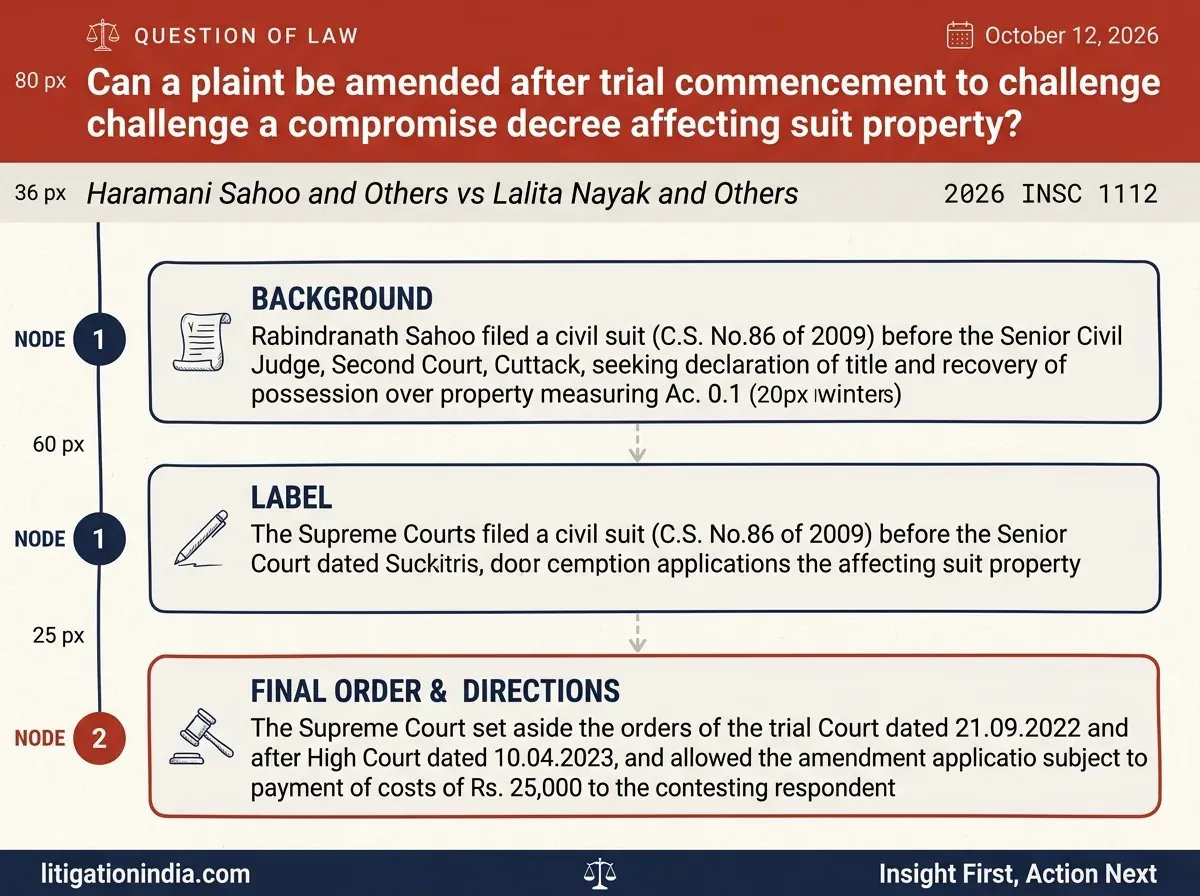
Supreme Court Allows Plaint Amendment to Challenge Compromise Decree Affecting Suit Property — infographic summary

What this case means

The appellants, legal heirs of the original plaintiff, sought to amend their civil suit plaint to challenge a compromise decree in a different suit that affected the disputed property. The Supreme Court allowed the amendment, finding due diligence was satisfied and the amendment did not fundamentally alter the suit's nature. The decision clarifies that where limitation is disputed and the amendment addresses the real controversy, courts should take a liberal approach.

What the Supreme Court held

The Supreme Court set aside the orders of the trial Court dated 21.09.2022 and the High Court dated 10.04.2023, and allowed the amendment application subject to payment of costs of Rs. 25,000 to the contesting respondents within two weeks. The appellants were directed to carry out amendments within four weeks thereafter, and respondents were given liberty to file additional written statements within such period as fixed by the trial Court. All questions of limitation, maintainability, applicability of Order XXIII Rule 3A, validity of the compromise decree, title, and possession were left open for the trial Court.

Case: Haramani Sahoo and Others vs Lalita Nayak and Others (2026) Citation: 2026 INSC 1112

Want the full legal reasoning, citations and case documents?

Read the full judgment analysis
Haramani Sahoo
Lalita Nayak
Order VI Rule 17 CPC
amendment of pleadings
due diligence
compromise decree
Order XXIII Rule 3A CPC
limitation
real controversy test
property dispute
2026 INSC 1112
Order VI Rule 17, Code of Civil Procedure, 1908
Order XXIII Rule 3A, Code of Civil Procedure, 1908
Order XXVI Rule 9, Code of Civil Procedure, 1908