Full text of the judgment
Text extracted from Haramani Sahoo and Others vs Lalita Nayak and Others. For the authoritative version refer to the Supreme Court of India's official website.
2026 INSC 1112 1
IN THE SUPREME COURT OF INDIA CIVIL APPELLATE JURISDICTION
CIVIL APPEAL NO. 13681 OF 2026 [Arising out of SLP (C) No. 25635 of 2023]
HARAMANI SAHOO AND OTHERS
… APPELLANT(S)
LALITA NAYAK AND OTHERS
… RESPONDENT(S)
J U D G M E N T R. MAHADEVAN, J.
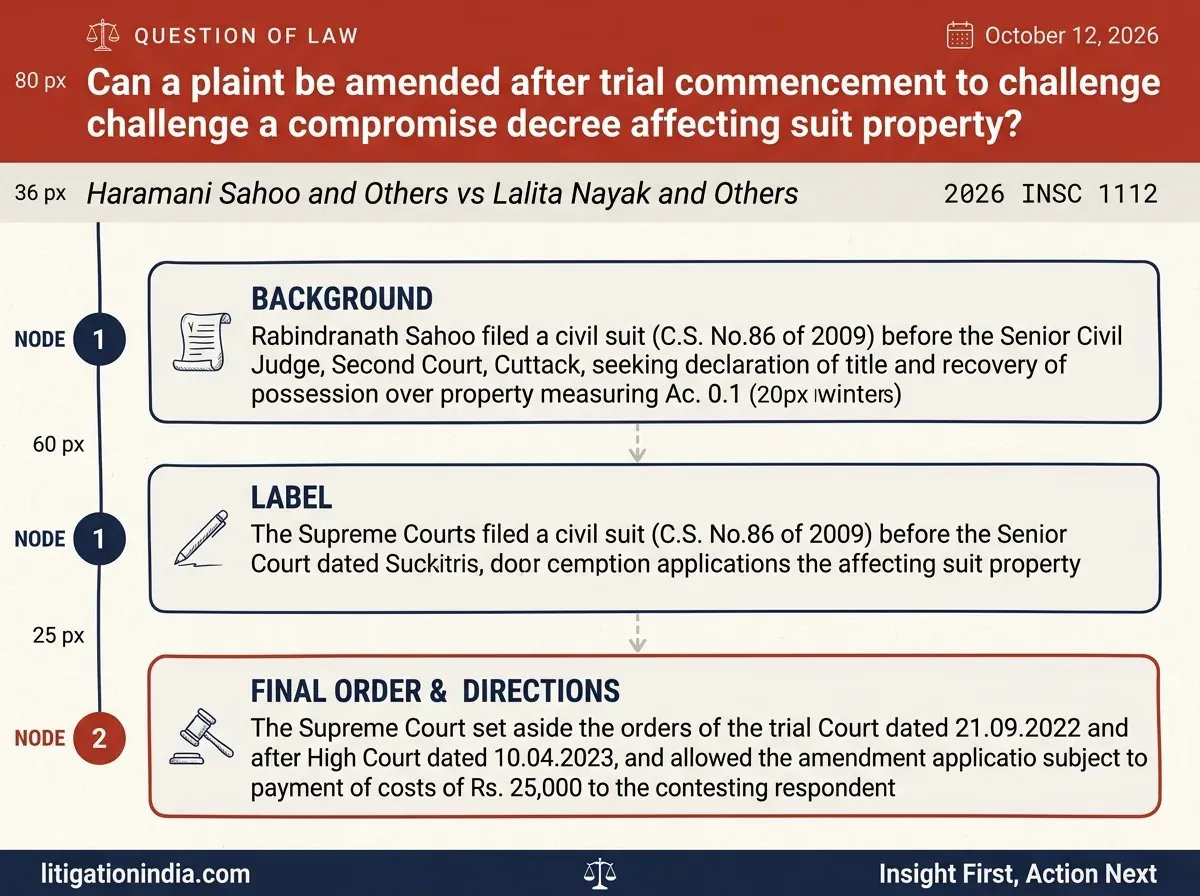
Leave granted. 2. The present Civil Appeal has been preferred against the order dated 10.04.2023 passed by the High Court of Orissa at Cuttack1 in C.M.P. No.1091 of 2022, whereby the High Court declined to interfere with the order dated 21.09.2022 passed by the Senior Civil Judge, Second Court, Cuttack 2 in C.S. No.86 of 2009 and dismissed the said Civil Miscellaneous Petition. 3. The appellants are the legal heirs of the original plaintiff, namely, Rabindranath Sahoo, who instituted C.S. No.86 of 2009 seeking inter alia declaration of his right, title and interest over the suit schedule property, recovery of possession, rectification of the registered sale deeds dated
1 Hereinafter referred to as “the High Court” 2 Hereinafter referred to as “the trial Court” Digitally signed by BORRA LM VALLI Date: 2026.10.12 16:31:32 IST Reason: Signature Not Verified
15.02.1971 and 28.07.1978, under which he had purchased property comprised in Hal Plot No.3370 / 4045 measuring Ac. 0.10 decimals and Hal Plot No.3371 / 4050 measuring Ac. 0.02 decimals, aggregating Ac. 0.12 decimals out of Ac. 0.16 decimals under Hal Khata No.198 published in the year 1986, and other consequential reliefs. 4. According to the appellants, in respect of Hal Plot No.3370 / 4045, sale deeds were successively executed by Defendant No.3 in favour of Defendant No.2 in the year 1976, by Defendant No.2 in favour of Defendant No.1 in the year 2005, and by Defendant No.1 in favour of Defendant No.11 in the year 2015. In respect of Hal Plot No.3371 / 4050, a sale deed was executed by Defendant No.8 in favour of Defendant Nos.9 and 10 in the year 2007. At that stage, the source of title of Defendant No.8 was not known to the original plaintiff. 4.1. Upon Defendant Nos.9 and 10 filing their written statement and disclosing that Plot No.3371 / 4050 under Khata No.1135 / 660 had been recorded in their names, the original plaintiff sought amendment of the plaint. By way of the proposed amendment, it was pleaded that Plot No.3371 / 4050 measuring Ac. 0.16 decimals and corresponding to Sabik Plot No.2761 (part), was vacant land and constituted the exclusive property of Mayadhar Mohapatra, who had acquired the same pursuant to a mutual partition amongst the purchasers under the registered sale deed executed in the year 1940. Defendant
Nos.9 and 10 thereafter filed their additional written statement denying the said averments. 4.2. Subsequently, the original plaintiff filed a further application under Order VI Rule 17 read with Section 151 of the Code of Civil Procedure, 19083, stating that although the Hal Plot numbers and Khata numbers had been disclosed by the defendants in their written statement, the mutation case number had not been mentioned either in the written statement or in the additional written statement. Upon conducting a search in the office of the Tahsildar, Niali, the original plaintiff came to know of a compromise decree passed in T.S. No.105 of 1998, to which he was not a party. He therefore sought to incorporate the foundational pleadings relating to T.S. No.105 of 1998 and also sought a declaration that the final decree passed by the trial Court in the said suit was null and void.
5. During the pendency of the said amendment application, the original plaintiff died and his legal heirs namely the present appellants were brought on record. The trial Court rejected the proposed amendment vide order dated 21.09.2022. Aggrieved thereby, the appellants preferred C.M.P. No.1091 of 2022 before the High Court. By the impugned order dated 10.04.2023, the High Court declined to interfere with the order of the trial Court and dismissed the Civil Miscellaneous Petition. Hence, the present Civil Appeal.
3 For short, “CPC”
6. The learned counsel appearing for the appellants submitted that the matter is complex, involving transactions dating back to the year 1940 and several persons claiming rights in different capacities. It was therefore submitted that having regard to the nature and complexity of the transactions, it was not unusual that despite due diligence, the pleadings required correction and elaboration from time to time. 6.1. It was further submitted that the Tahsildar, Niali in his order dated 31.08.2007 passed in R.P. Case No.998 of 2005, had noticed that there were multiple registered sale deeds in respect of the same property executed by different parties and that the Record of Rights had been corrected by the Tahsildar in individual case proceedings. According to the learned counsel, these circumstances had resulted in considerable confusion, as is evident from the observation of the Tahsildar that he was not in a position to decide the matter and pass any order. It was further submitted that the respondents had also not disclosed the complete particulars of their source of title and that it was only upon a thorough search being undertaken in the office of Tahsildar, Niali, that the original plaintiff came to know of the compromise decree passed in T.S. No. 105 of 1998. Upon obtaining the certified copies of the plaint and final decree passed in the said suit, the original plaintiff came to know that an area of Ac. 0.04 decimals including the suit land measuring Ac. 0.02 decimals in Plot No. 3371 / 4050 had been allotted to Defendant No.8 pursuant to the said compromise decree. It was submitted that the said allotment was illegal and the
circumstances in which the compromise decree came to be passed and the allotment was made were required to be brought on record and adjudicated upon by the trial Court. 6.2. Learned counsel submitted that without considering these relevant aspects, both the trial Court and the High Court erroneously rejected the amendment sought by the original plaintiff and thereafter pursued by the appellants upon being brought on record as his legal heirs. 6.3. Placing reliance on the decision of this Court in A.K. Gupta & Sons Ltd. v. Damodar Valley Corporation 4 , it was submitted that the proposed amendment neither introduces a new case nor sets up a new cause of action, but is necessary to bring on record the real question in controversy between the parties. 6.4. Learned counsel further submitted that while holding that a fresh suit on the amended claims would have been barred by limitation on the date on which the application for amendment was filed, and that the amendment had been sought after an inordinate lapse of time, both the trial Court and the High Court failed to appreciate that the question as to whether the relief sought by way of amendment is barred by limitation has to be examined in the facts and circumstances of each case. It was contended that the power to permit amendment of pleadings can be exercised at any stage of the proceedings where such amendment is necessary for determining the real questions in controversy
4 AIR 1967 SC 96
and in the interests of justice. In support of the said submission, reliance was placed upon the judgment of this Court in Abdul Rehman & another v. Mohd. Ruldu & others5. 6.5. On the aforesaid submissions, learned counsel for the appellants prayed that the orders passed by the trial Court and the High Court be set aside and the amendment sought by the appellants be allowed.
7. Per contra, learned counsel appearing for Respondent Nos.1 and 9 to 11 opposing the present appeal, submitted that the appellants have been protracting the proceedings for years by resorting to repeated applications under Order VI Rule 17 of the CPC. 7.1. Learned counsel traced the history of the litigation and submitted that the present proceedings have to be viewed in the backdrop of the repeated attempts made by the original plaintiff. It was submitted that the original plaintiff, Rabindranath Sahoo, had initially instituted C.S. No.185 of 2007 along with I.A. No.134 of 2007 before the Civil Judge (Second Court), Cuttack, in respect of the subject land. The relief sought therein was one of permanent injunction against Defendant No.1. After due contest, I.A. No.134 of 2007 was dismissed on 24.01.2008. The original plaintiff thereafter preferred F.A.O. No.11 of 2008 before the District Judge, Cuttack, which also came to be dismissed on 24.11.2008. Instead of proceeding with the said suit, the original plaintiff
5 (2012) 11 SCC 341
subsequently sought amendment of the pleadings after filing of the written statement and also enhanced the valuation of the suit, which ultimately came to be numbered as C.S. No.86 of 2009. 7.2. It was further submitted that after filing of the written statement by Defendant No.1, the original plaintiff again amended the pleadings, pursuant to which an additional written statement was filed on 16.07.2011. After several adjournments, the original plaintiff moved an application under Order XXVI Rule 9 of the CPC seeking appointment of a Survey Knowing Commissioner for local investigation of the suit property. The said application was rejected on 13.01.2012 after hearing the parties. 7.3. The learned counsel further submitted that the original plaintiff thereafter amended the plaint by impleading Defendant Nos.7 to 10 and subsequently Defendant No.11 and filed a consolidated plaint. After the newly added Defendant Nos.9 to 11 filed their written statements, the original plaintiff once again moved an amendment application on 19.05.2017, which was allowed subject to costs. It was contended that the present amendment application constitutes yet another attempt to enlarge the scope of the suit. 7.4. The learned counsel submitted that the present amendment application was filed after an inordinate delay of nearly fourteen years from the institution of the suit and after filing of the written statement as well as the additional written statement by the contesting defendants. Such an amendment, particularly at an advanced stage of the proceedings, would, according to the learned
counsel, fundamentally alter the nature and character of the suit and defeat the very purpose of the proviso to Order VI Rule 17 of the CPC. In support of the said contention, reliance was placed upon the judgment of this Court in Basavaraj v. Indira and others6. 7.5. The learned counsel particularly drew attention to the assertion of the original plaintiff that while searching for the status and ownership of the plot referred to in the registered sale deed dated 28.07.1978, he came to know of the compromise decree passed in T.S. No.105 of 1998. It was submitted that the amendment application does not disclose when, in what manner, or in what circumstances such search was undertaken, nor does it disclose when precisely the plaintiff acquired knowledge of the said compromise decree. The learned counsel also referred to the written statements filed by Defendant Nos.9 and 10, wherein particulars relating to Mutation Plot No.3371 / 4050 corresponding to Mutation Khata No.1135 / 660 had been disclosed. It was submitted that the said written statement was filed in the year 2017 and therefore, the original plaintiff was aware of the claim relating to the said plot at least from that point of time. However, no particulars have been furnished as to why, despite the alleged discovery, the matter could not have been raised in the earlier amendment applications. In the absence of a satisfactory explanation for the delay, the appellants ought not to be permitted to introduce a challenge to the compromise decree by way of amendment.
6 2024 INSC 151
7.6. It was further submitted that the proposed challenge to the compromise decree is also subject to the statutory bar contained in Order XXIII Rule 3A of the CPC. According to the learned counsel, the validity of a compromise decree cannot be challenged by way of a separate suit and therefore permitting the appellants to introduce such a challenge by way of amendment to the plaint would amount to allowing them to circumvent the statutory bar contained in the said provision. 7.7. The learned counsel submitted that the proposed amendment including the additional reliefs incorporated in the prayer clause, ought not to be entertained as a fresh suit on the amended claims would be barred by limitation on the date of the amendment application itself. Although limitation may ordinarily be a matter for consideration at the appropriate stage, it was contended that a claim which is ex facie barred by limitation and is sought to be introduced after an inordinate delay ought not to be permitted where it causes prejudice to the opposite party and seeks to reopen rights which have accrued by efflux of time. 7.8. It was finally submitted that the trial Court upon consideration of the entire factual and procedural history, rightly rejected the amendment application and that the High Court by the impugned order dated 10.04.2023, committed no error in declining to interfere with the said order. Learned counsel therefore prayed for dismissal of the appeal.
8. We have considered the rival submissions advanced by learned counsel appearing for the parties and have perused the material placed on record.
9. The controversy before us essentially concerns the permissibility of the amendment sought by the original plaintiff under Order VI Rule 17 of the CPC. For ease reference, the said provision is extracted below: “Amendment of Pleadings. The Court may at any stage of the proceedings allow either party to alter or amend his pleadings in such manner and on such terms as may be just, and all such amendments shall be made as may be necessary for the purpose of determining the real questions in controversy between the parties: Provided that no application for amendment shall be allowed after the trial has commenced, unless the Court comes to the conclusion that in spite of due diligence, the party could not have raised the matter before the commencement of trial.”
10. A plain reading of the aforesaid provision makes it clear that Order VI Rule 17 of the CPC confers a discretionary power upon the Court to permit amendments which are necessary for determining the real questions in controversy between the parties. However, once the trial has commenced, the exercise of such power is subject to the additional requirement that the Court must be satisfied that despite due diligence, the party could not have raised the matter before the commencement of trial. The object of the provision is to enable the Court to effectively and completely adjudicate upon the dispute between the parties, while at the same time, ensuring that a party does not
introduce at a belated stage, matters which could, with due diligence, have been raised earlier.
11. The principles governing the exercise of jurisdiction under Order VI Rule 17 of the CPC are well settled. In A.K. Gupta & Sons Ltd. v. Damodar Valley Corporation (supra), this Court explained that an amendment which introduces a new case or a new cause of action is generally impermissible, particularly where the new claim is barred by limitation. At the same time, where the amendment does not introduce a new cause of action or a different case, but merely sets out a different or additional approach to the same facts, such amendment may be permitted. The Court thus drew a distinction between an amendment introducing a new cause of action and one which merely elaborates or alters the approach to the case already pleaded. 11.1. In Rajesh Kumar Aggarwal & others v. K.K. Modi and others7, this Court held that the “real controversy test” is the basic and cardinal test governing an application under Order VI Rule 17. The Court is required to determine whether the proposed amendment is necessary for deciding the real question in controversy between the parties, while ensuring that such amendment does not cause injustice or prejudice to the opposite party. 11.2. Similarly, in Abdul Rahman and another v. Mohd. Ruldu and others (supra), this Court reiterated that amendments necessary for determining the real
7 (2006) 4 SCC 385
questions in controversy ought ordinarily to be permitted, provided they do not alter the basic nature of the suit. A change in the relief sought does not, by itself, amount to a change in the nature of the suit. The following paragraph from the said judgment is pertinent: “18. We reiterate that all amendments which are necessary for the purpose of determining the real questions in controversy between the parties should be allowed if it does not change the basic nature of the suit. A change in the nature of relief claimed shall not be considered as a change in the nature of suit and the power of amendment should be exercised in the larger interests of doing full and complete justice between the parties.”
11.3. In Revajeetu Builders and Developers v. Narayanaswamy and Sons & others8, this Court held that although the Courts have wide discretion in matters of amendment of pleadings, such discretion must be exercised judiciously and with great care. The Court further culled out certain factors to be taken into consideration while allowing or rejecting an application for amendment, which include the following: “63. On critically analysing both the English and Indian cases, some basic principles emerge which ought to be taken into consideration while allowing or rejecting the application for amendment: (1) whether the amendment sought is imperative for proper and effective adjudication of the case; (2) whether the application for amendment is bona fide or mala fide; (3) the amendment should not cause such prejudice to the other side which cannot be compensated adequately in terms of money; (4) refusing amendment would in fact lead to injustice or lead to multiple litigation;
8 (2009) 10 SCC 84
(5) whether the proposed amendment constitutionally or fundamentally changes the nature and character of the case; and (6) as a general rule, the court should decline amendments if a fresh suit on the amended claims would be barred by limitation on the date of application.”
11.4. In Life Insurance Corporation of India v. Sanjeev Builders Private Limited and another9, this Court, while recognising the liberal approach to amendments, also delineated circumstances in which an amendment may be declined, including where a time-barred claim is sought to be introduced, the nature of the suit is changed, or a valid defence of the opposite party is sought to be taken away. The Court cautioned against adopting a hyper-technical approach and emphasised that amendments which facilitate effective adjudication of the dispute and avoid multiplicity of proceedings ought ordinarily to be permitted, subject to the absence of injustice or prejudice to the opposite party. The following conclusions are apposite: “71.2. All amendments are to be allowed which are necessary for determining the real question in controversy provided it does not cause injustice or prejudice to the other side. This is mandatory, as is apparent from the use of the word “shall”, in the latter part of Order 6 Rule 17CPC. 71.3. The prayer for amendment is to be allowed: 71.3.2. To avoid multiplicity of proceedings, provided (a) The amendment does not result in injustice to the other side, (b) By the amendment, the parties seeking amendment do not seek to withdraw any clear admission made by the party which confers a right on the other side, and
9 (2022) 16 SCC 1
(c) The amendment does not raise a time-barred claim, resulting in divesting of the other side of a valuable accrued right (in certain situations). 71.4. A prayer for amendment is generally required to be allowed unless: 71.4.1. By the amendment, a time-barred claim is sought to be introduced, in which case the fact that the claim would be time-barred becomes a relevant factor for consideration. 71.4.2. The amendment changes the nature of the suit. 71.4.4. By the amendment, the other side loses a valid defence. 71.5. In dealing with a prayer for amendment of pleadings, the court should avoid a hypertechnical approach, and is ordinarily required to be liberal especially where the opposite party can be compensated by costs. 71.6. Where the amendment would enable the court to pin-pointedly consider the dispute and would aid in rendering a more satisfactory decision, the prayer for amendment should be allowed. 71.7. Where the amendment merely sought to introduce an additional or a new approach without introducing a time-barred cause of action, the amendment is liable to be allowed even after expiry of limitation. 71.8. Amendment may be justifiably allowed where it is intended to rectify the absence of material particulars in the plaint. 71.9. Delay in applying for amendment alone is not a ground to disallow the prayer. Where the aspect of delay is arguable, the prayer for amendment could be allowed and the issue of limitation framed separately for decision. 71.10. Where the amendment changes the nature of the suit or the cause of action, so as to set up an entirely new case, foreign to the case set up in the plaint, the amendment must be disallowed. Where, however, the amendment sought is only with respect to the relief in the plaint, and is predicated on facts which are already pleaded in the plaint, ordinarily the amendment is required to be allowed. 71.11. Where the amendment is sought before commencement of trial, the court is required to be liberal in its approach. The court is required to bear in mind the fact that the opposite party would have a chance to meet the case set up in amendment. As such, where the amendment does not result in irreparable prejudice to the opposite party, or divest the opposite party of an advantage which it had secured as a result of an admission by the party seeking amendment, the amendment is required to be allowed. Equally, where the amendment is necessary for the court to effectively adjudicate on the main issues in controversy between the parties, the amendment should be allowed.”
11.5. More recently, in Akkiraju Panduranga Rao and another v. Gunlapally Ranga Rao 10, this Court reiterated that the principal considerations while deciding an application for amendment are, first, whether the amendment is necessary for determining the real question in controversy and secondly, whether it can be allowed without causing injustice or prejudice to the opposite party. The Court further emphasised that while considering an application for amendment, courts should adopt a liberal approach and should not be unduly concerned with technicalities. 11.6. In light of the statutory framework and the principles enunciated above, we may now examine the permissibility of the amendment sought by the original plaintiff.
12. In the present case, there is no dispute that the application for amendment was filed after commencement of the trial and therefore, the proviso to Order VI Rule 17 of the CPC is attracted. The fact that the amendment was sought at a belated stage is, by itself, not determinative. The principal question is whether, the appellants have shown that despite due diligence, the matters now sought to be introduced could not have been raised before the commencement of the trial. The further question is whether the proposed amendment would fundamentally alter the nature and character of the suit.
10 2026 SCC OnLine SC 805
13. As regards the requirement of due diligence, the original suit concerns the right, title and interest in and possession of the very property which forms the subject matter of the proposed amendment. The proposed pleading relating to the compromise decree passed in T.S. No.105 of 1998 arises from the allegation that the said decree affects a portion of the very suit property, namely, Ac. 0.02 decimals comprised in Hal Plot No.3371 / 4050. The case of the original plaintiff is that he was not a party to the said suit and was unaware of the compromise decree. It is stated that only upon obtaining certified copies of the plaint and final decree on 22.06.2020, did he come to know of the compromise in respect of suit plot No.3371 / 4050 measuring Ac. 0.04 decimals along with other properties between Defendant No.8 and others. It is further stated that the written statement filed by Defendant Nos.9 and 10 did not disclose the source of title of their vendors. 13.1. The significance of these circumstances cannot be overlooked. The proposed amendment is not founded upon a transaction or an event wholly unconnected with the subject matter of the suit, but upon a subsequent discovery of a decree which, according to the original plaintiff, has a bearing upon the title to a portion of the very property in dispute. The record indicating that certified copies of the plaint and final decree were obtained on 22.06.2020 is a relevant circumstance in assessing the plea of due diligence. At this stage, it is not necessary for the Court to finally determine whether the plaintiff’s assertion regarding the date of knowledge is ultimately correct. What is required is to
examine whether sufficient explanation has been furnished for not raising the matter before commencement of the trial. 13.2. Having regard to the aforesaid circumstances, we are of the view that the explanation furnished by the appellants cannot, at this stage, be characterised as a mere omission, inadvertence or negligence. The subsequent discovery of the compromise proceedings, coupled with the assertion that the original plaintiff was not a party to those proceedings and that the source of title of the vendors was not disclosed in the written statement, provides a sufficient basis for accepting the plea of due diligence for the purposes of the proviso to Order VI Rule 17 of the CPC. The statutory requirement is therefore satisfied.
14. The next question is whether the proposed amendment fundamentally alters the nature and character of the suit. In our view, it does not. The original suit is founded upon the plaintiff’s claim to title, possession and related reliefs in respect of the suit property. The proposed amendment seeks to place before the Court facts concerning a compromise decree which, according to the original plaintiff, affects a portion of that very property and consequently bears upon the rights claimed in the suit. The proposed amendment may enlarge the factual and legal questions requiring adjudication; however, such enlargement cannot, by itself, be equated with a fundamental alteration of the nature and character of the suit.
14.1. The real inquiry is whether the amendment introduces a distinct and independent controversy having no connection with the original cause of action, or whether it merely brings on record additional facts and consequential reliefs having a direct nexus with the existing controversy. On the facts of the present case, the proposed amendment falls within the latter category. The subject matter of the proposed amendment and the original suit substantially overlap, and the adjudication of the proposed issue would have a direct bearing upon the title and possession claimed in respect of the suit property.
15. The respondents have however urged that the proposed challenge to the final decree passed in T.S. No.105 of 1998 is barred by limitation and by Order XXIII Rule 3A of the CPC. At this stage, we are concerned with the permissibility of the amendment and not with the ultimate merits or maintainability of the reliefs sought to be introduced. The objections raised by the respondents cannot therefore be finally adjudicated upon while deciding the application for amendment, unless the proposed claim is ex facie barred in law.
16. As regards limitation, it is well settled that a claim which is clearly barred by limitation, particularly where its introduction would defeat an accrued right of the opposite party, is a relevant consideration in the exercise of discretion under Order VI Rule 17. At the same time, where the question of limitation is itself arguable and depends upon disputed facts, including the date or manner in
which the plaintiff acquired knowledge of the relevant document or transaction, the amendment need not necessarily be rejected at the threshold. 16.1. In Ragu Thilak D. John v. S. Rayappan and others11, this Court held that where the plea of limitation is arguable, the amendment may be allowed and the question of limitation be left open for determination in the suit. In Sampat Kumar v. Ayyakannu and another12, this Court held that mere delay in seeking amendment is not, by itself, a ground for refusing an amendment. Similarly, in Pankaja and another v. Yellappa (Dead) by LRs and others13, this Court held that there is no absolute rule that an amendment must be rejected merely because the relief sought by way of amendment is alleged to be barred by limitation; the question has to be considered in the facts and circumstances of each case. 16.2. In the present case, the date of knowledge of the compromise decree itself is a matter in dispute and has not been conclusively determined. The material relied upon by the appellants, including the procurement of certified copies of the plaint and final decree on 22.06.2020 is a circumstance requiring consideration. It would therefore be inappropriate to finally determine the question of limitation while considering the application for amendment. The respondents shall remain at liberty to raise the plea of limitation before the trial Court, which shall consider the same in accordance with law.
11 (2001) 2 SCC 472 12 (2002) 7 SCC 559 13 (2004) 6 SCC 415
17. Equally, we do not propose to pronounce upon the applicability or otherwise of Order XXIII Rule 3A of the CPC. Whether the proposed challenge to the compromise decree is maintainable; whether such decree is susceptible to challenge in the manner pleaded; and what legal consequences, if any, flow from the fact that the original plaintiff was not a party to the proceedings in T.S. No.105 of 1998 are matters which are best left for consideration by the trial Court after the pleadings are complete and the parties have had an opportunity to address the same as per law.
18. It is clarified that permitting the amendment does not amount to acceptance of the averments incorporated therein, nor does it confer upon the appellants any declaration or substantive right in respect of the compromise decree. All questions relating to maintainability of the amended reliefs, limitation, the binding nature or otherwise of the decree, the applicability of Order XXIII Rule 3A of the CPC, title, possession and the merits of the respective claims are expressly left open for consideration by the trial Court in accordance with law.
19. The objection as to prejudice also does not warrant rejection of the amendment. The prejudice relied upon by the respondents principally arises from the additional factual and legal issues which they would now be required to meet. Such prejudice can adequately be addressed by permitting the
respondents to file an additional written statement and where necessary, by imposing appropriate costs. The mere fact that an amendment requires the opposite party to meet additional pleadings or issues does not, by itself, warrant refusal of the amendment where the amendment is necessary for a complete and effective adjudication of the controversy.
20. Conversely, refusal of the amendment may result in the controversy concerning title to the same property being fragmented into separate proceedings, with the attendant possibility of inconsistent findings in respect of the same parcel of land. Avoidance of such multiplicity, while preserving the respondents’ right to contest the amended pleadings on all available grounds, is also a relevant consideration in the exercise of jurisdiction under Order VI Rule 17 of the CPC.
21. The decision in Basavaraj v. Indira and others (supra) does not, on the facts of the present case, call for a different conclusion. The present case turns upon its own facts. In particular, the disputed chain of title, the assertion that the original plaintiff was not a party to the compromise proceedings, the subsequent discovery of the compromise decree, and the material indicating that certified copies of the plaint and final decree were obtained only on 22.06.2020, furnish an explanation which cannot, at this stage, be construed as a mere omission or
negligence. As indicated above, the requirement of due diligence contemplated by the proviso to Order VI Rule 17 of the CPC stands satisfied.
22. At the same time, the considerable delay in seeking the amendment and the inconvenience that may be caused to the respondents cannot be disregarded. The appropriate course therefore is to permit the amendment subject to costs, while preserving the respondents’ right to file their additional pleadings and to raise all objections available to them in law.
23. Accordingly, the orders dated 21.09.2022 passed by the trial Court in C.S. No.86 of 2009 and dated 10.04.2023 passed by the High Court in C.M.P. No.1091 of 2022, are set aside. The application for amendment is allowed, subject to payment of costs of Rs.25,000/- (Rupees Twenty Five Thousand) to the contesting respondents within two weeks from today. The appellants shall carry out the consequential amendments in the plaint within a period of four weeks thereafter. The respondents shall be at liberty to file their additional written statement(s) within such period as may be fixed by the trial Court. As observed earlier, all questions relating to limitation, maintainability, the applicability of Order XXIII Rule 3A of the CPC, the validity and binding nature of the compromise decree, title, possession and the merits of the respective claims are left open for consideration by the trial Court in accordance with law.
24. The Civil Appeal is allowed in the aforesaid terms.
25. Pending application(s), if any, shall stand disposed of.
.…………………………J. [B.V. NAGARATHNA]
.…………………………J. [R. MAHADEVAN] NEW DELHI; OCTOBER 12, 2026.