
All insights

Can a widow act as karta to sell inherited property claimed for legal necessity?

Step-Mother Cannot Act as Karta to Sell Property Inherited as Tenant-in-Common

A widow and her four step-daughters inherited land equally under the Hindu Succession Act after the husband/father died intestate. The widow tried to sell part of the property as 'karta' claiming lega

Litigation India Editorial 20 October 2026 1 min read 2026 INSC 613

Story

Case at a glance1 / 6

Supreme Court of India

Widow Cannot Act as Karta Over Co-Heirs' Shares

Darubai & Anr. vs Kamalabai & Ors. | 2026 INSC 613

Court: Supreme Court of India | Date: June 1, 2026Bench: Justice Sanjay Karol and Justice Augustine George MasihArea of Law: Hindu Succession Law — intestate inheritance, tenancy-in-commonDispute: Step-mother vs step-daughters over partition of deceased husband/father's property
Step-Mother Cannot Act as Karta to Sell Property Inherited as Tenant-in-Common · 2026 INSC 6132026-10-20T12:34:45.044785+00:00
The legal question2 / 6

Can a Widow Sell Joint Property as Karta for Legal Necessity?

The two legal questions before the Supreme Court

  • Appellant: As wife of deceased, she managed property as karta and sold a part out of legal necessity for a daughter's marriage.
  • Appellant: The First Appellate Court rightly recognised her karta status and the validity of the sale to Dattatraya.
  • Respondent: All five heirs inherited as tenants-in-common under Section 8 read with Section 19; no one heir can act as karta.
  • Respondent: The widow's sale beyond her 1/5th share was unauthorised; High Court correctly restored the Civil Court decree.
Step-Mother Cannot Act as Karta to Sell Property Inherited as Tenant-in-Common · 2026 INSC 6132026-10-20T12:34:45.044785+00:00
Statutory comparison3 / 6

Joint Tenancy vs Tenancy-in-Common Under Hindu Law

Key distinctions the Court drew to resolve the dispute

Legal SubjectJoint TenancyTenancy-in-Common (Section 19, HSA 1956)
Shares of co-ownersUnascertained; cannot be separately identifiedDefinite and separately identifiable
Rule of survivorshipApplies — survivor absorbs deceased's interestDoes not apply — share devolves on own heirs
Inheritance on deathNo separate succession; passes to co-ownersPasses to the deceased co-owner's own legal heirs
Karta authorityPossible where undivided joint ownership existsNot possible — each heir owns a separate share
Applies under HSA 1956No — Section 19 expressly excludes itYes — mandated by Section 19
Section 19, Hindu Succession Act, 1956: co-heirs always take as tenants-in-common, never as joint tenants.
Step-Mother Cannot Act as Karta to Sell Property Inherited as Tenant-in-Common · 2026 INSC 6132026-10-20T12:34:45.044785+00:00
The Court's reasoning4 / 6

How the Court Reached Its Decision

Step-by-step legal reasoning

  1. 1Step 1: Dajiba died intestate; his wife and four daughters are Class I heirs under Section 8, Hindu Succession Act, 1956.
  2. 2Step 2: Section 19 mandates that co-heirs take per capita as tenants-in-common — each gets a separate, defined 1/5th share.
  3. 3Step 3: CWT v. Chander Sen (1986) confirms property under Section 8 is individual, not HUF/coparcenary property.
  4. 4Step 4: Karta authority presupposes undivided joint ownership — absent here since shares are ascertained and separate.
  5. 5Step 5: Darubai could only deal with her own 1/5th; sale of others' shares to Dattatraya was unauthorised — appeal dismissed.
Step-Mother Cannot Act as Karta to Sell Property Inherited as Tenant-in-Common · 2026 INSC 6132026-10-20T12:34:45.044785+00:00
The verdict5 / 6

The Court's Final Verdict

Darubai & Anr. vs Kamalabai & Ors.

  • The Fact: Dajiba's widow and four daughters are Class I heirs; they inherited his separate property equally as tenants-in-common with 1/5th share each.
  • The Law: Section 8 and Section 19, Hindu Succession Act, 1956, read with CWT v. Chander Sen (1986) 3 SCC 567, mandate individual and defined shares — no karta authority arises.
  • The Result: The civil appeal was dismissed; the Bombay High Court's order restoring the Civil Court decree in favour of the daughters is affirmed.
Appeal dismissed. Darubai held only a 1/5th share and had no authority as karta to sell the daughters' shares.
Step-Mother Cannot Act as Karta to Sell Property Inherited as Tenant-in-Common · 2026 INSC 6132026-10-20T12:34:45.044785+00:00
Why it matters6 / 6

What This Means for You

Practical significance of this judgment

  • Daughters and widows inheriting together under Hindu law each own a separate, defined share — no single heir controls the rest.
  • A widow cannot claim karta status over co-heirs merely because the property came from her deceased husband.
  • Property inherited under Section 8, Hindu Succession Act, 1956 is always personal property — it never automatically becomes joint family property.
  • Any sale of a co-heir's share without their consent is invalid — each heir must independently deal with only their own share.
Under Hindu Succession Act, 1956, co-heirs always own separate shares — no one can sell another's share as karta.
Step-Mother Cannot Act as Karta to Sell Property Inherited as Tenant-in-Common · 2026 INSC 6132026-10-20T12:34:45.044785+00:00
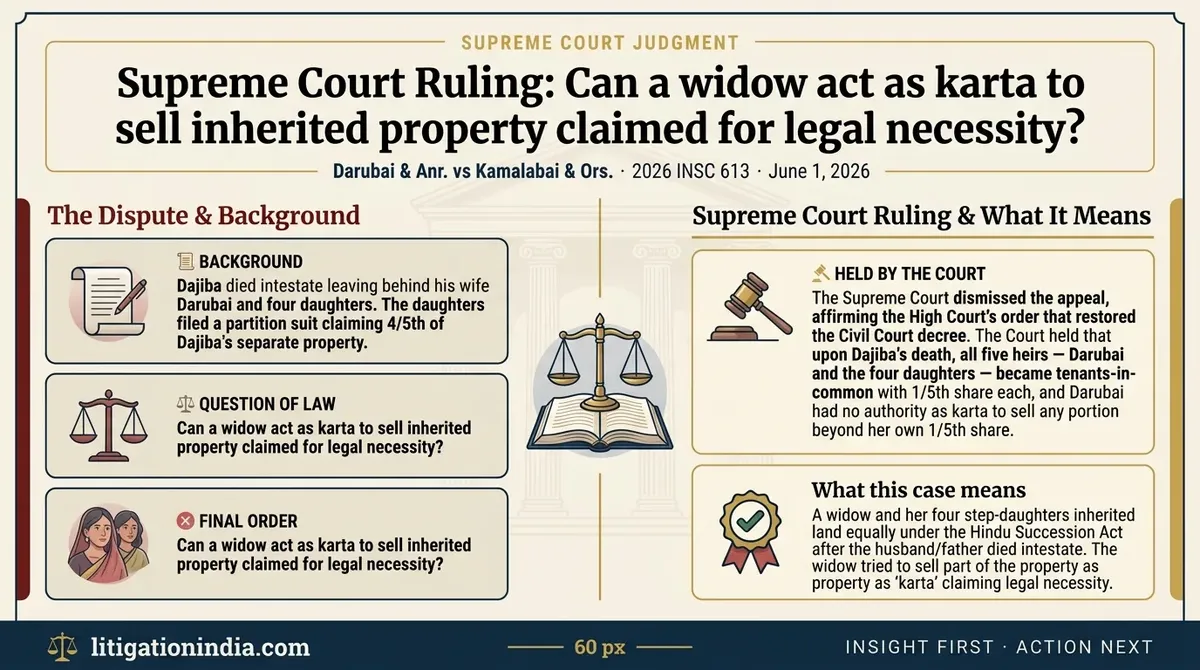
Step-Mother Cannot Act as Karta to Sell Property Inherited as Tenant-in-Common — infographic summary

What this case means

A widow and her four step-daughters inherited land equally under the Hindu Succession Act after the husband/father died intestate. The widow tried to sell part of the property as 'karta' claiming legal necessity. The Supreme Court held that since all heirs took as tenants-in-common with separate 1/5th shares under Section 8 read with Section 19, no one could act as karta over the others' shares.

What the Supreme Court held

The Supreme Court dismissed the appeal, affirming the High Court's order that restored the Civil Court decree. The Court held that upon Dajiba's death, all five heirs — Darubai and the four daughters — became tenants-in-common with 1/5th share each, and Darubai had no authority as karta to sell any portion beyond her own 1/5th share. No order as to costs was made.

Case: Darubai & Anr. vs Kamalabai & Ors. (2026) Citation: 2026 INSC 613

Want the full legal reasoning, citations and case documents?

Read the full judgment analysis
Darubai v Kamalabai
Hindu Succession Act 1956
Section 8
Section 19
tenants-in-common
joint tenancy
karta
legal necessity
partition
step-mother daughters dispute
intestate succession
2026 INSC 613
Section 8, Hindu Succession Act, 1956
Section 10, Hindu Succession Act, 1956