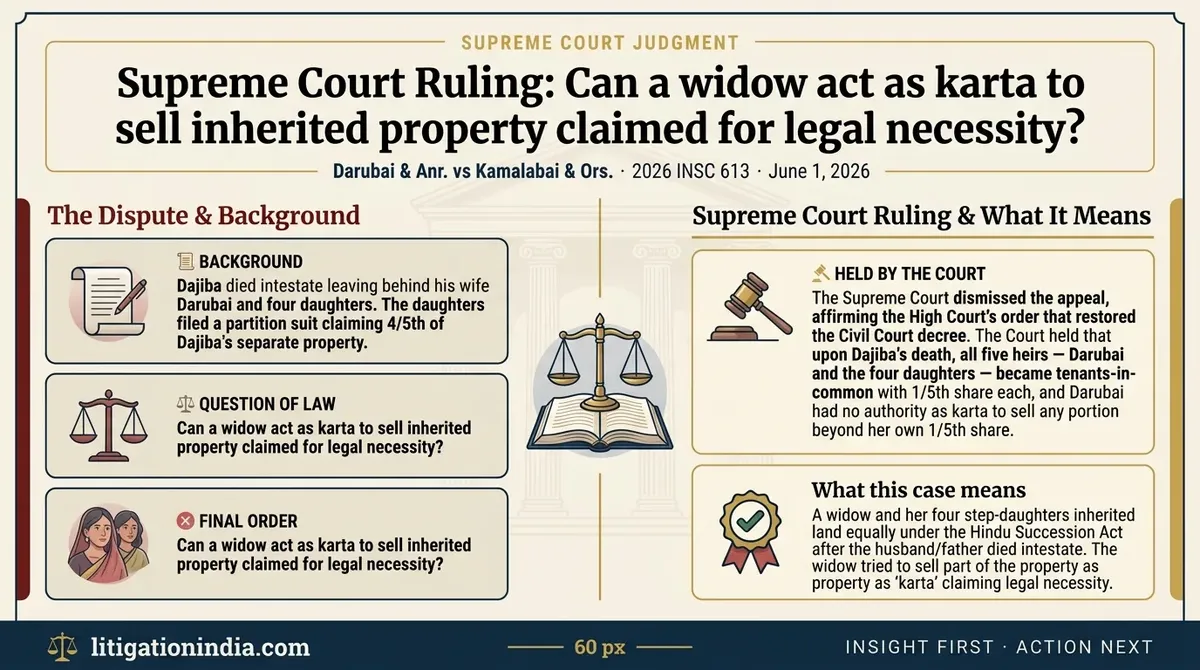
Full text of the judgment
Text extracted from Darubai & Anr. vs Kamalabai & Ors.. For the authoritative version refer to the Supreme Court of India's official website.
2026 INSC 613 C.A. No..of 2026 @ SLP(C)No.13232 of 2022 Page 1 of 12
IN THE SUPREME COURT OF INDIA CIVIL APPELLATE JURISDICTION
CIVIL APPEAL NO. __________________ OF 2026 (@ Special Leave Petition(Civil) No. 13232 of 2022)
DARUBAI & ANR.
… APPELLANT(S)
KAMALABAI & ORS. … RESPONDENT(S)
J U D G M E N T
SANJAY KAROL, J. Leave Granted. Digitally signed by SOURAV PAL Date: 2026.06.01 16:53:45 IST Reason: Signature Not Verified
C.A. No..of 2026 @ SLP(C)No.13232 of 2022 Page 2 of 12
2. The original-defendant is the appellant herein and challenges the final judgment and order dated 31st March 20221 passed by the High Court of Judicature at Bombay, Aurangabad Bench, which overturned the judgment in First Appeal2 passed by the IInd Additional District Judge, Nanded, dated 9th March 1999 which was in turn directed against the judgment in the suit for partition and separate possession3 in which the present respondent was the fourth plaintiff. The suit was decreed in terms of judgment dated 20th October 1995.
3. The four plaintiffs including the present respondent had filed suit for partition and separate possession claiming to be 4/5th owners of the property of late Dajiba, being the successors-in-interest as his daughters along with Darubai, who is the wife of Dajiba. In other words, this dispute which has been ongoing for more than half-acentury is a dispute between a step-mother and daughters. The suit property is “land and two houses located at village Sapti bearing No. 42/B area 2 Acres 23 Gunthas. Bearing No. 83/B Area 0.20 Gunthas, iii) Survey No. 146/C Area 2 Acres and 10, iv) Survey No.
1 Second Appeal No. 1648 of 2005 2 Regular Civil Appeal No. 234 of 1995 3 Regular Civil Suit No. 23 of 1972
C.A. No..of 2026 @ SLP(C)No.13232 of 2022 Page 3 of 12
43/C Area 2 Acres 6 Gunthas, Houses: and two tiled houses out of which one of the house of bounded by East-Road, West-House of Sakharam, North-House of Baba, and South-House of Yadav, ii) which is bounded as, East House of Sakharam, West-Road, North- Road and South-House of Baba”.
4. The Civil Court decreed the suit holding the plaintiffs to be entitled to their ask. The defendant’s reasoning that she had agreed to sell a part of the suit property, as ‘karta’ to one Dattatraya, out of legal necessity for the marriage of one of the plaintiffs, was rejected. The First Appellate Court, reversed the findings and held the legal necessity ground to be established along with the defendant’s right to manage the property and so, the judgment of the Civil Court was interfered with inasmuch as the sale to Dattatraya is concerned, only. In the Second Appeal filed by plaintiff no.4, the judgment of the Civil Court came to be restored. Hence, this appeal.
5. Two facets are not in dispute; the relationship inter parties, and the nature of the property as being the separate property of Dajiba. The question that we are asked to decide is whether the defendant could avail the ground of legal necessity as ‘karta’ of the family, and whether the parties to the lis, would succeed to the suit
C.A. No..of 2026 @ SLP(C)No.13232 of 2022 Page 4 of 12
properties as tenants in common or joint tenants, since their rights flow from Section 8 of the Hindu Succession Act, 19564.
6. The relevant provisions are as follows: “8. General rules of succession in the case of males.―The property of a male Hindu dying intestate shall devolve according to the provisions of this Chapter:― (a) firstly, upon the heirs, being the relatives specified in class I of the Schedule; (b) secondly, if there is no heir of class I, then upon the heirs, being the relatives specified in class II of the Schedule; (c) thirdly, if there is no heir of any of the two classes, then upon the agnates of the deceased; and (d) lastly, if there is no agnate, then upon the cognates of the deceased. … 10. Distribution of property among heirs in class I of the Schedule.―The property of an intestate shall be divided among the heirs in class I of the Schedule in accordance with the following rules:― Rule 1.―The intestate’s widow, or if there are more widows than one, all the widows together, shall take one share. Rule 2.―The surviving sons and daughters and the mother of the intestate shall each take one share. Rule 3.―The heirs in the branch of each pre-deceased son or each pre-deceased daughter of the intestate shall take between them one share. Rule 4.―The distribution of the share referred to in Rule 3— (i) among the heirs in the branch of the pre-deceased son shall be so made that his widow (or widows together)
C.A. No..of 2026 @ SLP(C)No.13232 of 2022 Page 5 of 12
and the surviving sons and daughters get equal portions; and the branch of his pre-deceased sons gets the same portion; (ii) among the heirs in the branch of the pre-deceased daughter shall be so made that the surviving sons and daughters get equal portions. And, “19. Mode of succession of two or more heirs.―If two or more heirs succeed together to the property of an intestate, they shall take the property,― (a) save as otherwise expressly provided in this Act, per capita and not per stirpes; and b) as tenants-in-common and not as joint tenants.”
7. Now, we explore joint tenancy and tenancy in common. In a joint tenancy, all co-owners together constitute ownership. It is governed by the rule of survivorship. When one joint tenant dies, his interest automatically accrues to the surviving co-owners, and not on his own progeny. What this means is that while the joint tenancy subsists, none of the co-owners have a separate inheritable share. For instance, suppose ‘A’ and ‘B’ jointly hold a property under the Mitakshara system,if ‘A’ dies, ‘B’ automatically absorbs ‘A’s interest by survivorship. There is no question of it devolving upon ‘A’s widow or children. Ownership, therefore, continues in the surviving coparcener without any separate succession taking place. As far back as Jogeswar Narain Deo v. Ram Chund Dutt5, it was
5 1896 SCC OnLine PC 5
C.A. No..of 2026 @ SLP(C)No.13232 of 2022 Page 6 of 12
recognized that joint tenancy does not fit into the scheme of Hindu law of succession. Watson LJ held “The principle of joint tenancy appears to be unknown to Hindu law, except in the case of coparcenary between the members of an undivided family.” On the other hand, in tenancy-in-common, each co-owner possesses a distinct, undivided share in the property. Physical possession may remain joint, the ownership of each individual coowner is identifiable and notionally separate. Survivorship has no place in this form of devolution. Upon the death of one co-owner, his share devolves upon his own heirs according to the law of succession. To illustrate, suppose ‘A’ dies intestate leaving behind ‘B’ and ‘C’ as his heirs,under Section 8 read with Section 19 of the HSA, ‘B’ and ‘C’ inherit the property as tenants-in-common. Each acquires a definite share. If ‘B’ later dies, ‘B’s share will devolve upon ‘B’s own legal heirs and will not automatically pass to ‘C’. The difference in the two systems determines the nature of property inherited by a son from his father. Ram Lall J. of the Lahore High Court in 1939 in Nawab Nisar Ali Khan v. Sardar Nawazish Ali Khan6, said thus:
6 1939 SCC OnLine Lah 153
C.A. No..of 2026 @ SLP(C)No.13232 of 2022 Page 7 of 12
“8….The distinction appears to us to lie in this, that where there is a jointness of title, each coparcener is in possession of every portion of the joint property while his share is not defined … Such jointness of title can ordinarily exist in the case of a coparcenary property only, but where the shares of co-owners are known and ascertained, a suit for partition is virtually a suit to enforce a right to a share in joint family property.” A 1957 judgment of the Allahabad High Court, Azizun Nisa v. Assistant Custodian7, aptly captures the distinction between the two concepts discussed above, as follows: “18. This distinction between interest arising out of a right existing in the property and interest arising independently of any such right is very material when one has to consider a property owned by two or more persons. The joint owners may be tenants-in-common or joint tenants (or coparceners). In the case of tenants-in-common they own the property in ascertained or defined shares, but the property has not been divided into the shares. In the case of joint tenancy the joint owners own the property in coparcenary and their shares have not been ascertained and cannot be ascertained except perhaps at the time of partition. In a tenancy-in-common a joint owner's share is inherited on his death by his personal heirs, whereas in a joint tenancy on the death of a joint owner the property belongs to the surviving joint owners. In a tenancy-in-common each joint owner owns or has a right in his share; in a joint tenancy all the joint owners together own the property, a joint owner having no ascertained share cannot be said to own a particular share in it. If a property is owned by two persons in equal shares, each is an owner of a moiety in it and each can have his moiety separated from the other.
7 1957 SCC OnLine All 83
C.A. No..of 2026 @ SLP(C)No.13232 of 2022 Page 8 of 12
But if two persons have an interest in a property, their interests cannot be separated and must always remain joint. There can be extinction of the interest of one of them but not partition. Assets of a company became evacuee property on account of an evacuee share-holder's having an interest, but since the interest extended over the entire property, the entire property must become evacuee property. In the case of tenancy-in-common every joint owner owns his share in the property and his share can always be separated from the others' share. The share owned by him could alone become evacuee property. He could be said to have an interest in the whole property, but since his interest was derived from his share in the property, which share could be partitioned off leaving him without any interest in the rest of the property, it would have been unnecessary and unreasonable to make the whole property evacuee property. So it could not have been intended by the Legislature that the whole should become evacuee property. This intention could be effectuated by interpreting the words “or interest” as suggested above.” In the very same judgment, the Allahabad High Court, has also referred to a case appearing in the All England Law Reports titled In re Schar Midland Bank Executor and Trustee Co. Ltd. v. Damer8 which held as follows: “the unity of the estate and of the interest in the estate enures for the benefit of each and all and….. each and all have one undivided and indivisible property in the subject-matter.”
8 (1950) (2) A.E.L.R., 1069, at p. 1072.
C.A. No..of 2026 @ SLP(C)No.13232 of 2022 Page 9 of 12
The issue stands conclusively settled in CWT v. Chander Sen9. The Court held that when property devolves upon a son under Section 8, the son takes it in his individual capacity and not as karta of his own Hindu Undivided Family. Once again, employing the means of a simple illustration-suppose ‘A’ dies intestate after 1956 leaving behind his son ‘B’. ‘B’ inherits ‘A’s property under Section 8. Under Mitakshara doctrine, ‘B’s son ‘C’ would automatically acquire a birthright in that property, and ‘B’ would hold it as karta of the joint family consisting of himself and ‘C’. However, since the property devolved through Section 8 succession, ‘B’ takes the property as his separate property. ‘C’ acquires no right in it by birth merely because it once belonged to ‘A’. This is in accordance with Yudhishter v. Ashok Kumar10, where Sabhyasachi Mukherji J.,(as he then was) who was also the author of the decision in Chander Sen (supra), reiterated that property inherited under Section 8 does not automatically assume the character of coparcenary property. It was held that descendants of the heir do not acquire rights in such property by birth because the inheritance is individual and statutory in nature.
9 (1986) 3 SCC 567 10 (1987) 1 SCC 204
C.A. No..of 2026 @ SLP(C)No.13232 of 2022 Page 10 of 12
Recent iteration of this understanding was expressed in M. Arumugam v. Ammaniammal11, by this Court as follows: “15. In Appropriate Authority (IT Deptt.) v. M. Arifulla [Appropriate Authority (IT Deptt.) v. M. Arifulla, (2002) 10 SCC 342] the issue which arose was whether the property inherited in terms of Sections 6 and 8 of the Succession Act was to be treated as the property of co-owners or as joint family property. The Court held as follows: (SCC p. 344, para 3) “3. … This Court has held in CWT v. Chander Sen [CWT v. Chander Sen, (1986) 3 SCC 567 : 1986 SCC (Tax) 641] that a property devolving under Section 8 of the Hindu Succession Act, is the individual property of the person who inherits the same and not that of the HUF. In fact, in the special leave petition, it is admitted that Respondents 2 to 5 inherited the property in question from the said T.M. Doraiswami. Hence, they held it as tenantsin-common and not as joint tenants.”
17. There is another reason to take this view. Section 30 of the Succession Act clearly lays down that any Hindu can dispose of his share of the property by will or by any other testamentary disposition which is capable of being so disposed of by him. The Explanation to Section 30 clearly provides that the interest of a male Hindu in Mitakshara coparcenary shall be deemed to be property capable of being disposed of by him within the meaning of Section 30. This means that the lawmakers intended that for all intents and purposes the interest of a male Hindu in Mitakshara coparcenary was to be virtually like
11 (2020) 11 SCC 103
C.A. No..of 2026 @ SLP(C)No.13232 of 2022 Page 11 of 12
his self-acquired property. Furthermore, when we conjointly read Section 30 with Section 19, which provides that when two or more heirs succeed together to the property of an intestate, they shall take the property per capita and as tenants-in-common and not as joint tenants. This also clearly indicates that the property was not to be treated as a joint family property though it may be held jointly by the legal heirs as tenants-in-common till the property is divided, apportioned or dealt with in a family settlement.” (Emphasis supplied) Accordingly, in the context of Section 8, the question of karta-ship ordinarily does not arise merely because the property has come from a paternal ancestor. The heirs succeed as tenants-incommon with definite and separate shares, and the property devolves by succession rather than by survivorship. 8. In view of what has been discussed hereinabove, it has been held that upon the death of Dajiba, Darubai and her four step daughters became tenants-in-common with definite and separate shares, to the tune of 1/5th each. When each of them have separate and identifiable shares, in the considered view of this Court, there arises no question of the defendant acting as karta to sell off a part of the property on account of legal necessity, be it for whatever reason, for she only had the right to do whatever she wished with the 1/5th share of the property that vested with her.
C.A. No..of 2026 @ SLP(C)No.13232 of 2022 Page 12 of 12
9. Consequently, the appeal fails and is dismissed. We only hope that with the finality that accompanies the above conclusion, the long-standing dispute between the parties can, in true effect, be put behind them, by the parties and they can truly move on to a better, more peaceful tomorrow for all those involved. In the circumstances, there shall be no order as to costs. Pending applications, if any, shall be disposed of.
………………………………………J. (SANJAY KAROL)
………………………………………J. (AUGUSTINE GEORGE MASIH)
New Delhi; June 1, 2026