
All insights

Can a court direct State absorption of a lecturer without impleading the State?

State Cannot Be Bound by Relief When Not Impleaded as Necessary Party

A lecturer at a no-grant-in-aid college was terminated, and the High Court directed the State to absorb him in another college. The Supreme Court held that since the State of Maharashtra was never for

Litigation India Editorial 13 October 2026 1 min read 2026 INSC 1118

Story

Case at a glance1 / 6

Supreme Court of India

State Cannot Be Bound Without Being Impleaded as Necessary Party

State of Maharashtra v. Sudhir S/O Motiramji Hiwarkar & Ors. | 2026 INSC 1118

Court: Supreme Court of India; Date: October 13, 2026Bench: Justice Dipankar Datta and Justice Sheel NaguArea: Service Law / Education Law / Writ JurisdictionCollege lecturer terminated from no-grant-in-aid institution sought State absorption
State Cannot Be Bound by Relief When Not Impleaded as Necessary Party · 2026 INSC 11182026-10-13T18:12:06.705881+00:00
The legal question2 / 6

Can a court order State to absorb a lecturer when State was never made a party?

Core legal dispute before the Supreme Court

  • Appellant: State was not impleaded; absorption policy applies only to grant-in-aid colleges per 1997 corrigendum.
  • Appellant: High Court exceeded jurisdiction by directing absorption contrary to executive policy.
  • Respondent: Section 79(4), Maharashtra Universities Act 1994 applies to all affiliated colleges without distinction.
  • Respondent: State was effectively represented through Joint Director and Assistant Government Pleader.
State Cannot Be Bound by Relief When Not Impleaded as Necessary Party · 2026 INSC 11182026-10-13T18:12:06.705881+00:00
The Court's reasoning3 / 6

Court's Step-by-Step Reasoning

From procedural defect to equitable relief

  1. 1Step 1: State of Maharashtra never formally impleaded; only Joint Director added in 2015, 15 years after filing.
  2. 2Step 2: Settled law (Ranjeet Mal, Jagtu, Chaman Lal) requires State as necessary party when financial liability is imposed.
  3. 3Step 3: On merits, 1997 corrigendum limits absorption policy to grant-in-aid colleges; Sudhir never challenged it.
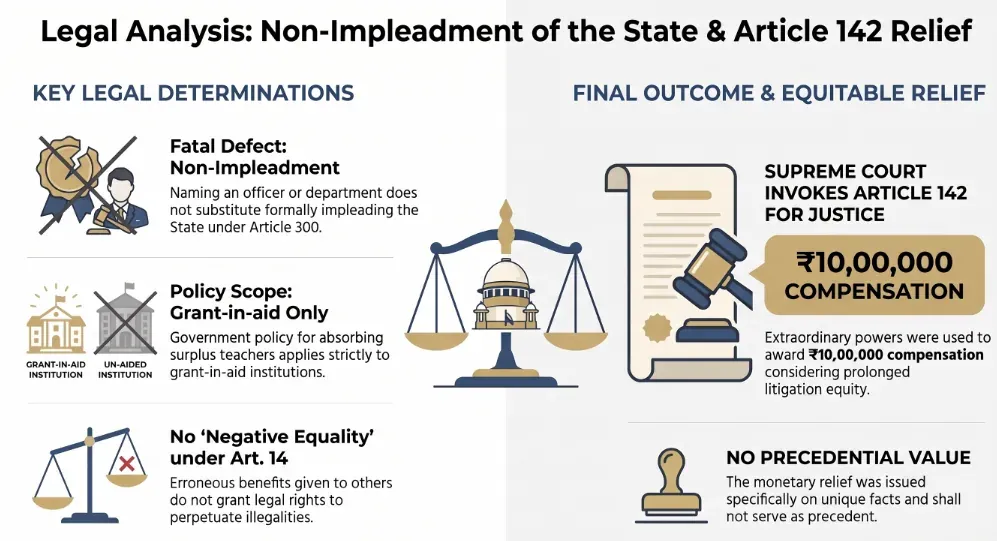
  4. 4Step 4: Parity claim rejected — Article 14 does not permit negative equality based on another's wrongful benefit.
  5. 5Step 5: Article 142 invoked to award Rs. 10 lakh from State given Sudhir's superannuation and decades of unemployment.
State Cannot Be Bound by Relief When Not Impleaded as Necessary Party · 2026 INSC 11182026-10-13T18:12:06.705881+00:00
Statutory comparison4 / 6

Officer Impleadment vs. State Impleadment

Key legal distinction drawn by the Court

Legal SubjectImpleading only an Officer/DepartmentImpleading the State (Article 300)
Effect on proceedingsProcedurally defective when financial liability is soughtCompetent and maintainable
Binding nature of decreeDoes not bind the State even if attained finalityBinds the State as juristic entity
Sufficient for relief?No — officer cannot be equated with the StateYes — State can be directed to comply
Impleading an officer is NOT the same as impleading the State under Article 300 of the Constitution.
State Cannot Be Bound by Relief When Not Impleaded as Necessary Party · 2026 INSC 11182026-10-13T18:12:06.705881+00:00
The verdict5 / 6

Supreme Court's Final Decision

Appeals allowed; Article 142 relief granted

  • The Fact: State never impleaded; Sudhir's college was no-grant-in-aid; he superannuated in November 2025 after 26 years of litigation.
  • The Law: A court cannot fasten financial liability on the State without formally impleading it; absorption policy does not apply to unaided colleges.
  • The Result: Absorption direction set aside; State directed under Article 142 to pay Rs. 10 lakh to Sudhir within 8 weeks.
State to pay Rs. 10 lakh within 8 weeks in full and final settlement; direction not to be treated as precedent.
State Cannot Be Bound by Relief When Not Impleaded as Necessary Party · 2026 INSC 11182026-10-13T18:12:06.705881+00:00
Why it matters6 / 6

What This Means for Ordinary People

Practical significance of the judgment

  • Always make the State a formal party in court if you want a government order enforced — an officer is not enough.
  • Teachers in unaided private colleges have no automatic right to State absorption if the government policy explicitly excludes them.
  • Even if your legal claim fails, the Supreme Court can use Article 142 to award fair compensation when deep injustice would otherwise result.
  • Claiming equality with someone who got an illegal benefit does not give you the same right — courts do not perpetuate illegality.
The State must be formally impleaded before any court can impose financial or administrative liability upon it.
State Cannot Be Bound by Relief When Not Impleaded as Necessary Party · 2026 INSC 11182026-10-13T18:12:06.705881+00:00
State Cannot Be Bound by Relief When Not Impleaded as Necessary Party

What this case means

A lecturer at a no-grant-in-aid college was terminated, and the High Court directed the State to absorb him in another college. The Supreme Court held that since the State of Maharashtra was never formally impleaded in the writ proceedings, this direction could not stand. Using Article 142, the Court awarded Rs. 10 lakh as equitable relief given his superannuation.

What the Supreme Court held

The Supreme Court allowed the appeals and set aside paragraph 26(iv) of the High Court's judgment directing absorption, on grounds of non-impleadment of the State and the inapplicability of the absorption policy to no-grant-in-aid colleges. Invoking Article 142, the Court directed the State to pay Sudhir Rs. 10 lakh within eight weeks in full and final settlement, without disturbing the Management's earlier compensation payment.

Case: State of Maharashtra vs. Sudhir S/O Motiramji Hiwarkar & Ors. (2026) Citation: 2026 INSC 1118

Want the full legal reasoning, citations and case documents?

Read the full judgment analysis
State of Maharashtra
Sudhir Hiwarkar
no grant-in-aid college
surplus lecturer absorption
non-impleadment of State
necessary party
Maharashtra Universities Act 1994
Article 142 Constitution
Article 300 Constitution
writ of mandamus
Article 142, Constitution of India
Article 300, Constitution of India
Article 14, Constitution of India
Section 79(4), Maharashtra Universities Act, 1994