
All insights

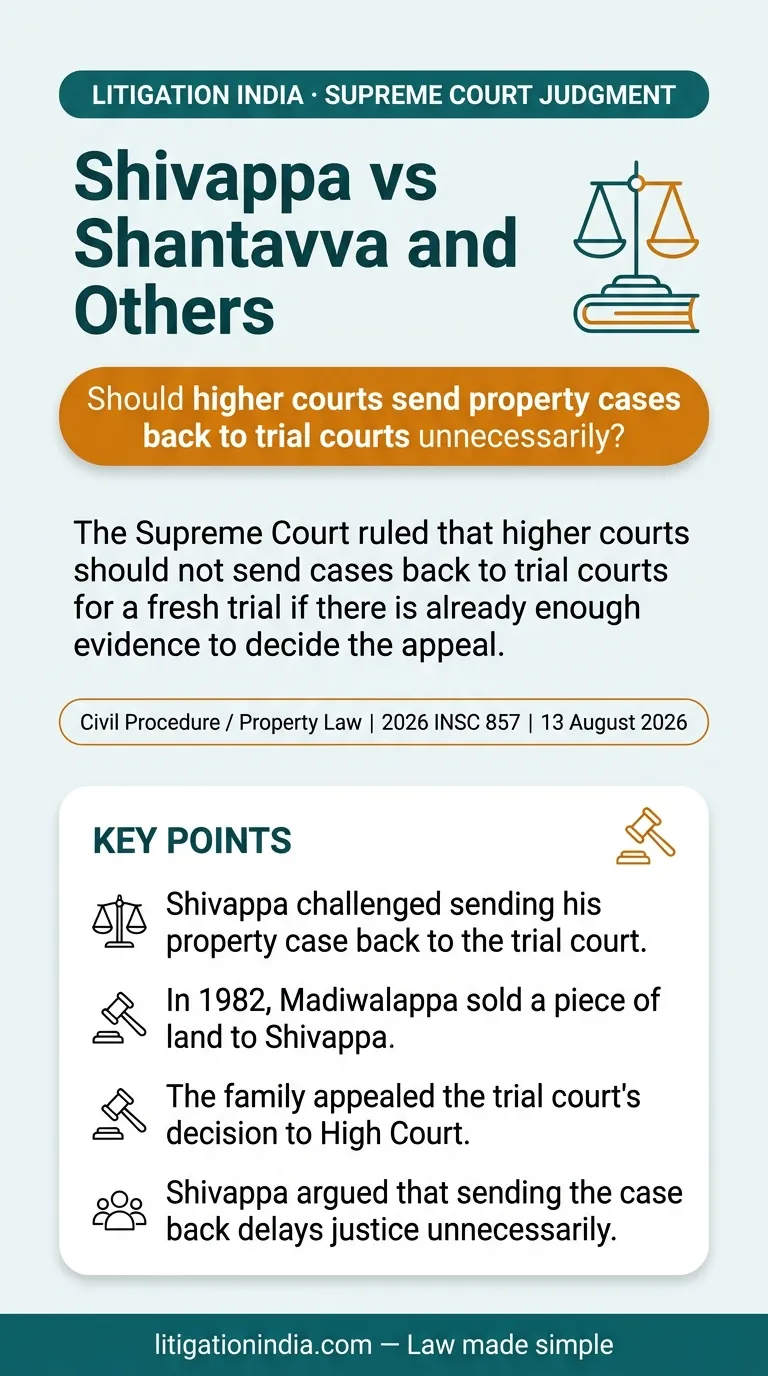
Should higher courts send property cases back to trial courts unnecessarily?

Shivappa vs Shantavva and Others

The Supreme Court ruled that higher courts should not send cases back to trial courts for a fresh trial if there is already enough evidence to decide the appeal.

Litigation India Editorial 15 August 2026 1 min read 2026 INSC 857

Story

Key points1 / 7

Case at a Glance

  • Shivappa challenged sending his property case back to the trial court.
  • The dispute involves a 1982 land sale deed.
  • Supreme Court decided on the rules for remanding cases.
Shivappa vs Shantavva and Others · 2026 INSC 8572026-08-15T15:29:17.643887+00:00
Key points2 / 7

The Background Story

  • In 1982, Madiwalappa sold a piece of land to Shivappa.
  • In 2015, Madiwalappa's family challenged the sale, calling it fake.
  • The Trial Court ruled the sale was valid and legal.
Shivappa vs Shantavva and Others · 2026 INSC 8572026-08-15T15:29:17.643887+00:00
Key points3 / 7

What Did the High Court Do?

  • The family appealed the trial court's decision to High Court.
  • The High Court ordered a fresh trial in the trial court.
  • It wanted new issues framed and more evidence recorded.
Shivappa vs Shantavva and Others · 2026 INSC 8572026-08-15T15:29:17.643887+00:00
Key points4 / 7

Arguments of Both Sides

  • Shivappa argued that sending the case back delays justice unnecessarily.
  • The family claimed new trial was needed to clear up doubts.
  • Pleadings and evidence were already complete in the appeal.
Shivappa vs Shantavva and Others · 2026 INSC 8572026-08-15T15:29:17.643887+00:00
Key points5 / 7

The Supreme Court's Decision

  • Sending cases back (remand) should not be done routinely.
  • It leads to unnecessary delays of decades for litigants.
  • High Court had enough evidence to decide the appeal itself.
Shivappa vs Shantavva and Others · 2026 INSC 8572026-08-15T15:29:17.643887+00:00
Key points6 / 7

What Happens Now?

  • The High Court's remand order is set aside.
  • The appeal is restored before the High Court.
  • High Court will now decide the case on its merits.
Shivappa vs Shantavva and Others · 2026 INSC 8572026-08-15T15:29:17.643887+00:00
Key points7 / 7

Key Takeaway for You

  • Higher courts must not avoid deciding cases when evidence exists.
  • Remanding a case must only be done in rare situations.
  • This rule prevents endless loops in property litigation.
Shivappa vs Shantavva and Others · 2026 INSC 8572026-08-15T15:29:17.643887+00:00
Shivappa vs Shantavva and Others — infographic summary

What this case means

The Supreme Court ruled that higher courts should not send cases back to trial courts for a fresh trial if there is already enough evidence to decide the appeal.

What the Supreme Court held

The Supreme Court set aside the High Court's order sending the case back to the Trial Court. It directed the High Court to decide the case itself on its merits using the existing evidence.

Case: Shivappa vs Shantavva and Others (2026) Citation: 2026 INSC 857

Want the full legal reasoning, citations and case documents?

Read the full judgment analysis
Remand of Case
Property Dispute
Partition Suit
Sale Deed Validity
Limitation Period
Civil Procedure / Property Law
Supreme Court legal news
Supreme Court judgment today
latest Supreme Court news
More in Civil Procedure / Property Law

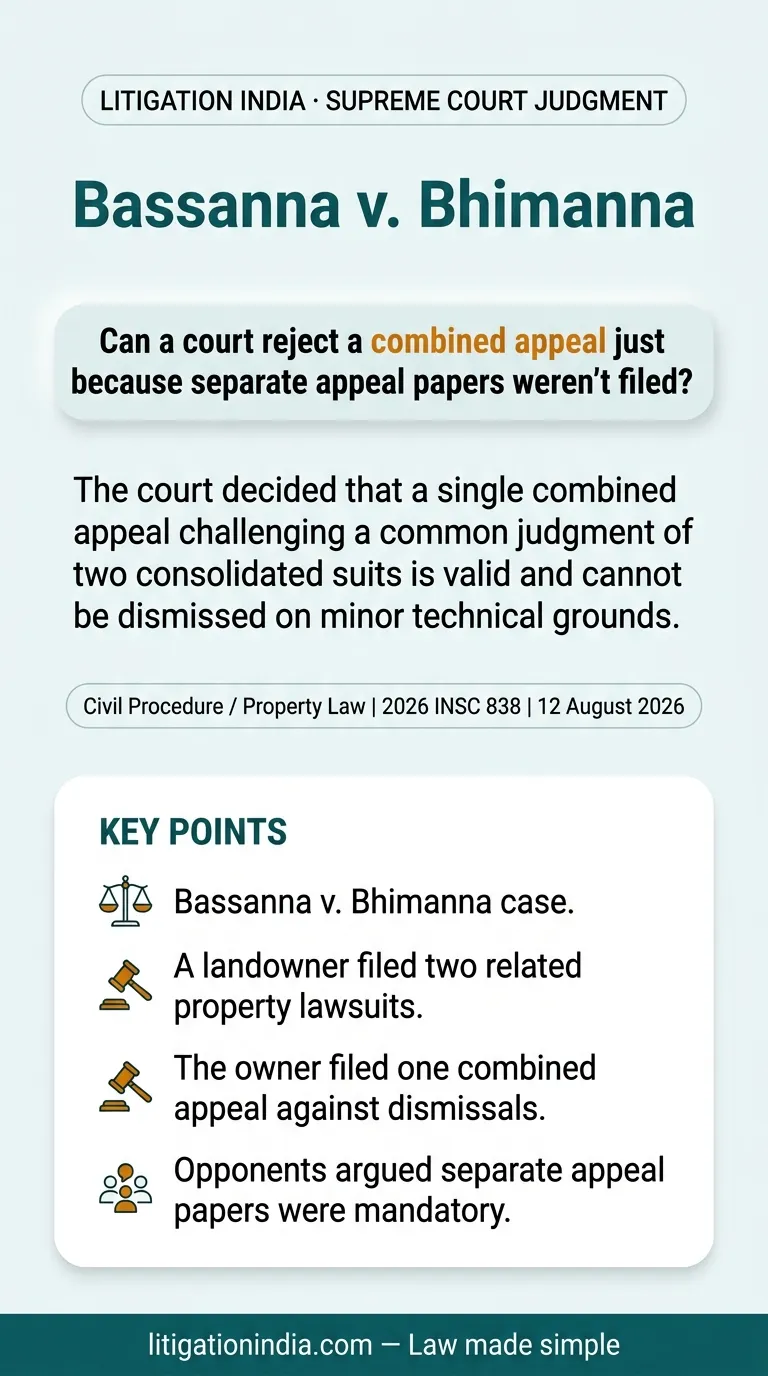
Bassanna v. Bhimanna
Civil Procedure / Property Law
15 Aug 2026

Bassanna v. Bhimanna

The court decided that a single combined appeal challenging a common judgment of two consolidated suits is valid and cannot be dismissed on minor technical grounds.