
All insights

Does receiving a child victim's complaint amount to knowledge of the offence under POCSO?

School Headmistress Cannot Be Discharged for Failing to Report Child Sexual Assault

A minor girl was sexually assaulted at her school in November 2019, but the school headmistress and staff suppressed the complaint instead of reporting it to police. The Supreme Court held that receiv

Litigation India Editorial 9 September 2026 1 min read 2026 INSC 675

Story

Key points1 / 7

Case at a Glance

  • Appeal by mother of 8-year-old sexual assault victim against discharge of school staff.
  • Incident occurred in November 2019 at SRS School, Arunachal Pradesh.
  • School headmistress suppressed complaint instead of reporting to police.
  • Supreme Court citation: 2026 INSC 675, decided 9 July 2026.
School Headmistress Cannot Be Discharged for Failing to Report Child Sexual Assault · 2026 INSC 6752026-09-09T23:05:19.462945+00:00
Key points2 / 7

What Happened

  • A Class VIII juvenile sexually assaulted a 7-year-old girl at school in November 2019.
  • Victim told her sister, friend, Head Girl, and Headmistress Linda Sema.
  • School staff conducted internal check, found no 'conclusive evidence', and ordered silence.
  • FIR registered only in April 2020 after victim's mother accidentally overheard conversation.
School Headmistress Cannot Be Discharged for Failing to Report Child Sexual Assault · 2026 INSC 6752026-09-09T23:05:19.462945+00:00
Key points3 / 7

The Legal Question

  • Does receiving a complaint from the child victim constitute 'knowledge' under Section 19(1) POCSO?
  • Can school authorities conduct their own inquiry before reporting to police?
  • Were all school staff liable, or only those who directly received the complaint?
School Headmistress Cannot Be Discharged for Failing to Report Child Sexual Assault · 2026 INSC 6752026-09-09T23:05:19.462945+00:00
Key points4 / 7

Arguments Made

  • Appellant: School had knowledge; reporting under POCSO is mandatory and cannot be conditioned on internal inquiry.
  • Linda Sema: She is an accountant with no authority; medical report showed no signs of assault.
  • Other teachers: They had no direct complaint from victim and had no duty to report.
  • Respondents: No 'reason to believe' existed as verification showed normal behaviour.
School Headmistress Cannot Be Discharged for Failing to Report Child Sexual Assault · 2026 INSC 6752026-09-09T23:05:19.462945+00:00
Key points5 / 7

What the Court Decided

  • Knowledge under Section 19(1) POCSO includes awareness from credible information received directly from the victim.
  • Linda Sema's discharge was set aside; Trial Court directed to proceed against her.
  • Other teachers discharged as victim did not directly inform them of the assault.
  • Internal inquiry before reporting is not a valid defence under POCSO.
School Headmistress Cannot Be Discharged for Failing to Report Child Sexual Assault · 2026 INSC 6752026-09-09T23:05:19.462945+00:00
Key points6 / 7

Why It Matters

  • School authorities must immediately report child sexual assault complaints to police.
  • They cannot substitute their own inquiry for statutory reporting obligation.
  • Delay in reporting destroys evidence and defeats child protection under POCSO.
  • Sub-section 7 of Section 19 protects good-faith reporters from liability.
School Headmistress Cannot Be Discharged for Failing to Report Child Sexual Assault · 2026 INSC 6752026-09-09T23:05:19.462945+00:00
Key points7 / 7

Key Legal Takeaways

  • Knowledge under POCSO Section 19 is not limited to direct sensory knowledge.
  • A child's direct complaint to any adult is sufficient to trigger reporting obligation.
  • Only those who received direct credible information from victim can be prosecuted under Section 21.
  • Minors (victim's sister, friend, Head Girl) are exempt from Section 21 liability per Section 21(3).
School Headmistress Cannot Be Discharged for Failing to Report Child Sexual Assault · 2026 INSC 6752026-09-09T23:05:19.462945+00:00
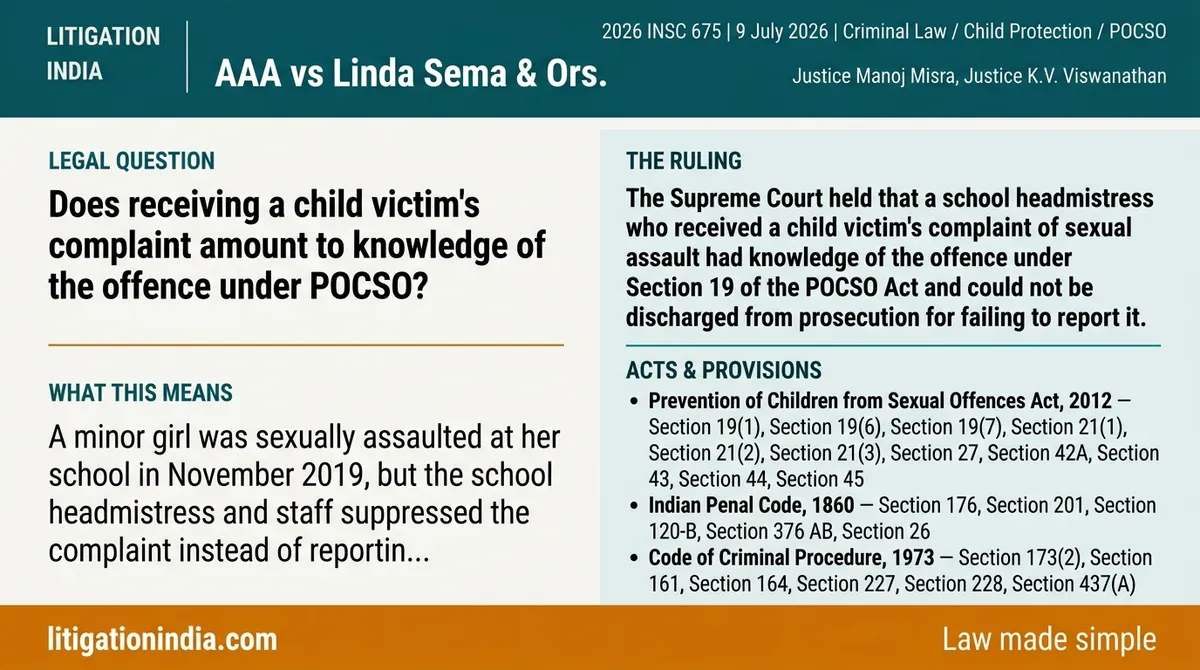
School Headmistress Cannot Be Discharged for Failing to Report Child Sexual Assault — infographic summary

What this case means

A minor girl was sexually assaulted at her school in November 2019, but the school headmistress and staff suppressed the complaint instead of reporting it to police. The Supreme Court held that receiving a complaint directly from a child victim amounts to knowledge of the offence under Section 19 of the POCSO Act, and the headmistress could not be discharged. This ruling clarifies that school authorities must report child sexual assault complaints immediately and cannot conduct their own inquiry before reporting.

What the Supreme Court held

The Supreme Court partly allowed the appeal and set aside the discharge of Respondent No.1, Linda Sema, from prosecution under Section 21 read with Section 19(1) of the POCSO Act and Section 176 of IPC, directing the Trial Court to proceed against her in accordance with law. The discharge of the other teachers and office bearers was upheld because the victim had not given them direct information about the assault. The Court clarified that its observations shall not be taken as an opinion on the merits of the allegations.

Case: AAA vs Linda Sema & Ors. (2026) Citation: 2026 INSC 675

Want the full legal reasoning, citations and case documents?

Read the full judgment analysis
POCSO Act
Section 19 reporting obligation
knowledge of offence
discharge of accused
child sexual assault
school authorities
Section 21 POCSO
failure to report
Linda Sema
AAA vs Linda Sema
Juvenile in Conflict with Law
framing of charge
Section 19(1), Section 19(6), Section 19(7), Section 21(1), Section 21(2), Section 21(3), Section 27, Section 42A, Section 43, Section 44, Section 45, Prevention of Children from Sexual Offences Act, 2012
Section 176, Section 201, Section 120-B, Section 376 AB, Section 26, Indian Penal Code, 1860