
All insights

Can a creditor listed as contingent liability claim full dues under IBC despite a rehabilitation scheme?

Rehabilitation Scheme Caps Creditor's Recovery at 25% of Principal Dues

A creditor listed as a contingent liability under a BIFR-approved rehabilitation scheme filed insolvency proceedings claiming full dues. The Supreme Court held that the creditor could claim at most 25

Litigation India Editorial 16 November 2026 1 min read 2026 INSC 1223

Story

Case at a glance1 / 6

Supreme Court of India

Rehabilitation Scheme Caps Creditor's IBC Claim at 25%

M/s. Ganesh Benzoplast Ltd. v. State Trading Corporation of India | 2026 INSC 1223

Court: Supreme Court of India | Date: November 16, 2026Bench: Justice Sanjay Kumar and Justice Sanjeev SachdevaArea of Law: Insolvency and Bankruptcy / Corporate Rehabilitation under SICASTC listed as contingent liability in BIFR-approved scheme, claimed full dues under IBC Section 9
Rehabilitation Scheme Caps Creditor's Recovery at 25% of Principal Dues · 2026 INSC 12232026-11-16T20:49:48.854896+00:00
The legal question2 / 6

Can a Contingent Liability Creditor Bypass a Rehabilitation Scheme and Claim Full Dues via IBC?

Core legal question before the Supreme Court

  • Appellant: STC accepted categorisation as contingent liability; never crystallized dues; maximum payable under RS already paid.
  • Appellant: Once rehabilitation scheme approved, it binds all creditors; no creditor can claim more than scaled-down dues.
  • Respondent STC: It was not paid 25% in five annual instalments from 2015 as required by Clause 11.11; lump-sum payment not compliant.
  • Respondent STC: It had an option under Clause 11.11 to wait seven years and then claim full dues; NCLT could not force first option.
Rehabilitation Scheme Caps Creditor's Recovery at 25% of Principal Dues · 2026 INSC 12232026-11-16T20:49:48.854896+00:00
Statutory comparison3 / 6

Unsecured Creditor vs. Contingent Liability Under the Rehabilitation Scheme

How Clause 11.11 applies differently depending on creditor category

Legal SubjectUnsecured Creditor (Annexure V)Contingent Liability (Annexure VI-a)
Clause 11.11 options25% in 5 instalments OR wait 7 yearsNo option until dues crystallized
Status in schemeRecognised creditor from cut-off dateMust first crystallize to attain creditor status
STC's positionSTC was NOT listed hereSTC listed at Serial No. 6, Rs. 11.35 crores
Maximum recoverable25% of principal dues25% of principal dues upon crystallization, per Court's ruling
STC never challenged its categorisation as contingent liability — it was too late to claim a higher status.
Rehabilitation Scheme Caps Creditor's Recovery at 25% of Principal Dues · 2026 INSC 12232026-11-16T20:49:48.854896+00:00
The Court's reasoning4 / 6

Court's Step-by-Step Reasoning

From STC's demand notice to dismissal of insolvency petition

  1. 1Step 1: STC listed as contingent liability in BIFR-approved RS, never objected, never crystallized its dues.
  2. 2Step 2: STC issued Section 8 IBC demand notice for full dues; IBC does not provide a mechanism to crystallize liability.
  3. 3Step 3: Under Modi Rubber Limited (2023), approved BIFR schemes bind all creditors; no creditor can claim more than scaled-down amount.
  4. 4Step 4: STC could at best attain unsecured creditor status and claim only 25% of principal dues — not full amount.
  5. 5Step 5: That 25% (Rs. 2,18,88,421) already paid and accepted; nothing remained in the Section 9 petition.
Rehabilitation Scheme Caps Creditor's Recovery at 25% of Principal Dues · 2026 INSC 12232026-11-16T20:49:48.854896+00:00
The verdict5 / 6

Supreme Court's Final Verdict

Appeal allowed; NCLAT judgment set aside; NCLT order restored

  • The Fact: STC was a contingent liability in the approved RS, never crystallized its claim, yet filed IBC petition for full dues.
  • The Law: Approved BIFR rehabilitation schemes bind all creditors; contingent creditors can at most claim 25% of principal dues upon crystallization.
  • The Result: Rs. 2,18,88,421 already paid to STC satisfied maximum payable; NCLAT erred in restoring the insolvency petition.
Appeal allowed; NCLAT judgment dated 21.01.2026 set aside; NCLT order dated 13.02.2020 restored. Parties to bear own costs.
Rehabilitation Scheme Caps Creditor's Recovery at 25% of Principal Dues · 2026 INSC 12232026-11-16T20:49:48.854896+00:00
Why it matters6 / 6

What This Means in Practice

For creditors, sick companies and insolvency practitioners

  • Creditors listed as contingent liabilities in a BIFR scheme must crystallize their dues before claiming any payment.
  • An approved rehabilitation scheme caps recovery — no creditor can use IBC to claim more than the scaled-down amount.
  • Silence on categorisation in a scheme is treated as acceptance; creditors cannot belatedly challenge their listed status.
  • A rehabilitated company cannot be destabilised years later by creditors claiming full pre-scheme dues through IBC.
Once a BIFR rehabilitation scheme is approved, it binds all creditors — no one can claim more than their scaled-down dues.
Rehabilitation Scheme Caps Creditor's Recovery at 25% of Principal Dues · 2026 INSC 12232026-11-16T20:49:48.854896+00:00
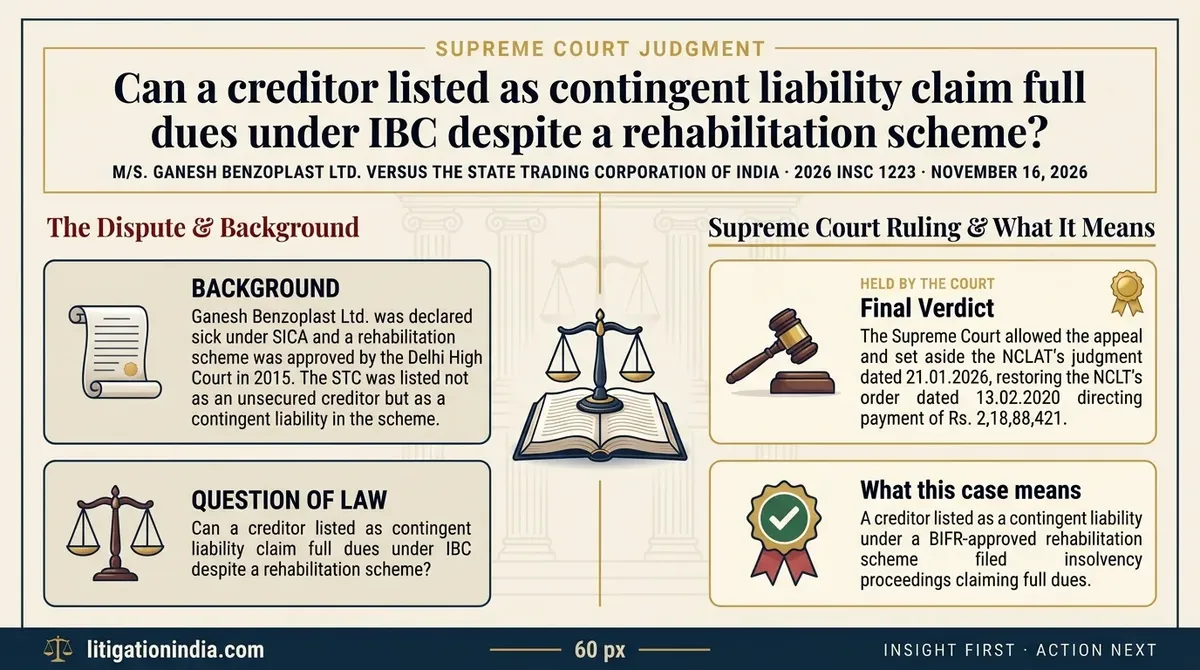
Rehabilitation Scheme Caps Creditor's Recovery at 25% of Principal Dues — infographic summary

What this case means

A creditor listed as a contingent liability under a BIFR-approved rehabilitation scheme filed insolvency proceedings claiming full dues. The Supreme Court held that the creditor could claim at most 25% of its principal dues under the approved scheme, and since that amount was already paid, nothing remained to be adjudicated. The ruling reinforces that approved rehabilitation schemes bind all creditors including contingent ones.

What the Supreme Court held

The Supreme Court allowed the appeal and set aside the NCLAT's judgment dated 21.01.2026, restoring the NCLT's order dated 13.02.2020 directing payment of Rs. 2,18,88,421. The Court held that since the maximum amount payable under the approved rehabilitation scheme had already been paid and accepted, nothing remained to be adjudicated in the insolvency petition. Parties were directed to bear their own costs.

Case: M/s. Ganesh Benzoplast Ltd. versus The State Trading Corporation of India (2026) Citation: 2026 INSC 1223

Want the full legal reasoning, citations and case documents?

Read the full judgment analysis
Ganesh Benzoplast
State Trading Corporation
IBC Section 9
CIRP
SICA rehabilitation scheme
contingent liability
unsecured creditor
Modi Rubber Limited
NCLT
NCLAT
scaled-down dues
sick industrial company
Section 8, Section 9, Insolvency and Bankruptcy Code, 2016
Section 3(1)(o), Section 15(1), Sick Industrial Companies (Special Provisions) Act, 1985