
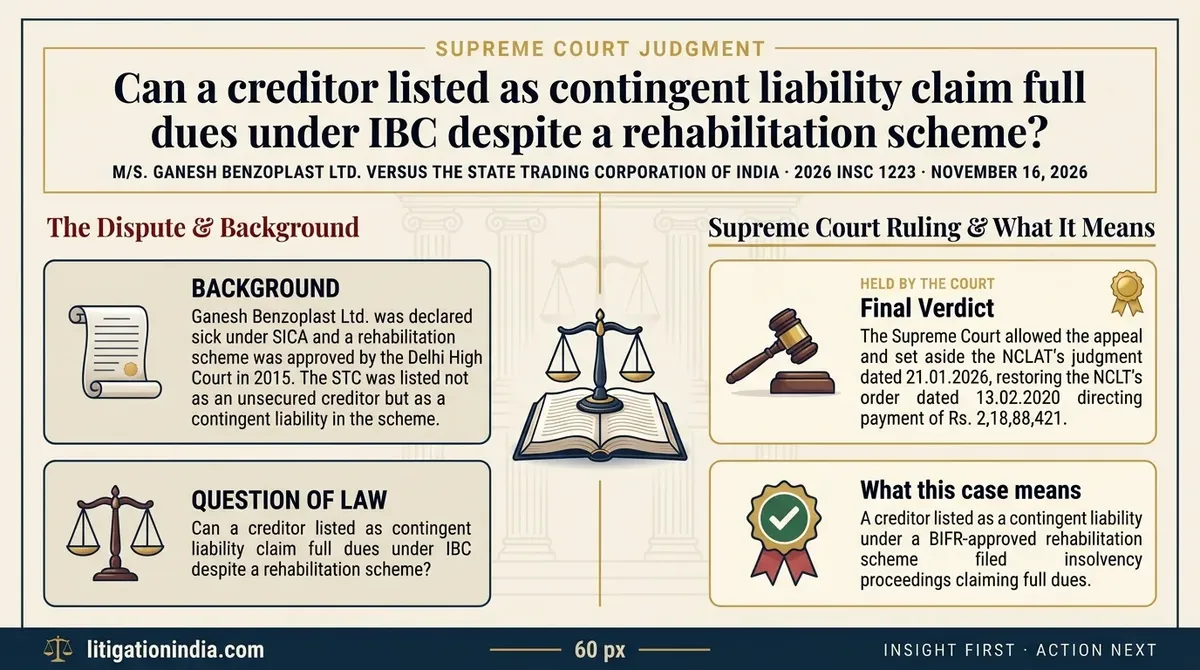
Full text of the judgment
Text extracted from M/s. Ganesh Benzoplast Ltd. versus The State Trading Corporation of India. For the authoritative version refer to the Supreme Court of India's official website.
2026 INSC 1223
Reportable IN THE SUPREME COURT OF INDIA CIVIL APPELLATE JURISDICTION
CIVIL APPEAL NO. 3097 OF 2026
M/s. Ganesh Benzoplast Ltd.
….. Appellant
The State Trading Corporation of India
….. Respondent
J U D G M E N T
SANJAY KUMAR, J
1. Company Petition (IB) No. 1975/MB/2018 was filed by the State Trading Corporation of India (STC), the respondent, under Section 9 of the Insolvency and Bankruptcy Code, 20161, seeking to initiate corporation insolvency resolution process (CIRP) against Ganesh Benzoplast Ltd., the appellant. However, by order dated 13.02.2020, the National Company Law Tribunal, Mumbai Bench2, disposed of the company petition directing the appellant to pay a sum of ₹2,18,88,421/within a time frame to the STC. This amount was stated to constitute 25% of the principal dues of the STC. Aggrieved by this order, the STC filed Company Appeal (AT)(INS) No. 753 of 2021 before the National Company
1 For short, ‘the IBC’ 2 For short, ‘the NCLT’ Digitally signed by Deepak Guglani Date: 2026.11.16 18:27:14 IST Reason: Signature Not Verified
Law Appellate Tribunal3, Principal Bench, New Delhi. By judgment dated 21.01.2026, the NCLAT allowed the appeal and restored Company Petition (IB) No. 1975/MB/2018 to the file of the NCLT for deciding the case afresh in accordance with law. Aggrieved by such restoration, the appellant filed the present appeal. 2. By order dated 17.03.2026, this Court stayed the operation of the impugned judgment dated 21.01.2026. 3. Ganesh Benzoplast Ltd., the appellant, is a company incorporated in Maharashtra during the year 1986. It is involved in the manufacture and storage of chemicals. Its infrastructure division provides storage tank terminals for storage of petroleum products, oils, etc., at the ports in the State. The appellant had business transactions with the STC to facilitate supply of toluene and allied products to it in the year 2003 and for export of its industrial lubricants during the years 2004 to 2006. 4. While so, the appellant sought reference under Section 15(1) of the Sick Industrial Companies (Special Provisions) Act, 19854, before the Board for Industrial and Financial Reconstruction (BIFR) due to erosion of its net worth, as reflected in its audited balance sheet for the financial year ended 31.03.2008. The reference was registered as Case No. 42 of 2009. On 06.05.2010, the BIFR declared the appellant a sick industrial unit, in
3 For short, ‘the NCLAT’ 4 For short, ‘the SICA’
terms of Section 3(1)(o) of the SICA and appointed an operating agency for formulating a Draft Rehabilitation Scheme (DRS). 5. The DRS was circulated on 18.04.2013 with the cut-off date fixed as 31.03.2011. After statutory hearings were held, the DRS was modified as directed and was submitted for approval to the BIFR. However, as the BIFR ceased to function, owing to absence of a member, the appellant approached the Delhi High Court by way of Writ Petition (C) No. 9320 of 2015 seeking approval of the DRS. The writ petition was allowed by a Division Bench of the Delhi High Court on 04.12.2015. Significantly, the DRS and the approved Rehabilitation Scheme (RS) provided for unsecured liabilities being scaled down under Clause 11.11. This clause reads as follows:- ‘11.11 Unsecured Liabilities a) The unsecured creditors would be paid at 25% of the principal dues in five equal annual instalment with an option not to accept the scaled down value of their dues and wait till the scheme of rehabilitation of the company has worked itself out/Seven years. M/s Pennar Paterson also will be treated at par with other unsecured creditors. Unsecured creditors also includes contingent liabilities, if crystallized.’
6. Annexure V appended to the DRS/RS furnished the details of the unsecured creditors of the appellant as on 31.03.2011. The STC did not figure in this list of 191 unsecured creditors. On the other hand, it was shown in Annexure VI(a), titled ‘List of Contingent Liabilities of Ganesh Benzoplast Ltd.’. The STC figured at Serial No. 6 in this list of ten
contingent liabilities and its claimed amount was shown as ₹11.35 crores. Therefore, in terms of Clause 11.11 of the DRS/RS, till its liability stood crystallized, STC could not attain the status of an ‘unsecured creditor’. Despite it being shown as a ‘contingent liability’ in the DRS/RS, the STC did not choose to challenge the same. The DRS had been published in the newspapers on 09.05.2013 but despite the same, the STC never objected to its status therein or the manner in which it was to be treated even if it attained the status of an ‘unsecured creditor’. Even after approval of the DRS by the Delhi High Court, vide order dated 04.12.2015, the STC remained unmoved. The said order was challenged by a third party, Avron Chemicals Pvt. Ltd., an unsecured creditor of the appellant, before this Court, by way of SLP(C) No. 12096 of 2016. The SLP was dismissed by this Court on 10.04.2018 observing that, given the facts of the case, this Court was not inclined to interfere with the said order. 7. However, the STC deemed it fit to issue a demand notice on 20.03.2018 to the appellant under Section 8 of the IBC, claiming that a sum of ₹24,26,44,490/- was due and payable to it. This sum comprised ₹17,00,05,876/- towards dues of export transactions; ₹3,68,62,534/towards domestic transactions; and ₹3,57,76,081/- for the appellant’s failure in submitting ‘C’ Forms under the Central Sales Tax Act. The appellant denied its liability, by reply dated 31.03.2018. Thereupon, the STC filed Company Petition (IB) No. 1975/MB/2018 before the NCLT on
05.06.2018 under Section 9 of the IBC. During the pendency of the case, the appellant handed over the requisite ‘C’ Forms to the STC on 30.01.2020. 8. In the order dated 13.02.2020 passed in the said company petition, the NCLT noted that the STC had filed a rejoinder wherein it stated that, as per the scheme sanctioned by the BIFR, it would be entitled to receive 25% of the principal dues in five equal instalments, treating it as unsecured creditor. The NCLT also noted that the issue relating to submission of ‘C’ Forms stood settled due to the submission of such forms by the appellant on 30.01.2020. Further, the NCLT took note of the letter dated 04.10.2019 addressed to the STC by the appellant, offering to settle the issue by paying ₹1.75 crore, by way of compromise, in full and final settlement of the STC’s claims. The NCLT observed that the said offer was reasonable, as STC could only be treated as an ‘unsecured creditor’ in terms of the RS. Though the STC insisted on admission of its company petition, the NCLT opined that payment of 25% of its dues, as offered by the appellant, would meet the ends of justice and, accordingly, quantified the amount payable as ₹2,18,88,421/-. Directing that this amount should be paid within 30 days from the date of receipt of the order, the NCLT disposed of the company petition. 9. This order was subjected to challenge by the STC before the NCLAT, by way of Company Appeal (AT)(INS) No. 753/2021. However, in
the first instance, the NCLAT dismissed the appeal on the ground of limitation, by judgment dated 20.04.2023. Aggrieved thereby, the STC filed Civil Appeal No. 5477 of 2023 before this Court. The appeal was allowed on 02.04.2025, holding that the STC’s appeal before the NCLAT ought to have been treated as having been filed within time. The STC’s appeal was restored to its original position and it was directed to be heard and decided on merits. It was pursuant to this remand order, that the NCLAT reheard the matter and allowed the appeal on 21.01.2026, directing the STC’s company petition to be restored on the file of the NCLT for decision afresh, leading to the filing of the present appeal. 10. Perusal of the impugned judgment dated 21.01.2026 reflects that the NCLAT was of the opinion that the bone of contention between the parties was with regard to treatment of the dues of the STC and observed that, an unsecured creditor had two options under the RS, namely, to accept 25% of its principal dues in instalments or, if it did not accept the scaled-down value of its dues, wait till the rehabilitation scheme worked itself out or seven years and agitate for its dues thereafter. The STC contended that, if it was to be treated as an unsecured creditor, it had to choose between the two options and the NCLT could not have forced it to take the first option of accepting only 25% of its dues. It was brought to the notice of the NCLAT that, pursuant to the order dated 13.02.2020 passed by the NCLT, the appellant had already paid ₹2,18,88,421/- to the
STC, which had accepted the same without prejudice. In that regard, the STC contended that the appellant should have paid the 25% amount in five annual instalments from 2015, as per Clause 11.11, but the appellant paid a lumpsum amount only after the passing of the order dated 13.02.2020. The STC, therefore, argued that such payment was not in keeping with Clause 11.11 and it could not be forced to accept the same. Concurring with the STC on this point, the NCLAT observed that there was no explanation as to why the STC’s dues were shown as a contingent liability and why, when the appellant denied that liability altogether, the NCLT had ordered payment of 25% of the principal dues. Holding so, the NCLAT allowed the appeal and restored the company petition. 11. The reasoning of the NCLAT failed to take note of the fact that the STC issued a demand notice on 20.03.2018, well within the seven year period under the so-called second option in Clause 11.11 of the RS sanctioned by the Delhi High Court on 04.12.2015. Further, the NCLAT also lost sight of the fact that the options were available only to an ‘unsecured creditor’ and not to claimants under the category of ‘contingent liabilities’. It was only upon crystallization of such a claim that a contingent liability could be treated as an unsecured debt. Admittedly, there was no crystallization of the STC’s claim, whereby it could call itself an ‘unsecured creditor’. Therefore, be it viewed from any angle, at the point of time that the STC issued a demand notice and even when it filed a company
petition, it did not act as per Clause 11.11 of the RS. Further, though the NCLAT deemed it fit to wonder why the STC’s claim was treated as a contingent liability, the inescapable fact remains that the STC itself accepted such categorization and never challenged it. It was, therefore, too late in the day for it to claim otherwise or raise that issue. 12. Insofar as the so-called second option under Clause 11.11 of the RS is concerned, the NCLAT strangely refused to give effect to the decision of this Court in Modi Rubber Limited vs. Continental Carbon India Limited5. Therein, this Court noted that after amendment of the SICA in 1994, the BIFR was empowered to scale-down/vary the dues of creditors, including decree holders, arbitration award holders and industrial award holders. This Court held that, once a rehabilitation scheme is approved by the BIFR, it would be binding on the unsecured creditors also, as there is no difference between unsecured creditors and creditors. It was further held that unsecured creditors did not have the option to not accept the scaling-down of their dues as the rehabilitation scheme itself would be rendered unworkable if this is permitted, thereby frustrating the very objective of the SICA. This Court held that minority creditors and unsecured creditors could not be permitted to stall rehabilitation of a sick company by not accepting the scaled-down value of their dues as unless and until there was a sacrifice by all concerned, including creditors,
5 (2023) 17 SCC 263
financial institutions, unsecured creditors and labourers, there could not be revival of the sick industrial company. 13. In Fertilizer Corporation of India Limited and others vs. Coromandel Sacks Private Limited6, this Court affirmed and applied the ratio laid down in Modi Rubber Limited (supra). That was a case where a holder of a decree against a sick company was not even part of the rehabilitation scheme approved by the BIFR but, despite the same, this Court held that, had it been part of the scheme, it would have had to settle for the scaled-down value of its dues, as a similar approach had been adopted in the scheme for settling the dues of other creditors and in such a scenario, the decree-holder would not have had any other option but to accept the scaled-down value and settle its dues. 14. In the light of the aforestated edicts, the option given under Clause 11.11 to unsecured creditors to wait till the scheme worked itself out or for seven years and thereafter agitate their claim for their full dues was not valid. Once the DRS was sanctioned, the approved RS was binding on all concerned, i.e., the unsecured creditors and the unsecured creditors in waiting, and there was no possibility of reopening the issue after the scheme worked itself out or after seven years, thereby putting the appellant, which stood rehabilitated, at the risk of becoming sick again. That being so, when the STC was not even treated as an ‘unsecured
6 (2024) 8 SCC 172
creditor’ but remained a mere ‘contingent liability’ as on the date of approval of the DRS by the Delhi High Court on 04.12.2015, the question of it claiming a higher status than an ‘unsecured creditor’, whereby it could agitate for the full dues claimed by it, did not arise. 15. The distinction sought to be drawn by the NCLAT, when faced with the decision of this Court in Modi Rubber Limited (supra), on the ground that the STC was not an ‘unsecured creditor’ but only a ‘contingent liability’, defies logic as the STC could, at best, attain the status of an ‘unsecured creditor’, if its dues stood crystalized and upon such an event materializing, Clause 11.11 of the RS only brought the STC on par with the unsecured creditors listed in Annexure-V appended to the RS, whereby it could only claim 25% of its principal dues and no more. 16. The STC’s contention that, as it was not paid 25% of its principal dues in five annual instalments starting from the year 2015, it could not be brought within the ambit of Clause 11.11 of the RS, is misconceived, as it was only upon crystallization of its dues that the STC, which was shown as a ‘contingent liability’ in Annexure VI(a), attained the status of an ‘unsecured creditor’ and was then entitled to payment of 25% of its dues in five annual instalments. Admittedly, the STC did not initiate any steps to have its dues crystalized and straightaway proceeded to issue a notice under Section 8 of the IBC for its entire dues. The regime of the IBC does not provide for determination of liability or quantification thereof, whereby
the STC could have sought crystallization of its dues thereunder. Therefore, the STC was not entitled to seek payment of 25% of its dues in five annual instalments from 2015 onwards. Despite the fact that the STC still remained a contingent liability, the appellant addressed the letter dated 04.10.2019 seeking closure, by offering to pay 25% of its principal dues without the STC even resorting to crystallization of its dues. This fair offer was acted upon by the NCLT, which directed payment of 25% of the STC’s dues, quantified at ₹2,18,88,421/-. 17. Admittedly, the STC’s claim for non-submission of C-Forms stood decimated by submission of such forms by the appellant on 30.01.2020. Therefore, only the other two claims relating to export transactions and domestic transactions remained and taking the same into account, the NCLT quantified the amount at ₹2,18,88,421/-. No dispute has been raised before us with regard to such quantification and the STC itself accepted this amount on 20.03.2020, without prejudice. Viewed thus, it is clear that nothing remained to be adjudicated in the company petition filed under Section 9 of the IBC, as the maximum amount that the STC could have realized, in terms of the approved RS, was already paid to it pursuant to the NCLT’s order dated 13.02.2020. The NCLAT, therefore, erred in overlooking this crucial fact and in allowing the STC’s appeal against the said order and restoring the company petition for decision afresh though there was nothing left to be adjudicated therein.
18. The appeal is accordingly allowed, setting aside the judgment dated 21.01.2026 passed in Company Appeal (AT)(INS) No. 753 of 2021 by the National Company Law Appellate Tribunal, Principal Bench, New Delhi, and restoring the order dated 13.02.2020 passed in Company Petition (IB) No. 1975/MB/2018 by the National Company Law Tribunal, Mumbai Bench. Parties shall bear their own costs.
.........................., J SANJAY KUMAR
…..............................., J. SANJEEV SACHDEVA November 16, 2026 New Delhi.