
All insights

Can reassessment proceed without issuing a mandatory Section 143(2) notice?

Notice Under Section 143(2) Is Mandatory for Reassessment Proceedings

The case concerned whether the Revenue could proceed with income tax reassessment without issuing a mandatory notice under Section 143(2) of the Income Tax Act, 1961. The Supreme Court held that such

Litigation India Editorial 28 October 2026 1 min read 2026 INSC 1171

Story

Case at a glance1 / 6

Supreme Court of India

Section 143(2) Notice: Mandatory, Not Curable

Principal Commissioner of Income Tax, Bhubaneshwar vs. Orissa Mining Corporation Ltd. | 2026 INSC 1171

Court: Supreme Court of India; Date: October 28, 2026Bench: Justice Sanjay Kumar and Justice Sanjeev SachdevaArea of law: Income Tax / Reassessment ProceedingsAssessment years: 2008-09, 2009-10, 2010-11, 2011-12
Notice Under Section 143(2) Is Mandatory for Reassessment Proceedings · 2026 INSC 11712026-10-28T18:52:22.088641+00:00
The legal question2 / 6

Can the Revenue Skip the Section 143(2) Notice in Reassessment?

Three legal questions decided by the Court

  • Appellant: Section 292BB bars objection to notice since assessee participated in proceedings.
  • Appellant: Assessee's request to treat Section 139 return as Section 148 return removes need for Section 143(2) notice.
  • Appellant: A Section 142(1) letter during proceedings equals compliance with Section 143(2).
  • Respondent: Non-issuance of Section 143(2) notice is not a curable defect and vitiates reassessment entirely.
  • Respondent: Section 292BB applies only to defects in service of a notice that was actually sent, not to complete non-issuance.
Notice Under Section 143(2) Is Mandatory for Reassessment Proceedings · 2026 INSC 11712026-10-28T18:52:22.088641+00:00
Statutory comparison3 / 6

Section 143(2) vs. Section 292BB: Scope Compared

What each provision does and how the Court applied them

ProvisionWhat it saysHow the Court applied it
Section 143(2)Mandates notice to assessee before reassessment assessmentHeld mandatory and sine qua non; non-issuance vitiates entire proceedings
Section 292BBDeems notice duly served if assessee appeared/cooperatedApplies only when notice was sent but had service defects; not when no notice issued at all
Section 142(1)Enables Assessing Officer to call for documents during inquiryCannot substitute for Section 143(2) notice; different purpose and stage
Notice Under Section 143(2) Is Mandatory for Reassessment Proceedings · 2026 INSC 11712026-10-28T18:52:22.088641+00:00
The Court's reasoning4 / 6

Court's Reasoning: Step by Step

From the legal question to the final conclusion

  1. 1Step 1: Section 143(2) notice is mandatory; its omission is not a curable procedural irregularity (Hotel Blue Moon).
  2. 2Step 2: Section 292BB deeming fiction operates only when Revenue claims notice was sent; inapplicable where notice was never issued.
  3. 3Step 3: Assessee's participation in proceedings does not confer jurisdiction on Assessing Officer absent Section 143(2) notice.
  4. 4Step 4: Assessee's choice to rely on earlier Section 139 return does not relieve Revenue of Section 143(2) obligation.
  5. 5Step 5: A Section 142(1) letter cannot substitute for a Section 143(2) notice; proceedings vitiated, appeals dismissed.
Notice Under Section 143(2) Is Mandatory for Reassessment Proceedings · 2026 INSC 11712026-10-28T18:52:22.088641+00:00
The verdict5 / 6

Verdict: Revenue Appeals Dismissed

  • The Fact: Revenue conducted reassessment without issuing mandatory Section 143(2) notice for multiple assessment years.
  • The Law: Section 143(2) notice is sine qua non; Section 292BB cannot save complete non-issuance; Section 142(1) letter is no substitute.
  • The Result: ITAT and High Court orders affirmed; all Revenue appeals dismissed; reassessment proceedings held vitiated.
All Revenue appeals dismissed; reassessment proceedings vitiated for want of mandatory Section 143(2) notice.
Notice Under Section 143(2) Is Mandatory for Reassessment Proceedings · 2026 INSC 11712026-10-28T18:52:22.088641+00:00
Why it matters6 / 6

What This Means for Taxpayers

  • You must always receive a Section 143(2) notice before the Revenue can proceed with reassessment.
  • Participating in reassessment proceedings does not mean you lose the right to challenge missing notices.
  • If you rely on your earlier filed return, the Revenue still cannot skip the Section 143(2) notice.
  • A document request letter under Section 142(1) is not a substitute for the mandatory Section 143(2) notice.
No Section 143(2) notice means no valid reassessment — the Revenue cannot skip this step, ever.
Notice Under Section 143(2) Is Mandatory for Reassessment Proceedings · 2026 INSC 11712026-10-28T18:52:22.088641+00:00
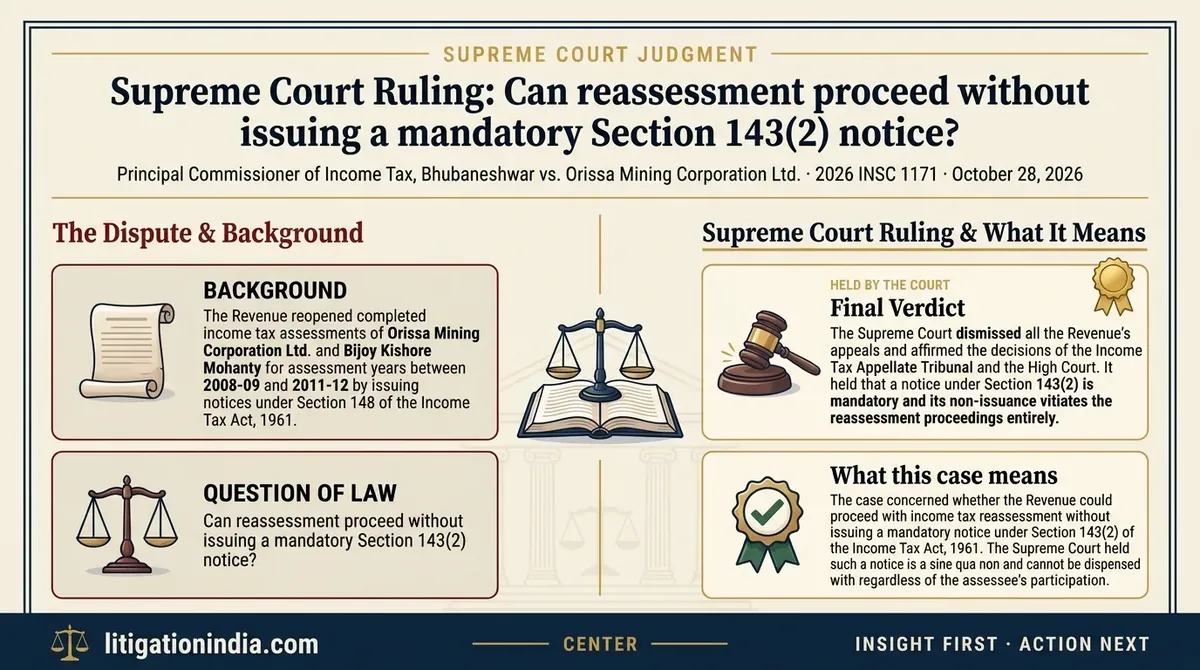
Notice Under Section 143(2) Is Mandatory for Reassessment Proceedings — infographic summary

What this case means

The case concerned whether the Revenue could proceed with income tax reassessment without issuing a mandatory notice under Section 143(2) of the Income Tax Act, 1961. The Supreme Court held that such a notice is a sine qua non and cannot be dispensed with regardless of the assessee's participation. Section 292BB cannot save cases where no notice was issued at all.

What the Supreme Court held

The Supreme Court dismissed all the Revenue's appeals and affirmed the decisions of the Income Tax Appellate Tribunal and the High Court. It held that a notice under Section 143(2) is mandatory and its non-issuance vitiates the reassessment proceedings entirely. Section 292BB does not apply where the Revenue itself admits no notice was issued, and a Section 142(1) letter cannot substitute for a Section 143(2) notice.

Case: Principal Commissioner of Income Tax, Bhubaneshwar vs. Orissa Mining Corporation Ltd. (2026) Citation: 2026 INSC 1171

Want the full legal reasoning, citations and case documents?

Read the full judgment analysis
Section 143(2) notice
Section 292BB
reassessment
Income Tax Act 1961
notice mandatory
Hotel Blue Moon
Orissa Mining Corporation
Section 147
Section 148
non-issuance of notice
vitiation of proceedings
Laxman Das Khandelwal
Section 143(2), Income Tax Act, 1961
Section 292BB, Income Tax Act, 1961