
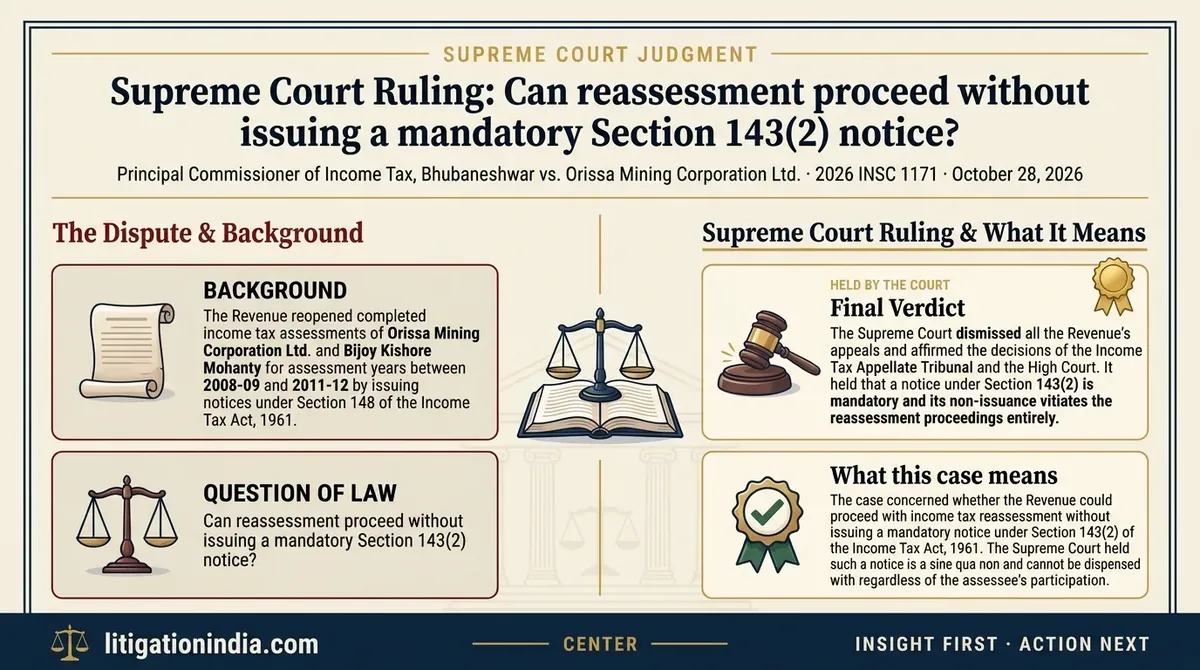
Full text of the judgment
Text extracted from Principal Commissioner of Income Tax, Bhubaneshwar vs. Orissa Mining Corporation Ltd.. For the authoritative version refer to the Supreme Court of India's official website.
2026 INSC 1171 1
Reportable IN THE SUPREME COURT OF INDIA CIVIL APPELLATE JURISDICTION
CIVIL APPEAL NO………….OF 2026 ( @ SPECIAL LEAVE PETITION (C) NO. 14546 OF 2023) PRINCIPAL COMMISSIONER OF INCOME TAX, BHUBANESHWAR ... APPELLANT (S) VERSUS ORISSA MINING CORPORATION LTD. …RESPONDENT(S) WITH Civil Appeal No…….. of 2026 (@ Special Leave Petition (C) No.25931 of 2026)
Civil Appeal No…….. of 2026 (@ Special Leave Petition (C) No.25932 of 2026)
Civil Appeal No…….. of 2026 (@ Special Leave Petition (C) No.3350 of 2024)
Civil Appeal No…….. of 2026 (@ Special Leave Petition (C) No.25882 of 2026)
J U D G M E N T SANJEEV SACHDEVA, J. 1. Leave granted. 2. As similar issues arise in all these appeals, and as such they have been taken up for consideration together. Revenue has assailed different orders Digitally signed by Deepak Guglani Date: 2026.10.28 18:51:02 IST Reason: Signature Not Verified
holding against the Revenue. Insofar as the respondent, Orissa Mining Corporation Ltd. is concerned, the assessment years involved are 2008-09, 2010-11 and 2011-12. Whereas in the case of respondent, Bijoy Kishore Mohanty, the assessment years involved are in the 2009-10 and 2010-11. 3. Common questions of law arising for consideration in all these appeals are: (i) Whether Section 292BB of the Income Tax Act, 19611 precludes an Assessee from raising an objection in any proceedings under the Act regarding non-service of a notice under Section 143(2) of the Act, if the Assessee had appeared and cooperated during the reassessment proceedings and had not raised any objection with regard to non-issuance of a notice under Section 143(2) of the Act? and (ii) Whether an Assessee who requests that the earlier Return of Income filed under Section 139 of the Act be treated as the Return of Income filed in response to a notice under Section 148 of the Act is not required to be given a notice under Section 143(2) of the Act?, and (iii) Whether a letter given by the Assessing Officer during the course of reassessment proceedings, requiring the Assessee to explain the grounds on which re-assessment of income was proposed, would tantamount to sufficient compliance of the provision of
1 ‘The Act’ for short
Section 143(2) of the Act? 4. In all these appeals, the Assessees had filed the respective Returns of their Income for the respective Assessment years under Section 139 of the Act, which were duly assessed, and assessment orders passed under Section 143(3) of the Act. Subsequently, the Revenue sought to reopen the assessments under Section 147 of the Act and issued notices under Section 148 of the Act, requiring the assesses to file the returns in the prescribed form. 5. In the case of Orissa Mining Corporation Ltd., the Assessee filed a response stating that its Return of Income originally filed under Section 139 of the Act, be treated as the Return of Income in response to a notice under Section 148 of the Act. In the case of Bijoy Kishore Mohanty, it is stated that the same Return of Income which had earlier been filed under Section 139 of the Act, was refiled in response to the notice issued under Section 148 of the Act. 6. Thereafter, admittedly no notice under section 143(2) of the Act was issued and the reassessment proceedings were commenced. During the reassessment proceedings, and notices under Section 142(1) of the Act were issued to the Assessee, seeking documents/stock information to be submitted. 7. Pursuant thereto, the reassessment orders were framed against the
Assessees, which were challenged by the Assessees by approaching the Appellate Authority, i.e., Commissioner of Income Tax (Appeals). One of the grounds raised by the Assessee before the Appellate Authority was with regard to failure of the Revenue to issue a notice under Section 143(2) of the Act, thereby vitiating the entire proceedings. 8. Appellate Authority rejected the argument of the Assessee with regards to vitiation of the proceedings on account of failure of the Revenue to serve a notice under Section 143(2) of the Act. Appellate Authority held that since the Assessees had participated in the assessment proceedings after the issuance of a notice under Section 148, followed by a notice under Section 142(1), the Assessees could not be allowed to raise the ground of non-issuance of a notice under Section 143(2) of the Act at the appellate stage. 9. Aggrieved therefrom, the Assesses approached the Income Tax Appellate Tribunal. In the respective cases, the Appellate Tribunal held that the assessment proceedings stood vitiated for want of notice under Section 143(2) of the Act and, thus, set aside the reassessment orders. 10. Aggrieved by the decisions of the Income Tax Appellate Tribunal, the Revenue challenged the respective orders before the High Court. The High Court had rejected the challenge, and upheld the orders of Income Tax
Appellate Tribunal, confirming that the assessment proceedings were vitiated on the ground of failure of the authority to issue a notice under Section 143(2) of the Act. 11. Section 143 of the Act reads as under: “143. (1) Where a return has been made under section 139, or in response to a notice under sub-section (1) of section 142, such return shall be processed in the following manner, namely: — ******* (2) Where a return has been furnished under section 139, or in response to a notice under sub-section (1) of section 142, the Assessing Officer or the prescribed income-tax authority, as the case may be, if, considers it necessary or expedient to ensure that the Assessee has not understated the income or has not computed excessive loss or has not under-paid the tax in any manner, shall serve on the Assessee a notice requiring him, on a date to be specified therein, either to attend the office of the Assessing Officer or to produce, or cause to be produced before the Assessing Officer any evidence on which the Assessee may rely in support of the return: Provided that no notice under this sub-section shall be served on the Assessee after the expiry of three months from the end of the financial year in which the return is furnished. (3) On the day specified in the notice issued under sub-section (2), or as soon afterwards as may be, after hearing such evidence as the Assessee may produce and such other evidence as the
Assessing Officer may require on specified points, and after taking into account all relevant material which he has gathered, the Assessing Officer shall, by an order in writing, make an assessment of the total income or loss of the Assessee, and determine the sum payable by him or refund of any amount due to him on the basis of such assessment: Provided that ******** (4) ******” 12. Section 143(2) of the Act mandates service of a notice on the Assessee, requiring him to attend the office of the Assessing Officer or to produced before the Assessing Officer any evidence on which the Assessee may rely in support of the return. This Court, in Assistant Commissioner of Income Tax and Another vs. Hotel Blue Moon2 has held that the omission on the part of the Assessing Authority to issue a notice under Section 143(2) of the act cannot be treated as a procedural irregularity that is curable, and therefore, the requirement of issuing a notice under Section 143(2) of the Act cannot be dispensed with. 13. This Court, in Hotel Blue Moon (supra) has specifically laid down that where the Assessing Officer intends to make an enquiry, he must necessarily follow the provisions of Section 142 and Section 143(2) & 143(3) of the Act.
2 (2010) 3 SCC 259
A notice under Section 143(2) of the Act is mandatory, as it grants the Assessee an opportunity to produce or cause to be produced any evidence or particulars based on which the Assessee claims relief. A notice under section 143(2) of the Act is sine qua non for a proceeding for reassessment under Section 147 of the Act. In the absence of a notice under Section 143(2) of the Act, no further proceedings can be undertaken by the Revenue. 14. In the present case, admittedly no notice under Section 143(2) of the Act was admittedly issued. The excuse given by the Revenue is that such a notice was not required to be given and failure to give such a notice is not fatal to the reassessment proceedings. Reliance is placed by the Revenue on the provision of Section 292BB of the Act, which reads as under:- “292BB. Notice deemed to be valid in certain circumstances. Where an Assessee has appeared in any proceeding or co-operated in any inquiry relating to an assessment or reassessment, it shall be deemed that any notice under any provision of this Act, which is required to be served upon him, has been duly served upon him in time in accordance with the provisions of this Act and such Assessee shall be precluded from taking any objection in any proceeding or inquiry under this Act that the notice was— (a) not served upon him; or (b) not served upon him in time; or
(c) served upon him in an improper manner: Provided that nothing contained in this section shall apply where the Assessee has raised such objection before the completion of such assessment or reassessment.” 15. Section 292BB creates a deeming fiction in respect of any proceedings in which an Assessee had appeared or an inquiry in which the Assessee cooperated relating to assessment or reassessment. The deeming fiction stipulates that any notice required to be served upon the Assessee, under the provision of the Act, shall be deemed to have been duly served upon him in time and in accordance with the provisions of the Act, and the Assessee is precluded from taking any objection that the notice was either not served upon him, or not served upon him in time, or served upon him in an improper manner. Said provision precludes an Assessee from raising an objection with regards to service, timely service and proper service of a notice which is required to be served upon him. Such a deeming fiction can come into play only if notice is alleged to have been sent by the Revenue. 16. Only when the Revenue contends that a notice, as required under the Act has been sent, the Assessee who has participated in the proceedings or inquiry relating to assessment or reassessment, pursuant to the notice would be precluded from taking any objection that the notice was not served upon him, or was not served in time, or that the service of notice was not proper.
Said deeming fiction cannot come into play where the Revenue has admittedly not even issued the notice. Where the Revenue itself contends that no notice was sent, as required under the Act, the provision of Section 292BB will have no applicability. 17. The Assessing Officer cannot undertake the proceedings of reassessment under Section 143(3), read with Section 147 of the Act, unless a notice under Section 143(2) of the Act has been issued to the Assessee. Mere participation of the Assessee in the assessment proceedings, in the absence of a notice under Section 143(2) of the Act, does not confer jurisdiction on the Assessing Officer to frame an assessment under Section 143 (3) of the Act. 18. Furthermore, in response to a notice issued under Section 148 of the Act, requiring the Assessee to file a Return of Income in the prescribed format, the Assessee has the option to file a fresh Return of Income. In case the Assessee does not wish to file a fresh Return of Income and seeks to rely upon the Return of Income filed earlier under Section 139 of the Act, it is open to the Assessee, in response to the notice under section 148 of the Act, to merely state that its earlier Return of Income be treated as the Return of Income in response to the notice and he remains bound by it. If the Assessee seeks to reiterate its earlier Return of Income, it is not necessary for the Assessee to refile a copy of its earlier Return of Income. In the present case, the Assessees
have chosen not to file a fresh return and have reiterated their Return of Income already filed, Thus, the obligation on the Revenue to issue a notice under Section 143(2) of the Act, requiring the Assessee to produce evidence on which the Assessee seeks to rely on in support of the Return of Income, cannot be dispensed with. 19. Furthermore, Section 143(3) of the Act empowers the Assessing Officer to make an assessment after hearing such evidence as the Assessee may produce and such evidence as the Assessing Officer may require on specified points, pursuant to the notice issued under Section 143(2) of the Act. 20. Admittedly, in the present case, no notice issued under Section 143(2) of the Act was issued to the Assessee for the respective assessment years. Consequently, in terms of the law laid down by this Court in Hotel Blue Moon (supra), the Assessing Officer could not have framed the assessments, and as such the proceedings are vitiated. As held in Hotel Blue Moon (supra), the omission on the part of the Assessing Authority to issue a notice under Section 143(2) of the Act is not a mere procedural irregularity and is not curable. 21. Furthermore, mere participation in the proceedings by the Assessees does not come to the aid of the Revenue in terms of the Section 292BB of the Act. Reference has been made to the judgment of this Court in Commissioner
of Income Tax vs. Laxman Das Khandelwal3, wherein this Court has held that the scope of Section 292BB is to make service of notice, having certain infirmities, to be proper and valid, if there was requisite participation on the part of the Assessee. It does not save complete absence of notice and nonissuance of notice under Section 143(2) of the act by the Revenue, and will make the entire proceedings invalid. 22. A letter given by the Assessing Officer under section 142 (1)4 of the
3 (2021) 18 SCC 691 4 Inquiry before assessment. 142. (1) For the purpose of making an assessment under this Act, the Assessing Officer may serve on any person who has made a return under section 115WD or section 139 or in whose case the time allowed under sub-section (1) of section 139 for furnishing the return has expired a notice requiring him, on a date to be therein specified, — (i) ***** (ii) to produce, or cause to be produced, such accounts or documents as the Assessing Officer may require, or (iii) to furnish in writing and verified in the prescribed manner information in such form and on such points or matters (including a statement of all assets and liabilities of the assessee, whether included in the accounts or not) as the Assessing Officer may require: Provided that—******** (2) For the purpose of obtaining full information in respect of the income or loss of any person, the Assessing Officer may make such inquiry as he considers necessary. *******
Act during the course of reassessment proceedings would not satisfy the requirements of a notice under section 143(2) of the Act. A notice under section 143(2) of the Act is a sine qua non for commencing the proceedings. A letter issued after commencing the proceedings would not cover up the lacuna in the proceedings and would not validate what is non est. 23. In view of the above, we find no infirmity in the view taken by the Income Tax Appellate Tribunal, as affirmed by the High Court. The question of law raised are, thus, answered as under: (i) Section 292BB of the Act does not preclude an Assessee from raising an objection in any proceedings under the Act regarding non issuance of a notice under Section 143(2) of the Act, merely because the Assessee had appeared and cooperated during the reassessment proceedings without raising any objection with regard to non-issuance of the notice. and (ii) The revenue is not absolved of its obligation to serve a notice under Section 143(2) of the Act even if the Assessee requests that the earlier Return of Income filed under Section 139 of the Act be treated as the Return of Income filed in response to a notice under Section 148 of the Act . and (iii) Mere issuance of a letter by the Assessing Officer under section 142(1) of the Act during the course of reassessment proceedings, requiring the Assessee to explain the grounds on which re-assessment of income was proposed, does not amount to sufficient compliance of the mandatory
obligation to serve a notice under Section 143(2) of the Act. 24. Consequently, we find no merit in the appeals, and the appeals are accordingly dismissed.
…………………….J. [SANJAY KUMAR]
…………………………….J.
[SANJEEV SACHDEVA] New Delhi; October 28, 2026