
All insights

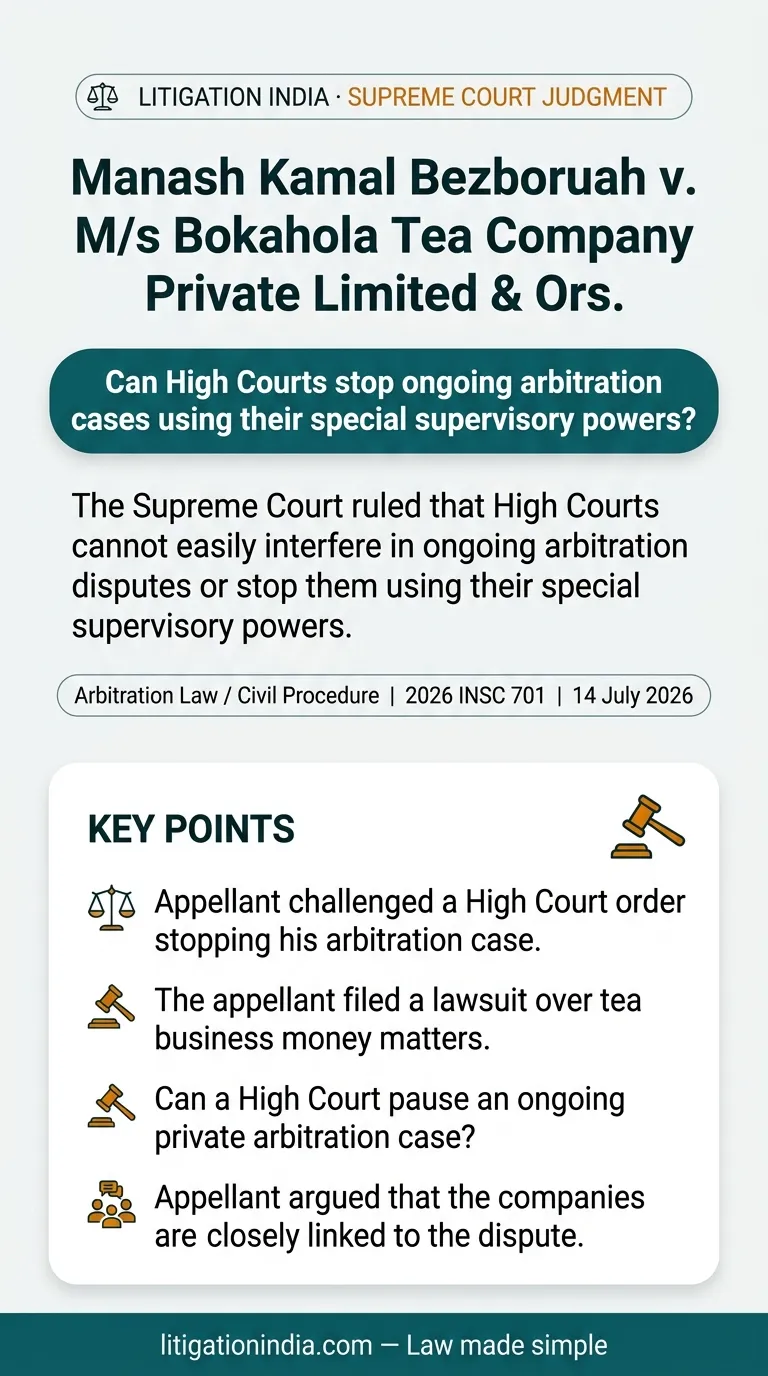
Can High Courts stop ongoing arbitration cases using their special supervisory powers?

Manash Kamal Bezboruah v. M/s Bokahola Tea Company Private Limited & Ors.

The Supreme Court ruled that High Courts cannot easily interfere in ongoing arbitration disputes or stop them using their special supervisory powers.

Litigation India Editorial 23 August 2026 1 min read 2026 INSC 701

Story

Key points1 / 6

Battle Over Tea Company Accounts

  • Appellant challenged a High Court order stopping his arbitration case.
  • A family partnership dispute was referred to an arbitrator.
  • The main issue was about who must participate in the case.
Manash Kamal Bezboruah v. M/s Bokahola Tea Company Private Limited & Ors. · 2026 INSC 7012026-08-23T19:04:37.162094+00:00
Key points2 / 6

The Partnership Dispute

  • The appellant filed a lawsuit over tea business money matters.
  • The Supreme Court sent the matter to a retired judge for arbitration.
  • Three companies claimed they never signed the arbitration agreement.
Manash Kamal Bezboruah v. M/s Bokahola Tea Company Private Limited & Ors. · 2026 INSC 7012026-08-23T19:04:37.162094+00:00
Key points3 / 6

Can High Courts Stop Arbitration?

  • Can a High Court pause an ongoing private arbitration case?
  • Who decides if a non-signatory company is bound?
  • Does the arbitrator have the power to decide their own jurisdiction?
Manash Kamal Bezboruah v. M/s Bokahola Tea Company Private Limited & Ors. · 2026 INSC 7012026-08-23T19:04:37.162094+00:00
Key points4 / 6

What Both Sides Claimed

  • Appellant argued that the companies are closely linked to the dispute.
  • The companies argued they cannot be forced into arbitration without signing.
  • They approached the High Court to seek immediate relief.
Manash Kamal Bezboruah v. M/s Bokahola Tea Company Private Limited & Ors. · 2026 INSC 7012026-08-23T19:04:37.162094+00:00
Key points5 / 6

What the Supreme Court Decided

  • The Supreme Court set aside the High Court's orders.
  • High Courts cannot easily interfere in ongoing arbitration processes.
  • The arbitrator is fully competent to decide who is bound.
Manash Kamal Bezboruah v. M/s Bokahola Tea Company Private Limited & Ors. · 2026 INSC 7012026-08-23T19:04:37.162094+00:00
Key points6 / 6

Why This Matters for You

  • Prevents wealthy parties from delaying cases using court appeals.
  • Saves time and money for ordinary business partners.
  • Ensures that arbitration remains a fast alternative to normal courts.
Manash Kamal Bezboruah v. M/s Bokahola Tea Company Private Limited & Ors. · 2026 INSC 7012026-08-23T19:04:37.162094+00:00
Manash Kamal Bezboruah v. M/s Bokahola Tea Company Private Limited & Ors. — infographic summary

What this case means

The Supreme Court ruled that High Courts cannot easily interfere in ongoing arbitration disputes or stop them using their special supervisory powers.

What the Supreme Court held

The Supreme Court set aside the High Court's orders that stopped the arbitration. It ruled that High Courts should not interfere in ongoing arbitration unless there is an obvious, undeniable lack of jurisdiction. The Court directed the arbitrator to independently decide if the three companies are bound by the agreement.

Case: Manash Kamal Bezboruah v. M/s Bokahola Tea Company Private Limited & Ors. (2026) Citation: 2026 INSC 701

Want the full legal reasoning, citations and case documents?

Read the full judgment analysis
Arbitration
High Court Interference
Article 227
Jurisdiction
Arbitration Law / Civil Procedure
Supreme Court legal news
Supreme Court judgment today
latest Supreme Court news